Anyone searching for the best Google Ads agency for accounting firms in Bengaluru deserves a straight answer before a proposal: paid search suits some accounting practices very well and suits others hardly at all. The difference is mostly whether the practice is run by chartered accountants.
A Koramangala tax adviser without the CA title, a GST practitioner enrolled near Shivajinagar, or an Electronic City bookkeeping company can bid on searches such as "itr filing for salaried employees bangalore" or "gst registration consultant", show a fee and an offer and track calls weekly. A CA firm faces Clause (6), the write-up conditions and a specific bar on adverts that invite people to its website. KaamGPT runs search campaigns for independent tax advisers and bookkeeping teams in the ordinary way, and for CA practices lays out the rules and leaves the call to the partners, refusing wording that would amount to chasing work.
- ₹4,999monthly is our starting fee for running the account; Google bills clicks to you
- ~30 daysto build campaigns, tracking and landing pages and complete the first optimisation cycle
- Four peaksdrive search demand: 31 July, 31 August, 31 October and 31 December
- 2 casesnon-CA practices run normal campaigns; CA firms judge ads against ICAI's rules
Why do tax and accounting ad campaigns waste money?
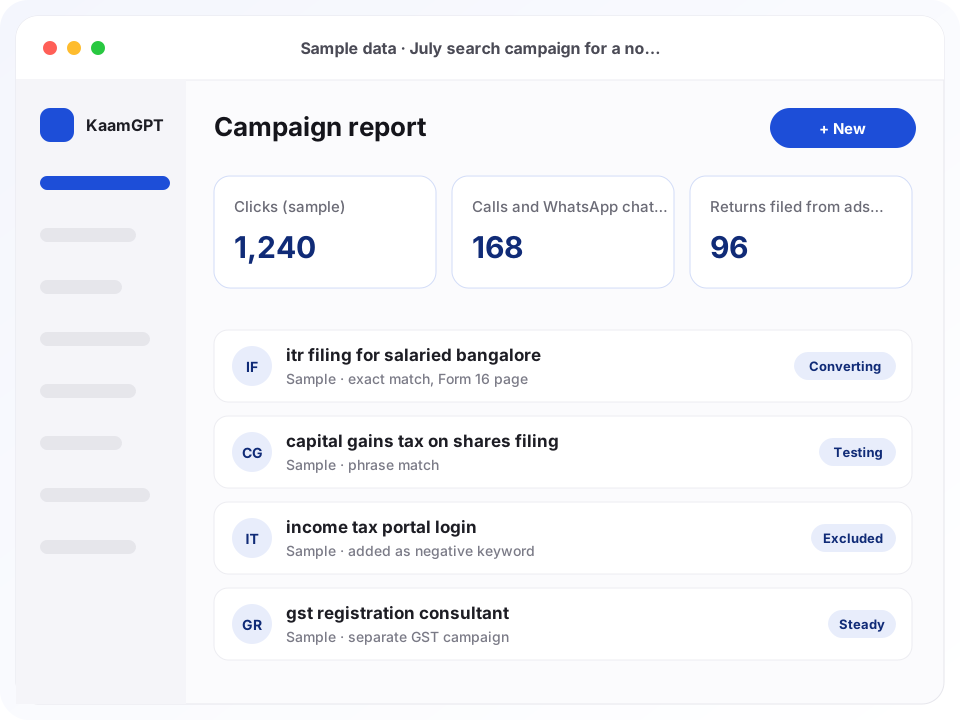
Search demand around tax deadlines is large, urgent and messy. A big share of people typing tax words into Google are not looking for an accountant at all; they want the government portal, a form, a status check or a job. Campaigns that do not filter them out pay for those clicks.
The second source of waste is mismatch with the practice itself. A firm that only handles business clients still pays for salaried searches if the keywords are loose, and a CA firm that copies a consumer brand's ad copy creates a professional problem that no click-through rate can justify. Fixing both starts with being precise about who the practice serves and what it may say.
- Broad keywords such as "income tax return" or "gst" match portal logins, status checks, form downloads and exam questions, so budgets drain before a single enquiry arrives.
- Ads point to a home page that lists every service, so a salaried employee looking for RSU help has to hunt for the relevant page and usually leaves.
- Campaigns start in the last week of July, when costs are highest and the team has no time to return calls, then stop on 1 August, missing the 31 August business-return window.
- Conversions are counted as any click on a phone number, so the account optimises toward callers who wanted a free answer, not clients who filed with the practice.
- Copy borrowed from consumer brands, such as "best CA in Bangalore" or warnings about penalties, which is ruled out for chartered accountants and is poor practice for everyone else.
How should a tax practice pace its ad budget through the year?
Search costs and conversion rates both rise as a deadline approaches, and so does the strain on your team. We pace budgets so that most spend lands two to three weeks before each due date, when searchers still have time to send documents and your staff still have time to process them, and we taper in the final days instead of bidding hardest when the office cannot cope.
For 2026 the calendar changed. Budget 2026 pushed the deadline for businesses and professionals without an audit a month later, to 31 August, while people filing ITR-1 or ITR-2 keep the 31 July date. That splits one July rush into two campaigns with different audiences: employees first, then shopkeepers, freelancers and small partnership firms. Audit-case returns follow on 31 October, and GST annual returns and late income-tax filings close the year on 31 December.
Salaried campaign, June to late July
Ads for Form 16, AIS mismatches, RSUs, foreign shares and capital gains, scheduled for weekday working hours and evenings, aimed at the technology corridors and central business districts.
Business-return campaign, July to late August
Ads for presumptive taxation, freelancers, professionals and small firms whose accounts are not audited, now that their date is 31 August. Copy states clearly which returns the practice files.
Monthly GST rhythm
Small, steady GST campaigns for registration and return filing with budget weighted toward the days before the 11th and the 20th, when traders realise they need help with that month's returns.
December close-out
From November, ads for GSTR-9 reconciliation and late income-tax filings. Copy stays factual about dates and avoids alarm about penalties, which reads badly and helps no one decide.
Quiet months for testing
February to May is cheaper and calmer. We test new ad copy and landing pages for bookkeeping and payroll retainers then, so the deadline months run on proven material.
What does Google Ads management cover for a tax or accounting practice?
A Google Ads agency for accounting firms in Bangalore earns its fee in the filtering: keywords, negatives, schedules and landing pages that keep the spend on people who want a practice like yours. Each item below is set up per service line.
Campaigns split by service and deadline
Separate campaigns for salaried returns, business returns, GST registration and returns, bookkeeping and payroll, each with its own budget and its own season. Our Google Ads management service runs and adjusts them week by week.
Google Ads in detail →GST registration keywords and ITR filing ads
We build GST registration keywords, return-filing terms and life-event searches such as property sale or foreign shares into tightly themed ad groups, so each ad and page answers exactly what was searched. ITR filing ads run only in the weeks they can convert.
Google Ads in detail →Negative keywords for tax searches
Before launch we add a long list of exclusions: portal, login, status, download, form, jobs, salary, course, exam, syllabus and similar. The list grows weekly from the search terms report, which is where most savings in this industry come from.
Google Ads in detail →One landing page per service
Each campaign lands on a page that describes that service, the documents needed, the process and, for non-CA practices, the fee. New pages can be built from ₹9,999 per project if the current site lacks them.
Websites in detail →Calls and WhatsApp as the conversion
Most tax enquiries come by phone or WhatsApp. We set up call tracking and click-to-chat, with a reply template and document checklist, so the team can answer quickly in deadline weeks.
WhatsApp campaigns in detail →Counting signed clients, not clicks
We record which enquiries became filings or retainers and feed that back into the account, so bidding favours the searches that bring clients. The lead generation page for accounting firms covers the follow-up process in depth.
Lead generation in detail →Recruitment campaigns for any practice
Hiring articled assistants and staff is allowed advertising even for CA firms, provided the ad has no promotional element. We run plain job campaigns for audit season hiring and the start of articleship batches.
Google Ads in detail →Why run a tax practice's ads with KaamGPT?
We tell CA firms the truth
If paid search is a poor or risky fit for your practice under ICAI's rules, we say so and point you to channels that work, such as search content and accurate listings.
Deadline-aware pacing
Budgets follow the 2026 calendar, including the separate 31 August window for non-audit business returns.
Heavy filtering from day one
Negative keyword lists for portals, forms and jobs are in place before the first rupee is spent.
Clients, not clicks
We measure filed returns and signed retainers, and optimise toward them.
Transparent spend
Google charges your card for clicks; our fee for running the account is a separate line in the quote.
Bengaluru team, remote by design
We work by call, WhatsApp and online meetings, which suits partners whose days are taken up by clients.
What does Google Ads management cost for a tax practice?
Our management fee begins at ₹4,999 monthly. Building campaigns, tracking and landing pages and finishing the first optimisation round takes roughly 30 days. Google bills the practice for clicks itself, and the quote in writing states the campaigns, the service lines and the reporting included.
Google Ads
Recommended₹4,999/month
Typically 30 days
Fits non-CA tax consultants, GST practitioners and bookkeepers chasing deadline searches, and any practice recruiting staff.
- Account setup
- Keyword strategy
- Ad copy testing
- Conversion tracking
- Bid optimisation
Digital Marketing
₹19,999/month
Typically 15 days
Fits practices that want paid search coordinated with the website, content and social work across the year.
- Channel strategy
- Creative production
- Campaign management
- Weekly reporting
SEO
₹14,999/month
Typically 30 days
Fits CA firms in particular, since organic search earns visits without advertising and suits the pull model.
- Technical audit
- Keyword research
- On-page optimisation
- Content plan
- Monthly reporting
Local SEO
₹4,999/month
Typically 14 days
Fits neighbourhood practices, CA or not, whose clients search for someone nearby on Google Maps.
- Google Business Profile optimisation
- Local keyword map
- Location page on-page fixes
- Citation building and NAP cleanup
- Local link outreach
- Review replies and posts
- Monthly report
Meta Ads
₹4,999/month
Typically 30 days
Fits practices promoting non-exclusive services or educational content to people who are not yet searching.
- Creative testing
- Audience building
- Retargeting funnels
- Pixel setup
- Weekly reporting
Lead Generation
₹24,999/month
Typically 14 days
Suits bookkeeping and payroll providers whose ad enquiries must be qualified and followed through to a signed retainer.
- Verified leads
- Multi-channel outreach
- CRM integration
- Lead scoring
- Replacement guarantee
- We do not set ad budgets for you; we suggest a range for each campaign and the practice decides what to spend with Google.
- For CA firms we will not run copy containing fees, offers, superlatives, testimonials or urgency appeals, whatever the budget.
| Package | Starts at | Timeline | Best for |
|---|---|---|---|
| Google Ads | ₹4,999/month | Typically 30 days | Fits non-CA tax consultants, GST practitioners and bookkeepers chasing deadline searches, and any practice recruiting staff. |
| Digital Marketing | ₹19,999/month | Typically 15 days | Fits practices that want paid search coordinated with the website, content and social work across the year. |
| SEO | ₹14,999/month | Typically 30 days | Fits CA firms in particular, since organic search earns visits without advertising and suits the pull model. |
| Local SEO | ₹4,999/month | Typically 14 days | Fits neighbourhood practices, CA or not, whose clients search for someone nearby on Google Maps. |
| Meta Ads | ₹4,999/month | Typically 30 days | Fits practices promoting non-exclusive services or educational content to people who are not yet searching. |
| Lead Generation | ₹24,999/month | Typically 14 days | Suits bookkeeping and payroll providers whose ad enquiries must be qualified and followed through to a signed retainer. |
What decides how much a practice should spend on ads?
Start from capacity. If your team can take on forty extra returns in July without hurting existing clients, the budget is whatever it costs to find forty good clients, not a round number. We help estimate the cost per enquiry in the first weeks and adjust from there.
The other driver is how many service lines you advertise and for how long. A GST-only practice may run small campaigns all year; a salaried-return specialist may spend almost everything in six weeks. Our pricing page lists management starting points; spend is planned separately with you.
- Team capacity in each deadline window, which caps how many new clients are worth buying.
- Number of service lines and campaigns: salaried, business, GST, bookkeeping, payroll, NRI.
- Competition for the search terms in your parts of Bengaluru during peak weeks.
- Landing page quality, which changes cost per click and conversion rate together.
- Whether calls and WhatsApp are answered quickly; slow replies waste paid enquiries.
- For CA firms, whether any paid search is appropriate at all under the guidelines.
How do we set up a tax practice's Google Ads account?
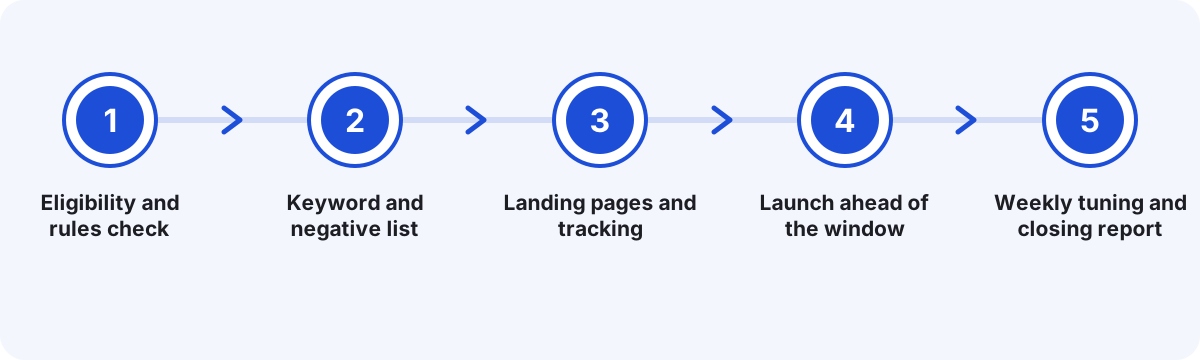
Eligibility and rules check
We confirm who stands behind the practice, chartered accountants or not, or a mix of both, and agree in writing what the ads may say. For CA firms this step may end with a recommendation not to run service ads.
Keyword and negative list
We map searches to service lines, build exclusions for portals, forms, status checks, jobs and courses, and set location and schedule targeting by audience.
Landing pages and tracking
Each campaign gets a matching page, call tracking, WhatsApp click tracking and a form, and we agree what counts as a qualified enquiry.
Launch ahead of the window
Campaigns go live several weeks before the relevant due date with modest budgets, so the account learns before costs climb.
Weekly tuning and closing report
During peaks we review search terms and budgets weekly; after each window we report enquiries, clients signed and cost per client, and plan the next one.
Which practices are Google Ads right for?
- Online tax return preparersNon-CA firms filing salaried and capital gains returns, for whom deadline search is the main source of new clients.
- Enrolled GST practitionersPractitioners handling registration, monthly returns and notices for traders and small suppliers.
- Bookkeeping companiesFirms selling monthly accounting retainers to startups, clinics, shops and agencies across Bengaluru.
- Payroll and statutory filing providersTeams that run salaries and the PF, ESI and professional tax returns for first-time employers.
- NRI tax servicesPractices helping non-residents with property sales, TDS certificates and returns, searched for from abroad.
- CA firms recruitingChartered accountants hiring staff or articled assistants, where plain job ads are an allowed exemption.
- CA firms weighing a write-up adPractices whose partners have studied the guidelines and want to test a strictly factual ad, with the decision theirs.
Which Bengaluru searches turn into paid-search demand for tax help?
Paid search in this industry is driven by deadlines more than by geography, but where people live and work still changes what they type. Staff in the Whitefield tech parks, on the ORR and in Electronic City search late in July for help with RSUs, ESPPs, foreign shares and capital gains, often on a phone during the working day. Many want a fixed fee and a fast online process.
Founders and small companies around Koramangala, HSR Layout and Indiranagar search for GST registration, monthly bookkeeping and payroll set-up, usually soon after incorporation or after their first hire. Traders around Shivajinagar, Commercial Street and the wholesale district near Majestic search for GST return filing and notice replies, frequently with a place name attached.
Manufacturers around Yeshwanthpur and the Peenya belt search less often and later, typically for tax audit or a specific notice, and they usually call rather than fill in a form. A campaign for a Bangalore practice therefore needs separate ad groups for each of these groups, with different landing pages and different hours of the day when ads run.
Should a CA firm hire the best Google Ads agency for accounting firms in Bengaluru at all?
Start with what the rules say rather than what other professions do. Under the first part of the Act's First Schedule, item (6) brands it misconduct for a practising CA to chase clients or work through adverts or by any other method. Clause (7) bars advertising services except through a write-up under the Council's guidelines. Those guidelines, updated to December 2025, let a write-up appear in electronic media in push as well as pull mode, but they also say a CA must not issue any advertisement or other material by which people are solicited to visit the firm's website.
A search ad is, by design, a short advertisement that invites a click to a website. Whether a strictly factual ad, listing only permitted particulars and non-exclusive services, can sit within the write-up proviso without breaching that bar is a judgement the guidelines do not settle in terms. ICAI does not pre-approve write-ups, and its Code of Ethics points members who are unsure toward the Institute's Ethical Standards Board. We think partners should take that step before running ppc for CA firms, and we will not run it for services reserved for chartered accountants.
That leaves CA firms with three realistic positions. Many will run no service ads and put the effort into search content and accurate listings, which the rules plainly allow. Some will run only recruitment campaigns, which are a recognised exemption. A few, after taking advice, may test a factual write-up ad for a non-exclusive service such as bookkeeping. We support each choice, and we write down which one the partners made.
- Never for CA firms: fees, discounts, offers, superlatives, testimonials, comparisons or urgency appeals in ads.
- Never for CA firms: ads for statutory audit, tax audit or other attestation work.
- Always allowed: plain recruitment ads for staff and articled assistants without promotional content.
- Worth doing first: organic search and an accurate map listing, which need no advertising at all.
What should ad copy for a tax practice say?
For a non-CA practice, good copy is specific and checkable: the service, who it is for, what the client provides, how the work is done and, where the firm publishes it, the fee. An example of the shape: "Salaried ITR filing in Bengaluru. Form 16, AIS and capital gains checked. Fixed fee shown before you start." Every statement must be true and capable of substantiation under the ASCI code, and claims such as "lowest fees" or "no notices ever" fail that test.
Google's own policies add limits that bite in this industry. Ads must not imply an affiliation with the Income Tax Department, GSTN or any government body, must not dress a private service up as an official portal, and must not make unreliable claims about outcomes. Where a service involves obtaining a government document or registration on someone's behalf, Google also restricts that category and may require certification. We keep copy describing the practice's own professional help, never the government's service.
If a CA practice's partners do decide to test a write-up ad for a non-exclusive service, its shape is narrower still: the firm name with the suffix Chartered Accountants, the service in neutral words, the area served and the registered address. No headline hooks, no fee, no adjectives, no reasons to choose the firm, and no wording that urges a click. In practice such an ad competes poorly against non-CA advertisers, which is one more reason most CA practices put their effort into organic search and their map listing instead.
- Non-CA example: service, audience, documents checked, process, published fee.
- CA write-up example: firm name with suffix, service in neutral words, area, registered address.
- Never in any ad: implied government links, promised outcomes, fear about penalties.
- Always: a landing page that matches the ad and repeats the same facts.
How do you build keywords and negatives for tax searches?
We group keywords by intent rather than by product. People who want someone to do the work for them use words such as consultant, help, service, filing for, charges, near and agent. People who want to do it themselves use login, portal, form, download, status, how to and last date. Google ads for tax consultants should target the first group and exclude most of the second, keeping only those how-to searches that a strong guide page can convert.
Negative keywords for tax searches need constant care because new forms, portals and terms appear each year, and the Income-tax Act 2025 will add a fresh vocabulary. During peaks we read the search terms report every few days. Recruitment campaigns are kept in separate accounts or campaigns, so words like articleship, jobs and vacancy can be excluded from service campaigns without blocking hiring.
- Service intent: "itr filing consultant", "gst return filing service", "bookkeeping services for startups", "tax audit ca".
- Life events: "capital gains on property sale filing", "rsu tax india help", "nri property sale tds".
- Typical exclusions: login, portal, status, download, pdf, calculator, last date, jobs, course, exam.
- Watch list: "free", which can be excluded or allowed depending on whether a free consultation is genuinely offered by a non-CA firm.
What counts as a conversion for an accounting practice?
A click on the phone number is not a client. We separate four stages: an enquiry made, an enquiry qualified as a real prospect for a service you offer, documents received, and work completed or a retainer signed. Calls shorter than a set duration, wrong numbers and people asking for the portal are filtered out of the qualified count.
The last two stages happen in your office, not on the website, so we set up a simple weekly upload of which enquiries became clients. Feeding that back into Google lets bidding favour the searches and times of day that produce filings and retainers. Forms collect only what is needed to call back, with a clear consent line, because the Digital Personal Data Protection Act applies to every lead a practice collects. Our general Google Ads guide for Bengaluru explains the tracking set-up in more detail.
What should a tax practice advertise after a deadline passes?
Searches do not stop on the due date; they change. In the first days of August and September people look for late filing, the fee for filing after the date and how to correct a return they filed in a hurry. Budget 2026 lengthened the window for revising a return to twelve months from the end of the tax year, with a fee for revisions after nine months, which gives practices a longer tail of genuine work and gives searchers more reasons to look for help well into the following year.
Copy for this period needs particular care. Someone who has missed a date is anxious, and fear-led ads about penalties are both poor practice and, for any firm, at odds with the ASCI requirement that ads not exploit a reader's inexperience. A calm ad that says the practice files late and revised returns, lists what the client should bring and states the fee where the firm may publish it, does better and stays defensible. For CA firms, this is exactly the kind of moment where the solicitation rule matters most, and where we would advise against service ads altogether.
- August and September: late filing and revised-return searches for salaried and business returns.
- November: tax audit stragglers and the run-up to GST annual returns.
- January: last-chance searches before the late-filing window for the earlier year closes.
- All year: notice-reply searches, which need factual copy and a page explaining what the practice can and cannot do.
- Google Ads management
- From ₹4,999 a month; ad spend paid to Google by the practice
- Set-up time
- About 30 days for campaigns, landing pages, tracking and first tuning
- 2026 search peaks
- 31 July (ITR-1, ITR-2), 31 August (non-audit business), 31 October (audit), 31 December (GST annual)
- CA firms
- Clause (6) bars solicitation; guidelines bar ads soliciting website visits; consult ICAI's ESB if unsure
- Non-CA practices
- ASCI code, consumer and data protection law, Google policies
- Always allowed
- Plain recruitment ads for staff and articled assistants
Where this applies around Bengaluru, Karnataka
- Bengaluru
- Karnataka
- India
- Whitefield
- Electronic City
- Koramangala
- Shivajinagar
- Yeshwanthpur
Frequently asked questions
27 answersAre chartered accountants allowed to run Google Ads in India?
Not freely. Clause (6) of the Chartered Accountants Act bars soliciting work by advertisement, and the advertisement guidelines say a CA must not issue advertisements that solicit people to visit the firm's website. A factual write-up is permitted in electronic media, but whether a search ad qualifies is a judgement for the partners, ideally after seeking a view from the Institute's ethics board.
Can a tax consultant who is not a CA advertise on Google?
Yes. The Institute's rules reach its members and their firms only. Independent advisers, GST practitioners and bookkeeping companies answer instead to the ASCI code, consumer and privacy law and Google's own policies, so their ads can show services and fees, provided every claim is true and they never present themselves as chartered accountants.
How much does a Google Ads agency for accounting firms in Bangalore charge with KaamGPT?
Our fee for running the account begins at ₹4,999 monthly, and building and tuning it takes roughly 30 days. Clicks are billed by Google to the practice itself. The written quote lists the campaigns, service lines, landing pages and reporting included.
When should a tax practice in Bengaluru start its ITR campaigns?
Several weeks before each window: by June for salaried returns due on 31 July, and by July for non-audit business returns now due on 31 August. Starting early lets the account learn while clicks are cheaper and gives clients time to send documents.
What should we ask a Google Ads agency for accounting firms in Bangalore before signing?
Ask how it will separate service lines, which negative keywords it starts with, what it counts as a conversion, who owns the account, and how it will handle ICAI's rules if your practice is a CA firm. An agency that cannot answer the last question clearly has not worked with accounting practices before.
Why did our tax ads get clicks but no clients?
For accounting firms it is usually because the keywords matched people looking for the government portal, a form, a status check or a job, and no negative keywords filtered them out. The second common cause is sending ads to a home page rather than a page for the specific service searched.
Can a CA firm run Google Ads to hire articled assistants?
Yes. Recruitment advertising for staff and articled assistants in the member's own office is a recognised exemption, provided the ad contains no promotional element and does not suggest the firm is better than others. Keep it to the role, location, requirements and how to apply.
Should accounting firms show fees in their Google ads?
Non-CA accounting firms may, if the fee is accurate and honoured, and showing it often filters out poor-fit enquiries. CA firms may not publish fees under the write-up conditions, so a CA firm's ad, if it runs one at all, must leave fees out.
What is a good negative keyword list for tax ads?
Start with portal, login, efiling, status, download, pdf, form, calculator, last date, jobs, salary, course, exam and syllabus. Add the names of government sites and tax software brands you do not offer. Then review the search terms report every few days during peaks and add what slips through.
Can our firm advertise on searches for the Income-tax Act 2025?
Non-CA firms can, though most of those searches come from people wanting to read the law, so a guide page converts better than a sales page. CA firms are better served publishing a clear explainer and letting it rank organically, which fits the pull model and needs no advertising.
Can GST practitioners advertise around the monthly return dates?
Enrolled GST practitioners who are not chartered accountants can. Small, steady campaigns weighted toward the days before the 11th and the 20th of each month, plus a larger push in November and December for annual returns, suit most practices serving traders in Bengaluru.
Do Google's financial services rules apply to tax and accounting ads?
Google's financial services policy focuses on financial products such as loans, investments and debt services, so ordinary accounting and tax help is not its main target. Other Google policies still apply: no implied government affiliation, no misleading claims, and restrictions on selling government documents or registrations.
Is the best Google Ads agency for accounting firms in Bengaluru one that pushes every practice to advertise?
No. A good agency checks first whether advertising is appropriate. For many CA firms the honest advice is to put the effort into search content and listings; for tax consultants and bookkeepers, carefully filtered campaigns often make sense. An agency that ignores the difference is putting its fee ahead of your risk.
How do you track calls from tax ads?
For accounting firms we use call tracking numbers on ads and landing pages, record call duration and outcome, and track WhatsApp clicks separately. Each week the practice marks which enquiries became clients, and that list is fed back to Google so bidding favours searches that produce work.
Can our accounting firm bid on competitors' names?
We advise against it. For CA firms it sits badly with the bars on solicitation and on comparisons with other firms. For other practices it invites trademark complaints and rarely converts, because people searching a firm by name usually want that firm.
What landing page does a tax ad need?
Accounting firms need one page per service: what is done, for whom, which documents are needed, how the process works and how to start. Non-CA firms add the fee. The page should load fast on mobile and offer call and WhatsApp buttons, since most tax searches in Bengaluru happen on phones.
Can ads help with late and revised returns after the deadline?
For non-CA practices, yes. Searches for late filing and revising a hurried return continue for weeks after each due date, and Budget 2026 extended the revision window to twelve months from the end of the tax year. Calm, factual copy works best; CA firms should not advertise for this work.
Can ads promise to reduce someone's tax or clear a notice?
No. Outcomes depend on the facts and the department, and promising them breaches the ASCI code's requirement that claims be capable of substantiation, as well as Google's rules on unreliable claims. Describe the service, not the result.
Does Google Ads help bookkeeping firms win monthly retainers?
It can, if campaigns target business-owner searches such as bookkeeping for startups or monthly accounting services, and the landing page explains scope and pricing clearly. Retainer decisions take longer than return filings, so accounting firms should judge results over months, not days.
Should a CA firm rely on SEO instead of paid search?
For most CA practices, yes. Organic search fits the pull model ICAI's website rules describe and needs no advertising. Our <a href="/best-seo-company-for-accounting-firms-in-bengaluru">SEO page for accounting firms</a> and the <a href="/services/seo">SEO service</a> explain how deadline guides are planned to rank in time.
Can a tax practice target ads to specific Bengaluru areas?
Yes. Accounting firms can target by location radius or by named areas. A practice near Shivajinagar might target the central trading districts for GST work, while an online return preparer might target the whole city but weight bids toward Whitefield and Electronic City in July.
How quickly can a Google Ads campaign start for a tax practice?
A basic campaign can be live within days, but the full set-up with landing pages, tracking and negative lists takes about 30 days. That is one more reason accounting firms should start before the deadline season rather than during it.
What about Meta ads instead of Google Ads?
The two platforms do different work. Search ads meet people at the moment they type a question; Facebook and Instagram find people earlier, which suits educational content and recruitment. Our <a href="/best-meta-ads-agency-for-accounting-firms-in-bengaluru">Meta Ads page for accounting firms</a> covers what CA firms and others can do there.
Will you run ads for a CA firm if the partners insist?
Only within limits we agree in writing: non-exclusive services, factual copy with no fees, offers, superlatives or testimonials, and a record that the partners have considered the guidelines. We will not run ads for audit or attestation work, and we turn down wording that chases work.
Do you handle ads in Kannada for Bengaluru practices?
Yes. For accounting firms, Kannada ads and landing pages can reach traders and families who search in Kannada, though most tax searches in Bengaluru are typed in English. We test both where the audience justifies it, and keep the landing page in the same language as the ad.
Who manages the account, and how do we contact them?
A Bengaluru specialist manages your account, working with you by call, WhatsApp and online meetings, with weekly updates during deadline windows. To talk about your practice's campaigns, call +91 79767 82366.
Who owns the Google Ads account and its data?
The practice does. We work inside an account registered to you, billed to your payment method, with our access granted as a manager. If you stop working with us, the account, its history and its conversion data stay with you.