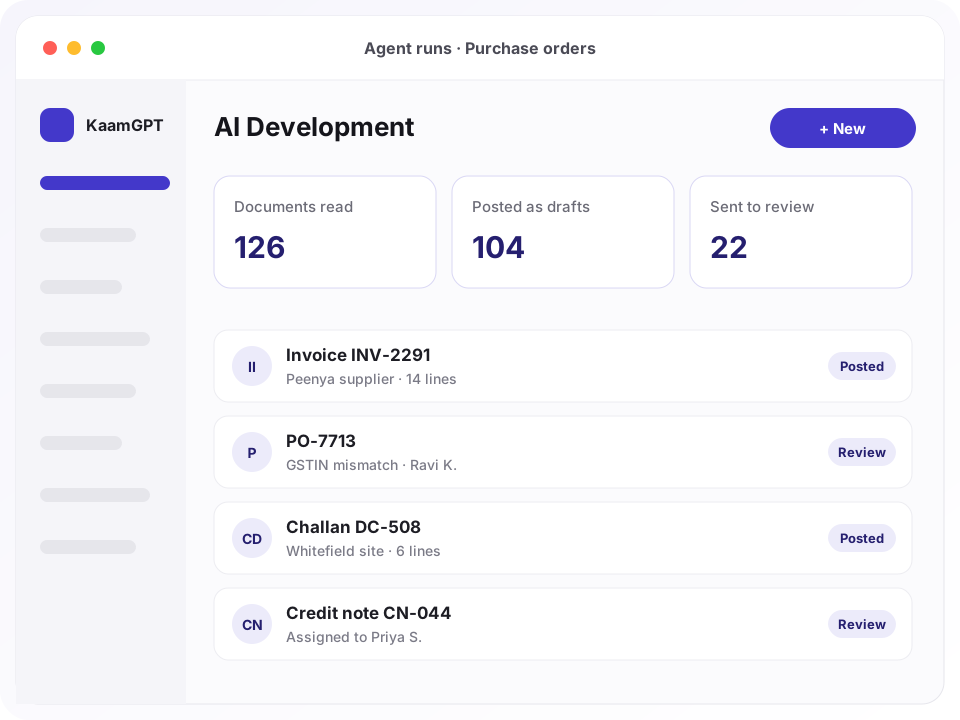
Choosing the best AI development company in Bengaluru is less about who demos the flashiest chatbot and more about who can make a model read your purchase orders, answer from your policy manuals and act inside your ERP without inventing things. KaamGPT builds that kind of working system: custom AI agents, document pipelines and workflow automations, each scoped against your real samples before any development starts.
Projects start from ₹49,999, the catalogue lists 30 days as the standard delivery window for a scoped build, and every engagement ends with a handover you can audit: the evaluation results, the data-flow map, the prompt versions and a runbook. The full AI Development service listing sits alongside the rest of the done-for-you work on KaamGPT's services page.
- ₹49,999published starting price per project, in INR
- 30 daysstandard delivery window for a scoped build
- 5workstreams: agents, documents, workflows, APIs, tuning
- 1 working dayfor a reply after you send an enquiry
What should the best AI development company in Bengaluru deliver on your build?
Eight deliverables that turn a language model into a system your staff will trust with real work.
Agents with a written action list
Every agent we build gets an explicit list of actions it may take, such as drafting a reply, tagging a lead or opening a ticket, and a list it may not. Anything outside that list waits for a person. This is how custom ai agent development stays safe when an email tries to smuggle instructions to the model, the risk OWASP lists first for LLM applications.
Document intelligence for Indian paperwork
Tax invoices with GSTIN and HSN codes, e-way bills, delivery challans, purchase orders, bank statements and scanned contracts are read into structured fields, each carrying a confidence score. Our document intelligence pipelines are tested on phone photos and skewed scans as well as clean PDFs, because that mix is what actually lands in an accounts inbox.
Answers grounded in your own files
For question answering we use retrieval-augmented generation: at the moment a question arrives, the agent searches your approved policies, manuals and product notes, answers from the passages it finds and shows which document each claim came from. When nothing relevant turns up, it says so and routes the question to your team instead of guessing.
Event-driven AI workflow automation
AI workflow automation works best when it starts from events you already record: a new contact, an overdue invoice, an incoming WhatsApp message, a completed call. Inside KaamGPT, automation rules can post those events to an HTTPS webhook, so the agent reacts in the background and its result lands where your team already looks.
Connections to systems you run
We integrate through the APIs your ERP, CRM, helpdesk or accounting software already exposes, using a service account limited to the records the agent genuinely needs. Where an older system has no API, we agree a scheduled export and import rather than screen-scraping, which fails quietly the day someone renames a column.
An evaluation set before development
Before building, we assemble test cases from your real documents and questions, each paired with the answer your team considers correct. Every prompt change, model upgrade or new document type is re-run against that set, so improvement is measured rather than asserted, and a regression is caught before any of your staff meets it.
A review queue for uncertain output
Low-confidence extractions and unusual requests land in a simple review screen where a person approves, corrects or rejects them. Corrections are logged and feed the next tuning round. You decide the threshold that sends an item for review, and it can be set stricter for high-stakes fields such as bank details and amounts.
Tuning once it is live
After go-live we study the failure log, adjust prompts, retrieval settings and business rules, and re-test whenever a model provider ships a new version. The length of the tuning period bundled with your project is written into the quote, so you know exactly when ongoing work begins and what it covers.
What does a custom AI build cost with KaamGPT?
Every project is priced in INR from a written scope, and the published starting point is ₹49,999 per project for a single, well-defined workflow. What moves the number is how many systems are involved, the variety of documents, the volume you expect and how much human review you want designed in. The final figure, the payment schedule and the delivery date all sit in the quote you approve before work begins.
- Custom AI agents
- Document intelligence
- Workflow automation
- API integration
- Ongoing tuning
Single-workflow build
From ₹49,999 per project
One agent or one document pipeline, connected to one core system, with a clear process owner on your side.
- Discovery session on your real samples
- Statement of work with acceptance tests
- Evaluation set built from your documents
- Integration with one core system
- Review queue for uncertain output
- Handover runbook and staff walkthrough
Multi-system agent programme
RecommendedQuoted after a call
Agents that read from and act across several systems, such as ERP, CRM, email and WhatsApp, with limits set per role.
- Action list and approval rules for each role
- Several integrations and event triggers
- Data map covering every provider and field
- Supervised pilot with staged review thresholds
- Documentation for your IT or security review
Tuning and extension retainer
Quoted after a call
Teams already running an AI system that now needs measured improvement, new document types or new intents.
- Scheduled review of the failure log
- Prompt, retrieval and rule adjustments
- Re-testing when model versions change
- New document types or intents added
- Evaluation report after each round
Optional add-ons
- WhatsApp front doorLet customers reach your agent on WhatsApp through the KaamGPT WhatsApp Chatbot app, with AI replies metered from the prepaid wallet.
- Voice front doorPut the same knowledge behind a phone line with KaamGPT AI Calls voice agents; call usage is drawn from the AI Calls credit wallet.
- Additional document typesNew formats added after launch, such as another supplier's invoice layouts or a fresh contract template; quoted separately.
- Running costs such as model API usage, hosting and any paid third-party connector sit outside the build fee; the quote itemises each one so your finance team sees the monthly picture before signing.
- If the build calls KaamGPT's own APIs, your workspace needs a plan with API access: Growth at ₹2,999 a month or Business at ₹7,999 a month, with the exact amount shown at checkout.
- Delivery dates assume timely access to samples, systems and a decision-maker; a delay on any of the three moves the date, and the statement of work says so plainly.
Why do so many AI pilots stall once the demo is over?
The pattern repeats across offices of every size. Someone connects a public chatbot to a folder of PDFs, the first ten questions look impressive, and the pilot is announced internally. Then a finance clerk asks about a vendor that was renamed last quarter, the bot answers confidently from an outdated contract, and trust disappears. The model was rarely the problem; nobody defined a correct answer, where the data may travel, or what the system may do.
Those are the gaps a serious partner closes before building anything. Picking the best AI development company in Bengaluru means picking one that writes acceptance tests from your own documents, maps every personal-data field against India's Digital Personal Data Protection Act, 2023, and designs a review step for cases the model is unsure about. Without those three things, even an accurate prototype gets switched off by the people it was meant to help.
- A support bot quotes last year's price list because nobody owns the document refresh.
- Supplier invoices arrive in dozens of layouts, and template-based extraction breaks whenever a vendor changes its billing software.
- An agent with write access to the CRM obeys an instruction hidden inside a customer email.
- Nobody can say which provider processed customer data, in which country, or when it will be erased.
- The freelancer who built the prototype has moved on, and no one knows which prompt version is live.
How does a KaamGPT AI project move from first call to live system?
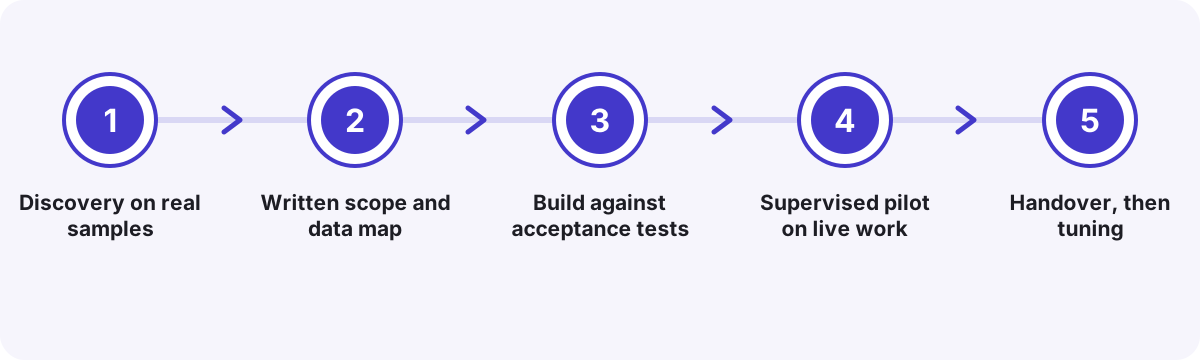
Discovery on real samples
We start with a call and a look at genuine material: a batch of the documents, emails or questions the system must handle, plus the rules a person applies today. You come away with a plain view of what is feasible, what needs human review and what should not be handed to a model at all.
Written scope and data map
The proposal becomes a statement of work listing deliverables, acceptance tests, integrations, the data each step touches and where it is processed. It carries the price in INR and a delivery date, with 30 days as the catalogue's standard window for a scoped build.
Build against acceptance tests
Development runs against the evaluation set from the first day. You see working checkpoints on your own data rather than slides, and every change to prompts or retrieval is re-scored before it reaches the next checkpoint.
Supervised pilot on live work
The system goes live with review switched on for everything, so your team sees each output before it counts. As results hold up on real traffic, the review threshold is relaxed field by field, never all at once.
Handover, then tuning
You receive the runbook, prompt versions, evaluation results, a record of every credential and where it is stored, and a walkthrough for the staff who will own the system. The agreed tuning period then begins, driven by the review log rather than hunches.
Is a custom AI build better than a freelancer or a ready-made chatbot?
Buyers searching for the best AI development company in Bengaluru usually weigh three routes. Each has a place; the differences show up in scope, testing and what happens once the system is live.
| What matters | KaamGPT AI Development | Freelancer from a gig marketplace | Ready-made AI chatbot subscription |
|---|---|---|---|
| Written scope and acceptance tests | Statement of work with tests built from your samples | Depends on the individual; often a chat thread | None; you configure it yourself |
| Works on your documents and systems | Yes, including ERP, CRM and KaamGPT apps | Yes, if the freelancer knows those systems | Usually uploaded files and a website widget |
| Measured accuracy before launch | Evaluation set re-run on every change | Rarely formalised | Not measured on your specific data |
| Human review of uncertain output | Review queue with thresholds you set | Built only if you ask for it | Typically answers everything directly |
| DPDP data-flow documentation | Field-level data map in the handover | Uncommon | The vendor's generic privacy policy |
| Cost to start | From ₹49,999 per project | Lower hourly rates, open-ended total | Low monthly fee, limited customisation |
| After launch | Agreed tuning period, optional retainer | Depends on availability | Generic product updates from the vendor |
The honest verdict. Pick KaamGPT when the AI must read your documents, act inside your systems and survive an audit of where data went. A skilled freelancer can be better value for a narrow, one-off script that your own engineers will maintain. A ready-made chatbot is the sensible choice when you only need answers from a public FAQ and never need the bot to take an action on anyone's behalf.
Where do Bengaluru businesses put a custom AI build to work?
Four illustrative scenarios showing the kind of problem this service is scoped to solve.
A precision-components manufacturer in Peenya
- The situation
- Purchase orders from OEM buyers arrive as PDFs, scanned printouts and emailed spreadsheets, all in different layouts. Two clerks retype part numbers, quantities and delivery dates into the ERP, and a single wrong digit can reach the shop floor before anyone notices.
- How KaamGPT fits
- A document pipeline reads each order, matches part numbers against the item master and checks quantities against open contracts. Clean orders go into the ERP as drafts through its API; any mismatched part number, price or date goes to the review queue with the original page shown beside it.
- What changes
- Clerks check flagged exceptions instead of retyping every line, and part-number errors surface during production planning rather than after dispatch.
A chartered accountancy practice in Jayanagar
- The situation
- Every month, clients send purchase bills as phone photos, WhatsApp forwards and email attachments. Staff key GSTIN, invoice number, date and taxable value into a working sheet before they can reconcile input tax credit, so the busiest week goes on data entry.
- How KaamGPT fits
- The pipeline sorts incoming bills by client, extracts invoice fields, validates the GSTIN format and flags duplicates. It then compares extracted bills with the client's downloaded GSTR-2B statement and produces an exceptions list that a partner reviews before anything is filed.
- What changes
- Articled assistants work through mismatches instead of typing, and partners can see which suppliers keep causing credit gaps for each client.
A B2B SaaS startup in HSR Layout
- The situation
- The support team answers the same integration and billing-setup questions every day. The right answers exist, but they are scattered across help articles, release notes and internal chat threads, and new support hires take weeks to learn where to look.
- How KaamGPT fits
- An agent built on retrieval-augmented generation searches only approved help articles and release notes, drafts a reply with links to its sources and leaves it for a support agent to send. Questions about pricing exceptions or account closure are never drafted; they go straight to a senior person.
- What changes
- Draft replies reflect the current release rather than someone's memory, and newer hires can see which document every answer came from.
A facilities-management company serving tech parks in Whitefield
- The situation
- Site supervisors report leaks, lift faults and housekeeping issues as WhatsApp messages with photos. A coordinator reads each one, types a ticket into a spreadsheet and chases the right technician, while reports sent late at night wait until morning.
- How KaamGPT fits
- Each incoming WhatsApp message triggers an automation that hands it to the agent. The agent classifies the issue, reads the building and floor from the text, logs a job in the maintenance tracker for the right trade and replies with an acknowledgement. Urgent or ambiguous reports go to the duty coordinator.
- What changes
- Every report gets a category and a reply straight away, and coordinators spend their attention on the escalations that truly need human judgement.
How AI project requests differ across Bengaluru's business districts
Bengaluru's demand for AI is not one market. Product startups in Koramangala and HSR Layout usually want support and onboarding agents trained on their own documentation, and they care most about reaching a working pilot quickly. Engineering and IT teams in Whitefield, Bellandur and Electronic City more often bring internal knowledge search, ticket triage and integration with systems their security team has already reviewed.
Away from the tech corridors, the requests change shape. Manufacturers in Peenya bring purchase orders and supplier invoices; professional firms in Jayanagar bring client paperwork ahead of GST deadlines. Kannada documents, such as property papers and some state department letters, are tested during scoping rather than assumed to work, because scan quality and script handling decide feasibility. Whichever firm you rate as the best AI development company in Bengaluru should run that test on your own pages.
What should you prepare before briefing an AI development partner?
The fastest projects are the ones where the client arrives with evidence rather than a vision statement. Collect a representative batch of real inputs, including the ugly ones: blurred photos, handwritten notes on printed invoices, forwarded emails with three replies stacked above the actual question. Even the best AI development company in Bengaluru cannot rescue a build that was briefed only with clean samples.
Next, write down the decisions a person currently makes with those inputs and who is allowed to make them. If a clerk rejects any invoice without a purchase-order reference, that rule belongs in the scope. If only the finance head may approve a change to a vendor's bank details, the agent must never be able to do it, however cleverly the request is phrased.
- A batch of real, messy inputs, with the known-difficult examples marked
- The correct output for each sample, agreed by the person who owns the process
- API documentation or a named contact for every system the agent will touch
- One decision-maker who can sign off acceptance tests and review thresholds
How do you know a document pipeline is actually working?
Overall accuracy is the wrong number to watch. A pipeline can read nearly every field correctly and still be unusable if the fields it misses are amounts and GSTINs. Measure per field, weighted by what an error costs: a wrong delivery address is an annoyance, a wrong bank account number is a loss. Your evaluation set should say plainly which fields are critical.
The second number is the review rate, meaning how many documents a person still has to open. It should fall gradually as tuning improves confidence, and it should never be forced down by loosening thresholds on critical fields. Track the time from arrival to posting too, because a pipeline that is accurate but runs overnight may not fix the delay you started with.
The NIST AI Risk Management Framework groups this discipline into four functions, govern, map, measure and manage, and it is a useful checklist for any team that wants its AI system to be reviewed rather than simply trusted.
- Field-level correctness on a held-back test set, never on the samples used for building
- Weekly review-queue volume, broken down by reason
- Errors that reached the downstream system despite review
- Time from arrival to posted record for a typical document
What does India's DPDP Act 2023 mean for an AI project?
Under the Digital Personal Data Protection Act, 2023, the business that decides why personal data is processed is the Data Fiduciary, and it stays responsible even when a processor does the work. On a KaamGPT build, you remain accountable for notices and consent while we act on your documented instructions. Section 8 also expects a valid contract with any processor and reasonable security safeguards against a breach.
Two provisions matter especially for AI. Where personal data is used to make a decision that affects someone, the Act asks the fiduciary to ensure that data is complete, accurate and consistent, a strong argument for human review on anything touching credit, hiring or claims. And once the purpose is served, the data must be erased, including copies a processor holds, so retention has to be designed in from the start.
Some AI inference providers process data outside India. KaamGPT's privacy policy limits such transfers to countries the Central Government has not restricted under the Act, and your data map names the provider for each step so your legal team can check it before go-live.
- Send the model only the fields a task needs; mask account and identity numbers by default
- Record which provider processes each field, and in which country
- Set retention periods for prompts, outputs and logs, then delete on schedule
- Keep a human decision on anything that materially affects an individual
Which industries get the most from custom AI agents and document pipelines?
- Manufacturing & engineeringPurchase orders and supplier invoices read into ERP drafts, with part numbers checked against your item master before posting.
- Accounting & tax practicesClient bills sorted, GSTIN and invoice fields extracted, and exceptions listed against downloaded GST statements for a partner to review.
- SaaS & IT servicesSupport agents that draft answers from approved help articles and release notes, show their sources and escalate sensitive requests.
- Healthcare & diagnosticsFront-desk and scheduling questions answered only from approved information, with every clinical question routed to qualified staff.
- Logistics & warehousingDelivery challans, e-way bills and proof-of-delivery photos matched to shipments, with discrepancies flagged before invoicing.
- Real estate & facilitiesMaintenance requests from WhatsApp classified by building and trade, and lease documents made searchable clause by clause.
- Education & training institutesAdmission enquiries answered from the current prospectus and fee rules, with counsellors handed any case that needs judgement.
- Legal & compliance teamsContract clauses extracted into a register, renewal dates tracked and non-standard terms flagged for a lawyer to read.
What makes KaamGPT a practical partner for a first AI build?
A price before the build
The published starting point is ₹49,999 per project, and the full amount sits in a written quote alongside deliverables and acceptance tests. You never discover the cost of a model integration halfway through the work.
Hooks into a workspace teams use
100+ companies across India use the KaamGPT workspace, and its apps expose automation webhooks plus APIs for WhatsApp, email and AI calls, so an agent can react to real business events and reply through channels your team already runs.
Plain about what AI cannot do
Model output is probabilistic, and our scopes say so in writing. Where a wrong answer costs money or affects a person, the design includes a review step, and we will tell you when a rule-based script would serve you better than a model.
Data flows you can defend
Every handover includes a field-level map of what data goes to which provider and where it is processed, written for the conversation you will eventually have with an auditor, a client's security team or the Data Protection Board.
Measured, not merely demoed
Acceptance is decided by the evaluation set agreed at scoping and re-run in front of you. A build that shines on five hand-picked questions but stumbles on your real documents does not pass, and that is the bar we hold ourselves to.
Conversations in Indian working hours
Enquiries get a reply within one working day, and reviews happen over calls, screen shares and WhatsApp during Indian business hours, so a decision on your build never waits for an overnight handoff to another time zone.
- Starting price
- From ₹49,999 per project, in INR; final amount in the written quote
- Standard delivery window
- 30 days for a scoped build, with the date set in the statement of work
- What is in scope
- Custom AI agents, document intelligence, workflow automation, API integration, ongoing tuning
- Delivered by
- The KaamGPT team, Bengaluru, over calls, screen shares and WhatsApp
- KaamGPT integrations
- Automation webhooks plus WhatsApp, email and AI Calls APIs (API access on Growth and Business plans)
- How to start
- Enquiry form, call or WhatsApp; reply within one working day
Where this applies around Bengaluru, Karnataka
- Bengaluru
- Karnataka
- India
- Koramangala
- HSR Layout
- Whitefield
- Bellandur
- Electronic City
- Peenya
- Jayanagar
Frequently asked questions
22 answersHow much does AI development cost with KaamGPT?
The published starting price is ₹49,999 per project, which covers a single, well-defined workflow such as one document pipeline or one agent connected to one core system. Larger programmes are quoted after a call. All prices are in INR, and the exact amount appears in the written quote you approve. Running costs like model API usage and hosting are itemised separately so nothing surprises your finance team later.
How long does it take to build a custom AI agent?
KaamGPT's catalogue lists 30 days as the standard delivery window for a scoped build, and your statement of work carries the actual date. Multi-system agents or projects with many document types can take longer. The timeline also depends on how quickly your team shares samples, grants system access and signs off acceptance tests, so we agree those dates alongside the build dates.
How is payment handled for an AI project?
Payment follows the schedule written into the statement of work, which you see and approve before any development begins. Amounts are in INR and tied to the scope in that document, so a change in scope is handled as a revised quote rather than an informal extra. Read KaamGPT's published terms before approving, because they govern every payment made against professional services.
What do you need from us to get started?
Send a short description of the process and, if you can, a few real examples of the documents or questions involved. After the enquiry, the team replies within one working day to set up a discovery call. For the build itself we need a representative sample batch, the correct output for each sample, access to the systems involved and one person who can make decisions.
Will our company data be used to train public AI models?
No. KaamGPT's terms state that identifiable customer data is not used to train publicly shared foundation models, and the same terms confirm your business owns its data. For each build, the data map names the model provider used at every step, what fields it receives and where it processes them, so your team can verify the arrangement rather than take it on trust.
Who owns the prompts, code and evaluation set after handover?
Ownership and licensing of the deliverables are written into the statement of work before development starts, so there is no ambiguity at handover. Your documents, records and other business data remain yours under KaamGPT's terms. We recommend keeping the evaluation set with your team in any case, because it is what lets anyone, including a future vendor, prove whether a change made the system better or worse.
Can the AI make mistakes or invent answers?
Yes. Language models produce probabilistic output, and no honest builder can promise otherwise. What a good build does is shrink and contain mistakes: answers are grounded in retrieved documents with sources shown, the agent declines when it finds nothing relevant, low-confidence output goes to a review queue, and the evaluation set catches regressions. Decisions that affect people should always keep a human in the loop.
Do you fine-tune models on our data?
Usually it is not the first step. Most business problems are solved faster and more cheaply with good retrieval, careful prompts and explicit business rules, all of which are easier to update when your documents change. We consider fine-tuning only when the evaluation set shows a clear gap those methods cannot close and you have enough clean examples to justify it; it is then quoted separately.
Which AI models does KaamGPT use for custom builds?
The model is chosen per task after testing on your evaluation set, weighing accuracy, cost per document or conversation, speed and where the provider processes data. A small model may handle classification while a larger one handles reasoning-heavy steps. Because the evaluation set exists, switching models later is a measured decision rather than a gamble, and the data map is updated whenever a provider changes.
Can the agent work with our ERP, CRM or accounting software?
In most cases, yes. We connect through the APIs your software already exposes, using a service account restricted to the records the agent needs. When an older system has no usable API, we agree a scheduled export and import instead. During discovery we confirm what each system allows, and anything that cannot be integrated cleanly is flagged in the scope rather than discovered mid-build.
Does a custom build connect to other KaamGPT apps?
Yes. KaamGPT automation rules can send events such as a new contact, an overdue invoice or an incoming WhatsApp message to an HTTPS webhook, and the agent can send messages or place calls through KaamGPT's WhatsApp, email and AI Calls APIs. API access comes with the Growth and Business plans listed on the <a href="/pricing">KaamGPT pricing page</a>, so check your plan before scoping an integration.
How do I speak to someone about an AI project?
Call or WhatsApp +91 79767 82366 and describe the process you want to automate, or use the enquiry form on the service page. Either way, the team replies within one working day. A useful first conversation needs only a rough description and, ideally, two or three real examples of the documents or messages involved, with anything sensitive masked.
What support do we get once the AI system is live?
Your statement of work defines the tuning period included with the project, how issues are reported and how quickly they are picked up. During that period we review the failure log, adjust prompts and rules, and re-test against the evaluation set. After it ends, a tuning and extension retainer is available on a quote, or your own team can take over using the runbook.
Is a freelancer cheaper than hiring KaamGPT for AI development?
Sometimes, on the invoice. A capable freelancer may charge less per hour, and for a narrow script your engineers will maintain, that can be the right call. The costs usually appear later: no written acceptance tests, no review queue, no data-flow documentation and nobody available when the model changes. Whether the other option is a freelancer or the best AI development company in Bengaluru, compare the full scope rather than the hourly rate.
Who is KaamGPT AI Development not a good fit for?
It is not the right service if you only need a simple FAQ bot on your website; the <a href="/best-whatsapp-chatbot-builder-in-bengaluru">WhatsApp chatbot builder</a> or a ready-made widget will do that for less. It also suits poorly when no one owns the process, when no real samples can be shared, or when the goal is fully automatic decisions on credit, hiring or claims without human review.
Can the system read Kannada documents or Karnataka-specific forms?
It depends on the document, so we test rather than promise. Printed Kannada text on clean scans is often workable, while handwriting, faded stamps and mixed-script pages need checking on your real samples during discovery. Karnataka-specific formats, such as property papers or state department letters, are added to the evaluation set so feasibility is measured before the scope is signed.
Can our approvers clear the review queue from a phone?
The review screen we build is a responsive web page, so an approver can open flagged items, compare them with the original document and approve or correct them from a phone browser. If your team works mostly in WhatsApp, the agent can also answer customers there through KaamGPT's WhatsApp Chatbot app, keeping review and conversation on the devices people already carry. A dedicated field app is a separate <a href="/best-mobile-app-development-company-in-bengaluru">mobile app development</a> project.
We already use a chatbot or no-code automation tool. Can you migrate it?
Yes. We start by listing what the current setup actually does, which flows are used and where it fails. Useful flows are rebuilt with proper tests, the rest are retired, and both systems run in parallel on real traffic until the new one matches or beats the old on your evaluation set. Only then is the old tool switched off.
Can you keep Aadhaar, PAN and bank details away from the AI model?
Yes, and that is our default. Identity numbers, bank account numbers and similar fields are masked or stripped before text reaches a model unless the task genuinely needs them, and KaamGPT's own terms bar sending credentials, card data or government identity numbers to AI features beyond what an app is built to hold. Where a field must be read, for example a bank account on a vendor invoice, it goes to human review.
What should we ask when shortlisting an AI development company in Bengaluru?
Ask to see how they would test your documents, not their best demo. The best AI development company in Bengaluru for your project should explain its acceptance tests, show a sample data-flow map, say which actions the agent may never take, name the model providers and their processing locations, and put the tuning period and running costs in writing before you pay anything.
Can you build an AI agent that takes actions, not just answers questions?
Yes, within limits you set. An agent can draft replies, tag and route leads, open tickets, update records or trigger a WhatsApp message, but each permitted action is listed in the scope and anything else requires a person. Actions with money or legal weight, such as changing bank details or approving payments, stay with your staff by design.
Do you take on AI projects from businesses outside Bengaluru?
Yes. Discovery, reviews and handover run over calls, screen shares and WhatsApp, so the process is the same for a company in Mysuru, Hubballi or anywhere else in India. Bengaluru examples dominate this page because that is where the KaamGPT team operates from, but the scoping method, the evaluation set and the data map do not change with your city.