 KaamGPT
Hiring a software development company in Bangalore is, at heart, choosing who will learn your business rules well enough to turn them into code. A dealer discount that changes after the fifth order, a hostel bed that must never be booked twice, a manager who may approve leave but not salaries: details like these decide whether new software gets used or quietly abandoned. KaamGPT builds web applications, portals, admin panels, CRMs and first product releases for businesses and founders across Bengaluru.
We are also our own most demanding client. The KaamGPT workspace bundles more than twenty business apps under a single login: screens in React with TypeScript, an API written in Python on FastAPI, records in PostgreSQL and queued jobs on background workers, all operated by us every day. This page explains how custom software development in Bangalore works with us: discovery, the written scope, fixed scope versus time-and-material, who owns the code, what OWASP and India's data-protection rules expect, and what happens after launch.
- ₹9,999website scope starts at, per project; web applications are quoted separately in writing
- ₹49,999per-project floor for an AI and automation layer
- ₹14,999starting price for a companion Android and iOS app on the same backend
- 20+business apps in the KaamGPT workspace, built and run by the same team
Commissioning software in Bengaluru, from Koramangala founders to Peenya factories
Bengaluru buyers come in two broad kinds, and a good scope adapts to each. Startup founders around Koramangala, Indiranagar and HSR Layout are often engineers themselves; they read pull requests, ask about automated tests and want repository access in the first week. Owners of established firms in Peenya, Chickpet or Jayanagar care about the process: whether the accounts clerk can learn it in a day, and whether orders still flow when the office internet drops.
The technology corridors shape requests too. Companies in Whitefield, Electronic City, on the Outer Ring Road, or at Manyata Tech Park by Hebbal often need vendor or employee portals that must pass a client's security questionnaire, so OWASP mapping and DPDP documentation get asked of any software development company in Bangalore up front. Hiring is the other local factor: a business that plans to bring engineering in-house later should pick a mainstream stack and insist on documentation from the start.
All of it is run from KaamGPT's one office in Bengaluru, which accepts work from any part of the city and from other states, as the Kota hostel platform shows. Most discovery happens on a call with a shared screen, and builds are reviewed on staging links your team opens on its own devices. Area guides on website development in Koramangala and app development in HSR Layout cover neighbourhood specifics.
- Service
- Custom web applications, portals, admin panels, CRMs, booking platforms and MVPs for Bengaluru businesses and founders
- Stack
- React and TypeScript, Python FastAPI, PostgreSQL and background workers; companion Android and iOS apps on the same backend
- Pricing
- Custom builds priced in writing after discovery; website scope from ₹9,999; AI and automation layer from ₹49,999
- Ownership
- Code ownership and handover method written into each quote; domains stay registered to your business
- Security and data
- Release checks mapped to the OWASP Top 10:2025; personal-data handling planned to the DPDP Rules, 2025
- Contact
- One line, +91 79767 82366, for voice calls and WhatsApp; one Bengaluru office taking projects citywide and from other states
Where do commissioned software projects in Bengaluru usually go wrong?
Commissioned software rarely fails on technology. It fails because the brief said “something like the food-delivery apps, only for our dealers” and nobody wrote down which dealer sees which price, what happens when stock runs out mid-order, or who may approve a credit note. The developer guessed, the owner disagreed at the first demo, and the following months went on rework nobody had budgeted for.
The second failure arrives later, and quietly. The code lives in a freelancer's personal account, the cloud server is billed to their card, and the only person who knows how to deploy has taken a full-time job elsewhere. Any software development company in Bangalore can write code; far fewer settle, before starting, who owns it, how it is tested, how personal data is protected and who answers when something breaks after launch.
- A one-line brief that leaves every business rule to the developer's guesswork
- Repositories, cloud logins and domains sitting in the vendor's name instead of yours
- No agreed acceptance checks, so “finished” becomes an argument rather than a test
- Consent screens and security controls bolted on after launch, when changing them costs most
- A single developer who understands the system, and no runbook for anyone else
Four platforms, four very different sets of business rules
Three of these are published KaamGPT case studies, described only as far as each case study goes; the fourth is an illustrative founder scenario that shows how a first release gets scoped. Outcomes are quoted as published, without invented figures.
TRECOM, a real-estate platform run from Bengaluru with listings across India
- The situation
- Six kinds of user, from tenants and buyers to owners, brokers, builders and investors, each needed a different view of the same property listings, plus a way to send enquiries and get help deciding.
- How KaamGPT fits
- One web portal with verified listings, search, lead routing and AI assistance, supported by SEO content and campaigns across search, social, WhatsApp and email. The TRECOM case study has the detail.
- What changes
- TRECOM runs its full property journey, from listing through discovery to enquiry, on its own platform, with a growing library of property guides for search.
My Room My Hostel, listing student rooms near Kota's coaching institutes in Rajasthan
- The situation
- Students and parents from all over India had to find hostels, PG rooms and flats near particular coaching institutes, while owners needed listings and enquiries kept current.
- How KaamGPT fits
- A booking website organised around the coaching institutes, with an admin panel where owners and the team manage listings and enquiries, as the hostel platform case study shows.
- What changes
- The platform takes hostel enquiries and bookings online from students and parents across India, with listings organised around the institutes they pick.
FlyMyCart, which ships parcels and shop-and-ship orders for NRI families from Bengaluru
- The situation
- Customers wanted to compare rates, book a pickup, pay and track a parcel without phoning anyone, and the team needed orders, pickups, rates and customers in a single place.
- How KaamGPT fits
- Phone apps for Android and iPhone that compare rates, book pickups, take payment and track parcels; a website designed around booking, with pages for each area; and one admin panel serving both.
- What changes
- Courier bookings and shop-and-ship orders now arrive directly, on FlyMyCart's own apps and its own website.
Illustrative: two founders in Koramangala testing a society-maintenance MVP
- The situation
- The founders had a pitch deck, a waiting list of apartment committees and money for one small release before deciding whether to raise a round.
- How KaamGPT fits
- Scope limited to raising a maintenance request, assigning it and closing it with a photo. Invoicing and vendor payouts stay in a spreadsheet for the pilot, and residents get WhatsApp status updates.
- What changes
- The founders learn from real residents whether committees adopt the product before paying for billing, dashboards or a native app, and the next scope is written from that evidence.
What does a KaamGPT custom software build include?
Each item below is a deliverable you can point to, not a promise of effort. The written scope for your project says which of them apply, at what depth, and how each one will be checked before you accept a release.
A written scope you can test against
Discovery ends in a document listing screens, user roles, business rules, integrations, data fields and an acceptance check for each feature, in plain English. A rule such as “a dealer cannot order above the credit limit unless accounts approves” becomes a line you can try yourself on the staging site. Disagreements then happen on paper, before code, when they cost an edit instead of a rebuild.
Roles and permissions designed first
Owner, staff, vendor, customer, auditor: we map who may view, create, edit, approve and export each kind of record before anyone draws a screen. Broken access control heads the OWASP Top 10 for 2025, and the cheapest place to prevent it is a permissions table agreed at the start and enforced on the server, not merely hidden in the interface.
Admin panels operations staff can run
Most businesses need the back office more than the customer screen. The admin panels behind A2Z WorkHub and FlyMyCart handle bookings, professionals, pickups, rates and customers from one place. Yours is specified with search, filters, bulk actions, a history of who changed what, and exports in the format your accountant asks for, whether that is Excel for Tally or a plain CSV.
Integrations we already operate
WhatsApp notifications through Meta's official Cloud API, online payments through gateways such as Razorpay and Cashfree, Google Search Console and Business Profile data, and transactional email: our own apps depend on these daily, so we know their approval steps, rate limits and failure modes. Your scope names each integration, whose account it runs under, and what the system does when the other side is down.
Background jobs that keep screens quick
Sending five thousand WhatsApp reminders, generating month-end statements or syncing a supplier's catalogue should never make someone stare at a spinner. That work goes onto queues processed by background workers, with retries and a visible status, the same pattern the KaamGPT workspace uses for campaigns and reports. Managers see progress, and nothing half-finishes without anyone noticing.
Release checks mapped to OWASP
Before each release, the application is reviewed against the OWASP Top 10:2025 categories that apply to it, including access control, misconfiguration, third-party package risk, cryptography, injection, authentication and logging. Passwords are hashed, secrets stay out of the repository, inputs are validated on the server, and the findings with their fixes are recorded for your files.
Personal data handled the DPDP way
Consent notices that itemise what is collected and why, a withdrawal button no harder to use than the original yes, retention periods per record type, masked identifiers in screens and logs, and an export or erase path for requests from the people whose data you hold. Planned against the DPDP Rules notified in 2025, so none of it is retrofitted in a hurry later.
Handover and a stated support period
At launch you receive administrator access, deployment notes, environment and backup details, and a list of third-party services showing who pays for each. Code ownership and the handover method are written into your quote. The support period is stated there too, from the month bundled with simple website scopes to longer arrangements for systems your business cannot run without.
How is custom software priced, and what moves the number?
There is no honest fixed price for software nobody has described yet, so custom builds are priced in writing after discovery. The number moves with user roles, business rules that have exceptions, integrations, migration from old systems, mobile apps alongside the web, and depth of reporting. A plain marketing site, by contrast, has a published floor of ₹9,999 a project under the website development service, and each published starting price can be checked on the KaamGPT services page.
- Custom design
- Mobile first
- SEO ready
- CMS included
- Analytics setup
- 1 month free support
MVP or first product release
Quoted in writing after discovery
Startup founders and new business lines that need one core journey in real users' hands, designed to be extended later rather than discarded.
- Discovery workshop and written scope
- Clickable prototype of the core journey
- Web application with essential roles
- Event tracking on the one key action
- Staging site and acceptance checks
- Handover notes and a support period
Business web application or portal
RecommendedScoped and priced after a call
Companies replacing spreadsheets and WhatsApp groups with a portal, admin panel, CRM or booking system that staff, vendors or customers sign in to.
- Roles and permissions table
- Admin panel with exports
- Integrations such as WhatsApp and payments
- Migration from existing sheets
- OWASP-mapped release checks
- DPDP notices, retention and logs
AI and automation layer
From ₹49,999 per project
Teams adding document reading, AI assistants or automated workflows to a system they already run, delivered through KaamGPT's AI Development service.
- AI agents shaped to your workflow
- Reading invoices, forms and contracts
- Automated hand-offs between steps
- Connection through your existing API
- Tuning after go-live
Optional add-ons
- Public website for the productA fast, prerendered marketing site and landing pages so the product can be found, scoped alongside the application; the website development company guide covers that work.
- WhatsApp chatbot front doorCustomers ask questions or check an order status on WhatsApp through the WhatsApp Chatbot app, linked to your system.
- Search and ads at launchSEO programmes beginning at ₹14,999 monthly, or Google Ads management whose fee begins at ₹4,999 each month, run by the same company once the product needs users.
- Extended support or retainerMonthly time for fixes, small features, dependency upgrades and browser or OS changes, quoted according to how critical the system is.
- Running costs sit outside the build fee: cloud hosting, domains, Meta's charges for WhatsApp template messages, payment-gateway transaction fees and any paid APIs. Your quote lists each one and the account that pays it.
- A companion Android and iOS app on the same backend begins at ₹14,999 a project under App Development; the mobile app development guide explains what that starting scope covers.
- When an existing KaamGPT workspace app already does the job, a monthly plan from ₹999 with GST included can beat commissioning code; the pricing page lays out all four plans.
Which stages does a KaamGPT software engagement go through?
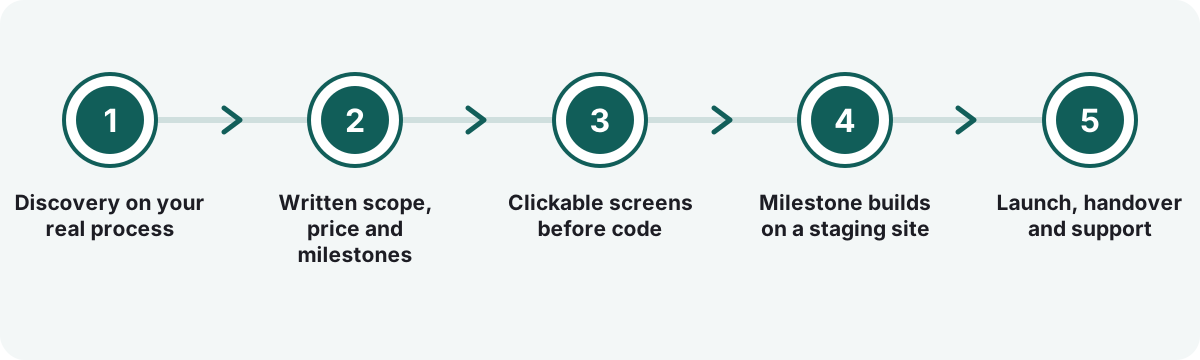
Discovery on your real process
Bring the spreadsheet, register, WhatsApp group or paper form the software will replace, plus two or three awkward real cases. Together we trace how work flows today, who touches it and where it breaks. For MVP development we also ask which single action a first user must complete for the product to prove anything at all.
Written scope, price and milestones
You receive the scope document, an itemised price, milestone dates and the acceptance checks. Fixed scope suits a well-understood workflow; time-and-material suits a product still finding its shape. No code is written before your approval, and the document explains how change requests are estimated and dated.
Clickable screens before code
Key screens are shared as a clickable prototype, so your staff can try the flow on the phones and laptops they already use. Moving a button costs minutes at this stage; moving it after the database and permissions exist can cost days.
Milestone builds on a staging site
Every milestone ends with a demo on a staging environment filled with realistic test data, never your live customers' details. You test against the acceptance checks, and anything that fails is fixed before the next milestone begins.
Launch, handover and support
Go-live is timed for a quiet business hour, old data is migrated with a rollback plan, and access and documents pass to you as the quote describes. The support period then starts: defects fixed, questions answered and small adjustments made as real usage reveals what testing missed.
Agency build, freelancer or off-the-shelf SaaS: which fits your project?
Before you hire a software development company in Bangalore, check whether you need custom code at all. The three usual routes suit different problems, and for a fairly ordinary process the honest recommendation is often a subscription rather than a build.
| What matters | Custom build with KaamGPT | Independent freelance developer | Ready-made SaaS subscription |
|---|---|---|---|
| Fits best when | Your process is the advantage and no product matches it | The job is small, well defined and short-lived | Your process is standard: invoicing, attendance, CRM, HR |
| Who writes the scope | Written with you after discovery, acceptance checks included | Often a chat thread or a short estimate | Nobody; you adapt to the product |
| Code and IP | Ownership and handover stated in the quote | Only what the contract you insist on says | You licence the product; the code is never yours |
| Security and DPDP work | OWASP-mapped checks; consent, retention and logs planned in | Varies with the individual's experience | Handled by the vendor; read its terms and data location |
| If a key person leaves | A team, a repository and handover notes remain | Real risk when the one developer moves on | The vendor maintains it while you subscribe |
| Integrations | WhatsApp Cloud API, payment gateways, Google data, your systems | Whatever the freelancer has done before | Only what the vendor offers or exposes by API |
| Cost pattern | Quoted per scope; AI layers from ₹49,999 | Lower day rates, open-ended total | Monthly fee, such as KaamGPT plans from ₹999 |
| Time to first use | Weeks, set by the milestones in the scope | Depends on the person's availability | The day you sign up |
The honest verdict. Commission a custom build when the way you work is what customers pay for and no product fits without contortions. A capable freelancer is good value for a narrow script or a one-off integration that your own staff will look after. Subscription software wins whenever the process is ordinary, and that includes the KaamGPT workspace itself. For programmes that need large dedicated teams on your premises, or regulated core banking systems, a big IT services firm is the better match, and we would rather say that up front.
What has running the KaamGPT workspace taught us about business software?
The workspace is the best evidence we can offer, because we live with its consequences every day. More than twenty apps, from CRM and attendance to WhatsApp campaigns, billing and a point-of-sale till, share one sign-in, one company record and one staff list. The browser side is React written in TypeScript, calling a FastAPI service in Python that keeps its records in PostgreSQL; slow jobs run on background workers, and our Flutter phone app, listed on both stores, reuses that backend with native Swift code for iPhone-specific features.
Operating it taught lessons that now shape client scopes. Messages go out via the WhatsApp Cloud API that Meta itself operates, where templates need approval and delivery receipts arrive after the send, so each message carries a status instead of an assumption. Our subscriptions are collected through Cashfree and Razorpay, which means coping with a payment the bank has accepted but whose confirmation reaches the server late. Plans, monthly allowances and the trial period all live in code, so pricing rules are business logic and get tested as such.
The mobile app also cleared Apple's App Review, which meant letting users delete their account inside the app, giving reviewers a working login with notes, recording a walkthrough and respecting Apple's purchase rules. Our public guide pages are rendered to plain HTML ahead of time, carry structured data, sit in an XML sitemap and are announced through IndexNow, because a product nobody can find does not sell. None of this is exotic. It is the unglamorous engineering that decides whether software is still trusted in its second year.
- Model the company, its roles and permissions first; every later module inherits them
- Treat every outside call, whether WhatsApp, payment or Google, as something that can fail, and store its state
- Move slow work onto queues so a busy month never freezes anyone's screen
- Keep one backend for web and mobile so each business rule lives in exactly one place
- Design account deletion and data export before an app store or a customer demands them
Which contract clauses protect the person paying for custom software?
Start with ownership, because Indian law does not settle it in your favour by default. Section 17 of the Copyright Act, 1957 makes an employer the first owner of work created under a contract of service, but an outside firm is not your employee. Section 19 adds a formality: no assignment of copyright is valid unless a signed document records it. Where the paper says nothing about duration, the law reads five years; where it says nothing about territory, it reads India alone. Have your lawyer check both points.
Next, choose the engagement model honestly. Fixed scope with milestone payments protects the budget when the workflow is well understood, such as a booking or approval system. Time-and-material against a capped monthly estimate suits a product whose users will change your mind. A hybrid often works best: fixed discovery and first release, then a time-based phase. Whatever the model, a change-request clause should say how new work is estimated, approved and given a date.
Finally, define done and what comes after it. Acceptance tests attached to the scope turn sign-off into an objective step. A warranty or support window states which defects are corrected at no extra cost, and for how long. Open-source licences in the code should be listed, since some impose duties if you distribute the software. KaamGPT writes code ownership and handover into every quote, and any software development company in Bangalore on your shortlist should be willing to do likewise.
- A signed IP assignment stating duration and territory, effective on payment
- Repository, cloud, domain and app-store accounts held in the company's name, with the vendor added as a user
- The scope document, with screens, roles, business rules and acceptance tests, attached as a schedule
- A change-request procedure: written estimate, your approval, then a revised date
- A defect warranty and support period, with response times in business hours
- A data-processing clause naming the security safeguards Rule 6 of the DPDP Rules expects
- A handover list covering credentials, deployment notes, backups and paid third-party services
What do OWASP's 2025 list and India's DPDP Rules ask of a new product?
OWASP describes its Top 10 as a standard awareness document for developers, and the 2025 revision reshuffles it. Broken access control stays first and now absorbs server-side request forgery; security misconfiguration climbs from fifth to second. Software supply chain failures widens the old outdated-components category, and mishandling of exceptional conditions is new. For a portal that means permission checks on every server request, pinned and audited dependencies, hashed passwords, and error handling that fails closed without leaking detail.
India's DPDP Act of 2023 became workable when MeitY notified its implementing Rules, the DPDP Rules, 2025, in November 2025. Most duties that touch product design, including the notice, security, breach and retention rules, received an eighteen-month runway, and 2026 reports said the government was consulting industry on shortening it, so building them in now is the prudent course. Rule 3 asks for a standalone notice itemising the data and each purpose. Rule 6 sets minimum safeguards: encryption, masking or tokens, access control, monitored logs and backups.
Rule 7 sets the breach routine: inform each affected person without delay, then give the Data Protection Board a detailed report within seventy-two hours of becoming aware. Rules 6 and 8 expect logs to be retained for a minimum of one year, Rule 9 wants contact details for data questions published on the website or app, and the Ministry's summary says access, correction and erasure requests must be answered within ninety days. Failing to keep reasonable safeguards carries a maximum penalty of ₹250 crore under the Act.
- Collect only the fields a purpose needs, and record each field's purpose in the data model
- Store every consent with a timestamp and the version of the notice the person saw
- Mask Aadhaar, PAN and bank numbers in screens, exports and logs alike
- Keep access and processing logs for a year, then delete them on a schedule
- Write the breach runbook before launch: who decides, who tells whom, and how fast
Which kinds of Bengaluru business benefit from bespoke software?
- Real estate and proptechMulti-sided portals where owners, brokers and buyers each see different data, with enquiry routing and listing verification.
- Student housing, coaching and educationSeat, room and batch availability that must never double-book, plus parent enquiries, fee reminders and WhatsApp updates.
- Courier, logistics and deliveryRate engines, pickup slots, live tracking and proof of delivery, with an admin view of every consignment and exception.
- Home services and field teamsBooking, dispatch to professionals, job photos and ratings, as in A2Z WorkHub's customer app and admin panel.
- Manufacturing and distribution around PeenyaDealer ordering portals with per-dealer price lists, credit limits and dispatch status, replacing phone orders and spreadsheets.
- Clinics, labs and wellnessAppointment and report portals where consent, masking and access logs matter as much as the booking screen does.
- D2C and retail brandsInventory, order and returns back offices sitting behind a storefront and syncing with marketplaces and courier partners.
- Pre-seed and seed startupsMVP development scoped to one measurable journey and built so the second release extends the first instead of replacing it.
What makes KaamGPT a sound software development company in Bangalore to hire?
We run what we build
The KaamGPT workspace is in daily use by businesses, so our engineers handle production incidents, migrations and upgrades on their own product, not only up to handover. That habit shows in your scope: we ask about backups, logs and failure states early, because we have needed them ourselves.
A stack your future hires will know
React, TypeScript, Python and PostgreSQL are widely taught and widely used, so if you later hire software developers in Bangalore to take the system in-house, they find familiar code and documented decisions instead of an obscure framework only the original vendor understands.
Web, mobile and AI from one team
A portal, a Flutter app on the same backend and an AI layer can be built by one team, so each business rule is written once. The Flutter app development guide covers the mobile side, and our AI development guide covers agents and document pipelines.
Integrations already in production
WhatsApp Cloud API messaging, Cashfree and Razorpay payments and Google Search Console data all run inside our own apps. Your integration work starts from lived experience of their approvals and quirks, not from the happy path in their documentation.
Terms settled before code
Larger scopes get a written quotation after a call, with milestones, acceptance checks, ownership and support spelled out. You decide with the document in front of you, and work begins once you sign it.
Marketing ready when the product is
Software needs users. The same company handles search optimisation, Google and Meta advertising and WhatsApp campaigns. For A2Z WorkHub that meant an app, a website and marketing together, and its published case study reports that it now outranks JustDial on the core home-service searches it competes for locally.
What does Google say its rankings reward?
Google’s automated ranking systems are designed to prioritize helpful, reliable information that’s created to benefit people, and not content that’s created to manipulate search engine rankings.
Where this applies around Bengaluru, Karnataka
- Bengaluru
- HSR Layout
- Peenya
- Indiranagar
- Hebbal
- Electronic City
- Whitefield
- Koramangala
- Karnataka
- India
Frequently asked questions
30 answersWhat price should we expect from a software development company in Bangalore for a custom web application?
There is no list price for custom software, because two portals with the same name can differ by months of work. KaamGPT quotes each build in writing after a discovery call. For reference, the published starting points are ₹9,999 for a website scope, ₹14,999 for a companion mobile app and ₹49,999 for an AI and automation layer, each per project; a web application with roles, integrations and an admin panel is priced from its own scope.
Why can't you give me a firm price on the first call?
Because the price lives in the exceptions. “Customers book a slot” is a day of work; “customers book a slot, corporate accounts get priority, late cancellations forfeit a deposit and staff can override both” is a different system. The discovery call surfaces those rules, and the estimate that follows prices what you actually described rather than a guess padded for safety.
Fixed price or time-and-material: which billing model suits our build?
Fixed price suits work you can describe completely today, such as moving an approval process from paper to software. Time-and-material suits a new product where real users will change the plan, because you pay for work done instead of a contingency. A common combination is a fixed discovery and first release, then capped monthly time. The model you pick is written into the quote, together with how change requests are handled.
How soon can a first version reach real users?
That depends on how narrow the first version is, which is why we push hard on scope. A release that does one journey well, such as raising and closing a service request, reaches pilot users far sooner than one that also handles billing, reporting and three user types. The milestone dates in your written scope are the commitment; we avoid promising timelines before that document exists.
Who holds the copyright in code written for us?
Under India's Copyright Act, 1957, an employer owns work its employees create, but a development firm is not your employee, so ownership has to be assigned in a signed document. KaamGPT writes ownership of the source code and the method of handover into each quote. Read that clause with your lawyer and check it states duration and territory, since the Act fills those gaps with five years and India only.
Can the repository sit under our own company's GitHub or GitLab account?
You can ask for that from day one, and it is a sensible request: the commit history then stays with you whatever happens to any vendor. Where the code lives during the build, and when full access passes to you, is fixed in the quote. The same thinking applies to the cloud account, the domain and any app-store developer listing, which are best enrolled in your business's own name.
Which languages and frameworks does KaamGPT write custom software in?
The web interface is built in React with TypeScript, the server side in Python with FastAPI, and data sits in PostgreSQL, with background workers processing queues. Companion Android and iOS apps share the same backend. This is what the KaamGPT workspace itself is built with, so it is maintained, upgraded and load-tested on our own product rather than picked for one client and forgotten.
Can you continue a project another developer left half-finished?
Often, yes, but only after reading what exists. We look at the code, the database, how it is deployed and whether anyone still holds the credentials, then tell you in writing whether extending it or rebuilding parts costs less over the next two years. Sometimes the honest answer is to keep the database and rewrite the screens; occasionally it is to start again.
What happens when we want a new feature halfway through the build?
You raise it, we put its effect on price and dates on paper, and you approve it or park it. Small changes inside existing screens are often absorbed; anything that adds a role, an integration or a new business rule becomes a change request. Parking good ideas for the second release is usually wiser, because a launched first version shows you which ideas matter.
How is the software tested before our staff and customers touch it?
Each milestone is demonstrated on a staging site loaded with realistic dummy data, and you run the acceptance checks listed in the scope yourself. Before release the application is reviewed against the relevant OWASP Top 10:2025 risks, permissions are tried role by role, and failure paths are exercised, such as a late payment confirmation or a WhatsApp template rejection. Defects found are fixed before sign-off.
Will our application meet the DPDP Act from the day it goes live?
It will be designed for the DPDP Act, 2023 and the Rules notified in 2025: itemised consent notices, easy withdrawal, purpose-tagged fields, retention periods, masked identifiers, year-long logs and an export or erase path. Compliance itself remains your duty as the Data Fiduciary, because it also rests on your policies, staff and contracts, so have your adviser review the notices before launch.
If customer data leaks after launch, what does Indian law expect us to do?
Rule 7 of the DPDP Rules, 2025 asks the business to inform each affected person without delay, in plain language, covering what happened, the likely consequences, what is being done and whom to contact. The Data Protection Board must also be told without delay, followed by a detailed report within seventy-two hours of becoming aware. A runbook written before launch makes that deadline achievable.
Where will the application be hosted, and in whose name will the cloud account sit?
Hosting is chosen during scoping to fit your traffic, budget and any customer requirement about data location. Our advice is to hold the cloud account in your company's name, paid from your card, with KaamGPT given its own login. The quote records the arrangement, and your domain stays registered to your business, just as it does on every website we manage.
After go-live, who fixes bugs and handles small changes?
The support period in your quote covers defects, questions and minor adjustments after launch. Simple website scopes include a month, companion apps three months, and larger systems get a period matched to how much the business depends on them. After that, a monthly retainer can cover fixes, dependency upgrades, browser or operating-system updates and minor features, or your engineers can pick the system up from the handover notes.
Can the system message our customers on WhatsApp automatically?
Yes, via Meta's own WhatsApp Cloud API, the route the KaamGPT workspace itself uses. Order confirmations, reminders and status updates are sent as pre-approved templates, and Meta bills those messages separately from the build. Templates need Meta's approval before first use, so we draft them early. The <a href="/tools/whatsapp-marketing">WhatsApp Business API app</a> shows the official route working inside our own product.
Can customers pay online inside the application?
Yes. Gateways such as Razorpay and Cashfree handle cards, UPI and netbanking, and KaamGPT collects its own subscriptions through both, so we know the awkward cases: a payment the bank approves but the server hears about late, a customer closing the tab mid-payment, a duplicate confirmation. The gateway account belongs to your company, and its transaction fees go to the gateway, not to us.
Will our accountant be able to export data for the books?
Exports are part of the admin panel specification: date-ranged CSV or Excel files of invoices, payments, orders or any other records your accountant needs, laid out in the column order they ask for so they can import or reconcile them. If invoicing is your main need, the KaamGPT <a href="/tools/bills">Bills app</a> may already cover it without any custom work.
Do we need a phone app, or will a web application be enough?
Start with the web if your users sit at desks or only open the system weekly; a responsive web app works on phones without any store approval. Choose an installed app when people need push notifications, camera-heavy work, offline use in the field or a home-screen habit. The <a href="/flutter-app-development-company-in-bangalore">Flutter development guide</a> compares the options in more depth.
Can AI features be added after the first release?
Yes. Often that is the better order: launch the core system, collect real records, then add AI where the data shows repetitive judgement, such as reading invoices or answering routine customer questions. KaamGPT's AI Development work has a ₹49,999 floor per project and connects to an existing application through its API. The <a href="/services/ai-development">AI development service page</a> lists what is included.
What separates a product development company in Bangalore from an outsourcing vendor?
A project vendor builds what the ticket says. A product partner questions whether the ticket matters, measures whether users complete the key action, and plans the second release around that evidence. KaamGPT works the second way because we build and sell our own product; workspace apps are revised from customer behaviour, and we bring that habit of shipping small and measuring to client builds.
Should we hire our own developers instead of commissioning a firm?
Hire in-house when software is your product and you can fund a team that outlasts the first release, including someone senior enough to make architecture calls. Commission a firm when you need a working system soon, lack a technical lead, or need several skills for a short period. A common path is to commission the first version, then hire and bring it in-house using the handover notes.
Will you work alongside our CTO or internal engineers?
Yes. You might want us to build one module while your team owns the core, or have your engineers review every pull request we open. Coding conventions, branch rules and who approves merges are agreed during scoping. Technical founders in Bengaluru often prefer this arrangement, since their team learns the codebase while it is being written rather than meeting it for the first time at handover.
Must we subscribe to the KaamGPT workspace to commission custom software?
No. A custom build stands on its own, with its own hosting and accounts. You can connect the two if it helps, for example by sending leads from a portal into the KaamGPT <a href="/tools/crm">CRM app</a> or by reusing the workspace's WhatsApp connection for alerts, but that is an option weighed during scoping, never a condition of working with us.
Could a ready-made KaamGPT app replace the software we were about to commission?
Sometimes, and the discovery call is where you will hear it. Attendance, HR, CRM, project tracking, POS billing, invoicing and WhatsApp campaigns already exist as workspace apps, and workspace plans begin at ₹999 monthly, GST inclusive, with a free fortnight to try them. If one fits your process, you skip the build entirely; if it nearly fits, a small custom module beside it may be enough.
How do we compare quotes from three development firms fairly?
Put every quote against the same written scope; otherwise you are comparing three different imaginary systems. Then check what each leaves out: data migration, hosting, the admin panel, testing, security review and the support window. Ask each software development company in Bangalore who owns the code, where the repository lives and who answers calls after launch. The lowest total is rarely the cheapest system once those gaps are priced.
Who should we call to talk through a software idea?
Use +91 79767 82366 for a call or a WhatsApp note describing the process, its users and any system the software must connect to; the <a href="/services">services page</a> also takes callback requests. Expect the first call to dig into your business rules rather than follow a sales script, and the written scope follows once those rules are clear.
Is being outside Bengaluru a problem when commissioning a build?
Not really. As a software development company in Bangalore with a single office, we already run discovery, demos and reviews over calls and staging links. My Room My Hostel's booking site serves students and parents heading to Kota in Rajasthan, and TRECOM lists property across India. Clients in other cities simply schedule calls around their own working hours.
Which documents make the discovery call most useful?
Bring whatever the software will replace: the spreadsheet, register, form or WhatsApp group export, with personal details masked. Add three real cases that caused trouble, a list of everyone who will log in and their roles, and any system it must talk to, such as your accounting package or a payment gateway. A rough budget range helps us propose a first release that fits it.
Which parts of an MVP can safely stay manual at first?
Anything a founder can do by hand for the first fifty customers: invoicing, payouts, onboarding calls, matching supply with demand, even some notifications. MVP development should automate only the action that proves the idea, plus anything that would embarrass you if done manually. Manual steps also teach you the real rules before they harden into code, which makes the second scope far more accurate.
How are payments for a build usually staged?
The payment schedule appears in the quotation you sign, so you see every instalment before committing. Fixed-scope work is commonly staged against milestones, with each instalment tied to a milestone passing its acceptance checks. Time-and-material work is normally billed monthly against the agreed estimate and its cap. Either way, nothing about money should surprise you when the last milestone arrives.
Sources
- OWASP Top 10 project page (OWASP Foundation)
- Digital Personal Data Protection Rules, 2025, Gazette notification (MeitY)
- Digital Personal Data Protection Act, 2023 (MeitY)
- Copyright Act, 1957, Chapter IV: ownership and assignment (Copyright Office, Government of India)
- Google Search Central: Creating helpful, reliable, people-first content