 KaamGPT
Most people shortlisting a mobile app development company in Bangalore can already picture the home screen. Far fewer have priced the parts nobody sees: the server behind it, the admin panel staff will live in, the payment rules each store applies, and the yearly updates Apple and Google demand. This guide is what KaamGPT's app team tells a founder or business owner across the table before anyone sketches a screen, including the cases where an app is the wrong purchase.
It is also the hub for our app pages. Platform depth sits on the Android build guide, the iPhone and App Store guide and the Flutter guide, while the package itself is broken down on the app package guide and in our App Development listing. KaamGPT ships its own Flutter app on both stores and has built client apps for a home-services company, a courier and a food-delivery business in the city.
- ₹14,999Where a two-platform app build begins
- ~10 daysUsual delivery for that entry scope
- iOS + AndroidPlanned, tested and submitted together
- 3 monthsOf post-launch support in the listed package
Why can five quotes for one app idea look nothing alike?
Send the line "we want something like the big food apps" to five vendors and the replies can differ by a factor nobody can explain. Each vendor has silently pictured a different product. One priced a customer app that reads a fixed menu. Another priced three apps, a rider tracker, a restaurant console and payouts. Neither is wrong; the brief simply never said which product was wanted.
The fix is not haggling over the total. It is splitting the idea into who uses it, what each of those people must do on day one, and which jobs can wait for a second release. Once the brief is written that way, quotes from each app development company in Bangalore you approach can be compared line against line, and the cheapest honest version of the product usually turns out smaller than the founder feared.
- Quotes that list screens but never mention the server, the admin panel or who pays for maps and OTP messages.
- A version one that tries to serve customers, partners and staff at once, and launches months late for all three.
- Store listings opened under the developer's personal login, so the business cannot push an update without them.
- No crash reporting or usage analytics, so nobody knows why ratings are falling after launch.
- An app that misses the yearly Apple and Google deadlines and quietly stops reaching people on newer phones.
- Starting build
- ₹14,999 per project, covering iPhone and Android together
- Typical delivery
- Roughly ten days for the entry scope; bigger apps are phased in the quote
- In the starting scope
- Push alerts, offline core flow, both store submissions, three months of support
- Quoted separately
- Backend and admin panel, payments, live tracking, extra roles, integrations
- Proof you can install
- KaamGPT's own Flutter app on both stores; client apps for A2Z WorkHub, FlyMyCart and CloseToBuy
- Base
- A single Bengaluru office; clients across the city and elsewhere are handled remotely
Which kinds of app do Bengaluru businesses and founders commission?
Most app ideas we hear fit one of eight briefs. Naming yours early decides the user roles, the backend and roughly where the quote will land.
Booking and appointment apps
Customers choose a service and a time, pay now or on the day, and get a reminder; staff see who is booked where. Home-service firms, clinics, salons and tutors are the usual buyers. The hard parts are slot rules, cancellations and deciding who gets assigned to each job. Our published A2Z WorkHub case study follows this pattern: browse, book, pay and track the professional, all inside one Android and iOS app.
Ordering apps with live tracking
A menu or catalogue, a cart, a checkout and an order that moves on a map. Behind the customer app sit at least two more surfaces: a console for the restaurant or store and a delivery-partner view. Tracking costs real money in maps usage and battery tuning, so it gets a line and a price of its own, never hidden inside the entry price.
Quote, pickup and shipment apps
Logistics customers want a price before they commit. These apps compare rates, book a pickup, take payment and show each status change, while an admin panel manages rates, pickups and customers. FlyMyCart, which handles courier and shop-and-ship work for NRI families from Bengaluru, runs this flow on Android and iOS in apps we built.
Two-sided marketplace apps
Buyers on one side, sellers or service providers on the other, and an operator in the middle approving listings, settling disputes and paying out. Marketplaces need onboarding with document checks, ratings, commission logic and split settlements through a payment gateway's marketplace product. They are the most expensive category here, which is why launching the demand side first is often the wiser order.
Field-force and internal staff apps
Visit logs with photos, delivery proof, stock counts, inspection checklists and attendance for people who work away from a desk. If what you need is standard attendance or leave, KaamGPT's ready-made Attendance app may do the job without a custom build, and we will suggest it during scoping instead of selling a project you do not need.
Loyalty and membership apps
Points, stamp cards, member prices and push offers for retailers, cafés and gyms with regulars. Watch the payment rule early: a membership that unlocks content or features inside an iPhone app falls under Apple's in-app purchase requirement, while a gym visit or a coffee bought at the counter is a real-world service that may be paid by UPI or card.
First releases for funded or bootstrapped startups
Startup app development is a different job from building for an established business. The founder needs evidence, not features: a release small enough to ship in weeks, instrumented to show whether people return, and cheap to change after the first round of interviews. We cut scope with you and write down what is deliberately left out.
Phone companions to a web product or workspace
Plenty of Bengaluru software firms started as web products, and their users now want something in their pocket. A companion app takes the few jobs people do on the move and runs them on the same backend. Where the business already works inside KaamGPT, the app can feed leads into the workspace CRM and trigger updates through the workspace's official WhatsApp messaging app.
What happens between the first scoping call and launch day?
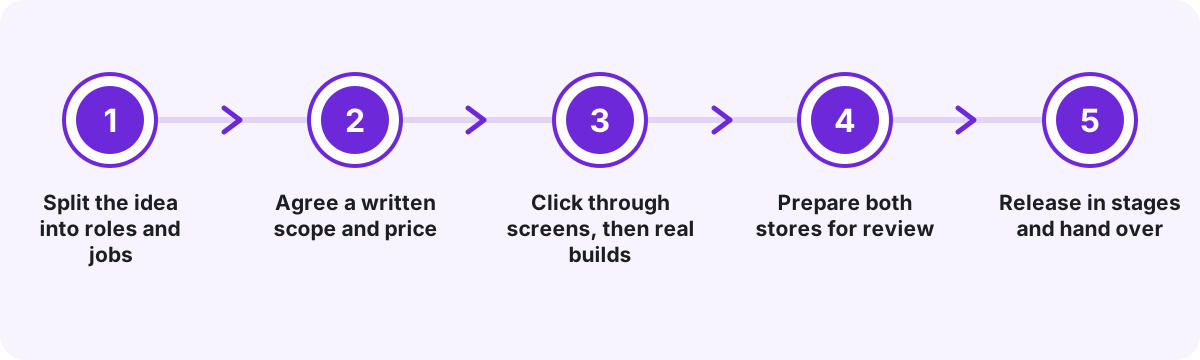
Split the idea into roles and jobs
On a call we list every type of user, the three or four things each must do on day one, and the systems the app touches. Every feature is tagged now, next or later, so version one stays honest and the conversation about money stays specific.
Agree a written scope and price
The quote names the platforms, screens, roles, integrations, schedule and payment terms, plus whose Apple and Google accounts the app ships under and how code handover works. No design work begins until you have accepted it.
Click through screens, then real builds
You approve clickable screens before engineering begins. Working builds then reach your own phones, iPhones through Apple's TestFlight and Android handsets through a Play internal test track, so feedback comes from the devices your customers carry rather than a laptop preview.
Prepare both stores for review
Listings, screenshots, Apple's App Privacy answers, Google's Data safety form, a reviewer login and in-app account deletion are made ready together. A personal Play developer account created after November 2023 also needs its closed test, a dozen opted-in testers for fourteen straight days, so that goes on the plan early.
Release in stages and hand over
After approval, the listing goes live in your company's name, ideally reaching a slice of Android users first while crash reports are watched. Three months of support follows the handover, and anything new after that is scoped as its own phase.
What have real Bengaluru app projects looked like?
Three of these are drawn from case studies published on our site and go no further than those write-ups. The fourth is an illustrative startup brief, not a named client.
A2Z WorkHub, home services across Bengaluru and Dubai
- The situation
- Maids, tutors, cleaning, repairs and care were all on offer across two cities, and the business wanted one place where a customer could browse every service, reserve a time, pay and track the professional.
- How KaamGPT fits
- An Android and iOS customer app, a mobile-first website nudging visitors to book or install, and one admin panel for bookings, professionals, services and pricing, supported by local SEO, Meta Ads, and Google Ads carrying call and WhatsApp extensions.
- What changes
- According to its case study, A2Z WorkHub now sits above JustDial in Bengaluru results for the core local home-service searches it targets, with bookings arriving straight through the app and site it owns.
FlyMyCart, a courier serving NRI families with shop-and-ship
- The situation
- NRIs abroad wanting Indian products shipped to them, and Bengaluru families sending parcels overseas, needed to see a rate, book a pickup, pay and follow the shipment from their own phones.
- How KaamGPT fits
- Two store apps, Android and iOS, where customers check rates, schedule a pickup, pay online and follow the parcel; a website built around booking, with landing pages for Bengaluru areas; and a back office for orders, pickups, rates and customers, with search, ads and social run together.
- What changes
- Its write-up records that FlyMyCart's courier and shop-and-ship orders now come in directly, through apps and a website of its own.
CloseToBuy, a Bengaluru food-delivery business
- The situation
- The business needed the full delivery journey in customers' hands: discovering restaurants, ordering, and following the order live to the door.
- How KaamGPT fits
- A customer app plus the restaurant-side and rider-side journeys, one back office where menus, restaurants, orders and deliveries are managed, and a store listing with a website designed to drive installs.
- What changes
- Its case study notes that CloseToBuy went live on Google Play, its whole journey working from placing an order to tracking it live.
Illustrative: a pre-seed tutoring marketplace in HSR Layout
- The situation
- Two founders want parents to find home tutors nearby, but building a parent app, a tutor app and payouts at once would consume most of their runway before they learn anything.
- How KaamGPT fits
- Version one is a parent app only. The founders vet and match tutors themselves through an admin panel, WhatsApp carries the confirmations, and fees are collected by payment link until volumes justify in-app checkout.
- What changes
- The founders see which subjects and neighbourhoods book repeatedly before spending on a tutor app, and they can show investors real usage instead of mock-ups.
Native, cross-platform or a progressive web app: which should you build?
The technology question comes after the scoping question, not before. Once you know what the app must do, this table settles most cases; the Android, iOS and Flutter guides go deeper on each route.
| What matters | Fully native (Swift and Kotlin) | Cross-platform (Flutter) | Progressive web app (PWA) |
|---|---|---|---|
| Codebases you maintain | Two, one per platform | One Dart codebase for both stores | One web codebase, no store build |
| Camera, Bluetooth and background location | Full first-party access on each platform | Through plugins, with a native bridge where a plugin falls short | Only what each mobile browser chooses to expose |
| Presence on the stores | Two listings, one per store build | Both listings, fed from one build | Shared as a link; no store listing by default |
| Push alerts on iPhone | Yes | Yes | Only after the user adds it to the Home Screen, on iOS 16.4 or later |
| Working with no signal | Full on-device database | Full on-device database | Possible with service workers, harder to make dependable |
| Shipping a fix | Two builds, each through its store's review | One build, then each store's review | Live the moment it is deployed |
| Build effort for both platforms | Highest: two specialised efforts | Lower: shared screens, logic and tests | Lowest, especially if a web app exists |
| Where it wins | Hardware-heavy, AR or deeply platform-styled products | Most booking, ordering, delivery and staff apps | Occasional-use tools, catalogues and internal dashboards |
The honest verdict. KaamGPT ships its own app in Flutter, with native Swift code for certain iPhone features, and that is the route we suggest for most business apps. Go fully native when the product lives on hardware, heavy graphics or platform-specific design. Pick a progressive web app when people open it occasionally and installs are not the goal. Every mobile app development company in Bangalore ought to recommend that cheaper web route in those cases; one that never does is selling rather than advising.
Which of three budgets does your app idea fall into?
Our app work is priced from ₹14,999, and that sum buys a two-platform build: iOS and Android, push alerts, the core flow usable offline, listing on the two stores and support for three months after handover, normally delivered in about ten days. Anything with its own server, an admin panel, payments or live tracking gets a written price after scoping. We publish the entry figure so founders comparing every mobile app development company in Bangalore get an early, honest signal when an idea belongs on the second or third card.
- iOS + Android
- Push notifications
- Offline support
- App store submission
- 3 months support
Focused first app
₹14,999 onwards, per project
For a first customer or staff app with one main job and a short list of screens, built without a heavy custom server.
- One brief, built for iPhone and Android
- Push notifications for the events that matter
- Core flow usable without a connection
- Apple and Google store submission
- Support for three months after handover
Connected business app
RecommendedWritten quote once scoped
Booking, ordering or service businesses whose staff need a web console and whose customers pay or get updates through the app.
- Customer app plus a web admin panel
- Roles and permissions for staff and managers
- Payment gateway in your business name
- CRM and WhatsApp updates through your KaamGPT workspace
- Crash reporting and named analytics events
Marketplace or delivery platform
Priced per phase after a discovery call
Founders building two- or three-sided products, where customers, partners and an operator each need their own surface.
- Customer app and partner app, planned as phases
- Live location and status tracking
- Split settlements through a gateway's marketplace product
- Operator console for approvals and disputes
- Release plan tied to what each phase must prove
Optional add-ons
- Website or landing page for the appA quick-loading page describing the app, with badges pointing to both store listings, built under Website Development, which opens at ₹9,999.
- Install campaigns on Google and MetaThe same team can run app campaigns on both networks. Management costs ₹4,999 per network per month, and the media spend never passes through us: you pay Google and Meta for it yourself.
- AI featuresAn assistant, natural-language search or reading of uploaded files inside the app, scoped under AI development, where projects begin at ₹49,999.
- Kannada or Hindi interfaceTranslated screens, notifications and store listings, priced separately since the work reaches every screen and listing.
- Apple bills USD 99 for every membership year of its developer programme, and Google Play's registration is a single USD 25 payment; both go from your business to Apple and Google directly, never through KaamGPT.
- Usage-based services such as maps, OTP messages and gateway fees are billed by those providers to your own accounts.
- If the app runs on your KaamGPT workspace, that subscription is separate from the build, priced ₹999–₹9,999 per month inclusive of GST, as the plans page shows.
- Apple's and Google's review periods come after the build schedule, not inside it, and larger scopes are dated separately in the quote.
Which line items should your mobile app development company in Bangalore quote separately?
Screens are the visible part of an estimate and rarely the expensive part. Cost hides in four places: the number of distinct user types, the outside systems the app exchanges data with, the tasks that must survive without signal, and anything involving money. A two-role booking app reading one calendar is a small project. The same app with partner payouts, live location and an ERP feed is a very different one, even if both show twelve screens.
The list below is the feature-by-feature view we walk through on scoping calls. None of these items is bad; each simply carries work that a one-line brief never mentions, and several carry running costs paid to someone other than the developer.
Ask for every item as a separate line, priced, with the assumption behind it written alongside. That is the fairest way to compare custom mobile app development quotes, and it lets you push expensive lines into a second release without renegotiating the whole project.
- Phone sign-in by OTP: one screen, but every SMS or WhatsApp code is billed by its provider, and resend limits must be built in
- Payments: a gateway account registered to your company, server-side order creation, webhook checks, failed-payment handling and daily reconciliation
- Live location: background-location disclosures on both stores, battery tuning, and maps usage billed per request
- In-app chat or calls: message storage, moderation, delivery receipts and a notification for every reply
- Extra roles and the admin panel: each role adds screens, permissions and tests, and the admin is usually its own web app
- Integrations with Tally exports, an ERP, a CRM or a device: effort depends on what the other system allows
- Kannada or Hindi: every label, notification, error message and store listing is translated and tested
How should a Bengaluru startup plan its first app release?
Write the one sentence the release must prove, such as "parents near HSR Layout will book a second tutoring session through an app", and cut everything that does not test it. Sign-in, the core action, a confirmation and a contact route usually make the list. Profiles, referral codes, wallets and dark mode usually do not, however often they appear in other apps' screenshots.
Manual steps behind the scenes are legitimate. Founders can match supply by hand in an admin screen, confirm by WhatsApp, collect fees by payment link and settle partners by bank transfer for the first weeks. Each manual step you survive teaches you what to automate; each one automated too early is runway spent on a guess.
Put real people on it before the public does. Apple's TestFlight allows up to 100 internal testers from your team and up to 10,000 external ones, although the first external build needs Apple's beta review. Google Play's internal testing track takes up to 100 testers. Recruit from your waitlist, watch five people use the build in person, and fix whatever confuses them.
For a pitch, a live store listing, a short recording of the real flow and usage you can explain carry more weight than another polished prototype. Name your analytics events in the scope itself; events added after launch lose the first cohort's behaviour for good.
- One sentence the release must prove, agreed before design
- One user role in version one, two at the very most
- Analytics events named and tested before the first store submission
- A written manual fallback for every step you chose not to automate
- For commerce ideas, a look at ONDC, the DPIIT-backed open network whose public beta began in Bangalore Urban district in September 2022, before building a marketplace of your own
What does an app need once it is live on both stores?
Launch day starts the maintenance bill rather than ending the project. An app worth handing over reports crashes with the app version and device model, and log a short list of named events: signed up, finished the core action, came back. Without those, a falling rating is a mystery and every feature request is a guess.
Apple and Google raise the floor every year. Since 28 April 2026, Apple has refused App Store Connect uploads not compiled with Xcode 26 and its iOS 26 SDK. On Google Play, from 31 August 2026 every new app and update has to target API level 36 (Android 16), with an extension to 1 November 2026 on request; and once February 2027 begins, updates aimed at Android 15 or above must cope with 16 KB memory pages.
Store policy moves as well. Both stores require apps that allow account creation to offer account deletion, and Google also asks for a deletion-request link that works outside the app. Privacy answers need updating whenever a new SDK starts collecting data, and the Rules made under the DPDP Act in November 2025 phase in most business duties over eighteen months.
A sensible rhythm is a small fix release every few weeks, a feature release each quarter, and a test pass on every new iOS and Android beta before it reaches customers' phones. When the app shares its backend with your KaamGPT workspace, leads, orders and WhatsApp updates keep flowing through the same CRM and the same official WhatsApp connection, on Meta's Cloud API, that your team already uses.
- Crash reports grouped by build number and reviewed after each release
- Store ratings, and the actual words in one-star reviews
- How many new users finish the core action in their first session
- Notification opt-ins by the screen where permission was asked
- The requirement pages Apple and Google publish, read every quarter
Why does it matter that KaamGPT runs an app of its own?
Our own app lives on both stores
The KaamGPT app is published as "KaamGPT Marketing Agency" on the App Store and "KaamGPT - Digital Marketing" on Google Play, and every business app in the KaamGPT workspace opens inside it as a native screen. Every release decision we advise on, we have had to make for ourselves.
App Review handled first-hand
We took that app through Apple's review ourselves. The submission covered deleting an account from inside the app, a reviewer login accompanied by notes, a screen-recorded walkthrough, and purchase flows kept within Apple's rules. Treat that as experience to draw on for your submission, never as a promise that a reviewer will approve it.
Native code where Flutter stops
The app is Flutter on both platforms, with native Swift code on iPhone for the phone features that needed it. We plan that kind of bridge in the scope rather than discovering it in week three.
A backend already carrying real businesses
The same team runs a Python FastAPI service on PostgreSQL with background workers for queues, WhatsApp messaging on Meta's official Cloud API, and online payments through Cashfree and Razorpay for its own subscriptions. Your app's server is built with those habits.
Client apps you can open today
A2Z WorkHub, FlyMyCart and CloseToBuy are written up on our work page with what was built and what is published about the outcome. Ask on the call which parts of those builds resemble yours.
Launch marketing from the same desk
The apps above were launched alongside SEO, paid search, paid social, WhatsApp and email handled by the same company, so the store listing, the landing page and the install campaigns are planned together instead of being passed between vendors.
Which kinds of Bengaluru business should seriously consider an app?
- Home servicesSlot booking, professional assignment and job status for cleaning, repair and care companies spread across many neighbourhoods.
- Courier, cargo and shop-and-shipInstant rates, pickup requests, payment and shipment status for doorstep and international couriers.
- Cloud kitchens and groceryMenus, carts, store consoles and live order tracking for cloud kitchens and neighbourhood stores selling direct.
- Clinics and diagnosticsAppointment requests, report alerts and visit reminders that collect only the patient data the service needs.
- Coaching and edtechBatch schedules, attendance notices, fee reminders and recorded-class access for students who check their phones long before their email.
- Co-living, PGs and real estateTenant complaints with photos, rent reminders and site-visit booking for operators managing several buildings.
- Manufacturing and distributionDealer ordering, field-sales visit logs and dispatch updates for units around Peenya and the industrial belts.
- Fitness and wellnessClass booking, membership status and trainer schedules for studios whose members expect to book from the phone.
How does building for Bengaluru users change an app?
Customers here expect to pay by UPI, hear back on WhatsApp and read in the language they choose, which may be Kannada, English or Hindi, and often Tamil or Telugu, depending on the area and the audience. An app tested only in English over a Koramangala office connection can look finished and still let down a delivery partner riding from Yelahanka to Electronic City through patchy coverage and heavy traffic.
Buyers differ by neighbourhood too. Founders around HSR Layout, Indiranagar and Koramangala tend to want investor-ready first releases; firms near Whitefield, Marathahalli and Manyata Tech Park often ask for staff and companion apps; family businesses in Jayanagar, Malleshwaram and around Peenya want customers or dealers ordering without phone calls. The right mobile app development company in Bangalore picks up those differences on the first call and scopes for them.
KaamGPT works out of one Bengaluru office and serves clients across the city and beyond remotely: scoping happens over video, feedback arrives on WhatsApp, and each test build lands on the client's own phones. Area guides such as app development in Whitefield and app development in Electronic City cover the briefs that are typical in those parts of the city.
How does KaamGPT compare with a freelancer or a large agency?
App development in Bengaluru three ways. KaamGPT’s column is from its published price list; the others describe how those arrangements usually work.
| What you get | KaamGPT | A freelancer | A large agency |
|---|---|---|---|
| Starting price | From ₹14,999 per project, as published | Quoted per job | Quoted after a proposal, often as a monthly retainer |
| What is included | iOS + Android; Push notifications; Offline support; App store submission | Whatever one person covers | Set out in the proposal |
| First delivery | Typically 10 days | Agreed per job | Set in the proposal |
| Price agreed | Written quote with scope and price before work starts | Ask for it in writing | In the signed proposal |
| Who you talk to | A Bengaluru team by call, WhatsApp or online meeting · +91 79767 82366 | The freelancer directly | Usually an account manager |
What does Indian law require of a business that holds customer data?
A Data Fiduciary shall protect personal data in its possession or under its control, including in respect of any processing undertaken by it or on its behalf by a Data Processor, by taking reasonable security safeguards to prevent personal data breach.
Where this applies around Bengaluru, Karnataka
- Bengaluru
- Jayanagar
- Whitefield
- HSR Layout
- Koramangala
- Indiranagar
- Electronic City
- Yelahanka
- Karnataka
- India
Frequently asked questions
30 answersWhat kinds of apps do Bengaluru businesses most often ask KaamGPT to build?
Requests tend to fall into eight groups: booking apps for home services, clinics and tutors; ordering apps with live tracking; quote, pickup and shipment apps for couriers; two-sided marketplaces; field and staff apps; loyalty apps; first releases for startups; and companion apps for software that began in the browser. Our published work includes a home-services app, a courier app and a food-delivery app, and each brief type shifts the user roles, the backend and the budget in its own way.
How much app can ₹14,999 realistically buy?
Enough for an app with one main job and a short screen list: iPhone and Android builds, push notifications, the core flow working offline, submission to both stores with a three-month support window after it, typically in around ten days. It does not stretch to a separate server with an admin panel, a payment gateway, a moving map or several user roles; those get a written price once scoping is done, as the <a href="/services/app-development">App Development listing</a> explains.
Which features push an app quote furthest beyond the entry price?
Usually live location tracking, marketplace payouts and a second or third user role, because each brings its own app surface, server logic and testing. In-app chat, links to an ERP or accounting system, and full Kannada or Hindi translation come next. Request each one as a separately priced line, then decide which genuinely belong in the first release and which can wait for real usage data.
Is Flutter good enough for a serious business app, or should we insist on native?
For most booking, ordering, delivery and staff apps, Flutter is a sound choice: one codebase, matching behaviour on both stores, and cheaper changes later. KaamGPT ships its own app on it, with native Swift on iPhone for some phone features. Products built around Bluetooth hardware, AR or heavy graphics can justify fully native work, and the scoping call should say so. The <a href="/flutter-app-development-company-in-bangalore">Flutter guide</a> compares the routes in depth.
Could a progressive web app do the job instead of a store app?
Sometimes, yes. If customers open the tool occasionally, deep phone hardware is not needed and installs are not the point, a PWA costs less and updates instantly. On iPhone, though, web push works only after the user adds the site to the Home Screen on iOS 16.4 or later, and there is no store listing to be found in. Wrapping a website in an app shell is different again: Apple's guideline 4.2 turns away apps that are little more than a repackaged website.
How many weeks separate a first conversation from a public launch?
The starting scope typically needs about ten days of building, counted from the day the written quote is signed. Add time for screen approval at the start and for store review at the end, which Apple and Google control and which runs long when a build is sent back, plus fourteen days of closed testing on a personal Play account created after November 2023. Business apps and marketplaces are given separate dates in their quotes, often split into phases so something useful ships early.
As a first-time founder, how do I stop my MVP budget from running away?
Fix the one thing the release must prove, keep a single user role, and run the rest by hand: matching, payouts and support can live in an admin screen and on WhatsApp for the first weeks. Ask for every feature as a priced line so lines can move to version two without reopening the whole deal. Scoping this way ships sooner and keeps money aside for reaching users, which is where many first releases struggle.
Can investors or pilot customers try the app before it reaches the stores?
Yes. On iPhone, TestFlight lets you invite up to 100 people from your own team and as many as 10,000 outside testers by email or public link, once Apple has approved the first beta build. On Android, a Play internal testing track takes up to 100 testers. Everyone installs the genuine build on a personal phone, which makes a far stronger demonstration than a clickable prototype on a laptop screen.
Whose name should appear as the seller on our App Store and Play listings?
Your business's. Whichever mobile app development company in Bangalore you hire, enrol in the Apple Developer Program and open the Google Play developer account in the company's name, then add the developers as team members. The listing, its ratings and its install history then remain the business's property if the vendor changes. Organisation accounts on both stores ask for proof of the business, so start enrolment in week one rather than the last week.
What do we receive at handover besides the published app?
Source-code ownership and handover terms appear in the quote itself, so before work begins you know exactly what you will hold. Items worth asking any vendor to list explicitly: the code repository, custody of the signing keys, server and environment access, store listing access, and short notes on how to build and release a new version. Recovering any of these after a falling-out is slow, and sometimes impossible.
Does every app need an admin panel, and what goes in one?
Most apps that handle bookings, orders or partners do, because somebody has to approve, edit, assign and settle things. An admin panel is usually a separate web app, the kind of build our <a href="/software-development-company-in-bangalore">custom software team</a> scopes, with its own logins and roles covering orders and their status, customers, partners, prices, payouts and reports. A simple staff app that only feeds an existing system may not need one. The panel is scoped alongside the backend, not inside the entry price.
Can app sign-ups land straight in our CRM and trigger WhatsApp confirmations?
Yes, when the app's backend is shared with your KaamGPT workspace. New sign-ups and enquiries can be written into the workspace <a href="/tools/crm">CRM</a>, and confirmations, reminders or order updates can be sent from your business's WhatsApp number through the official Cloud API from Meta. Message charges and the workspace plan apply separately, and the connection is planned in the quote so your team sees app leads beside every other lead.
Which payment rules apply if the app sells a service rather than a digital membership?
Apple draws the line by what is bought. For physical goods and for services used outside the app, such as a cleaning visit, a courier pickup or a meal, Apple requires payment to be taken outside its in-app purchase system, so a UPI or card gateway in your business name is normal. Unlocking content or features inside the app, digital subscriptions included, must use Apple's in-app purchase, which changes your pricing. Google Play's own rules on digital goods are checked at scoping too.
Can customers watch a rider or technician approaching on a map?
Yes, and <a href="/works/closetobuy-food-delivery-app-development">CloseToBuy's published case study</a> covers an order followed live up to the customer's door. It is priced separately because the partner's phone has to report its position while the app is in the background, which both stores make you disclose and justify; battery use needs tuning; and map views are billed by the maps provider. Status-only tracking, such as picked up and out for delivery, costs far less and is often enough for a first release.
Can our customers switch the app to Kannada?
Yes. Kannada, Hindi or another Indian language can be added to every label, notification, error message and both store listings, with a language switch that remembers each person's choice. It carries its own price because every screen, message and listing changes and a second set of text needs checking. Customer apps here often launch in English and Kannada together, while a staff app may need Hindi or Tamil for the people really using it.
What will Apple and Google charge us, separate from the build?
Apple's developer membership is USD 99 for each membership year, and Google Play asks a one-time USD 25 registration fee; your business pays both directly. On top come usage costs from the services the app relies on, such as maps requests, SMS or WhatsApp messages and the payment gateway's per-transaction fees. Apple and Google also take a commission on digital goods sold inside apps, which matters if you plan paid subscriptions.
What usually trips up a first App Store or Play Store review?
The repeat offenders are predictable: no working demo login, or a backend switched off while the reviewer looks; missing in-app account deletion; a privacy policy or data-safety answers that do not match what the app collects; an app that is mostly a website; and, on Android, a target API level below Google's current floor. None is hard to fix, and all of them are cheaper to prevent than to argue over after a rejection.
Why does an app need paid work every year even without new features?
Because the platforms keep moving. Apple now accepts only uploads built with Xcode 26 and the iOS 26 SDK; on Google Play, every new app or update submitted from 31 August 2026 must target Android 16; and from February 2027, Android updates aimed at Android 15 or above must handle 16 KB memory pages. Libraries age, payment and maps SDKs change, and store policies tighten. Agree a few maintenance releases a year with your mobile app development company in Bangalore before launch, not after.
How will we know if people are really using the app after launch?
Through analytics events named in the scope, not download counts. Track sign-ups, the core action, repeat use in the second and fourth week, and the screen where people give up; pair that with crash reports per app version and the words in store reviews. A monthly look at those signals tells you whether to fix, simplify or build the next feature, and keeps second-phase spending tied to evidence.
Our previous developer disappeared halfway; can you finish an unfinished app?
Possibly. That turns on what you still control: the source code, the Apple and Google accounts, the server and database, and any keys used to sign earlier builds. We review what exists first, and the quote then says plainly whether finishing the current code or rebuilding the weak parts costs less. Where a store listing already exists, publishing under it keeps the reviews and installs it has earned.
Will KaamGPT write our app in React Native if we ask?
No. KaamGPT builds cross-platform apps in Flutter, the framework its own app runs on, adding native platform code where a feature needs it. React Native is a capable framework with a large community, and if your existing codebase already uses it, a team specialising in it may serve you better. For a new build, our Flutter guide sets out the trade-offs between Flutter, React Native and fully native development neutrally.
When is a website enough for a single clinic or shop, and when is an app worth building?
A website often covers the first stage. An app pays its way when customers come back frequently, when alerts they must not miss matter, or when the job needs the camera, location or offline use. A single clinic may do better with online booking on a fast site, while a chain with repeat patients is a different case. Our sibling page on <a href="/website-development-company-in-bangalore">building a business website in Bangalore</a> covers that route.
How should we compare proposals from different app developers in Bangalore?
Lay every proposal side by side on one list: user roles, screens, backend and admin panel, integrations, payments, offline behaviour, store submission, account ownership, code handover, support length and what counts as a change request. A bid that leaves a line blank is cheaper only until that line is needed. Ask every mobile app development company in Bangalore you are weighing up to show an app of theirs live in both stores, and to name what it would leave out of version one.
Can founders based in Dubai, the US or elsewhere in India hire you for an app?
Yes. Projects run over video calls, WhatsApp threads and shared test builds, so location changes little except meeting times. A2Z WorkHub, one of our published app projects, serves customers in both Bengaluru and Dubai. Businesses abroad should decide early which countries their store listings will target, how payments in other currencies will be collected, and which privacy laws apply to their users there.
How do I get my app idea in front of KaamGPT's team?
Your first step can be a WhatsApp message or a call to +91 79767 82366 saying who the app serves and the first thing those people must be able to do; the callback form in the <a href="/services">services catalogue</a> works too. Enquiring costs nothing. A scoping call comes before any quote, and you leave it with a sharper brief whether or not you go on to build with us.
Can an AI assistant or smart search be added to the app later?
Yes, and adding it later is often wiser than launching with it. An assistant that answers questions, search that understands plain language, or reading of uploaded documents is scoped as an AI development project (those start at ₹49,999), and the app calls it like any other service. Keeping it in a separate quote makes model usage costs visible and lets you test whether users actually want it.
Which DPDP Act duties apply to the customer data our app collects?
The DPDP Act, India's 2023 law on digital personal data, covers the personal data that businesses here collect, and its Rules, notified in November 2025, bring most duties into force in phases over eighteen months. In practice: gather only the data the service truly requires, explain why in a clear notice, take consent where it is needed, secure what you store, and give people a way to have it erased. Designing for this now costs less than retrofitting it later.
What should a founder have ready for the first scoping conversation?
Bring constraints rather than designs: a budget ceiling, any date the launch is tied to, who will run the app day to day once it is live, and the one outcome version one must prove. A rough list of user types and the systems involved, such as a payment gateway or an existing database, makes that first call a working session rather than an introduction.
Can the same team market the app once it is in the stores?
Yes. For the apps in our case studies, the company that built them also ran SEO, paid search, paid social and WhatsApp messaging. The management fee for <a href="/best-google-ads-agency-in-bengaluru">Google Ads campaigns</a> around a launch is ₹4,999 a month, matching Meta Ads, and the ad spend goes from you to each platform; the website team can also build the app a landing page. Plan the launch budget in the same conversation as the build.
What signs show an app studio suits a small first project?
Look for four things: a clearly stated starting price, a written scope before any payment, apps they have built that you can install from both stores today, and a plain answer about who owns the accounts and code afterwards. KaamGPT meets those for focused first apps. If the product needs a big engineering team over many months, or regulated lending features, a larger firm is the better fit, and we would say so.