 KaamGPT
Before hiring an Android app development company in Bangalore, find out whether it understands the handsets your customers actually hold. For a great many Bengaluru businesses those are Android phones at every price point, plenty of them entry-level models with little memory, nearly full storage and a maker's battery manager that closes apps in the background. KaamGPT's Android projects open at ₹14,999, with an iPhone build riding along in the same listed scope, and the team treats Google Play's paperwork as part of the engineering rather than an afterthought.
This page is the Android-specific view: developer account types, the closed test Google demands of new personal accounts, target API deadlines, the Data safety form, OTP and UPI flows that pass Play policy, and the Kotlin-or-Flutter decision. For the wider picture across both platforms, read the guide to mobile app development in Bangalore; for Apple's review rules, see the iPhone app development guide. Prices and inclusions for every engagement sit on KaamGPT's App Development offer.
- ₹14,999opening price of a project, Android and iPhone builds together
- ~10 daysof build for the listed scope, before Google's testing and review
- US$25Google Play's one-time registration fee, paid by your business to Google
- 3 monthsof support after launch, with its scope written into the quote
How do Bengaluru's Android users shape the way an app is built?
Bengaluru's buyers are not one audience. A retailer ordering stock from Chickpet, a lathe operator in Peenya and a software engineer in Electronic City may all use Android, yet on very different phones, data plans and reading languages. Apps for trade customers here should assume an entry-level, low-RAM handset with little free storage and, often, Kannada as the comfortable reading language, then treat the newest flagship as the easy case. That is the reverse of how most apps get tested.
Movement shapes the build as well. Field staff cross the city between Yeshwanthpur, Whitefield and Marathahalli on two-wheelers and drop signal inside buildings, so an app that queues work and syncs later beats one that spins. Customers in HSR Layout, Koramangala and Jayanagar expect dispatch alerts as notifications and links shared on WhatsApp to open the right screen. Ask every Android app development company in Bangalore you are weighing how its app behaves in each of those moments.
For neighbourhood detail, our area guides cover app projects around Whitefield, apps for Electronic City firms and Yeshwanthpur businesses going mobile. Every one of them is served from the same Bengaluru office, over calls and test builds.
- Starting price
- ₹14,999 floor per project, covering an Android and an iPhone build
- Build time
- Roughly ten days of build for the listed scope; Google's testing and review add time
- Google Play fee
- US$25, paid once by the business to Google when registering
- New personal accounts
- A closed test with 12 or more opted-in testers for 14 consecutive days before production access
- Target API rule
- Android 16 (API level 36) is the minimum target for new apps and updates since 31 August 2026
- Support window
- Three months from launch, its scope defined in the quote
Why do Android apps that run well on the developer's phone break on customers' phones?
Most Android apps are tried on whatever handset the developer carries, usually a recent flagship. Customers in Bengaluru carry a far wider spread: entry-level devices with 2 GB or 3 GB of memory, phones several Android versions behind, and models whose manufacturer layers its own battery manager on top of Google's rules. An app that never ran on those phones launches with faults nobody saw in testing: a cold start that drags, a checkout screen wiped when the system reclaims memory, an order alert that simply never shows up.
The second trap is Google Play itself. A business hiring an Android app development company in Bangalore for the first time rarely knows that a fresh personal developer account cannot publish to production until a closed test has run, that every listed app files a Data safety form and a financial features declaration, or that an app aimed at an old API level stops reaching new users on newer phones. Each of these turns a finished build into weeks of waiting when nobody planned for it.
- OTP sign-in built on the READ_SMS permission, which Google Play's SMS policy lists as an invalid reason for that access.
- A UPI pay button that finds no payment apps on Android 11 and later, because the manifest never declared which apps it needs to see.
- Order updates that stay silent because notifications start switched off for new installs on Android 13, and the app never asked at a sensible moment.
- A personal developer account opened for a clinic or a lender, when Google insists on an organisation account for health and financial apps.
- An update pushed to every user at once, with no staged rollout to halt when crash reports start climbing.
Which Android apps suit Bengaluru trades, and what changes once they ship?
Three illustrative briefs modelled on enquiries we typically get, plus one published KaamGPT project. No invented names, numbers or results.
A wholesale textile trader in Chickpet supplying retailers across Karnataka
- The situation
- Retailers from Tumakuru, Mysuru and Hubballi place orders by phone call and WhatsApp photo, often from entry-level Android handsets. Catalogue PDFs are too heavy to open on weak data, orders get misread, and payment proof arrives as screenshots that staff match by hand every evening.
- How KaamGPT fits
- A Kannada and English ordering app with a light catalogue that loads thumbnails first, carts that survive the system closing the app, UPI payment through the retailer's own UPI app, and an order-status alert requested right after the first order is placed.
- What changes
- Orders arrive as clean line items instead of voice notes, payments match against order numbers, and counter staff stop retyping WhatsApp messages.
A CNC machine maintenance firm in Peenya with technicians on company Android phones
- The situation
- Breakdown calls come in from factories across the industrial area. Technicians write service reports on paper, photos sit in personal galleries, and the office learns a job is closed only when someone rings in.
- How KaamGPT fits
- A staff-only app distributed privately to the company's own phones, with each day's jobs cached for dead spots inside sheds, photos taken through the camera rather than broad gallery access, and a foreground service running only while a visit is being logged.
- What changes
- Service reports reach the office complete, photos attach to the right job, and supervisors see open breakdowns without phoning each technician.
A diagnostic lab offering home sample collection around HSR Layout and Bellandur
- The situation
- Patients book collection slots by phone, reports go out as email attachments that older parents seldom open, and the owner was about to register a personal Play account for an app holding health information.
- How KaamGPT fits
- The developer account is opened as an organisation using the lab's D-U-N-S number, as Google requires for health apps. The app books collection slots, shows reports behind a login, and declares health data accurately in the Data safety form.
- What changes
- Patients find slots and reports in one place, and the listing sits under the lab's registered organisation rather than one person's name.
CloseToBuy, a Bengaluru food-delivery business (published KaamGPT project)
- The situation
- CloseToBuy needed customers to discover restaurants, order and follow each order live to the door, on Android, on iOS and on the web, with one back office covering restaurants, menus, orders and deliveries.
- How KaamGPT fits
- The KaamGPT team delivered the customer app, the restaurant and delivery flows, the admin panel plus an install-driving website, then prepared the store listing. The CloseToBuy case study lists every deliverable.
- What changes
- CloseToBuy went live on the Play Store carrying the full ordering and live-tracking journey.
What does KaamGPT build into an Android app before it reaches Google Play?
Eight pieces of Android-specific engineering that you should expect any Android app development company in Bangalore to demonstrate, each tied to a platform rule or to a phone your customers genuinely use.
Testing on the phones your buyers own
Before designs are signed off, we ask which handsets your customers and staff use, then test on a spread that includes an entry-level phone with little memory and an older Android release, not just a current flagship. Play Console's pre-launch report adds an automatic crawl on Google's lab devices when a build is uploaded, capacity permitting, surfacing crashes, accessibility gaps and layout breaks on screens we do not own. Image sizes, list lengths and startup work are tuned for the slowest phone on your list.
OTP that fills itself, without SMS access
Google Play does not accept broad SMS permissions for account verification, so one-time codes are read through Google's SMS Retriever API, which needs no extra permission at all. Your server sends a message of no more than 140 bytes carrying an 11-character hash built from the package name and the signing certificate. Under Play App Signing, Google re-signs store builds, so the hash must come from Google's certificate; computing it from the upload key quietly breaks auto-fill in production.
UPI checkout through the customer's own app
For orders and bookings, a gateway merchant account held by your business hands the payment to whichever UPI app the customer prefers, using an Android intent. Apps targeting Android 11 or later can only see the installed apps they declare, so the manifest lists the UPI intent inside a queries element. Play's payments policy keeps tangible goods and in-person services like food delivery or cleaning outside Google's billing system, which is why a gateway fits. Gateway work is quoted whenever an app needs it.
Notifications that outlast battery savers
On Android 13 and later, a fresh install starts with notifications off until the user grants the POST_NOTIFICATIONS permission, so the request appears at a moment that explains itself, such as straight after the first order. Delivery runs through Firebase Cloud Messaging, with user-visible alerts sent as the message type Android delivers even in Doze. Each kind of alert gets its own notification channel, letting customers mute promotions without losing dispatch updates.
WhatsApp links that open the right screen
Many Bengaluru customers first meet your link inside a WhatsApp chat. With Android App Links, a link to your website's product, order or booking page opens the matching screen in the app directly, skipping the 'open with' chooser, once a small verification file is published at /.well-known/assetlinks.json on your domain. People who have not installed the app land on the web page or the Play listing instead of an error.
A Play Console account that stays yours
The developer account is registered to your business, as an organisation account with a D-U-N-S number wherever Google requires one, and KaamGPT is invited as a user with only the permissions releases need. Builds go up as Android App Bundles under Play App Signing: Google holds the app signing key, your business keeps the upload key, and Play Console can reset that upload key if it is ever lost.
Declarations filed before review starts
Every listed app needs a Data safety form that covers data gathered by third-party SDKs as well as your own code, a privacy policy link, a financial features declaration even if the truthful reply is none, content rating answers and, if people can create accounts, both an in-app deletion path and a web page where deletion can be requested. We draft these from the actual build, not a template, so the listing and the app say the same thing.
Staged releases watched through Android vitals
Updates go out by staged rollout: a slice of users first, widened by hand while the numbers stay clean. If a release misbehaves, the rollout is halted so nobody else receives it, and a corrected release follows. Android vitals tracks user-perceived crash and ANR rates, and Google says an app above its bad-behaviour thresholds may lose visibility on Play or carry a warning on its listing, so those figures are read after every release.
What does an Android app cost with KaamGPT, and which costs go to Google or others?
Every KaamGPT app project starts from one published floor of ₹14,999, normally a build of around ten days, and that figure already covers an iPhone build next to the Android one. What lifts a quote is Android work beyond that scope, such as an admin panel and the server behind it, gateway-based UPI checkout, Kannada screens or a staff app talking to printers. Fees Google charges, and time Google takes, are listed separately below so none of it hides inside the price.
- iOS + Android
- Push notifications
- Offline support
- App store submission
- 3 months support
Android-first launch app
From ₹14,999 a project
A business whose customers mostly carry Android phones and who wants one focused app on Google Play, plus the iPhone build produced in the same project.
- Android build released on Google Play first
- iPhone build from the same project scope
- Push alerts with an in-context permission request
- Offline handling of the main task
- Play submission with Data safety and declarations
- 3 months of support after launch
Business Android app with a backend
RecommendedQuoted in writing once scoping is done
Distributors, labs, delivery and service firms that need customer accounts, an admin panel, payments, and order or job status flowing back to staff.
- Admin panel for orders, users and content
- UPI checkout through a gateway in your name
- OTP sign-in through the SMS Retriever API
- Android App Links from WhatsApp and the web
- Kannada and English interface
Staff and field device app
Priced once we have mapped the workflow
Teams that hand Android phones to technicians, salesmen or delivery staff and want the app distributed only to them, never listed for the public.
- Private distribution to company phones
- Job lists cached for sites with no signal
- Camera capture without broad gallery access
- Location used only while a visit is active
- Bluetooth printer or scanner support where needed
Optional add-ons
- Website alongside the appA fast site whose pages your App Links point to, scoped through KaamGPT's website development, with sites from ₹9,999.
- Promotion for the Play listingGoogle Ads management, starting at ₹4,999 monthly, to drive installs; the media budget itself is billed by Google to your own ads account, separate from KaamGPT's fee.
- AI features inside the appAn assistant, document reading or request sorting, scoped under AI development for Bengaluru businesses, which starts at ₹49,999 per project.
- Google Play's US$25 registration is a one-time charge your business pays to Google directly, and Dun & Bradstreet issues D-U-N-S numbers without charging for them.
- The ten-day figure covers building the starting scope. A 14-day closed test on a new personal account, the production-access application and Play's own app review all add calendar time on top.
- Payment gateway charges, and the SMS provider's fees for OTP messages, are billed to you by those companies. In India, business SMS goes out under a sender and template registered on TRAI's DLT system, and that template has to carry the app hash line.
- Source-code handover, and which signing keys each side holds, are spelled out in the signed quote.
What are the steps between a first phone call and a production release on Play?
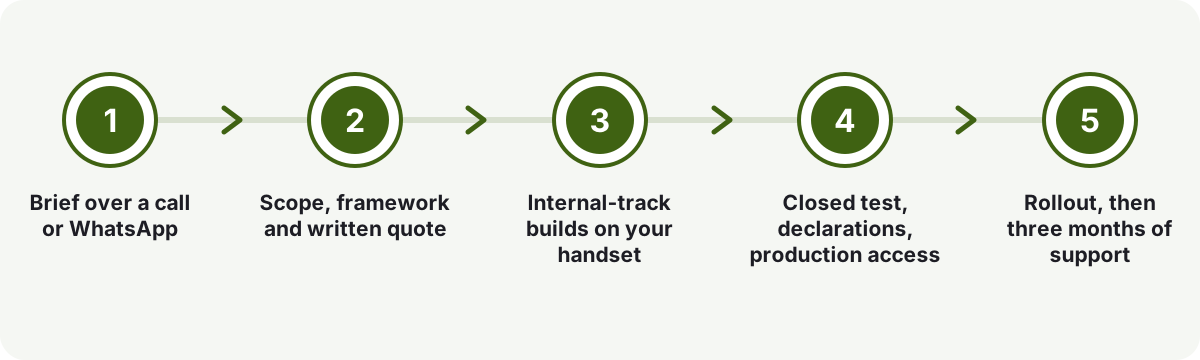
Brief over a call or WhatsApp
Describe the app's job and the people it serves. Three Android questions come up early: which phones your users carry, whether your business already holds a Google Play developer account, and whether the app touches money, health records or SMS, because each one changes the account type or the declarations Google expects.
Scope, framework and written quote
The quote names every screen, the Android features involved (notifications, UPI, OTP, camera, location), which Android-only parts need Kotlin platform code, which store goes live first, and in whose name the developer accounts and source code sit. Nothing starts until you accept it.
Internal-track builds on your handset
Builds land on Play's internal testing track, which takes up to 100 testers and usually makes a fresh upload available within minutes. You and your staff install from a Play Store link, exactly as customers will, and each remark is tied to the screen in question.
Closed test, declarations, production access
A personal account opened after 13 November 2023 must keep a dozen or more testers enrolled in a closed test for 14 unbroken days, then an application for production access, which Google says it usually answers within seven days. Organisation accounts are not subject to that test. Data safety and the other App content forms are filed alongside.
Rollout, then three months of support
The first public release reaches everyone; later updates use staged rollouts. Across the three-month support window we read Android vitals and new reviews, fix what the quote covers, and flag Play policy or target API changes that call for a fresh build.
Kotlin, Flutter or a mobile website: what should an Android app development company in Bangalore recommend?
Three honest routes for an Android-first business, compared on what decides cost, reach and long-term upkeep. The right one depends on your customers, not on the developer's habits.
| What matters | Kotlin native Android app | Flutter app for Android and iPhone | Mobile website, no store app |
|---|---|---|---|
| Wins when | The product lives only on Android and needs deep platform access | Customers are split between Android and iPhone | Customers buy rarely and will not install anything |
| Interface toolkit | Jetpack Compose, Google's Kotlin-only UI toolkit | Widgets drawn by Flutter's own rendering engine | HTML and CSS inside the phone's browser |
| iPhone version | A separate Swift build that the quote must cover | Same Dart codebase, inside the starting scope | Opens in Safari with no extra build |
| Widgets, foreground services, Bluetooth printers | Direct access through Android APIs | Through Kotlin platform code called from Dart | Mostly out of reach |
| Install size on entry-level phones | Smallest, with no bundled engine | Larger baseline, because the engine ships inside | Nothing to install |
| Google Play 16 KB page rule | Kotlin-only code already complies | Needs a current Flutter release, since the engine is native code | Does not apply |
| Store paperwork | Full Play Console work: listing, declarations, tracks | Play Console plus Apple's App Review | None; search engines do the finding |
| Alerts and offline use | Full notification channels and background sync | Full, through plugins and platform code | Web push in Chrome; offline needs a service worker |
The honest verdict. No single route suits every brief. Kotlin wins for an Android-only operations tool that leans on printers, background services or home-screen widgets. Flutter wins when the same app must reach iPhone owners too, which is why KaamGPT's own app, listed on both Google Play and Apple's store, is built in it. A plain mobile website wins when customers order twice a year. Whoever you hire as your Android app development company in Bangalore must be able to say which route fits your customers, and why the other two do not.
What does Google Play Console ask of a new business before the first release?
Start with the account type, because it is awkward to unwind later. Google offers personal accounts for individuals and organisation accounts for businesses, and it requires the organisation type for apps that offer financial products or services, health apps, VPN apps and government apps. An organisation account needs a D-U-N-S number, which Dun & Bradstreet issues at no charge; Google's own help page warns about third parties charging high fees to arrange one. Registration costs US$25 once, and identity checks may ask for a government ID and a card in the same legal name.
Personal accounts carry two extra gates. The owner must verify access to a real Android device through the Play Console mobile app, and any personal account registered after 13 November 2023 must hold a closed test of 12 or more opted-in testers lasting 14 consecutive days before production unlocks. The application that follows asks how testers were recruited, how engaged they were, what changed because of their feedback, and how many installs you expect in the first year.
Then comes the App content page: privacy policy, Data safety form, financial features declaration, content rating questionnaire, target audience, an ads declaration and, when users can sign up, an account-deletion web link that names the app or developer as the listing does. Every app on a closed, open or production track files the Data safety form, even one that collects nothing, and the answers must include whatever your third-party SDKs send off the phone. Only builds that never leave the internal testing track are exempt.
- Settle personal or organisation before paying the US$25
- Request a D-U-N-S number directly from Dun & Bradstreet if Google needs one
- Recruit 12 or more real testers before the closed test begins
- List every SDK's data collection before you fill in the Data safety form
- Publish the account-deletion web page before you submit
Should an Android-first product be written in Kotlin or in Flutter?
Google has described Android development as Kotlin-first since I/O 2019, and in practice new Jetpack libraries, samples and documentation assume Kotlin. Jetpack Compose, the current Android UI toolkit, is Kotlin-only, while existing Java code still runs and interoperates. Kotlin app development is the natural pick when the product will only ever live on Android and leans on the platform: foreground services for live trips, home-screen widgets, Bluetooth thermal printers at a billing counter, Wear OS, Android Auto or accessibility services.
Flutter is the better bet once iPhone users matter as well. One Dart codebase draws the same interface on both platforms, so a fix reaches both stores together, and Android-only needs are met with small pieces of Kotlin platform code called from Dart. KaamGPT's own app, called KaamGPT - Digital Marketing on Google Play and KaamGPT Marketing Agency on Apple's store, is a Flutter build, with the KaamGPT workspace's apps running as native screens within it.
Two Android costs belong in the decision. A Flutter app carries its rendering engine, so its smallest download is bigger than an equivalent Kotlin app's, which matters to customers whose entry-level phones are already full. And because that engine is native code, Flutter apps fall under Google Play's 16 KB memory page rule: apps targeting Android 15 or later must support 16 KB pages on 64-bit devices, and updates lacking that support are blocked from 1 February 2027. Apps written purely in Kotlin or Java already comply.
- Android only, heavy hardware or background work: Kotlin with Jetpack Compose
- Android and iPhone on one shared roadmap: Flutter
- A working Java app: move to Kotlin screen by screen, not in one rewrite
- Any app bundling native libraries: confirm 16 KB support well before February 2027
How does a Play Store listing get approved, found and well reviewed?
The play store listing has hard limits: an app name of 30 characters, a short description of 80 and a full description of 4,000. Google's metadata policy bars emojis, repeated special characters and ALL CAPS in the title, icon or developer name, along with ranking claims such as '#1' or 'Popular' and promotional lines about discounts. Unattributed testimonials in the description are out too. Write the short description as the single sentence a shopkeeper in Rajajinagar would use to explain the app to a friend.
Most rejections we prepare for are permission problems rather than design problems. Google's SMS policy names broad SMS access for account verification as an invalid use and points developers to alternatives such as the SMS Retriever API. Since 28 May 2025, apps without a core need for broad photo access must rely on the Android photo picker instead of READ_MEDIA_IMAGES. Payments for tangible products and in-person services stay outside Play's billing system, while digital content sold inside the app must go through it.
Ratings depend on when you ask. Google's In-App Review API shows the rating card inside the app, but it enforces a quota Google does not publish, so the call follows a success moment, such as a delivered order, and never sits behind a 'Rate us' button that may show nothing. Google also tells developers not to ask 'Do you like the app?' first. Reply to reviews from Play Console, and watch Android vitals, because crash and ANR rates above Google's thresholds can cost visibility.
- A title within 30 characters, leading with the business name
- Screenshots of real screens, in the language customers read
- Permission declarations filed for every sensitive permission requested
- Review prompts triggered by success, never by a button
- A weekly look at crash and ANR clusters by phone model
Where in Bengaluru's economy does an Android-only app pay off?
- Wholesale and distributionRetailer ordering on entry-level phones, with thumbnails loaded first, carts that persist and UPI payment matched to each order number.
- Industrial and machine servicesTechnician apps for factory floors, with cached job lists and camera capture that never asks for the whole photo gallery.
- Diagnostics and clinicsBooking and report apps under an organisation developer account, as Google requires for health apps, with honest Data safety answers.
- Couriers and shippingPickup booking, rate checks and tracking, the pattern behind FlyMyCart's Android app for NRI shoppers and doorstep courier customers.
- Food and grocery orderingOrdering with live tracking and order alerts on their own notification channel, the journey CloseToBuy put on the Play Store.
- Home servicesSlot booking, payment and professional tracking for cleaning, repairs and care, the job A2Z WorkHub's app does across Bengaluru.
- Coaching and tuition centresClass schedules, dues alerts and mock-test scores for parents who check everything on an Android handset instead of email.
Why trust KaamGPT with a release on Google Play?
Our own app ships on Google Play
KaamGPT publishes its own Flutter app to Google Play, where it is listed as KaamGPT - Digital Marketing, and to Apple's store. Every workspace app is a native screen within it, so the team lives with Play Console releases, policy emails and Android vitals for a product it relies on every day.
Android apps already live for Bengaluru clients
FlyMyCart's Android app compares rates, books pickups, takes payment and tracks shipments; A2Z WorkHub's customer app sells home services across Bengaluru; CloseToBuy reached the Play Store with ordering and live tracking. Each is a published case study on the KaamGPT works page.
Accounts opened in your business name
We advise that your business enrols in Google Play itself and invites KaamGPT as a user, so ratings, reviews and install history remain the business's own. If an existing app sits under someone else's developer account, Play's app transfer can move it, with its users, ratings and reviews, into your own.
UPI payments we run for ourselves
KaamGPT collects its own subscription payments via Cashfree and Razorpay, so gateway set-up, payment callbacks and failed-payment handling are familiar ground rather than a first attempt on your project.
Marketing from the same team after launch
Once the listing is live, the people who built the app can run Google Ads campaigns, Meta Ads and social posts that point at it, with ad copy written in English, Kannada and Hindi.
One Bengaluru office, every part of the city
Everything runs from KaamGPT's one Bengaluru office, with scoping by phone, progress on WhatsApp and builds delivered through Play's test tracks, so a wholesaler in Chickpet and a workshop in Peenya get identical treatment.
How does KaamGPT compare with a freelancer or a large agency?
App development in Bengaluru three ways. KaamGPT’s column is from its published price list; the others describe how those arrangements usually work.
| What you get | KaamGPT | A freelancer | A large agency |
|---|---|---|---|
| Starting price | From ₹14,999 per project, as published | Quoted per job | Quoted after a proposal, often as a monthly retainer |
| What is included | iOS + Android; Push notifications; Offline support; App store submission | Whatever one person covers | Set out in the proposal |
| First delivery | Typically 10 days | Agreed per job | Set in the proposal |
| Price agreed | Written quote with scope and price before work starts | Ask for it in writing | In the signed proposal |
| Who you talk to | A Bengaluru team by call, WhatsApp or online meeting · +91 79767 82366 | The freelancer directly | Usually an account manager |
What does Indian law require of a business that holds customer data?
A Data Fiduciary shall protect personal data in its possession or under its control, including in respect of any processing undertaken by it or on its behalf by a Data Processor, by taking reasonable security safeguards to prevent personal data breach.
Where this applies around Bengaluru, Karnataka
- Bengaluru
- Chickpet
- Peenya
- Yeshwanthpur
- Electronic City
- HSR Layout
- Whitefield
- Marathahalli
- Karnataka
- India
Frequently asked questions
30 answersHow much does an Android app cost to build with KaamGPT?
KaamGPT's listed app scope costs ₹14,999 a project and is usually built in around ten days. It already includes an iPhone build, push notifications, offline support for the main flow, store submission, plus support for three months. Apps that need an admin panel, payments, extra user roles or hardware are priced in a written quote once scoping is complete. Google's one-time US$25 registration sits outside that figure and is paid by you to Google.
If we only care about Android for now, is the iPhone build still part of the price?
Yes. The listed scope already spans iOS and Android, so an Android-first business pays nothing extra for the iPhone build. The release order is agreed in the quote: Google Play first, with the App Store listing following once your business has joined Apple's developer programme. The <a href="/ios-app-development-company-in-bangalore">iOS development guide for Bengaluru</a> covers what Apple asks for before it approves a listing.
Should my company open a personal or an organisation Google Play developer account?
A business should normally register as an organisation. Google requires that type for apps offering financial products or services, health apps, VPN apps and government apps, and organisation accounts avoid the closed-testing gate placed on new personal accounts. The trade-off is paperwork: a D-U-N-S number and documents in the business's legal name. A sole proprietor testing a small idea can start personal, knowing the extra testing step applies.
How do we get a D-U-N-S number for Play Console registration?
Apply directly with Dun & Bradstreet, which issues D-U-N-S numbers without charging for them; Google's help page specifically warns about third-party services asking high fees to arrange one. Register with exactly the legal name and address on your GST or incorporation papers, because the organisation details you later enter in Play Console are checked against that record. Request the number early, since the developer account cannot be completed without it.
Why is the production track locked on our newly created Play account?
Personal developer accounts registered after 13 November 2023 must first complete a closed test: twelve or more testers, each opted in for 14 straight days. Only then does the dashboard offer Apply for production, where Google asks about the test, the app and how you judged it ready. Google says it usually reviews these applications within seven days. Organisation accounts are not subject to this requirement.
Where do we find twelve testers for Google's closed test, and what must they do?
Staff, family members and a few loyal customers usually make up the list, added by email or through a Google Group. Each person opts in through the test link and must stay opted in for the full 14 days; anyone who leaves and rejoins restarts their count. Google also asks how engaged testers were, so give them real tasks, such as placing an order, rather than only installing the app.
Our app was built a few years ago. Will Google Play still show it to new users?
Only if its target API level is recent enough. Since 31 August 2026, existing apps must target Android 15 (API level 35) or higher to stay available to new users on phones running newer Android versions, and every new app or update must target Android 16 (API level 36). Apps that fall behind stay installable only on phones running the same or an older release. Raising the target means testing behaviour changes, not just editing a number.
Does an app that collects no personal data still need a Data safety form?
Yes. Google requires the form for every app published on a closed, open or production track, even when the honest answer is that nothing is collected, and a privacy policy link is needed to complete it. Analytics, crash reporting, maps and advertising SDKs often send data off the phone, and Google counts that as your app's collection. Only apps that live solely on the internal testing track are exempt.
Can customers' OTP codes be filled in automatically without the app reading their SMS?
Yes. Google's SMS Retriever API lets the app receive the one verification message meant for it, with no SMS permission, provided the text stays within 140 bytes and includes your app's 11-character hash. Google's SMS policy now names the Digital Credentials API as its first suggestion for verification, with SMS Retriever and the SMS User Consent API as alternatives. Broad SMS access purely for verification is not allowed on Play.
How does a UPI payment work inside an Android app you build?
When the customer taps pay, the app passes the request to a gateway merchant account opened by your business, which opens the customer's chosen UPI app through an Android intent. The customer approves with their UPI PIN there and comes back to your app, which confirms the result with your server before marking the order paid. On Android 11 and later, the manifest declares that intent so installed payment apps are visible.
Will Google take a cut of orders paid through our Android app?
Not for physical goods and real-world services. Google Play's payments policy keeps its billing system away from items such as groceries or clothing and from services like food delivery, transport or cleaning, so those orders run through your own payment gateway and its fees. Digital content or features sold inside the app, such as a premium membership, must use Google Play's billing, and Google's service fee then applies.
Why do some customers say they never get our app's notifications?
There are three usual causes. On Android 13 and later, notifications start switched off for new installs, so anyone who dismissed the permission prompt sees nothing. Many phone makers also add battery managers that stop background apps more aggressively than stock Android does. And sending every alert on one channel tempts people to block them all. Asking at a useful moment, delivering through Firebase Cloud Messaging and splitting alerts into channels solves most cases.
Will the app run smoothly on a cheap phone with 2 or 3 GB of RAM?
That is the phone we design for first. Lists load in pages, images are sized for small screens before they reach the phone, heavy work stays off the main thread and large objects are released promptly. Google's Android vitals now scores memory usage by device RAM tier, alongside crash and ANR rates. Before launch we test on an entry-level handset and read the pre-launch report from Google's device lab.
Which Android versions will our app support?
We set the minimum version after looking at the phones your customers and staff really use, not by habit. Supporting very old releases costs testing time and restricts which modern libraries can be used, while setting the bar too high locks out shopkeepers on older handsets. The target version is a separate question that Google answers for you: new apps and updates must currently target Android 16.
Can the app be written in Kotlin instead of Flutter?
KaamGPT builds in Flutter and writes Kotlin for the pieces only Android can do, such as Bluetooth printers, home-screen widgets and long-running background work. If your product will only ever run on Android and is mostly that kind of platform work, an all-Kotlin build with Jetpack Compose may suit it better, and we will say so plainly at scoping. When iPhone users matter too, the <a href="/flutter-app-development-company-in-bangalore">Flutter development guide</a> walks through that choice.
Who keeps the app's signing keys, and what happens if one goes missing?
Under Play App Signing, Google keeps the app signing key that signs what customers download, protected in its key management service. Your business keeps the upload key, which proves each new build comes from you. If the upload key is lost, the account owner can request an upload key reset in Play Console using a new certificate. Custody of each key, and the handover steps, appear in your quote.
Can a link shared on WhatsApp open a particular product or order inside the app?
Yes, through Android App Links. Your website publishes a small assetlinks.json file proving the app and the domain belong together, and from then on a tapped link to, say, an order page opens that screen in the app without the 'open with' chooser. Customers who have not installed the app simply see the web page. Since Android 15, Dynamic App Links also let the matching rules change without shipping a new build.
What is a staged rollout on Google Play, and why bother with one?
A staged rollout sends an update to a portion of your users first, and you widen it by hand when crash reports and reviews look clean; it never grows on its own. If something breaks, halting the rollout stops further users receiving that version, though people who already have it keep it until a corrected release arrives. It works only for updates, never for an app's very first release.
Can an app for our own staff stay off the public Play Store?
Yes. Staff apps can be distributed privately to company phones instead of being listed for everyone, either through a testing track limited to named users or as a private app for your organisation. Google exempts permanently private apps from its target API rule and from the Data safety form. Which route suits you depends on how many phones you manage and who looks after them, and we settle it during scoping.
Will Google's new developer verification affect an APK we install outside the Play Store?
Eventually, yes. Google's Android developer verification began protecting users in Brazil, Indonesia, Singapore and Thailand on 30 September 2026, and Google says verification will extend globally to apps on certified Android devices in 2027. Apps installed from outside Play will then need a verified developer behind them. If your field app is sideloaded today, plan to register it, or move it to private Play distribution, before that happens.
What happens during the three months of Android support?
We watch Android vitals and new Play reviews, fix defects in the delivered scope, and handle Play policy emails that ask for changes, such as an updated declaration, within the limits the quote defines. If Google raises its target API requirement or a library must be updated to keep the app releasable, we explain what it involves. New screens and features are quoted separately, so support never quietly becomes an open-ended build.
Another developer published our Android app. Can you take it over?
Usually. We need access to the Play Console listing, the source code, if it was handed to you, and ideally the upload key. If the app sits in the previous developer's own account, Google's app transfer can move it into your business's account, carrying users, ratings, reviews and the listing with it, once the receiving account approves. After reviewing the code, the quote states whether repairing or rebuilding costs less.
Who do we contact at KaamGPT to start an Android project?
Dial +91 79767 82366, a number that also takes WhatsApp messages, and describe the app, its users and the handsets they carry. Prefer a form? The callback form on the <a href="/services/app-development">App Development listing</a> asks for no payment. A scoping call is then booked, and the written quote comes after that conversation.
Why does an Android app development company in Bangalore need to know which phones my customers use?
Because the answer decides how the app is built. A customer base on entry-level handsets needs smaller downloads, careful memory use, lighter images and testing on slower hardware, while staff on company-issued phones allow other choices. The phones also shape the minimum Android version, whether Flutter's larger engine matters, and which notification problems to expect from manufacturer battery managers. Guessing wrong surfaces later as crashes and one-star reviews.
Can our Play Store page appear in Kannada alongside English?
Yes. Play Console lets you add a translated store listing for each language, with a localised app name, descriptions and screenshots, and Play shows people the translation that matches their language where one exists. The app's own screens are a separate job: Kannada strings, fonts that render properly and layouts that cope with longer words. Interface translation touches every screen, so it is quoted on its own.
Does replying to Play Store reviews actually make a difference?
It does. Replies appear publicly under each review, so future customers see how you handle problems, and a reviewer can edit the rating once an issue is fixed. Reply from Play Console with specifics rather than a template. To gather more ratings, the In-App Review API shows Google's rating card inside the app at a good moment, but Google caps how often it appears and forbids leading questions beforehand.
Would a mobile website serve us better than an Android app?
Sometimes, and a good Android app development company in Bangalore will say so. If customers buy once or twice a year, find you through Google search and never need alerts, a fast mobile website costs less and needs no Play Console work at all. An app earns its place when people return weekly, want notifications, pay by UPI repeatedly or work offline. KaamGPT's <a href="/best-website-development-company-in-bengaluru">website builds for Bengaluru businesses</a> begin at ₹9,999 a site.
Does a health or lending app face extra rules on Google Play?
Yes. Google requires an organisation developer account for apps offering financial products or services and for health apps. Every app also completes the financial features declaration, and personal loan apps must give details of the lenders they work with, plus licence proof in the countries Google lists. Health data must be declared accurately in the Data safety form. We raise these points at scoping because they change the account and the timeline.
How many weeks before a brand-new Android app appears on Google Play?
For the starting scope, the build takes about ten days. On a new personal account, add the 14-day closed test and Google's production-access decision, which it says usually comes within seven days, then the app review itself. An organisation account skips the closed-test gate, so the timeline shortens. Recruiting testers and drafting declarations happen during the build, so Google's clock starts early; a quote that counts only build days leaves out Google's calendar.
What should we ask Android app developers in Bangalore before signing anything?
Ask whose name the Play developer account will be in, which phones they will test on, how OTP and payments will satisfy Play policy, who files the Data safety form, and how updates will reach users after launch. Ask to install a live app they built from Google Play and to see its listing. Clear answers on these points tell you more than any slide deck.
Sources
- App testing requirements for new personal developer accounts (Play Console Help)
- Meet Google Play's target API level requirement (Android Developers)
- Provide information for Google Play's Data safety section (Play Console Help)
- Android vitals and bad behaviour thresholds (Android Developers)
- Digital Personal Data Protection Act, 2023: Section 8(5)