 KaamGPT
Choosing an iOS app development company in Bangalore is really a choice of who will escort your app through Apple's gate. Drawing screens is the visible part; enrolling your business with Apple, answering the privacy questionnaire truthfully and handing a reviewer a login that works are the parts that set your launch date. KaamGPT has walked that road with its own Flutter app (search the App Store for KaamGPT Marketing Agency) and prepares client apps the same way.
This guide is for owners and product leads in Bengaluru whose customers, patients or staff reach for an iPhone or iPad first. It covers what Apple asks of a business before the first upload, the review guidelines that commonly send a build back, where UPI and card payments are allowed on iOS, and what our app development service includes from ₹14,999. Still choosing a platform? The Bangalore mobile app development hub weighs the options first.
- ₹14,999Starting project price; the iPhone and Android builds come together
- ~10 daysTypical build span for that scope, with Apple's review on top
- US$99Apple's yearly developer fee, paid by you straight to Apple
- 10,000External TestFlight testers Apple lets one app invite
Which Bengaluru businesses need iPhone-specific planning, and why?
One published project and three illustrative scenarios. The illustrations describe the kinds of briefs that reach us, not named clients.
FlyMyCart, a Bengaluru courier and NRI shop-and-ship service (published case study)
- The situation
- NRIs ordering Indian products for delivery abroad, and Bengaluru households booking doorstep courier pickups, needed to compare rates, book, pay and follow a shipment from whichever phone they carry, iPhones as well as Android handsets.
- How KaamGPT fits
- The build covered an app for iPhone and one for Android in which customers see courier rates side by side, fix a pickup slot, pay online and watch the parcel's progress, plus a website that leads with booking, landing pages for the Bengaluru areas served, and a back office where the team manages orders, pickups and rate cards. A courier pickup is a real-world service, the kind of purchase guideline 3.1.3(e) keeps outside in-app purchase.
- What changes
- FlyMyCart now receives its courier bookings and shop-and-ship orders on its own apps and website, as recorded in the published FlyMyCart project.
An aesthetic dermatology clinic in Indiranagar (illustrative)
- The situation
- Many patients book from iPhones and expect a polished experience. The clinic wants appointment booking, before-and-after photo sharing and paid video consultations, yet skin photos are sensitive health data and healthcare is a field Apple treats as highly regulated.
- How KaamGPT fits
- The clinic enrols as an organisation so the app comes from the legal entity providing care, as guideline 5.1.1(ix) expects. Photos are stored with consent and declared on the privacy label; one-to-one video consultations are person-to-person services under 3.1.3(d), so the clinic's own gateway collects those fees.
- What changes
- The clinic launches under its own name, with privacy answers it can defend and a payment flow Apple's rules permit.
A test-prep institute in Jayanagar selling courses and doubt sessions (illustrative)
- The situation
- The institute wants students to buy recorded lecture packs inside the app, join live online batches and book one-to-one doubt sessions with a tutor, all collected through the Razorpay account its website already uses.
- How KaamGPT fits
- The scope separates the three. Recorded packs are digital content under guideline 3.1.1 and need in-app purchase; a live online batch is a one-to-many service and also goes through in-app purchase; one-to-one tutoring qualifies under 3.1.3(d) for the existing gateway. Prices are set with Apple's commission in mind.
- What changes
- Payments are settled before the build, so review does not stall on them and the institute knows its margin on every product.
A home-interiors firm in HSR Layout whose designers carry iPads (illustrative)
- The situation
- Designers visit apartments with printed catalogues and tape measures, then retype measurements back at the studio. Many sites have weak signal, and the owners do not want a sales tool appearing in App Store search.
- How KaamGPT fits
- An iPad-first app holds the catalogue offline, captures room measurements and photos, and syncs draft quotes once back online. It passes App Review like any app; Apple's unlisted distribution then keeps it out of search, reachable only by a direct link and protected by staff sign-in.
- What changes
- Site visits end with a draft quote on the iPad instead of a notebook, and the tool stays private to the firm's own designers.
- Entry price
- ₹14,999 a project, iPhone and Android together
- Typical build
- Around ten days to build the starting scope; Apple's review time comes on top
- Apple's fee
- 99 USD per membership year, which the client pays Apple itself
- Account ownership
- Apps published under the client's own Apple Developer Program membership
- Own App Store app
- KaamGPT Marketing Agency: Flutter with native Swift, taken through App Review by the team
- First step
- Ring or message us, or use the callback form on the services listing; that first talk is free
What does KaamGPT deliver for an iPhone app beyond the code?
Each card below is work an iOS app development company in Bangalore needs to own, from Apple's paperwork to the last reviewer note. Anything beyond the starting project is itemised in the quote up front.
Apple enrolment in your company's legal name
We walk your account holder through Apple Developer Program enrolment: organisation membership for a private limited company or LLP, a free D-U-N-S number from Dun & Bradstreet that matches your registered name exactly, a working website and a work email on your own domain. Once Apple approves you, KaamGPT is invited into App Store Connect with a team role, so we build and submit while the membership, seller name and payouts stay with you.
Signing, certificates and push keys set up
An iPhone build installs only when it is signed. Inside your account we create the bundle identifier, the distribution certificate and provisioning profiles, plus the key Apple's push notification service needs, and record where each one lives and when it expires. Builds come from the Xcode release Apple currently demands for uploads, so a store submission is never blocked by an outdated toolchain in the week of launch.
TestFlight rounds before anything goes public
Your team installs working builds through Apple's TestFlight app. Up to 100 internal testers with App Store Connect access can try a build once it finishes processing; a pool of up to 10,000 people outside your company, such as loyal customers, can join by invitation or a public link after the first build clears Beta App Review. Each build stays testable for 90 days, so feedback rounds are planned with real dates.
Privacy labels and manifests that match the build
Before submission we list every piece of data the app and its SDKs send off the phone, then answer App Store Connect's privacy questions from that list, not from memory. The app carries a privacy manifest giving approved reasons for required-reason APIs, and every permission prompt for the camera, photos, contacts or location gets a purpose string that tells the customer plainly why the app is asking.
Sign-in and account deletion built to Apple's rules
Phone-number sign-in through your own system needs no extra login button. Offer Continue with Google as the main account login and guideline 4.8 asks for an equivalent option that lets people keep their email private and gathers no app activity for advertising without consent, usually Sign in with Apple. Any app that lets people create an account must also let them begin deleting it within the app itself, a rule Apple has enforced since 30 June 2022.
Alerts through Apple's push service
Order updates, appointment reminders and delivery alerts reach iPhones through Apple Push Notification service. The permission prompt appears after a moment that shows its value, such as a confirmed booking, and promotional messages go out only to people who ticked an opt-in shown inside the app, with a way to opt out, as guideline 4.5.4 requires. Offers and order updates get separate switches in the app's settings screen.
Swift where the iPhone needs native code
KaamGPT's own app is written in Flutter with native Swift for phone features, and that pattern is our default proposal: shared screens in one codebase, Swift modules where the iPhone needs them, for example Face ID, camera capture or universal links opened from a WhatsApp message. When a product lives mostly in Apple-only territory, Swift app development throughout is scoped instead, and the quote records which route was chosen and why.
Payments placed on the right side of Apple's rules
Digital unlocks such as premium tiers, subscriptions or course packs go through in-app purchase, which needs your account holder to sign Apple's Paid Apps Agreement and add tax and banking details in App Store Connect. Anything physical, or a service someone receives in person, such as a meal order, a salon slot or a courier pickup, must be paid outside in-app purchase, so the app hands off to a UPI and card gateway registered to your business.
How does an iPhone app move from a first call to a live App Store listing?
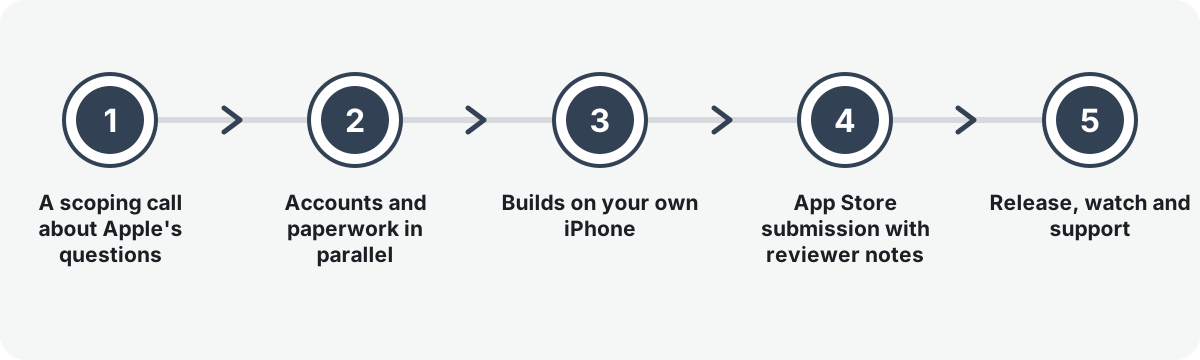
A scoping call about Apple's questions
Besides screens and users, the call settles the iPhone-specific choices: how people sign in, what the app sells and how each item is paid for, whether iPad matters, and what data leaves the phone. A written quote with price, schedule and payment terms follows before any design work.
Accounts and paperwork in parallel
While screens are designed, you request a D-U-N-S number if your company lacks one, which Apple says can take up to five business days, then enrol and invite us. The privacy policy, support URL and app name are drafted now, because App Store Connect asks for all three.
Builds on your own iPhone
Each working build lands, via TestFlight, on your iPhone and the handsets your staff use. Every remark is tagged to the screen it refers to, and each build is tried on an iPad and an older iPhone as well as a new one, since Apple asks iPhone apps to run on iPad whenever possible.
App Store submission with reviewer notes
We prepare screenshots that show the app in use, the description, keywords, age-rating answers and privacy details, then write review notes with a demo login and, where it helps, a short screen recording of the main flow. Reviewer questions are answered inside App Store Connect.
Release, watch and support
After approval you pick the release moment, and later updates can roll out gradually over seven days. Crash reports are watched after each version, support runs for three months from handover, and second-phase features get their own price before anyone starts them.
Why trust KaamGPT with the Apple side of your app?
We have been on the receiving end of App Review
KaamGPT took its own Flutter app, KaamGPT Marketing Agency, through Apple's review itself: in-app account deletion, written notes and access for the reviewer, a recorded walkthrough, and paid plans handled within Apple's purchase rules. We bring that experience to your submission; it is not a forecast of how Apple will decide on it.
The same stack as our own iPhone app
Our app runs in Flutter on Android and iOS, with native Swift on the iPhone for phone features, and the workspace's business apps open natively inside it. A client project starts from that tested pattern rather than from a stack we have only read about.
Your account, your seller name
We advise that you publish under an Apple Developer Program membership in your company's name, and we ask only for a team-member invitation. If you ever switch developers, the listing, ratings and payouts do not move with them; the quote spells out how source code is handed over.
iOS apps in our published work
Both the FlyMyCart courier app and the A2Z WorkHub app for home services shipped on Android and iOS, together with their websites and marketing. Every project, including web-only ones, is on our works page.
A price floor printed in public
The ₹14,999 entry figure is printed on our services listing and unpacked in our guide to the full app package, so before any call you can tell whether an idea fits the entry scope or will need a quote covering extra roles, payments or iPad work.
Leads that land where your team works
Enquiries, bookings and sign-ups captured in the app can land in KaamGPT CRM and fire WhatsApp confirmations over the WhatsApp Cloud API, Meta's official route, rather than sitting in a database nobody opens. Workspace plans and their allowances sit on our pricing page.
What does an iPhone app cost through KaamGPT, and what goes to Apple?
Pricing for our app projects opens at ₹14,999, and even that entry scope ships an iPhone build beside the Android one, with push alerts, a core flow that copes offline, publication in Apple's and Google's stores, and help for three months after handover. On an iOS project the number usually moves because of payments, sign-in methods, iPad layouts and native Swift modules. When you weigh one iOS app development company in Bangalore against another, line up what each quote includes rather than the headline figure.
- iOS + Android
- Push notifications
- Offline support
- App store submission
- 3 months support
Entry app with an iPhone build
From ₹14,999 a project
A focused customer or staff app needed on both iPhone and Android, resting on a few core screens and one main job.
- Push alerts through Apple's notification service
- Both an iPhone and an Android build
- A core flow that keeps working offline
- Store listings written and submitted to Apple and Google
- Three months of support after handover
iOS-first business app
RecommendedQuoted in writing after scoping
Brands, clinics and NRI-facing services whose most valuable customers carry iPhones and who need payments, roles or an admin panel.
- Sign in with Apple wherever social login is offered
- In-app purchase or gateway checkout, mapped to Apple's rules
- Admin panel for orders, bookings or content
- An external TestFlight round with real customers
- Swift modules for Face ID, camera or universal links
iPad or internal team app
Priced after a scoping call
Showrooms, clinics and field teams handing iPads to staff, where the app may be distributed privately instead of listed in search.
- iPad-first layouts designed for landscape use
- Offline catalogue or records that sync later
- Unlisted App Store distribution where it suits
- Staff sign-in that keeps outsiders out
- Handover notes for certificates and accounts
Optional add-ons
- Landing site with App Store badgesA quick page describing the app, with the store badges, scoped under our website service (its entry price is ₹9,999).
- App-install campaigns on Instagram and FacebookMeta campaigns pointing iPhone users at your listing; KaamGPT's management fee for them begins at ₹4,999 each month, and spend runs through your own Meta ad account. Install reporting on iOS respects Apple's tracking permission.
- An assistant inside the appQuestion answering or document reading, scoped under AI development (entry price ₹49,999) and wired in like any other backend.
- Apple bills its membership, 99 USD per membership year in local currency, to you directly; KaamGPT never handles that payment.
- Apple's commission applies to in-app purchase sales only. UPI and card fees are a matter between you and the gateway, on your own merchant account.
- The roughly ten-day build covers the starting scope alone; App Review time, and any resubmission, comes on top of it.
- Nothing is billed for the first call; the quote lists each payment milestone, and design waits until you have accepted it.
Wrapper, Flutter with Swift bridges, or pure Swift: what should your iPhone app be built as?
Three ways an iPhone app gets made, compared on what Apple's reviewers and your customers will actually notice. KaamGPT's own app takes the middle route; the right one for you depends on what the app has to do on the phone.
| What matters | Website wrapped in an app shell | Flutter with Swift bridges | Native Swift and SwiftUI |
|---|---|---|---|
| Risk under guideline 4.2 | High unless it does far more than the site | Low when screens are built as real app UI | Low |
| Android from the same work | Yes, but it inherits the website's limits | Yes, one Dart codebase serves both stores | No, Android becomes a separate build |
| Face ID, camera and share sheet | Patchy, through web plugins | Through Swift platform channels | Direct access to Apple's frameworks |
| Widgets, Live Activities, Apple Watch | Not practical | Each needs its own Swift extension | Built inside the same Xcode project |
| Working without a signal | Weak; leans on the browser cache | Local database stored on the phone | Local storage such as SwiftData |
| Keeping up with each iOS release | Little to update, little to gain | Framework and plugins updated together | New Apple APIs usable on day one |
| What we would use it for | Rarely; a fast mobile website usually serves better | Most business apps needed on both stores | Products built around Apple-only features |
The honest verdict. For most Bengaluru businesses that need iPhone and Android together, a cross-platform build with Swift where the phone demands it gives native-feeling screens without paying for two codebases, and it is how KaamGPT ships its own app. If your product leans on Apple-only features such as a Watch companion or heavy widget use, fully native Swift is the better fit. And if the app would only display your website, a fast mobile site costs less and avoids a 4.2 rejection. Any iOS app development company in Bangalore owes you a plain answer on which of the three fits.
What should an iOS app development company in Bangalore check before pressing Submit?
Apple publishes its App Review Guidelines in full, and the reasons a first build bounces are rarely mysterious. Run the checklist below against the actual build on a real iPhone, not against a design file, because the reviewer judges what installs. A clean pass is no promise of approval, which is always Apple's call, but it turns a rejection into a specific, fixable note instead of a surprise in launch week.
Two dated rules catch older projects in particular. Since 1 May 2024, uploads must declare approved reasons for required-reason APIs, including calls made inside third-party SDKs, in a privacy manifest. Since 28 April 2026, Apple accepts uploads only from Xcode 26 with the iOS 26 SDK, so an app nobody has opened for a year often needs a rebuild before even a one-line text fix can ship.
Reviewers also read the listing as carefully as the app. Guideline 2.3.7 warns against packing metadata with trademarked terms, popular app names or pricing, and the age-rating questionnaire Apple revised for January 2026 must be answered before an update can be submitted, so we fill both in during the build rather than on the last evening.
- 2.1: a demo account that works, a backend left switched on, no placeholder text
- 2.3.3: screenshots of the app in use, not a splash or login screen
- 4.2: features beyond what your website already does
- 4.8: an equivalent private login whenever Google or Facebook sign-in is offered
- 5.1.1(i) and (v): a privacy policy link in the listing and the app, plus in-app account deletion
- 5.1.2(i): App Tracking Transparency permission before any cross-app tracking
- 4.5.4: explicit opt-in before any promotional push message
Who should own the Apple developer account, and how does a company in India enrol?
Own it yourself. The developer account is where the app's name, ratings, payouts and future updates live, and the Account Holder is the person who signs Apple's agreements. If a vendor holds it, changing vendors means a formal app transfer, or a fresh listing that starts again from zero ratings. Apple charges 99 USD per membership year, shown in local currency at enrolment, and offers fee waivers to eligible nonprofits, accredited educational institutions and government entities.
Enrol as an organisation if you are a private limited company, an LLP or another registered entity. Apple needs a D-U-N-S number in your exact legal name, free from Dun & Bradstreet, taking up to five business days to arrive plus up to two for Apple to receive it. You also need a public website on your own domain and a work email at that domain. Trade names and branches are refused, and whoever enrols must have authority to bind the company.
A sole proprietorship enrols as an individual, which means the App Store shows the owner's personal name as the seller. A neighbourhood bakery can live with that. For a clinic, a lender or anything else Apple counts as highly regulated, guideline 5.1.1(ix) expects the app to come from the legal entity providing the service, so settle the entity question with your accountant before enrolling.
- Account Holder: a director or founder, never the agency
- KaamGPT invited with an App Manager or Admin role, revocable whenever you like
- Certificates, profiles and the push key listed in a handover note with expiry dates
- Renewal date in a shared calendar: if the membership expires, the app is no longer available for download
When must an iPhone app use in-app purchase, and when can it take UPI or cards?
Apple's rule turns on what is being sold. Under guideline 3.1.1, anything that unlocks features or content inside the app, whether subscriptions, premium tiers, course packs or in-app currency, must use Apple's in-app purchase, and the app may not swap in its own licence keys or QR codes. Under 3.1.3(e), physical goods and services consumed outside the app must be paid by other methods, such as Apple Pay or card entry, which is where an Indian UPI and card gateway fits.
The edges matter for Bengaluru service firms. Real-time services between two people, such as a tutoring session, a medical consultation, a property tour or personal fitness training, may be paid outside in-app purchase under 3.1.3(d); a live online class for a whole batch is one-to-many and returns to in-app purchase. Free companion apps for a paid web tool in VoIP, cloud storage, email or web hosting are exempt under 3.1.3(f) if nothing is sold inside them.
Outside the United States storefront, apps may not carry buttons, links or other calls to action that point customers to a non-Apple way of buying digital goods, except where Apple's region-specific entitlements apply. KaamGPT takes its own subscription payments through Cashfree and Razorpay, and its iPhone app passed review within Apple's purchase rules, so we plan this conversation before design, never after a rejection.
- Salon slot, food order, courier pickup: your payment gateway
- Premium subscription, recorded course, extra app features: in-app purchase
- One-to-one consultation or tutoring in real time: either route is allowed
- Live online class or webinar for many viewers: in-app purchase
- UPI and card fees are the gateway's; Apple's commission touches only in-app purchase sales
Bengaluru sectors where the iPhone build deserves extra care
- Clinics and dental practicesPatient booking, reports and consultation payments, submitted by the clinic's own legal entity because Apple treats healthcare as a highly regulated field.
- Premium retail and jewelleryCatalogues, store-visit booking and private previews for buyers who expect an app that behaves like a proper iPhone app.
- NRI-facing servicesCourier, property care and elder-care services whose paying customer may open the App Store in Dubai or London, with storefront countries chosen in App Store Connect.
- Coaching and test prepCourse packs through in-app purchase and one-to-one doubt sessions through your gateway, mapped before the first screen is drawn.
- Fitness and wellness studiosMemberships for sessions attended in person go through your gateway; live online group classes streamed in the app need in-app purchase.
- Real estate developers and brokersSite-visit booking, brochures and new-launch alerts, collecting only the personal details a sales team genuinely uses.
- Corporate and tech-park teamsiPhone and iPad tools for staff, distributed unlisted so they never surface in public App Store search.
What changes when the customers are Bengaluru iPhone users?
Android phones outnumber iPhones across India, yet Bengaluru has a large iPhone-carrying crowd: premium shoppers, professionals along the Whitefield, Manyata and Outer Ring Road tech corridors, and families whose children work abroad. Apple runs its own store here, Apple Hebbal at Phoenix Mall of Asia on Bellary Road. For iPhone app development in Bangalore, that mix means the iPhone build is often the one your highest-value customers judge you by, so it gets its own test time rather than a quick look after Android.
Distance matters less than people expect. KaamGPT runs everything from one Bengaluru base, and iPhone projects for clients in Koramangala, Hebbal, Electronic City, Malleshwaram and beyond run remotely: you install each TestFlight build on your own phone, send comments and screen recordings on WhatsApp, and review the App Store listing together on a shared call. Good iOS app developers in Bangalore need not sit down the road from you; the Hebbal app development page shows that process for one neighbourhood, and clients elsewhere in Karnataka are handled the same way.
Local habits shape the app too. Customers here are used to typing an OTP sent to their mobile number, paying by UPI and getting updates on WhatsApp rather than email. Each works on an iPhone with some care: a phone-OTP login needs a test number with a fixed code for the reviewer, a checkout that lists installed UPI apps must declare their URL schemes in the build, and links shared on WhatsApp should open the app directly through universal links.
Why do iPhone apps from Bengaluru businesses stall at App Review?
Most first-time app owners budget for design and code, then meet a third piece of work nobody priced: Apple. A build can be finished on a Friday and still sit in App Store Connect for weeks because the developer account was opened in the wrong name, the reviewer could not sign in, or the privacy label disagreed with an analytics SDK bundled inside the app. None of that is a coding problem, and each item is avoidable with a checklist.
So when you shortlist an iOS app development company in Bangalore, press them on these moments rather than on which frameworks they enjoy. Apple revises its guidelines and upload requirements every year, and a good answer names the current rules, quotes guideline numbers and explains what the reviewer will see on the first launch of your build.
- A freelancer opened the Apple account as an individual, so the App Store lists that person's own name as the seller instead of your company.
- A website wrapped in an app shell comes back under guideline 4.2 for doing nothing the site cannot already do.
- The reviewer's login needs an OTP sent to a phone Apple does not have, and the build is marked incomplete under guideline 2.1.
- Recorded courses are sold inside the iPhone app through a card gateway, which guideline 3.1.1 reserves for Apple's in-app purchase.
- The privacy label claims no data is collected while a bundled analytics SDK quietly sends device identifiers to its own servers.
How does KaamGPT compare with a freelancer or a large agency?
App development in Bengaluru three ways. KaamGPT’s column is from its published price list; the others describe how those arrangements usually work.
| What you get | KaamGPT | A freelancer | A large agency |
|---|---|---|---|
| Starting price | From ₹14,999 per project, as published | Quoted per job | Quoted after a proposal, often as a monthly retainer |
| What is included | iOS + Android; Push notifications; Offline support; App store submission | Whatever one person covers | Set out in the proposal |
| First delivery | Typically 10 days | Agreed per job | Set in the proposal |
| Price agreed | Written quote with scope and price before work starts | Ask for it in writing | In the signed proposal |
| Who you talk to | A Bengaluru team by call, WhatsApp or online meeting · +91 79767 82366 | The freelancer directly | Usually an account manager |
What does Indian law require of a business that holds customer data?
A Data Fiduciary shall protect personal data in its possession or under its control, including in respect of any processing undertaken by it or on its behalf by a Data Processor, by taking reasonable security safeguards to prevent personal data breach.
Where this applies around Bengaluru, Karnataka
- Bengaluru
- Karnataka
- India
- Electronic City
- Whitefield
- Koramangala
- HSR Layout
- Indiranagar
- Jayanagar
- Hebbal
Frequently asked questions
30 answersWhat does KaamGPT charge to build an iPhone app for a Bengaluru business?
Our entry project is priced at ₹14,999. Inside that scope sit the iPhone build and its Android twin, push alerts, a main flow that keeps working offline, listing on the iPhone and Android stores, and support through the first three months. Payments, extra user roles, iPad layouts or native Swift features raise the price, and the final number goes on paper before design begins. Apple's own developer fee is separate.
Can you build only the iPhone version and leave Android for later?
Yes. If your early customers mostly carry iPhones, an iOS-only first release is a sensible way to learn before paying for a second platform, and the quote reflects the narrower scope. If the app is built cross-platform from the start, adding Android later reuses most of the screens and logic instead of beginning again from a blank project. When that day comes, our <a href="/android-app-development-company-in-bangalore">Android app development guide for Bangalore</a> explains what Google Play asks of new developers.
Do I need to buy a Mac to own or update our iOS app?
No. Building and signing an iPhone app needs Xcode, which runs only on a Mac, but that machine is ours. You need an Apple Account with two-factor authentication to act as Account Holder, and App Store Connect access to see builds, sales and ratings from any browser. TestFlight then puts each build on your own iPhone for testing.
Should a proprietorship firm enrol with Apple as an individual or as an organisation?
Apple accepts only legal entities as organisations and refuses trade names, so a sole proprietorship enrols as an individual and the owner's personal name appears as the seller on the App Store. That is fine for many small shops. If you want the business name shown, or you work in healthcare or finance, settle the entity question with your accountant before enrolling.
How many days does a D-U-N-S number take for Apple enrolment?
Apple's support page asks you to allow up to five business days for Dun & Bradstreet to issue the number, then up to two more business days for Apple to receive it. The number costs nothing for Apple enrolment. Use your company's exact registered name, since Apple refuses trade names and branches, and check it against your incorporation papers first.
Who pays Apple's 99 USD developer fee, and what happens if it lapses?
You do, directly to Apple, because the membership is in your name; Apple lists 99 USD per membership year and shows the local-currency price during enrolment. Put the renewal date in a shared calendar. If the membership expires, the app is no longer available for download and no updates can be submitted, although copies already installed keep working.
Can an iOS app development company in Bangalore promise that Apple will approve my app?
No honest one can, because approval is Apple's decision on each submission. A developer can build to the current guidelines, give the reviewer a working demo login and clear notes, and keep the backend live during review. KaamGPT took its own app through App Review, so we know where builds tend to snag, but approval is never sold as a deliverable.
What happens after Apple rejects a build we submitted?
The reviewer's message in App Store Connect cites the guideline concerned and often what needs changing. Some issues are fixed in metadata or review notes without a new build; others need a code change and resubmission. You can reply to the reviewer, or appeal to the App Review Board if you believe the decision is wrong. Your quote states how resubmissions are treated.
Will Apple accept an app that only shows our website inside it?
Usually not. Guideline 4.2 asks for features, content and interface that go beyond a repackaged website, so a plain wrapper is likely to be rejected, and 4.2.2 rules out apps that are mainly marketing material or a collection of links. An app earns its place with things a site cannot do as well: offline records, push alerts, the camera, Face ID or a quicker repeat-order flow. If none apply, a fast mobile website is the better buy.
If our app's login is a mobile-number OTP, do we still need Sign in with Apple?
Not for that alone. Guideline 4.8 applies when an app uses a third-party or social login such as Google or Facebook for the main account; it must then also offer an equivalent option that limits data to name and email, lets people keep their email private and avoids ad tracking without consent. An app using only your own phone-OTP system falls under Apple's exception.
Is in-app account deletion really required for a small business app?
Yes, whenever people can create an account in the app. Apple has required in-app account deletion since 30 June 2022 under guideline 5.1.1(v). The option must remove the account record and associated personal data, not merely deactivate it, and a link straight to a web page that completes deletion is acceptable. Outside highly regulated fields, never make people phone or email you to do it.
Our coaching centre sells recorded courses. Can the iPhone app take payment through Razorpay?
Not for the recorded courses. Content unlocked inside the app is digital, so guideline 3.1.1 requires Apple's in-app purchase. One-to-one online tutoring is different: under 3.1.3(d) a real-time person-to-person service may use another payment method, so your gateway can collect it. Live online classes for a whole batch count as one-to-many and need in-app purchase. We map each product before design.
Can a salon, restaurant or courier app on iPhone take UPI payments?
Yes. A haircut, a delivered meal or a parcel pickup is a physical good or a service used outside the app, and guideline 3.1.3(e) requires those to be paid some other way than through in-app purchase. A UPI and card gateway account in your business's name handles it. On iPhone, a checkout that lists the customer's installed UPI apps must declare those apps' URL schemes in the build.
What is the App Tracking Transparency prompt, and will our app have to show it?
It is the iPhone pop-up asking whether an app may track the user across other companies' apps and websites. Guideline 5.1.2(i) requires that permission before any such tracking, for example sharing a device identifier with an ad network for targeting or measurement. If your app does no tracking, there is no reason to show the prompt, and its privacy label should say so.
What goes into the privacy section of an App Store listing?
Apple asks which data types the app collects, whether each is linked to the user, and whether any is used for tracking. Collected means sent off the device and kept longer than needed to serve the request, and the answers must cover what third-party SDKs such as analytics or ad tools gather. Data processed only on the phone does not count. Inaccurate answers can lead to rejection or removal.
Why did App Store Connect flag our upload over a privacy manifest?
Since 1 May 2024, any new app or update must declare approved reasons for certain APIs, such as reading user defaults or file timestamps, in a privacy manifest, including calls made by third-party SDKs. An older SDK without its own manifest is a frequent culprit. Updating that SDK, or declaring the reason in your app's PrivacyInfo.xcprivacy file, usually clears the issue.
How can our team try the iPhone app before customers see it?
Through TestFlight. Internal testers, up to 100 people who are App Store Connect users, can install a build as soon as it has processed. External testers, as many as 10,000 of them, join by email invitation or a public link once the first build passes Beta App Review. Every build expires after 90 days, and testers can send screenshots with comments straight from the TestFlight app.
Can an app for our staff stay out of App Store search?
Yes, through Apple's unlisted app distribution. The app still goes through normal App Review; you then request unlisted status, and Apple provides a direct link while the app never appears in search, charts or categories. Anyone holding the link can download it, so the app needs its own staff sign-in. It suits sales tools, franchisee apps and employee resources.
Will our iPhone app also run properly on an iPad?
It should at least work there. Guideline 2.4.1 asks that iPhone apps run on iPad whenever possible, so an iPhone layout opened on an iPad must not break. A proper iPad design, with wider screens, landscape use and multitasking, is extra work that pays off for showrooms, clinics and field teams, and it is priced as part of the scope.
Is Flutter good enough for iPhone users, or should the app be written in Swift?
For most business apps, Flutter produces screens iPhone users accept as native, and it is what KaamGPT's own App Store app uses, with Swift for phone features. Swift and SwiftUI throughout win when the product depends on Apple-only features such as Apple Watch, Live Activities or many widgets. Our <a href="/flutter-app-development-company-in-bangalore">Flutter development guide for Bangalore</a> walks through when each one wins.
Who keeps the source code, signing certificates and push keys after launch?
When the app lives in an Apple developer account your company holds, the listing, certificates and push key are created there and stay yours. The quote sets out the timing and format of the source-code handover. At handover you receive a note listing each certificate, profile and key, where it lives and when it expires, so a future developer can carry on without guesswork.
Our iOS app was built by a developer who has gone silent. Can you take it over?
Often, depending on what you can recover. If the app sits in your own Apple account, updates can ship under the same listing and keep its ratings. If it sits in the old developer's account, Apple's app transfer process can move it to yours once both account holders agree. Without the source code, a rebuild may cost less than untangling, and the quote will say which.
Can we send offers and announcements as push notifications on iPhone?
Yes, with consent. Guideline 4.5.4 allows promotional pushes only to people who explicitly opted in through consent wording shown in your app, and the app must offer a way to opt out. Order updates and reminders are not marketing, so keep them separate. Blasting offers at everyone who allowed alerts for their bookings is how apps get muted or deleted.
Does a clinic's app have to be published under the clinic's own company?
Apple expects it. Guideline 5.1.1(ix) says apps offering services in highly regulated fields, with healthcare and financial services among them, or apps needing sensitive user information, should be submitted by the legal entity providing the service rather than an individual developer. So the clinic enrols as an organisation, holds the account, and invites KaamGPT to build and submit on its behalf.
How much time should our launch plan leave for App Review?
Treat review time as Apple's, and leave room for at least one round of questions. Plenty of submissions are reviewed quickly, but a rejection, a reviewer who cannot log in or a missing in-app purchase item adds days. Avoid tying a launch to a festival sale or event until the build is approved; you can then release it manually on the day you choose.
Which number reaches KaamGPT about an iPhone app project?
Ring +91 79767 82366 about your iPhone app, or WhatsApp the same number a note describing in two or three lines the people the app serves and what it sells; a callback request on the <a href="/services/app-development">KaamGPT app development page</a> works too. A scoping call is the next step, then a written quote. Mention any Apple developer access you already hold, because that changes the first week's plan.
Apple now requires Xcode 26. Does that affect an app we launched two years ago?
Only when you next update it. Apple has turned away uploads not built in Xcode 26 on the iOS 26 SDK since 28 April 2026, and since 9 September 2026 an iOS build must target iOS 13 or later. Your live app stays on sale, but the next fix, even a typo, needs a rebuild with current tools, and older plugins sometimes need updating first.
Can our NRI customers in Dubai, London or the US download our Bengaluru app?
Yes, if you make it available there. In App Store Connect you choose the countries and regions where the app is offered, so a business serving NRI families can list it in the UAE, the UK or the US alongside India. Payments, delivery areas and support hours should match those storefronts, and the US storefront has its own rules on linking to web checkouts.
Which questions should I put to an iOS app development company in Bangalore at the first meeting?
Ask whose Apple account the app will live in, how they handle a rejection, which guidelines they expect your app to touch, how payments will split between in-app purchase and a gateway, and what the handover note contains. Ask to see an app they took through review themselves. Vague answers about accounts or payments are the warning signs worth acting on.
Can the iPhone app send its bookings and leads into KaamGPT CRM?
Yes. Our app builds come with a shared backend able to plug into your KaamGPT workspace; a booking or enquiry made on an iPhone then shows up in the <a href="/tools/crm">CRM</a> beside leads from your website and ad campaigns, and can send a WhatsApp confirmation over Meta's official Cloud API. The list of synced fields is agreed when we scope the app.