 KaamGPT
Ecommerce website development in Bangalore is less about putting products on a page than about what happens after someone taps Pay. A shopper in Yelahanka pays by UPI, a buyer in Hubballi wants cash on delivery, a retailer from Tumakuru asks for the dozen-piece price, and every one of those orders needs a GST invoice, a courier label and a status message. KaamGPT builds custom online stores around that whole flow, with checkout settling into a gateway account that your business holds, not one that KaamGPT controls.
One number deserves clarity up front. The published starting fee for KaamGPT's Website Development service, ₹9,999, buys a catalogue or enquiry site that has no cart. A store that collects money carries checkout, stock, shipping, invoices and an admin panel, so it is priced separately, in writing, once the catalogue and integrations are known. Below: what moves that figure, how a custom store compares with Shopify and WooCommerce, and which Indian rules checkout must respect. The services page lists KaamGPT's whole managed menu, while briefs arrive through the Website Development listing.
- ₹9,999is where catalogue and enquiry sites without a cart or payment step begin
- In writingthe way stores with checkout, stock and shipping get their price, once scoping is done
- Your nameon the payment gateway, domain, Merchant Center and WhatsApp Business accounts
- Cashfree + Razorpaythe two gateways KaamGPT runs in production for its own subscription payments
What does a custom ecommerce website need before it can ship real orders?
Eight building blocks separate a store that takes orders from one that only takes photographs. Each is scoped, costed and tested separately, which shows plainly which parts matter on launch day and which belong in phase two.
Catalogue, variants and stock per location
Every product carries variants such as size, colour, pack weight or fabric length, and each variant gets its own SKU, price, photographs and stock count. Stock is held per location, so the shop and the godown are counted separately and a low-stock alert reaches the right person. Large catalogues arrive through a spreadsheet import rather than hundreds of manual entries, and the same sheet can update prices in bulk before a sale.
UPI-first checkout on your own gateway
On a phone, the Pay step hands over to the buyer's UPI app and returns them to the order page; on a laptop, a QR code appears instead. Cards and netbanking run through the same gateway account, opened in your business's name. An order is marked paid only when the gateway confirms it server to server, never because a browser tab said so, which closes the gap that lets unpaid orders slip into the packing queue.
Cash on delivery with sensible limits
COD can be switched on by pincode, capped by order value and paired with a confirmation step on WhatsApp before anything is packed. Expensive items can require a part-payment online, and any COD handling fee is shown on the product and cart pages rather than sprung on the buyer at the last step. A simple report shows which pincodes and couriers send parcels back, so the rules can be tightened with evidence.
A GST invoice raised for every order
The store will raise a numbered tax invoice for each paid order, from a financial-year series, with the HSN code from the product record and the tax split decided by where the parcel is delivered. Business buyers can enter a GSTIN at checkout so their copy supports input tax credit. A return produces a credit note tied to the first invoice rather than an edited one, and the month's invoices export in one file for your CA.
Shipping rates, labels and tracking
Rates are worked out from weight and destination zone, and a pincode box on the product page tells a buyer whether you deliver there before they fill the cart. The admin books the pickup with your courier or aggregator account, prints the label with its airway bill number, and stores the tracking link. Buyers follow the parcel on a tracking page on your own domain, not a courier site full of other brands.
Order updates over the official WhatsApp API
Confirmation, dispatch, out-for-delivery and delivered messages are sent as Meta-approved templates over the WhatsApp Business Platform, the same official route used by the WhatsApp Business API tool inside KaamGPT. COD buyers can confirm or cancel with a button, which saves a phone call per order. Abandoned-cart nudges and offers reach only shoppers who ticked the consent box, since Meta's marketing templates require opt-in.
An admin panel the packing team can run
Orders line up by status: new, confirmed, packed, shipped, delivered, returned. Staff print pick lists and packing slips in batches, record returns at a dedicated desk, and each role is limited to its own screens, so a packer never sees revenue figures. Owners get daily sales by channel and payment mode, and an export that drops straight into accounting software without reformatting columns by hand.
Product pages built for crawlers and shoppers
Category and product pages are delivered as real HTML with their own titles, descriptions and Product structured data carrying price, currency and availability. Variant URLs resolve to one canonical product page instead of splitting signals, filters stay out of the index, and a product feed is prepared for Google Merchant Center. Out-of-stock pages stay live and say so, instead of vanishing and taking their search history with them.
- Catalogue site without checkout
- From ₹9,999; the basic scope usually ships in roughly seven days
- Store with cart and payments
- Each line priced on paper once scoping has fixed what the store must do
- Payment modes
- UPI, cards, netbanking and COD on a gateway account held by your business
- Invoices
- A GST invoice for each order, with IGST or CGST plus SGST chosen from the delivery state
- Technology
- TypeScript and React storefronts on a secured API, as in KaamGPT's own workspace
- Base
- A single office in Bengaluru; sellers across the city are served remotely
What decides the ecommerce website cost for a Bengaluru store?
In ecommerce website development in Bangalore, five things move the figure more than design does: how many products and variants you carry, which payment and COD rules you need, how orders are shipped, whether trade buyers see their own prices, and what the store must connect to, such as billing software or an app. KaamGPT's only published catalogue price, ₹9,999, applies to sites without checkout. Anything that takes money is costed per scope, each line separately, which lets you postpone one feature without reopening the others.
- Custom design
- Mobile first
- SEO ready
- CMS included
- Analytics setup
- 1 month free support
Catalogue and enquiry site
From ₹9,999 — no checkout
Shops and brands that want their range online with WhatsApp or call enquiries, but are not yet ready to take payments, ship parcels or manage returns.
- A custom look, drawn for small screens before desktop
- Product and category pages editable in the CMS
- An ask-on-WhatsApp button carrying each product code
- Search-ready pages, with analytics under your own Google login
- A first month of fixes and CMS help, included
Full online store with checkout
RecommendedQuoted in writing after scoping
D2C brands, retailers, grocers and wholesalers ready to collect payment online, ship across the city or the country, and run fulfilment from an admin panel.
- Cart and payment step wired to your gateway account
- COD rules, shipping rates and courier tracking
- A GST invoice and credit note flow for every order
- Admin roles for packing, accounts and owners
- Order templates on the official WhatsApp API
- Product structured data and a Merchant Center feed
Store with an app or a multi-vendor marketplace
Scoped and priced separately
Sellers whose buyers reorder often enough to want an app, or founders building a marketplace where many vendors sell. Those builds are covered in the Bangalore mobile app page and on the software development hub.
- Android and iOS apps sharing the store's backend
- Vendor onboarding, commission and payout design
- Separate dashboards for sellers, riders or staff
- Push notifications for order status and offers
- Phased delivery, with the web store launching first
Optional add-ons
- Shopping and search ads on GoogleRunning these campaigns carries a ₹4,999 minimum monthly fee, and Google invoices click costs to your own Ads account directly; read the Bengaluru Google Ads management guide.
- Meta catalogue and Reels adsCatalogue, Reels and retargeting campaigns for the store, charged from ₹4,999 monthly for management; the ad budget goes from your card to Meta, never through KaamGPT.
- Ongoing SEO for categories and productsTechnical fixes, category copy and monthly keyword reports through the SEO programme, with ₹14,999 as the opening monthly fee.
- A KaamGPT workspace beside the storeWhatsApp Business API, CRM, email and Bills apps, with plans starting at ₹999 monthly, tax inclusive, after a 14-day trial; compare tiers on the plans page.
- Per-payment charges are billed by your gateway to your account, and shipping by your courier or aggregator; neither appears on KaamGPT's invoice.
- WhatsApp order messages are charged by Meta per delivered template, at rates that depend on the message category, through your own WhatsApp Business account.
- Adding a cart, payments or shipping to the ₹9,999 starting scope turns it into a store project with its own written price and its own timeline.
- Domain renewals, product photography and paid fonts or extensions sit outside the build unless the scope document names them.
Why do Bengaluru sellers outgrow marketplaces and Instagram DMs?
Marketplaces bring buyers, but they keep them. The shopper's phone number, the repeat-purchase data and the right to remarket all stay with the platform, while commissions, fulfilment fees and sponsored-listing spend come out of every payout. Selling through Instagram messages has the opposite problem: you own the conversation but nothing else. Orders sit in chat threads, addresses arrive with half a landmark, and somebody checks payment screenshots against the bank app late at night.
A store of your own fixes this only when it is built around how the business actually runs. That means stock that matches the godown, cash-on-delivery rules that stop parcels bouncing back, and invoices your accountant accepts without retyping. Good ecommerce website development in Bangalore starts from the packing table and the bank statement, then works forward to the product page.
- UPI screenshots matched by hand against the bank app before anything is packed.
- Cash-on-delivery parcels returning unopened, with courier charges paid in both directions.
- An item sold online that already left the shop counter that morning.
- No customer list of your own to send a Deepavali offer to.
- Out-of-state orders invoiced one at a time in a spreadsheet, with the tax split guessed.
What happens between the scoping call and a store's first paid order?
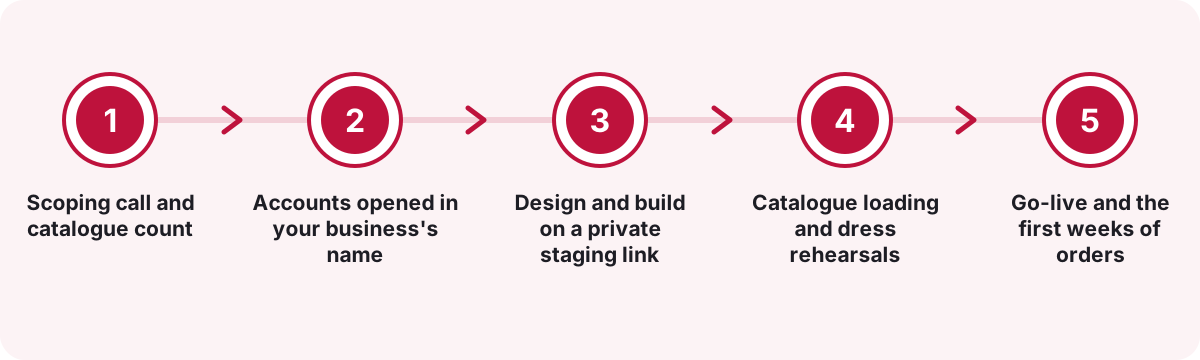
Scoping call and catalogue count
We go through what you sell and how: number of products and variants, payment modes, delivery zones, wholesale pricing, existing billing or stock software, and who will pack orders. The output is a written scope with every screen and integration listed, a timeline, and the price for that scope.
Accounts opened in your business's name
You complete the gateway's KYC with your business PAN, bank account and GSTIN, and register or keep the domain, Merchant Center, Search Console and WhatsApp Business accounts. KaamGPT then gets developer or manager access wherever the work needs it. Gateway verification can take days, so it starts in week one, not the week before launch.
Design and build on a private staging link
Mockups of product, category, cart and checkout begin on a narrow phone canvas, and you review them on your own handset. Payments run in the gateway's test mode, COD rules and shipping rates are configured, and invoice layouts are checked against a real order from your books before anything touches live money.
Catalogue loading and dress rehearsals
Your product sheet is imported and cleaned: missing weights, duplicate SKUs and blurry photographs get flagged. Then the team runs complete test orders, prepaid and COD, through payment, invoice, label, tracking, cancellation and return, so the packing staff have practised every path once.
Go-live and the first weeks of orders
The store switches to live payments, the sitemap goes to Search Console and the product feed to Merchant Center. During the first month of support we watch real orders with you, fix whatever behaves differently in production, and agree what the second phase should hold.
Custom build, Shopify or WooCommerce: which one fits your store?
All three can run a good Indian store. They differ in who carries the monthly cost, who maintains the software and how far checkout can bend to your process. KaamGPT builds custom stores only and does not sell Shopify or WooCommerce projects, so the table below describes those platforms neutrally from their own published terms.
| What matters | Custom store built by KaamGPT | Shopify (hosted platform) | WooCommerce (on WordPress) |
|---|---|---|---|
| Cost to start | Project fee quoted in writing after scoping | Low; Shopify's India price list showed Basic at ₹1,499 a month, billed yearly, in November 2026 | The plugin itself is free; hosting, a theme and paid extensions are extra |
| Ongoing cost | Hosting and support as written in the quote; no platform cut per order | Monthly plan and app subscriptions, plus an extra per-order fee when a third-party gateway is used | Hosting, yearly extension renewals and developer time for updates |
| Checkout flexibility | Built to your rules: COD by pincode, trade price lists, GSTIN capture, slots | Polished standard checkout; deeper changes depend on plan and apps | Highly adaptable through plugins, with quality varying plugin to plugin |
| Indian payment options | Your own Razorpay, Cashfree or other gateway, integrated directly | Indian gateways connected as third-party payment providers | Gateway plugins published by the Indian providers themselves |
| Time to first sale | A few weeks, set by the agreed scope | Days, using a ready theme | Days to weeks, depending on the theme and plugins chosen |
| Who maintains the software | KaamGPT during support; code ownership and handover terms set in the quote | Shopify runs hosting and security; you manage themes and apps | You or your developer patch WordPress, PHP, themes and plugins |
| Best suited to | Unusual flows: wholesale tiers, hyperlocal slots, subscriptions, a store plus an app | Standard D2C catalogues that want to start selling quickly | Content-led brands already publishing on WordPress |
The honest verdict. If your catalogue is ordinary, your checkout needs nothing unusual and you want to be selling next week, Shopify is the sensible start, and KaamGPT will tell you so on the first call. WooCommerce suits a team that already runs WordPress and has someone to keep it patched. A custom build earns its fee when the process itself sets you apart: trade buyers with their own prices, delivery slots in a few pincodes, a store that must share data with an app, or order volumes where per-order platform fees start to add up.
Four Bengaluru sellers, four very different stores
The first three are sketches assembled from patterns common in ecommerce website development in Bangalore, not client claims. The fourth is a published KaamGPT case study, described only as far as its published outcome goes.
A cold-pressed oil and millet brand shipping from Basavanagudi
- The situation
- Orders come through Instagram messages, glass bottles crack in transit, and COD buyers in distant pincodes refuse parcels that cost money both ways.
- How KaamGPT fits
- Product pages carry the details printed on each pack, from net quantity to shelf life and the packer's address. Glass items ship prepaid only, COD is capped and confirmed on WhatsApp, shipping is priced by weight, and buyers who opt in get a reorder reminder when a pack would be running low.
- What changes
- Orders reach the packing table already paid or confirmed, with a correct invoice and a usable address, and the founders stop reconciling screenshots at night.
A Chickpet silk and fabric wholesaler with retail customers on the side
- The situation
- Retailers from Davanagere, Ballari and Hosur order by sending photos on WhatsApp, and wholesale rates must never be visible to walk-in or retail shoppers online.
- How KaamGPT fits
- Two price lists in one store: approved retailers sign in with a verified GSTIN to see trade rates and minimum quantities, while everyone else sees retail prices. Bulk orders allow a part payment online, out-of-state invoices carry IGST, and new arrivals publish to both lists at once.
- What changes
- Regular retailers reorder from the catalogue by themselves, and staff time moves from forwarding photographs to packing and dispatch.
A Malleshwaram provisions store delivering within a few kilometres
- The situation
- Phone orders are misheard, loose items weigh slightly more or less than ordered, and delivery staff wait at apartment gates without a tower or flat number.
- How KaamGPT fits
- Delivery is limited to nearby pincodes with time slots. Checkout has separate boxes for tower, flat and the gate riders should use, plus a substitution preference. Items sold by weight are confirmed with the final amount before dispatch, and buyers pay online or by UPI QR at the door.
- What changes
- Pickers work from a list sorted by shelf, riders reach the right door first time, and regular customers keep ordering from a shop they already trust.
CloseToBuy, a Bengaluru food-delivery startup
- The situation
- The business needed customers to discover restaurants, place an order and track it to the doorstep from an Android phone, an iPhone or a browser.
- How KaamGPT fits
- KaamGPT built the customer app, restaurant and delivery flows, a back office where restaurants, menus, orders and deliveries are managed, plus a website built to push app installs. The full story is on the CloseToBuy case study page.
- What changes
- The published result: CloseToBuy's Play Store launch shipped the full journey, from placing an order to watching it arrive live.
What makes ecommerce website development in Bangalore different from selling elsewhere?
Delivery inside the city is its own design problem. Large apartment complexes in Whitefield, Electronic City, Hebbal and Sarjapur Road route riders through a security desk, so checkout should capture tower, flat and gate instructions as separate fields. Nearby orders can go out with your own riders or a same-day partner, while anything beyond the city goes by courier. Planning delivery zones by pincode rather than by area name avoids arguments about where one layout ends.
The trades also differ by neighbourhood. Chickpet's silk and fabric houses deal with retailers across Karnataka and beyond, SP Road's electronics traders need model-compatibility search, Jayanagar and Malleshwaram provision stores deliver within a few kilometres, and brands launched from Koramangala and HSR Layout sell to the whole country from day one. Lacquered wooden toys from Channapatna, down the Mysuru road, sell to gift buyers nationwide and travel best with careful packing notes.
All store projects run out of KaamGPT's sole Bengaluru office, over calls, screen-shares and private staging links, so a Yelahanka manufacturer and a Banashankari boutique get the same process. Area guides such as store websites for Commercial Street shops and website development in Jayanagar show how catalogue sites differ street by street.
What do India's E-Commerce Rules expect your store to display?
India's Consumer Protection (E-Commerce) Rules, 2020 were notified on 23 July 2020 as G.S.R. 462(E). They cover every model of online selling, and a brand or shop selling its own stock from its own site is what the rules call an inventory e-commerce entity, a term that expressly includes single-brand retailers. The rules apply from the moment selling becomes a regular commercial activity, not only once a store is large.
Rule 4 asks for your legal name, the principal geographic address of your headquarters and branches, website details, and contact numbers and email for customer care and for a grievance officer, whose name and designation must also appear. That officer acknowledges a complaint within forty-eight hours and resolves it within one month. Rule 7 adds a ticket number for every complaint so the buyer can track it, which in practice means a small complaints desk inside the admin panel.
Checkout carries its own duties. Rule 7 wants the total shown as one figure, broken down into delivery, handling and tax. Payment methods, their security, any fees, charge-back options and the payment provider's contact details belong on the site. Consent must come from a deliberate click, never a pre-ticked box, and cancellation charges are allowed only if you bear similar charges when you cancel. The consumer regulator's 2023 dark-pattern guidelines also name drip pricing, basket sneaking and false urgency.
Packaged goods bring one more layer. Under India's Legal Metrology (Packaged Commodities) Rules, 2011, as amended in 2017, an online seller shows the label declarations on the product page: who made, packed or imported the item, the net quantity, the retail sale price, the consumer-care contact and, for imports, the country of origin. The month of manufacture is the main exception. Treat this as a build checklist, not legal advice; have your lawyer or CA check it against your goods.
- A footer block with legal name, registered address and branch addresses.
- A grievance officer's name, designation, phone number and email on a dedicated page.
- Return, exchange, delivery and cost-of-return-shipping terms linked from every product page.
- Price break-up visible in the cart before the payment step, not after it.
- Unticked consent boxes for marketing messages and saved details.
- Label declarations stored as product fields, so they cannot be skipped on new items.
How should checkout handle UPI, cards, COD and GST for Indian buyers?
Design for UPI first. On a phone, the gateway's intent flow lists the UPI apps installed on the handset and returns the buyer to your order page after approval; on a desktop, the buyer scans a QR code. Either way, mark the order paid only after the gateway's server-to-server notification arrives. Card payments follow the Reserve Bank of India's 2021 card-on-file tokenisation framework: merchants and their payment aggregators may not store actual card numbers, so a saved card becomes a network token held through the gateway.
Cash on delivery still matters outside the big cities, but every refused parcel costs two shipping legs and blocks stock for days. Offer COD by pincode and order value, confirm each COD order on WhatsApp before packing, and for expensive items ask for a token amount online. Show any COD fee on the product page and in the cart. Review return-to-origin rates by pincode and courier every month, and switch COD off where the evidence says so.
Tax is decided by the delivery address. For goods that move, the IGST Act places the supply where the movement ends, so a parcel to Mysuru carries CGST and SGST, while one to Chennai or Pune carries IGST. Shipping taxable goods across state lines generally requires GST registration whatever your turnover, under Section 24 of the CGST Act, with narrow exceptions such as certain handicraft sellers. Ask your CA before launch, because the store's invoice logic follows that answer.
- Payment status taken from the gateway webhook, with a daily settlement report to reconcile.
- COD capped by order value and blocked for pincodes with repeated returns.
- HSN code and tax rate stored on each product, not typed per invoice.
- Place of supply taken from the delivery state, including for gift orders.
- Business buyers' GSTIN validated at checkout so their invoice supports input credit.
How does a new store get its products found on Google Search and Shopping?
Start with the product page itself. Google's documentation for merchant listing structured data requires a Product with a name, an image and an Offer carrying a price above zero and a three-letter currency code, INR here. Availability, SKU or GTIN, shipping details and a return policy are recommended, and only pages where a shopper can actually buy qualify for these listings. In a KaamGPT build, public product and category pages are rendered as HTML on the server, so the markup and the visible price come from the same record.
Next, Google Merchant Center. Free listings can show your products at no cost across Google surfaces including Search, Images and Lens, the Shopping tab, YouTube and Maps. The feed needs an id, title, link, image link, price, description and availability for every item, and in India Google requires shipping settings or a shipping attribute. Approval of the feed does not promise placement; Google still matches products to searches using the data you send, so accurate titles and photographs matter.
Category pages catch long-tail searches, such as handloom cotton sarees under ₹2,000 or a cold-pressed groundnut oil 5 litre can, so each deserves a short written introduction and filters that stay out of the index. Paid traffic follows once tracking is proven: Shopping and Performance Max campaigns through the PPC agency in Bangalore guide, and Instagram product posts and Reels through the social media marketing page.
- Product structured data with price, INR currency and availability on every buyable page.
- One canonical URL per product, with variants handled as options rather than copies.
- Merchant Center shipping settings and return policy filled in before the feed is submitted.
- Sold-out products kept live with their availability marked, not deleted.
- An XML sitemap listing products and categories, submitted to Search Console on launch day.
Which Bengaluru trades gain most from a store of their own?
- D2C beauty and personal careIngredient-led product pages, shade and size variants, and replenishment nudges for shoppers who have consented to them.
- Packaged food, spices and sweetsPack declarations on every page, weight-based shipping, prepaid-only rules for fragile jars, and festive gift boxes.
- Sarees, ethnic wear and textilesLength, fabric and blouse-piece variants, trade price lists for retailers, and IGST invoices for buyers in other states.
- Grocery and provisionsDelivery slots by pincode, items sold by weight confirmed before dispatch, and gate and flat details captured at checkout.
- Electronics and mobile accessoriesModel-compatibility filters, serial numbers recorded on invoices, and warranty terms stated beside each product.
- Wholesale and industrial suppliesSign-in pricing for approved buyers, minimum order quantities, quote requests for large lots and GSTIN-checked invoices.
- Handicrafts, toys and giftingStory-led pages for lacquerware and wooden toys, gift messages, and careful packaging rules for long-distance parcels.
- Furniture and home décorBulky-item freight by zone, assembly options, and delivery booking that respects apartment move-in rules.
An online seller's year in Bengaluru, month by month
A store's busiest weeks are decided months earlier, when stock is ordered, couriers are booked and code changes are frozen. The calendar below is a planning aid for sellers shipping from Bengaluru, built around local festivals, school terms, the two rainy spells and the financial year, not a forecast of anyone's sales.
| When | What happens | What to do in marketing |
|---|---|---|
| January | Sankranti hampers and Republic Day sales | Ellu-bella boxes and sugarcane bundles sell to families posting them to relatives, so publish hamper bundles with a dispatch cut-off date. Clear winter stock with a clearly ended sale page rather than a countdown timer that quietly resets. |
| March–April | Ugadi orders and a new financial year | Holige, new clothes and puja items peak before Ugadi. On 1 April the invoice series rolls over to the new financial year, so test the first invoice of the year in staging during the last week of March. |
| May–June | School reopening and summer shifting | Uniform, stationery, school-bag and lunch-box sellers should have size charts and bundle pages live by mid-May. Families moving house order furniture and kitchen basics, so bulky-item delivery zones need checking before the rush. |
| June–September | Monsoon parcels and rain delays | Move paper cartons to waterproof outer packaging, add a short delay note to delivery estimates on heavy-rain days, and plan for grocery orders rising on days when people avoid stepping out. Keep courier SLAs visible in the admin panel. |
| August | Varamahalakshmi and Independence Day | Silk sarees, jewellery, flowers and puja kits sell in a narrow window before Varamahalakshmi. Put the dispatch deadline on product pages, and switch COD off for items that cannot arrive in time. |
| September–November | Dasara and Deepavali peak | Load festive collections in early September, pre-book courier pickups, and freeze checkout changes a fortnight before Deepavali. Sweets, dry-fruit boxes, lights, clothing and electronics are the usual festive categories; keep a person watching failed payments daily. |
| November–February | Wedding season and year-end gifting | Bridal wear, jewellery, return gifts and corporate hampers move through these months. Offer bulk-order forms with trade pricing, and run a full stock count in December so January starts with honest availability on every page. |
Why hand KaamGPT the part of your store that touches money?
Payments we operate ourselves
Customers pay for KaamGPT's subscriptions online via Razorpay and Cashfree, so gateway webhooks, failed payments, retries and settlement reports are part of the team's daily work rather than something read about. Your store's checkout is built by people who reconcile their own settlements.
WhatsApp on Meta's official platform
The WhatsApp Business API tool inside KaamGPT runs on Meta's WhatsApp Cloud API, with every template submitted for Meta's approval. Order updates built for your store take that same official route, so they go out from your verified business number within Meta's messaging rules.
Ordering and tracking already shipped
The FlyMyCart project covers quotes, pickup booking, online payment and shipment tracking across Android, iOS and the web, and the CloseToBuy app carries orders through to live tracking. Both are published case studies.
Same tools as KaamGPT's own workspace
Shopper-facing screens are React written in TypeScript, talking to a hardened API, the approach behind the KaamGPT workspace, which pairs a Python FastAPI service with PostgreSQL and queue-driven background workers. Slow tasks such as sending invoices or refreshing tracking belong in queues like these, not in the shopper's checkout.
Accounts registered to your business
The gateway, domain, Merchant Center, Search Console and WhatsApp Business accounts are your company's own from the moment they exist; KaamGPT works inside them with manager or developer access. Who owns the code, and how a copy reaches you, is settled in the quote before development starts.
Straight answers about platforms
KaamGPT does not sell Shopify or WooCommerce builds, which makes it easier to say plainly when one of them would serve you better. If a hosted platform suits your catalogue and budget, that advice comes in the opening conversation.
How does KaamGPT compare with a freelancer or a large agency?
Website development in Bengaluru three ways. KaamGPT’s column is from its published price list; the others describe how those arrangements usually work.
| What you get | KaamGPT | A freelancer | A large agency |
|---|---|---|---|
| Starting price | From ₹9,999 per project, as published | Quoted per job | Quoted after a proposal, often as a monthly retainer |
| What is included | Custom design; Mobile first; SEO ready; CMS included | Whatever one person covers | Set out in the proposal |
| First delivery | Typically 7 days | Agreed per job | Set in the proposal |
| Price agreed | Written quote with scope and price before work starts | Ask for it in writing | In the signed proposal |
| Where enquiries go | Straight into the KaamGPT CRM, with WhatsApp follow-up | Your own tools | Their tools or yours |
| Who you talk to | A Bengaluru team by call, WhatsApp or online meeting · +91 79767 82366 | The freelancer directly | Usually an account manager |
How does Google measure a page’s experience?
Core Web Vitals is a set of metrics that measure real-world user experience for loading performance, interactivity, and visual stability of the page.
Where this applies around Bengaluru, Karnataka
- Bengaluru
- Karnataka
- India
- Chickpet
- Basavanagudi
- Whitefield
- Koramangala
- Malleshwaram
- HSR Layout
- Jayanagar
Frequently asked questions
30 answersWhat will an online store with UPI and cash on delivery cost me with KaamGPT?
How much it costs depends on the scope, which is why each store gets a written price only after we have scoped it, never off a rate card. Catalogue size and variants, payment and COD rules, shipping integrations, trade pricing and any companion app are what move it. For ecommerce website development in Bangalore, the only published figure is ₹9,999, and it covers catalogue sites without a cart.
Why doesn't the ₹9,999 website price include a cart and payments?
That entry scope means a custom-designed, phone-first site, an editing CMS, analytics wiring and post-launch help for the first month. A checkout adds gateway integration, payment confirmation, stock reservation, invoices, shipping rates, labels, tracking and an order admin, each of which has to be built and tested against real failure cases. Pricing it as the same product would hide real work, so stores get their own line-by-line quote.
How many weeks does online store development usually take for a few hundred products?
A catalogue of three or four hundred SKUs with one gateway, COD rules and one courier integration typically runs for a few weeks; the agreed scope document sets the actual dates. The slowest parts are rarely code. Gateway KYC, clean product data with weights and HSN codes, and decent photographs decide the timeline, so we ask for them in the first week.
In whose name is my store's payment gateway account opened?
Yours. You apply to the gateway as the business, complete its KYC with your PAN, bank account and GSTIN, and the money settles from the gateway into your own bank account. KaamGPT receives developer access to connect the store and never holds or routes your sales money, which also keeps settlement reports and chargeback notices addressed to you.
Can I pick Razorpay, Cashfree or another Indian gateway for checkout?
Yes. Both are familiar ground, since Razorpay and Cashfree are the gateways KaamGPT's own subscribers pay through, and the store integrates other established Indian gateways too, provided their APIs support server-side payment confirmation. Choose on settlement timing, support quality, UPI success rates in your experience and the fees they quote you, then the store is built around that account.
Is it possible to allow cash on delivery only for certain pincodes or order values?
Yes; pincode-level COD rules are usually the first thing configured. COD can be enabled for a list of pincodes, capped above a chosen order value, blocked for specific products such as fragile or perishable items, and switched off for buyers with a history of refused parcels. The admin panel lets you change those rules yourself without a developer.
How can a store cut down on COD parcels that are refused at the door?
The surest way to reduce refusals is to confirm before you pack. A WhatsApp message with Confirm and Cancel buttons weeds out impulse orders and wrong addresses early. Beyond that, ask for a small online advance on expensive items, show delivery dates honestly, and review refusals by pincode and courier every month. Prepaid incentives help too, provided any COD fee is shown upfront rather than added at the last step.
Will buyers in Kerala or Maharashtra get the correct IGST invoice automatically?
Yes. The store reads the delivery state from the shipping address and applies IGST for deliveries outside Karnataka and CGST plus SGST inside it, using the HSN code and rate saved on each product. Invoice numbers come from a financial-year series, gift orders follow the delivery address, and a return produces a credit note linked to the original invoice.
Do I need GST registration before shipping orders to customers in other states?
Generally yes. Section 24 of the CGST Act requires registration for anyone making inter-state taxable supplies of goods, whatever the turnover, with narrow exceptions such as certain handicraft sellers. Because the answer shapes how the store issues invoices, confirm your position with your chartered accountant before launch, and keep the GSTIN ready for the gateway's KYC too.
Can trade customers see wholesale prices that retail visitors never see?
Yes. Approved trade buyers sign in, usually after their GSTIN is checked, and see their own price list, minimum order quantities and bulk-order options, while everyone else sees retail prices. Different buyer groups can have different lists, and an order above a set value can turn into a quote request instead of an instant checkout.
Which courier services can a KaamGPT store book pickups and print labels with?
Any courier or shipping aggregator that offers an API for rates, pickups, labels and tracking events. During scoping we read the provider's API documentation and confirm what it supports, such as COD remittance reports or reverse pickups for returns. Your account with the courier stays in your name, and tracking appears on a page on your own domain.
Can order confirmations and delivery updates reach buyers on WhatsApp?
Yes. They travel over the WhatsApp Business Platform, Meta's official channel, as pre-approved templates for confirmation, dispatch, out-for-delivery and delivery. Meta charges per delivered template message at rates set by category, billed to your WhatsApp Business account. Promotional messages need the buyer's opt-in, so the checkout carries an unticked consent box for offers.
What does the grievance officer rule mean for a small D2C brand?
The E-Commerce Rules of 2020, made under the Consumer Protection Act, require every e-commerce entity to name a grievance officer on its platform with contact details and designation. Complaints must be acknowledged within forty-eight hours and resolved within one month, and inventory sellers give each complaint a trackable ticket number. In a small brand the founder often fills the role; the store just has to support it.
Can my products appear on Google Shopping without spending on ads?
They can be eligible. Google Merchant Center's free listings can show products on Search, Images, the Shopping tab, YouTube and Maps at no cost, provided the feed and site meet Google's policies and, in India, shipping settings are filled in. Google decides when and where products appear, so treat free listings as a bonus channel, not a promised one.
Would Shopify serve my brand better than a custom-built store?
For some sellers, yes, and the advice will be plain about it. If your catalogue is standard, checkout needs nothing unusual and speed matters most, Shopify gets you selling within days on its India plans, with apps for Indian gateways. A custom build makes sense when your process is different: trade price lists, pincode delivery slots, made-to-order items, or a store that shares its backend with an app.
Can my existing WooCommerce or Shopify products and customers move to the new store?
Products, categories, images and order history usually export to CSV and can be imported after cleaning. Customer records move only where your privacy notice allows it, and passwords cannot be carried across, so customers set a new one on first sign-in. Old product URLs are redirected to their new addresses so search engines keep the history those pages earned.
Does KaamGPT also build stores on Shopify or WooCommerce?
No. KaamGPT writes its custom stores in TypeScript, using React for the storefront, and does not sell Shopify or WooCommerce projects. If one of those platforms fits you better, the honest advice is to use it; hire someone who works on that platform daily, and come back if your process outgrows it.
How should I judge an ecommerce web developer in Bangalore before signing?
Ask to place a test order on a live store they built, then ask how payment status is confirmed, who owns the gateway and domain accounts, what a sample GST invoice from that store looks like, and how returns are recorded. Any ecommerce web developer in Bangalore worth hiring will show you these, along with the code ownership terms, in writing.
Can packing staff use the admin panel without seeing revenue or customer phone numbers?
Yes. Roles decide what each person sees. A packer can view the day's pick list, mark orders packed and print labels, but never sees sales totals or full phone numbers; an accounts role sees invoices and settlements; owners see everything. Every status change is logged with the person and time, which settles most disputes about a missing parcel.
Can the store sell loose items by weight, such as rice, dals or dry fruits?
Yes. Products can be sold in fixed packs, such as 500 g or 1 kg, or by approximate weight with the final amount confirmed after weighing. For the second kind, the buyer approves the adjusted total on WhatsApp before dispatch and pays online or by UPI at the door, so nobody argues about a few grams at the gate.
Could shoppers switch my store's language to Kannada?
They can. Navigation, category pages, checkout screens and order messages can all carry a Kannada version, with product names and descriptions translated inside the catalogue sheet. A native Kannada reader should proof every translated string, and each translated template is tested on a phone, so the second language carries a separate price in the scope document.
Will online orders and my shop counter share the same stock figures?
They can if your billing software allows it. If it offers an API or a scheduled export, stock sync is scoped as an integration; if not, a daily spreadsheet import keeps the two close, and items selling fast can carry a safety buffer online. The scoping call settles which approach fits before any build price is given.
Who owns the store's code and customer data once it goes live?
Your customer list and order history are your company's property and live in accounts it controls. Ownership of the code and the handover process, including hosting and how you obtain a copy, are agreed on paper before development begins, which means the position is clear from the first invoice instead of surfacing during a disagreement later.
What happens to store fixes and changes after the support month?
The first month after launch covers fixes wherever live orders behave differently from the approved build. After that, new features, integrations or design changes are estimated request by request, or under an ongoing arrangement agreed in writing. Your team keeps adding products and editing prices through the admin without paying for that.
Can buyers pay an advance for made-to-order or customised items?
Yes. A product can be marked made to order with a stated production time, and checkout collects an advance online with the balance due before dispatch through a payment link sent on WhatsApp. Tailored blouses, engraved gifts and custom furniture often work this way, and each payment is recorded against the same order and invoice.
Can the store run subscriptions like a monthly coffee or grocery box?
Yes, where your gateway supports recurring payments. Buyers approve a mandate once, for example through UPI AutoPay or a card mandate, and the gateway charges on schedule under its own rules for notifications and approvals. The admin shows upcoming renewals, skipped months and failed charges, so the packing team plans each cycle from real numbers.
Which comes first for a newly launched Bengaluru store: paid ads or SEO?
Usually both, at different speeds. Ads bring the first buyers within days and prove which products convert; SEO builds category traffic over months. A sensible plan for ecommerce website development in Bangalore launches with tracking in place, a small Shopping or search budget via the <a href="/ppc-agency-in-bangalore">PPC guide</a>, and Instagram content through the <a href="/social-media-marketing-agency-in-bangalore">social media page</a>.
Does the website ever store my customers' full card numbers?
No. Under the Reserve Bank of India's card-on-file tokenisation framework, merchants and payment aggregators may not store actual card data. Card details are entered on the gateway's secure fields, and a returning buyer's saved card exists as a network token held through the gateway, not as a number in your database.
Can one store sell to shoppers abroad as well as across India?
It can, with planning. International orders need a gateway that accepts foreign cards, prices shown in the buyer's currency or clearly in rupees, export paperwork from your courier, and duty terms stated before payment. Most sellers are better served by starting with India only and adding specific countries once the courier and gateway side has been tested.
How do I begin scoping a store with KaamGPT?
Share a sample of your product sheet, the payment modes you want, where you ship and how orders are handled today. Voice calls and WhatsApp chats both land at +91 79767 82366; written briefs go through the <a href="/services/website-development">Website Development page</a>, and the scoping call for ecommerce website development in Bangalore gets booked outside your shop's rush hours.
Sources
- Consumer Protection (E-Commerce) Rules, 2020 — Gazette of India, G.S.R. 462(E), 23 July 2020
- Google Merchant Center Help — free listings on Google
- Google Search Central — merchant listing (Product and Offer) structured data
- Reserve Bank of India — Card-on-File Tokenisation (CoFT) Services, 7 September 2021
- Google Search Central: Understanding Core Web Vitals and Google search results