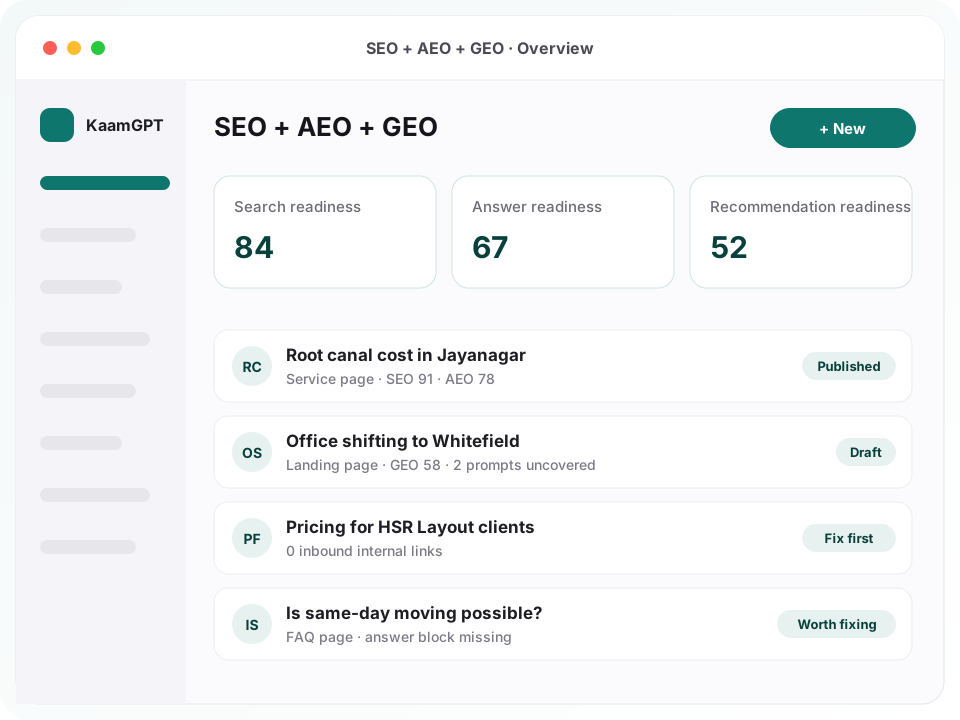
If you are shortlisting the best SEO software in Bengaluru, start with one question: what will it help you publish? KaamGPT's SEO + AEO + GEO app is where you write a page, watch three separate scores move as you type, and then generate the files search engines and AI assistants read: meta tags, JSON-LD, sitemap.xml, robots.txt and llms.txt. It suits people who would rather fix their own pages than wait on a monthly report.
The three scores answer three different questions. SEO asks whether a page can rank in Google's list of links. AEO, or answer engine optimisation, asks whether ChatGPT, Perplexity or Gemini can lift a clean passage from it and cite you. GEO, generative engine optimisation, asks whether a model would name your business when someone in Koramangala types 'who should I use for this near me'. A page can pass one and fail the other two, so the app never blends them into one number.
- ₹0Free plan with the whole app, for a team of up to five people
- 62checks behind three scores: 25 for SEO, 20 for AEO, 17 for GEO
- 31AI crawlers named one by one in the robots.txt it writes
- 11schema.org types you can add from the editor, plus a site-wide entity graph
Why Bengaluru searches are won one neighbourhood at a time
People here rarely search for a service in the city as a whole. They search in Koramangala, HSR Layout or Whitefield, and plenty still type 'Bangalore' rather than the official name. So when you test the best SEO software in Bengaluru, check how it treats places. In this app, areas are typed places rather than loose words, down to a PIN code such as 560034, and both spellings can sit among a page's secondary phrases without spawning duplicate pages.
The mix of businesses shapes the work as well. Startups around HSR Layout and Indiranagar often run JavaScript-heavy marketing sites and tend to care most about being cited by the AI tools their buyers use. Clinics in Jayanagar and manufacturers near Electronic City care more about the map listing and a consistent address. One app serves both, because separate SEO, AEO and GEO scores show each team which of the three it is actually losing.
Why do solid Bengaluru websites still go missing from AI answers?
Most small-business sites in the city were built to look good in a browser, not to be read by a machine. The homepage is a JavaScript bundle, the service pages share one meta description, and nobody has opened robots.txt since the agency handed over the login. Google may still send a trickle of visits. But an assistant asked about a service in Whitefield needs a short, attributable answer and a business it can place on a map, and neither exists.
Older audit tools were designed for ten blue links. They count words and check title lengths, which still matters, yet they rarely tell you whether GPTBot is blocked, whether an llms.txt file exists, or whether your company appears under three slightly different names across your own schema. That is the gap anyone weighing the best SEO software in Bengaluru now has to judge: ranking is one job, and being quoted and being recommended are two more.
- A 'Disallow: /' left over from the staging site quietly blocks every crawler, search and AI alike.
- Service pages for HSR Layout and Koramangala are near-copies, so search engines pick one and ignore the rest.
- The answer to the page's main question sits in paragraph six, where no answer engine goes looking for it.
- Structured data pasted once from a free generator breaks on the next edit and silently stops working.
- The business name, phone and address differ between the website, the map listing and the directories that mention it.
Which Bengaluru teams gain most by running SEO, AEO and GEO in-house?
Four common situations, and what changes when the team does the work inside one app.
A three-chair dental clinic in Jayanagar
- The situation
- The clinic ranks for its own name but not for treatments. Its root canal page never states a price range, the address on the site differs from the map listing, and robots.txt still carries a blanket block from a redesign.
- How KaamGPT fits
- The front-desk manager sets the business type to Dentist, pastes the map link and Place ID, lists Jayanagar, JP Nagar and Basavanagudi as typed areas, and rebuilds the page around one question with a direct answer, key facts and an FAQ block. The AI policy switches to allowing search crawlers.
- What changes
- The page now answers the question patients actually ask, and the clinic reads as one business with one address everywhere it appears.
A B2B SaaS startup in HSR Layout
- The situation
- Two years of blog posts have piled up. Several target the same phrase, the pricing page has no inbound links, and the React marketing site gives crawlers very little text until its scripts run.
- How KaamGPT fits
- Insights flags the phrases targeted twice and the orphaned pricing page. The team merges overlapping posts, points a canonical from the weaker one, adds internal links with descriptive anchors, and publishes a static index.html per page alongside llms-full.txt for agents that read whole sites.
- What changes
- Each topic has one page making its case, and the commercially important pages are linked from the ones that already attract readers.
A packers-and-movers firm in Electronic City
- The situation
- It serves a dozen localities and cloned one page per area with the name swapped. The copies compete with each other, none mentions a real local detail, and directories list the firm under two different phone numbers.
- How KaamGPT fits
- Each area page gets its own typed service areas instead of inheriting the full list, a place named in the title and opening line, and prompts such as 'same-day shifting from Electronic City to Whitefield'. The directory entries are corrected, then added as corroboration links.
- What changes
- Area pages stop undercutting one another, and every listing now describes the same company with the same contact details.
An online skincare label run from Koramangala
- The situation
- The founders want their products cited when shoppers ask assistants for recommendations, but they are uneasy about their ingredient guides being used to train models that never link back.
- How KaamGPT fits
- They pick the 'cite me, don't train me' preset, so AI search crawlers are allowed and training crawlers blocked, with ai.txt stating the same terms. Product pages gain Product schema, a comparison table against common alternatives, sourced statistics and a named reviewer.
- What changes
- The brand keeps the referral route from AI search open while saying plainly, in two machine-readable files, that training use is not welcome.
What should the best SEO software in Bengaluru actually do for your pages?
Everything here works on a draft, before anything goes live, because that is when changing a page costs nothing.
Three scores, kept apart on purpose
Each page gets an SEO score from 25 checks, an AEO score from 20 and a GEO score from 17. Every check names what is missing and why it matters, with partial credit so the number moves as you work. The overview shows search, answer and recommendation readiness side by side instead of hiding a weak one inside an average.
A placement map for your target phrase
Set the one phrase a page should rank for and the keyword panel shows where it appears across nine places: meta title, H1, URL slug, meta description, the first 100 words, a subheading, image alt text, the body and the direct answer. A density band warns when the phrase barely appears or has been repeated until it reads like spam.
Direct answers and key facts on the page
Write the 15-to-60-word answer to the page's question, then insert it straight after the H1 as a marked block. Key facts such as price, timing and coverage go in as a definition list, which is about as machine-readable as HTML gets. The answer can also be flagged as speakable for voice assistants.
A JSON-LD schema generator, no hand-coding
Add WebPage, Service, LocalBusiness, Product, Article, BreadcrumbList, Organization or WebSite markup built from the page's own fields, plus FAQPage, QAPage and HowTo from the answer tab. FAQPage is built from the questions you enter. Invalid JSON pulls the score down in plain sight rather than failing quietly on the live site.
robots.txt that names each AI crawler
The generated robots.txt lists 31 AI crawlers by name and splits them into search bots, which cite and link to you, and training bots, which do not. Pick a preset such as 'cite me, don't train me', or override one bot at a time. A site-wide block switches the AI rules off rather than contradicting itself.
An llms.txt generator, plus ai.txt
llms.txt hands AI agents a curated markdown map of your site, grouped by category, with each page described by its direct answer. llms-full.txt inlines every page's text in one file, and ai.txt states your AI-use terms in plain words. llms.txt, ai.txt and the entity graph carry the same one-sentence business description, so no file contradicts another.
One business entity graph for GEO
Describe the business once: one of 33 schema business types, a one-sentence description, typed service areas down to PIN code, the Google Business Profile link and Place ID, branches and the directories that list you. The app emits it as a single graph with a stable identifier for your homepage, so every page points at the same company.
Site-wide Insights, ranked by severity
Some problems only show across pages: two pages chasing one phrase, a published page nothing links to, a link to a slug that was renamed, a service area with no page of its own. Insights sorts them into 'Fix first', 'Worth fixing' and 'Opportunity', links to the affected pages, and suggests internal links worth adding.
What does SEO + AEO + GEO cost for a Bengaluru team?
Every plan includes the full app: the same checks, the same generators and the same publishing. Plans differ by how many people can use the workspace, storage, support and API access. Prices are quoted in INR, with the exact figure confirmed at checkout; committing for a quarter, half a year or a full year takes 10%, 15% or 20% off. Every limit is listed on the KaamGPT pricing page.
Free
₹0forever
No card needed
₹0 for up to five people: room for a founder and one writer to build, grade and publish a complete site, with 512 MB of storage and community support.
- Up to 5 employees
- 1,000 emails / month
- 200 WhatsApp messages / month
- 512 MB storage
- Community support
Starter
₹999/month
or ₹9,590 billed yearly — 20% less
Billed at ₹999 monthly, or ₹9,590 for the year, covering 25 people and 5 GB with email support; right for a small in-house team keeping a growing page library current.
- Up to 25 employees
- 25,000 emails / month
- 5,000 WhatsApp messages / month
- 5 GB storage
- Email support
Growth
Recommended₹2,999/month
or ₹28,790 billed yearly — 20% less
Billed at ₹2,999 monthly for up to 100 people and 25 GB, adding API access and faster email responses, for companies where marketing, sales and product all edit pages.
- Up to 100 employees
- 1,50,000 emails / month
- 30,000 WhatsApp messages / month
- 25 GB storage
- API access
- Priority email support
Business
₹7,999/month
or ₹76,790 billed yearly — 20% less
Billed at ₹7,999 monthly for up to 500 people and 100 GB, with priority help and onboarding, for larger organisations that want support setting the site up properly.
- Up to 500 employees
- 7,50,000 emails / month
- 1,50,000 WhatsApp messages / month
- 100 GB storage
- API access
- Priority support + onboarding
Optional add-ons
- Done-for-you SEO serviceFrom ₹14,999 a month if you would rather a team ran the technical audit, keyword research, on-page fixes and monthly reporting.
- Website buildFrom ₹9,999 per project through website development, when the current site cannot take root files or needs rebuilding first.
- The app does not host your website or register your domain; the generated files are uploaded to whatever host you already use.
- The people limit is shared across the workspace, so colleagues using other KaamGPT apps count towards the same plan.
- Starter, Growth and Business all open with 14 trial days before the first charge.
How do you go from an empty workspace to files on your live site?
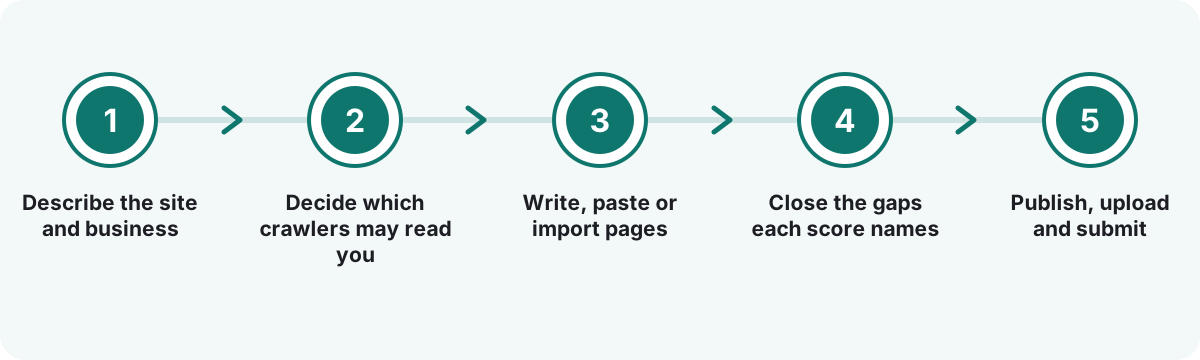
Describe the site and business
Enter the domain, organisation name, phone, address and profile links once. Paste the verification token from Google Search Console, Bing Webmaster Tools or Yandex, and the app writes the matching meta tag into the head of every page it exports.
Decide which crawlers may read you
Choose an AI crawler policy: allow everything, let AI search engines in while blocking training crawlers, or block all AI. The robots.txt preview updates as you change it, so you can read exactly what crawlers will see before anything is published.
Write, paste or import pages
Use the visual editor, or switch to the HTML, CSS and JavaScript tabs for full control. Existing pages come in as JSON, singly or in a batch, and land as drafts. A worked sample page walks you through the AEO tab if the idea is new to you.
Close the gaps each score names
Work down the failing checks: place the target phrase, insert the direct answer, add schema, list service areas and write the assistant prompts the page should answer. The live preview is the real exported HTML at desktop and mobile widths, not a mock-up.
Publish, upload and submit
Publishing stores robots.txt, sitemap.xml, llms.txt and any other files you switched on in your workspace storage, with a site ZIP holding each page's index.html. Upload them to your host, paste entity.jsonld into the homepage head, submit the sitemap in Search Console and, if you like, send the IndexNow file to Bing.
How does it compare with a CMS SEO plugin or a rank-tracking suite?
Most teams judging the best SEO software in Bengaluru already own one of these. The overlap is smaller than the feature lists suggest.
| What matters | KaamGPT SEO + AEO + GEO | CMS SEO plugin | Rank-tracking and backlink suite |
|---|---|---|---|
| Separate score for AI answerability | Yes: 20 AEO checks with their own score | Usually one blended SEO score | Rarely; built around rankings |
| AI crawler rules in robots.txt | 31 crawlers named, search vs training, per-bot overrides | Typically a free-text robots editor | Reports on crawlability, does not write rules |
| llms.txt, llms-full.txt and ai.txt | Generated from your pages and settings | Depends on the plugin or an add-on | Not generated |
| Business entity graph with typed service areas | One graph, 33 business types, Place ID, branches | Basic organisation markup | Not generated |
| Keyword volume and rank tracking | Not included; bring phrases from Search Console | Not included | Its core strength |
| Backlink analysis | Not included | Not included | Its core strength |
| Where your pages can live | Any host: static files, site ZIP and JSON export | Inside that one CMS | Audits any site, produces no files |
The honest verdict. No single product is the best SEO software in Bengaluru for every team. Pick KaamGPT when you build and fix pages yourself, AI answers and local recommendations matter, and your site is not tied to one CMS. Keep a rank-tracking suite for search volumes, competitor positions and backlinks, which this app does not provide. If your CMS plugin already suits you, adding llms.txt and an AI crawler policy may be all you are missing.
What should robots.txt tell AI crawlers, and what can it not do?
Split AI crawlers into two groups before deciding anything. Search and answer bots, such as OAI-SearchBot, PerplexityBot and Claude-SearchBot, fetch a page to answer someone right now and usually link back. Training crawlers, such as GPTBot, CCBot and Bytespider, collect text for models and send no visitors. For most service businesses, letting the first group in is free referral traffic; the second is a genuine business decision about your content.
Two points trip people up. Google-Extended only controls whether Google may use your content for Gemini training and grounding; Google's own crawler documentation says it does not affect inclusion or ranking in Search. And robots.txt is a request that well-behaved crawlers honour, not a lock. Google's robots.txt guide says it is not a way to keep a page out of search results, which is what a noindex directive is for.
- Check for a leftover 'Disallow: /' from a staging site before changing anything else.
- Allow AI search crawlers unless you have a specific reason to stay out of AI answers.
- Decide on training crawlers deliberately, and state the same decision in ai.txt.
- Use a page's noindex directive to keep it out of results; the app also leaves noindex pages out of the sitemap.
How do you write a direct answer an AI assistant will quote?
Answer engines break pages into chunks and quote the chunk that stands on its own. So the answer to the page's main question belongs directly under the H1, in one passage of roughly 15 to 60 words, naming who, what, where and, when it matters, what it costs. If that passage needs the rest of the page to make sense, it is unlikely to be the one lifted.
Back it with structure: key facts as label-and-value pairs, at least three FAQ pairs, headings phrased as the questions people ask, paragraphs under about 90 words, and a table wherever a comparison is being made. Then show who is saying it: a named author with a role or profile link, and a source for any number you quote. Google says AI Overviews need no special optimisation beyond sound SEO, so this work helps ordinary rankings too.
A useful test while trialling any candidate for the best SEO software in Bengaluru: take your most valuable service page, write its direct answer, and ask whether a stranger could act on those sentences alone. If they could not, no tool will make the page quotable. The AEO score measures whether the pieces are present and well placed; the sentence itself is still yours to write.
Which GEO mistakes stop a local business from being recommended?
Generative engines recommend entities, not pages. When someone asks for 'a reliable CA firm near Indiranagar', the model is deciding whether your name refers to a real, locatable business that serves that area, and whether anyone besides you agrees. That is why the GEO score deliberately mixes page checks with business-wide ones, such as whether you are linked to a map listing and listed anywhere else.
The fixes are unglamorous and mostly one-time. Most of them live in site settings rather than on any single page, which is why a well-written page can still score poorly on GEO until the business record behind it is complete. These are the gaps the checks catch most often.
- Choosing the generic LocalBusiness type when a specific one, such as Dentist, Plumber or AccountingService, exists.
- A name, phone number or address that differs, even by a character, between the site, the map listing and directories.
- No corroboration at all: not one directory or profile link outside your own website.
- Area pages that target a place they never mention in the title, opening line or answer.
- Prices, areas and dates left untouched for more than six months, which the GEO freshness check flags as stale.
Which kinds of business gain most from three separate scores?
- Clinics & diagnosticsTreatment and test pages with a price range, a direct answer and Dentist or MedicalBusiness schema tied to the map listing.
- Packers, movers & home servicesArea pages that each name their own locality, with typed service areas and a travel radius instead of cloned copies.
- SaaS & IT servicesBlog and pricing pages checked for cannibalisation and orphans, with llms-full.txt giving agents the whole site in one file.
- D2C & e-commerce brandsProduct schema, comparison tables and a crawler policy that welcomes AI search while declining model training.
- CA, legal & advisory firmsAccountingService or LegalService schema, named authors with roles, and cited sources for every figure a page quotes.
- Real estate & interiorsProject and locality pages with typed areas down to PIN code, and a branch entry for each sales office.
- Coaching institutes & schoolsCourse pages built around the questions parents and students really type, with FAQPage and HowTo markup.
- Restaurants & cloud kitchensRestaurant schema, opening hours and one business description repeated across llms.txt, ai.txt and the entity graph.
Why do in-house teams run their search and AI visibility work on KaamGPT?
Grades drafts, not just live pages
Every score is computed from the page you are writing, with no crawl and no external API. You see what is wrong while you can still change the sentence, rather than in a report a month after publishing.
Your files, on your own host
Nothing ties your site to KaamGPT. Download a static site ZIP, per-page JSON or a full backup of pages, categories and settings at any time, and share a download link that expires within the hour.
Plain about what it leaves out
It does not track rankings, estimate search volume or analyse backlinks. It says so up front and expects you to pair it with Search Console or a dedicated suite, rather than pretending to replace them.
Roles that separate writing from publishing
Permissions split viewing, creating, editing, deleting and publishing pages from managing site settings. A junior writer can draft all week without being able to change robots.txt or push a page live.
Rupee pricing with a genuine free plan
The Free plan carries the whole app for up to five people, and paid plans are billed in INR with discounts for longer terms. 100+ companies across India use KaamGPT.
One workspace with your other tools
The same sign-in and team list cover email and WhatsApp campaigns, attendance, projects, bills and the Google Business Profile app, so a landing page and the campaign pointing people at it are run by one team.
- Price
- ₹0 on Free; ₹999 on Starter, ₹2,999 on Growth, ₹7,999 on Business, monthly in INR, final figure shown at checkout
- Free plan and trial
- Full app free for up to 5 people; 14-day trial on paid plans
- Scores
- SEO (25 checks), AEO (20 checks) and GEO (17 checks), shown separately
- Files generated
- robots.txt, sitemap.xml, llms.txt, llms-full.txt, ai.txt, feed.xml, entity.jsonld, IndexNow files, static site ZIP
- Works with
- Any web host where you can upload to the root folder; runs in the browser, alongside every other KaamGPT app
- Contact
- Phone and WhatsApp buttons appear throughout this page
Where this applies around Bengaluru, Karnataka
- Bengaluru
- Whitefield
- Jayanagar
- Indiranagar
- Koramangala
- HSR Layout
- Electronic City
- Karnataka
- India
Frequently asked questions
22 answersIs KaamGPT the best SEO software in Bengaluru for a small business?
It depends on the job. If you want to write and fix your own pages and make them readable by AI assistants as well as Google, it fits well, and the Free plan lets you test that at no cost. If you mainly need rank tracking or backlink data, a dedicated suite will serve you better.
How much does the SEO + AEO + GEO app cost?
The app sits inside every KaamGPT plan, and Free costs nothing for up to five people. Starter is ₹999 per month, Growth ₹2,999 per month and Business ₹7,999 per month, and a year of Starter paid upfront is ₹9,590. Prices are quoted in INR, and checkout confirms the exact figure. Full limits sit on the <a href="/pricing">plans and pricing page</a>.
Can I try the SEO app free before paying anything?
Yes. The Free plan includes the entire app, all 62 checks and every generator for up to five people, with 512 MB of storage and community support. Paid tiers open with 14 days to test API access or priority help first. The simplest way to judge whether it is the best SEO software in Bengaluru for your site is to <a href="/signup">create a free workspace</a> and grade one real page.
What does setting up the SEO app involve, and how long does it take?
Setup is mostly typing what you already know: domain, organisation name, phone, address and profile links, then your AI crawler policy. That is enough to get your first page graded, and a worked sample page shows every AEO field filled in. Most of the time after that goes into rewriting pages, which depends on how many you have and how far each one is from passing.
Can it promise first-page rankings or AI citations?
No, and nobody honestly can. Google, ChatGPT and other engines decide what to rank and quote. The app makes sure each page gives them what they look for: a clear target phrase, a direct answer, valid structured data, crawlable files and a business they can identify. Competition, content quality and links from other sites still matter. If you need visitors sooner, <a href="/best-digital-marketing-agency-in-bengaluru">paid and social campaigns</a> can run alongside.
What is the difference between SEO, AEO and GEO?
SEO is about ranking in Google's list of links. AEO, answer engine optimisation, is about being the passage an assistant quotes, so it grades direct answers, FAQs, facts and AI crawler access. GEO, generative engine optimisation, is about being the business a model recommends, so it grades your entity, service areas, map link and third-party listings.
Does blocking GPTBot or Google-Extended hurt my Google rankings?
No. GPTBot is OpenAI's training crawler, and Google-Extended controls only whether Google may use your content for Gemini training and grounding; Google states it is not a ranking signal for Search. Blocking training crawlers leaves normal search intact. Blocking AI search crawlers such as OAI-SearchBot is different, because it can keep you out of ChatGPT's search answers.
Does the app write my page content with AI?
No. It does not generate articles. It grades what you write, suggests assistant prompts from your target phrase and place, and inserts the blocks you fill in, such as the direct answer, key facts, sources and service areas. Keeping authorship with you is deliberate: a page an engine quotes should say what your business really offers.
Will it work with my existing website and hosting?
Yes, if you can upload files to your site's root folder and edit the homepage head. The app exports robots.txt, sitemap.xml, llms.txt and the other files under the exact names they need, plus a static index.html per page. Site builders that lock the root folder limit what you can use, though page content and schema still copy across.
How do I move pages over from my current website or SEO tool?
Import accepts JSON: a single page, an array of pages or a full backup from this app, with fields such as title, slug, HTML content, meta title, meta description and JSON-LD. Imported pages land as drafts, so nothing goes live by accident. Pages with no export can be pasted into the HTML tab and graded straight away.
Who owns the pages and files, and how is my data kept separate?
You do. Your pages, categories and settings sit inside your own workspace, walled off from every other company's. Generated files sit in storage under your company's own prefix, downloads need the right permission, and shared links expire within an hour. Scripts are stripped from page HTML when it is saved, and a full backup can be downloaded whenever you like.
What support comes with each plan?
Help scales with the tier. Free workspaces rely on the community, Starter adds email help, Growth moves your emails up the queue, and Business adds priority handling plus guided onboarding. Inside the app, every failing check explains what is missing and why it matters, which settles most questions before anyone needs to ask them.
Who can walk me through the SEO app before I sign up?
Phone us, or message on WhatsApp, at +91 79767 82366. Share your domain and the page you care about most, and someone from KaamGPT will walk you through how the app would score it and which fixes would come first. The same number is the quickest way to ask about plans for a larger team.
How is this different from the SEO plugin inside my CMS?
A plugin usually gives one SEO score and meta fields for that CMS only. This app keeps three separate scores, writes robots.txt rules for 31 named AI crawlers, generates llms.txt, llms-full.txt, ai.txt and a business entity graph, and exports files for any host. A plugin wins if your whole site lives in that CMS and you only need basic metadata.
Does it connect with other KaamGPT apps?
It shares the workspace, sign-in, team list and roles with every other KaamGPT app, but it does not pull data from them. The natural pairing is the <a href="/best-google-business-profile-software-in-bengaluru">Google Business Profile app</a>: the map link and Place ID you enter here are what tie your website to that listing for generative engines.
Who is SEO + AEO + GEO not a good fit for?
Skip it if you want someone else to do the work; the <a href="/best-seo-services-in-bengaluru">done-for-you SEO service</a> exists for that. It is also not a rank tracker, keyword-volume tool or backlink analyser. And if your site builder will not let you upload root files or edit the head, that limits what any tool, this one included, can change on your live site.
Does it handle Kannada pages and Bengaluru-specific search terms?
You can type Kannada text into the editor, but exported pages are declared as English and the readability score is tuned for English prose, so guidance on a Kannada-first page is weaker. Local terms work well: typed areas cover neighbourhoods, districts, Karnataka as a state and PIN codes, and both 'Bengaluru' and 'Bangalore' can be secondary phrases.
Can I use it on my phone?
Yes. KaamGPT runs in the browser, so you can check scores, review Insights and publish from a phone. The live preview has a mobile width, which is handy for seeing how a page reads on a small screen. Long rewrites and the HTML, CSS and JavaScript tabs are more comfortable on a laptop.
What is llms.txt, and do AI companies actually read it?
llms.txt is a proposed convention: a markdown file at your site's root that gives AI agents a short, curated map of your pages. It is not a ratified standard and no vendor promises to read it, but it costs one small file. The app builds it from your published pages, using each page's direct answer as its description.
Does it submit my pages to Google and Bing automatically?
Not automatically. It writes sitemap.xml for you to submit in Google Search Console, puts your verification tokens into every exported page, and can create an IndexNow key and URL list for Bing and other participating engines. You send the IndexNow file yourself after uploading, so no engine hears about a page before it is live.
Can several people work on the same site?
Yes. Anyone within your plan's people limit can be given access, and permissions separate viewing pages, creating, editing, deleting and publishing them, managing categories, and changing site settings such as the domain, robots.txt and AI crawler policy. Writers can draft freely while one person controls what goes live.
Do I need a Google Business Profile for a good GEO score?
You can start without one, but the GEO score will stay lower. One check looks for a map link plus a Google Place ID, and another for the business's phone, street and city. Local recommendations lean on a listing that matches your site exactly, so setting one up usually comes early in the work.