 KaamGPT
Ask three firms for a website and you usually get three quotes that cannot be laid side by side: one lists pages, one lists hours, one shows a single total. If you are vetting a website development company in Bangalore, this guide is written for exactly that moment. It covers the kind of site you are really buying, the lines every written quote must carry, how design, development and a lone freelancer differ, and what you should hold in your own name on launch day.
KaamGPT, based in Bengaluru, builds client websites and also runs its own production software, so the advice here comes from people who maintain live code every working day. The Website Development service begins at ₹9,999 per build; a site within that scope normally launches inside a week. Every other managed offer sits on KaamGPT's services page, and the screen-by-screen package guide spells out what that first scope contains.
- ₹9,999is where KaamGPT website builds begin
- ~1 weekusual build time once content and sign-offs are in
- 1 monthof post-launch support inside every website project
- 8client case studies published on KaamGPT's Works page
Four Bengaluru websites KaamGPT has shipped, and the job each one does
These are published client projects rather than invented scenarios. Each outcome below repeats only what the matching case study on KaamGPT's Works page reports.
RentaMaids247: monthly maid services across the city
- The situation
- Families looking for domestic help search by their own locality, so a single citywide page could not answer what each of them was really asking: is help available near me, and how quickly will someone call back?
- How KaamGPT fits
- A site built to win a callback: every locality the service covers gets its own landing page with local SEO behind it, and enquiries route to phone, WhatsApp or a callback form. Paid search and social ads reach the areas organic results do not yet cover.
- What changes
- The site shows up when families search for maid services in the Bengaluru areas RentaMaids247 covers, and enquiries come in by phone, WhatsApp and the callback form.
Globe Courier: a parcel service based in Banaswadi
- The situation
- A courier sending parcels across India and to more than 200 countries has to answer the first thing every sender asks, which is the price, before it can win the pickup.
- How KaamGPT fits
- A quote-first website where the instant quote comes before the pickup request, a Google Business Profile plus local pages covering the north-eastern localities, and ads plus WhatsApp for quick quotes and tracking links.
- What changes
- Quote requests and pickup bookings now arrive online, and Globe Courier appears for local courier searches in and around Banaswadi and across the north-east of the city.
OneMove Chess Academy: chess coaching for children
- The situation
- Parents comparing classes want programme levels, batch timings and a chance to try a session first, and answering every one of those questions by phone does not scale.
- How KaamGPT fits
- A website organised around programmes and levels with one-step demo-class booking, supported by local SEO aimed at parents searching nearby and social posts drawn from classes and tournaments.
- What changes
- Parents now request demo classes on the website, and the academy's visibility in nearby searches and on social media is still being built up.
A2Z WorkHub: a home-services brand working in Bengaluru and Dubai
- The situation
- A home-services brand competing with large directories for local searches needed its own website to sell every service and steer visitors towards booking or installing its app.
- How KaamGPT fits
- A fast, mobile-first website that sells each service and points visitors to the company's Android and iOS app, one admin panel serving both, plus local SEO, paid search and social ads, and WhatsApp and email campaigns.
- What changes
- In Bengaluru, A2Z WorkHub outranks JustDial on its most important home-service searches, and customers book straight from its own app and website.
- Entry figure
- ₹9,999 for each website project; bigger scopes quoted in writing after scoping
- Typical build time
- A week or so for the starting scope, from the day content is approved
- Site types built
- Company sites, ad landing pages, catalogues, booking sites, multi-area sites, portals and web apps
- Technology
- React and TypeScript with prerendered public pages; FastAPI and PostgreSQL behind web apps
- After launch
- First month of support included; ongoing maintenance quoted in advance
- Base
- Bengaluru, with one office handling clients city-wide and beyond
Which kind of website is your Bengaluru business actually commissioning?
Most briefs fall into one of eight types. Naming yours first is the quickest route to comparable quotes, because each type carries its own pages, integrations and pricing logic.
Company website for credibility and enquiries
The classic five-to-ten page site: what the business does, evidence that it is genuine, and the way to reach it. This is business website development in its plainest form, and the job KaamGPT's ₹9,999 starting scope was shaped around. The effort goes mostly into writing and structure, with separate pages for each service, a team page with genuine photos and an enquiry route on every screen, rather than into complicated code.
Landing pages built for paid campaigns
One offer, one form, nothing else to click, and a headline matched to the ad that brought the visitor. These pages succeed or fail on load time and conversion tracking, so page and campaign have to be planned as one piece of work. When paid search is in the plan, read how the pay-per-click team in Bangalore structures campaigns before you brief the page.
Product catalogues that ask for a price, not payment
Manufacturers in Peenya and wholesale traders around Chickpet often need buyers to see specifications, pack sizes and certifications, then request a rate rather than pay online. A catalogue site keeps hundreds of items in the CMS, filters them by category and sends every enquiry to sales with the product attached. Once you need a cart and payment, the job becomes a store, covered in the ecommerce build guide.
Booking and appointment sites
Clinics, salons, tutors and coaching academies need a visitor to pick a slot, not fill a form and hope for a call back. The site presents services, practitioners and timings, then hands the booking to a calendar your staff manage; KaamGPT's own Calendar app can play that part. Booking confirmations and reminders can follow on WhatsApp via Meta's official Cloud API, the route KaamGPT's own messaging apps run on.
Multi-branch and multi-area sites
A business serving many parts of the city needs a page per branch or area that says something true about that place: services offered there, timings, a nearby landmark, the right phone line. Pages identical but for the place name help nobody, and Google's spam policies list substantially similar pages built for neighbouring searches among their examples of doorway abuse. RentaMaids247's site gives every Bengaluru locality it serves its own landing page.
Customer, dealer and partner portals
Work that lives behind a login: order status for distributors, documents for clients, enquiries routed to brokers. A portal needs user roles, permissions, an audit trail and a proper database design, which puts it well outside a brochure-site budget. These are scoped after a discovery call and quoted in writing, and the custom software guide for Bangalore describes how that scale of build is run.
Web applications and first product releases
Dashboards, marketplaces, internal tools and SaaS launches. KaamGPT builds these on the foundation its own workspace runs on: typed React screens, a FastAPI service written in Python, Postgres for storage and queue workers for slow jobs such as sending messages. The TRECOM real-estate portal is one example, bringing every side of a property deal, from tenants to investors, onto a single platform.
Rebuilds of a site that already ranks
A redesign is the riskiest brief on this list, because the old site may already earn search visits you cannot see. The safe order is an inventory of every URL that gets traffic or links, a map from each to its new address, and permanent redirects issued by the server, status 301 or 308, switched on at launch. Google's site-move guidance asks for those redirects to stay in place for at least a year.
How does a KaamGPT website project move from scoping call to handover?
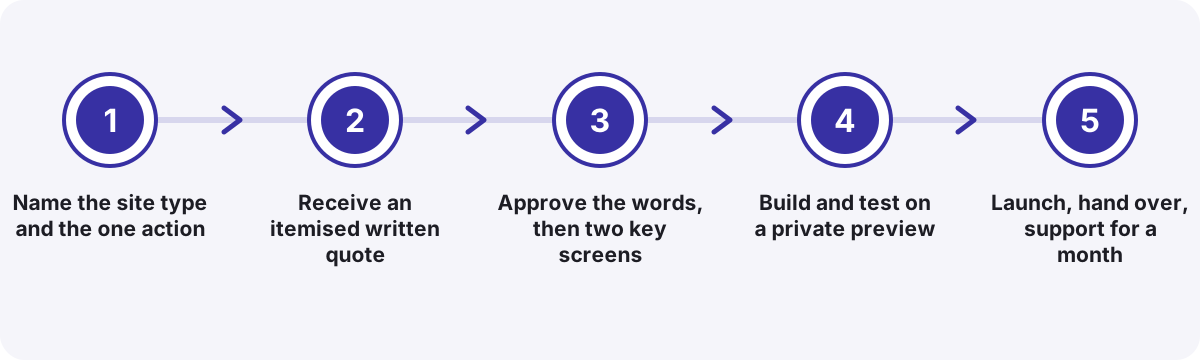
Name the site type and the one action
A short call fixes which of the eight site types you need, who your visitors are and the single action that matters most: a call, a WhatsApp message, a booking or a quote request. Logins you already hold for the registrar, hosting and analytics get listed now, so nothing surfaces late.
Receive an itemised written quote
The job is broken into lines: page and template list, content responsibility, CMS, integrations, revision rounds, hosting, domain, ownership of design and code, support, timeline and payment stages. You can strike out or add lines before approving anything.
Approve the words, then two key screens
Copy for the front page and one typical inner page is settled first, then both screens get designed for a phone before anything else and signed off. The remaining pages follow the approved pattern, which is how a starting scope fits into roughly a week.
Build and test on a private preview
Pages are coded in TypeScript with React and prerendered, so each public address carries its full text in the HTML. Forms, WhatsApp links, analytics events and structured data are wired up, and the preview is tried on a mid-priced Android handset over a mobile connection before you review it.
Launch, hand over, support for a month
DNS is pointed, HTTPS confirmed, redirects tested and the sitemap submitted in your Search Console. You receive a handover note listing every account, its owner and its renewal date, and fixes plus CMS help during the first month come with the project.
What makes KaamGPT a sensible shortlist pick for a website build?
Builders who run their own production software
The team that builds client sites also maintains the KaamGPT workspace, a live multi-app product: TypeScript and React screens talking to a FastAPI backend written in Python, with PostgreSQL holding the data and worker processes draining job queues. Habits such as typed code and versioned database changes carry over to client builds.
A number on the table before the first call
Website Development shows ₹9,999 per project as its public entry price. The scoping conversation begins from that figure, and anything that moves it shows up as a separate, priced entry in the quote you approve.
Ownership settled on paper
Your domain, analytics and Search Console are registered to the company itself, KaamGPT receives manager access only, and the ownership and handover of design and code are written into each quote rather than left to memory.
Case studies with named clients
Projects for RentaMaids247, Globe Courier, OneMove Chess Academy and A2Z WorkHub are written up on KaamGPT's case-study pages, each stating what was built and what the business now does with it.
Search and ads on the same desk
Search optimisation, Maps visibility and ads on Google and Meta are KaamGPT services too, so page structure, tracking and the campaign plan get decided together instead of by vendors who never speak to each other.
One Bengaluru office, every area covered
A single Bengaluru office handles every client, and those from Electronic City to Yelahanka get the same routine: a scoping call, private preview links and a WhatsApp group for day-to-day questions.
Where does website pricing in Bengaluru start, and what pushes it up?
KaamGPT publishes one figure for websites: ₹9,999 a project, attached to a fixed starting scope that normally ships within a week once content and sign-offs arrive. Anything larger is priced from the scoping call and itemised, so you can see which feature moved the total. Anyone ranking a website development company in Bangalore on price alone should read the three cards below, which show where that opening figure stops and what lies beyond it.
- Custom design
- Mobile first
- SEO ready
- CMS included
- Analytics setup
- 1 month free support
Entry-level website
₹9,999 upward, per project
A company site, a campaign landing page or a compact booking site whose pages, layouts and integrations fit the defined starting scope.
- Two key screens signed off at phone width first
- Prerendered pages with titles and structured data
- CMS with logins for the editors you name
- Analytics and Search Console created in your accounts
- Typically launched within a week of content
- One month of post-launch support
Larger business or multi-location site
RecommendedQuoted in writing after scoping
Catalogues with hundreds of products, businesses with several branches or service areas, bilingual sites, and rebuilds of a site that already earns search traffic.
- Page plan priced template by template
- Branch or area pages with genuinely local content
- URL inventory and permanent-redirect map
- English and Kannada versions where buyers need them
- Dated milestones set out in the quote
Web app or customer portal
Priced after a discovery call
Startups and operators who need logins, roles, dashboards or a dealer portal rather than brochure pages.
- Screens, roles and permissions agreed in writing
- Acceptance checks attached to each milestone
- Typed React front end over Python FastAPI
- Data model agreed before the build starts
- Code ownership and handover terms in the quote
Optional add-ons
- SEO after launchTechnical fixes, a content calendar and authority building, billed monthly from ₹14,999; the SEO services guide for Bangalore sets out what that programme covers.
- Local SEO for one locationProfile optimisation on Google, a local keyword map, citation clean-up and answers to reviews, billed monthly from ₹4,999, aimed at firms that win most walk-ins through Google Maps; the local SEO guide for Bangalore has the detail.
- Google Ads managementCampaign structure, keyword choice and bidding, for a KaamGPT fee that opens at ₹4,999 a month; Google charges click costs to an ad account your company owns, and KaamGPT's fee never includes them.
- WhatsApp chatbotAn automatic first reply to enquiries that arrive from the site, configured in KaamGPT's WhatsApp Chatbot app under your workspace subscription.
- What raises a quote fastest: more distinct templates, integrations such as payments or a CRM, copywriting, extra languages, migrating an old site, and any formal accessibility audit a corporate buyer asks for.
- Domain registration, separately billed hosting, payment-gateway charges and paid fonts or stock images are paid to those providers; the quote names each one and says who pays it.
- A cart with checkout is never part of the starting price. Apps a site can hand work to, such as Calendar, CRM or the WhatsApp tools, run on a workspace plan listed on KaamGPT's plans page, starting with the ₹999 Starter plan, GST already inside the price.
- The one-week estimate is counted from the day your words, images and sign-offs reach the team; bigger jobs carry their own dated milestones.
KaamGPT, a freelance website developer or a template builder: which fits your project?
Plenty of owners weigh an agency against a website developer in Bangalore who works alone, or against assembling the site themselves on a hosted template service. Each route can be right. They differ most in who carries the risk when something breaks or someone moves on.
| What matters | KaamGPT Website Development | Independent freelance developer | Hosted template builder |
|---|---|---|---|
| Who designs and who codes | Design and engineering on one team | One person, usually stronger at one of the two | You, inside the builder's templates |
| Scope agreed before work starts | Itemised quote you approve first | Varies; sometimes a chat message | None; you pick a monthly plan |
| Platform | React and TypeScript plus a CMS; no WordPress builds | Often WordPress, which suits many sites well | Tied to that builder's own system |
| Public pages as crawlable HTML | Prerendered on every public address | Depends on theme and plugins | Generally handled by the platform |
| When a key person is unavailable | Another team member picks the work up | Work waits until they return | Platform help desk; content stays your job |
| Moving the site elsewhere later | Ownership and handover terms in the quote | Depends on what was agreed | Export options differ by builder |
| Integrations: WhatsApp API, payments, CRM | Written in code against official APIs | Mostly through plugins | Limited to the builder's add-on store |
| Cheapest way to a one-page presence | Rarely the lowest price | Often | Usually, if your own time is free |
The honest verdict. Pick a template builder for a simple page you will maintain yourself, and a trusted freelancer when you want WordPress specifically or a small, sharply defined job. KaamGPT does not sell WordPress builds; it fits when the site must carry enquiries, bookings or logins and you want scope, ownership and support written down. Whichever website development company in Bangalore reaches your shortlist, put these eight rows to them in writing.
What must a website development company in Bangalore spell out in its quote?
Treat the quote as the specification. If a line is not written, assume it is not included, because that is how the invoice will read on the day a disagreement starts. The checklist below is the one a web lead uses when laying three proposals side by side. A document missing more than two of these lines is not yet a quote; it is an estimate.
Ownership deserves a clause of its own. India's Copyright Act, 1957 gives first ownership to whoever authored a work, and it classes computer programmes as literary works. Code an outside firm writes for you is not your employees' work, so the copyright begins with the firm or freelancer, not with you. Section 19 adds that a transfer of copyright is valid only on paper, signed by the person transferring it, and it should name the rights, how long they last and where they apply.
Those last details matter more than they look. Leave the period out and the Act treats the transfer as lasting five years; leave the territory out and it is read as covering India alone. A line saying 'the client owns the website' can therefore give you less than it sounds. KaamGPT writes ownership and handover terms into each quote, and whoever you hire, ask your own lawyer to read the wording.
- Pages and templates: the full page list, and how many distinct layouts sit behind it.
- Content: who writes the copy, who supplies photographs, and proof of the right to use them.
- CMS: which system, with an administrator login in your name rather than only an editor seat.
- Revisions: how many rounds at design stage and at build stage, and the rate for extra rounds.
- Hosting and domain: where the site runs, who pays each renewal, and the domain held in your company's name.
- Code and design: a transfer clause naming rights, duration and territory, plus repository access at handover.
- Support and AMC: what the included period covers, then the yearly maintenance price and response times.
How fast and how findable should a new site be on day one?
Core Web Vitals, Google's measures of real-world page experience, give a checkable answer. LCP, the moment the biggest image or text block appears, should arrive by 2.5 seconds; INP, the lag between a tap and the screen reacting, should stay at or under 200 milliseconds; CLS, how far the layout jumps, should not exceed 0.1. Each bar must hold for three visits in four (the 75th percentile), counted separately on phones and desktops.
Since 2024, INP has stood where First Input Delay used to, so an audit still quoting FID is stale. Know which numbers you are reading, too. PageSpeed Insights shows field data from the Chrome UX Report over the previous 28 days, beside a Lighthouse lab run in a simulated environment. A newly launched site often has too few real visits for field data, so judge launch week on the lab run plus a real budget Android phone, then watch the field figures fill in.
Findability depends on how pages are delivered. Google works through a JavaScript site in stages: it fetches the address, queues the page so its scripts can be executed, then indexes what it finds. Its own JavaScript SEO guidance still calls server-side or pre-rendering a great idea, partly because not every bot runs JavaScript. Links should be ordinary anchor elements carrying an href, routes should use the History API rather than # fragments, and a missing address should never answer 200 with a 'not found' message, the soft-404 trap single-page apps fall into.
KaamGPT practises this on itself first: kaamgpt.com's public guides go out as prerendered pages carrying structured data, listed in an XML sitemap, with IndexNow used to announce changes. Client builds get the same prerendered delivery on every public page, so crawlers never meet an empty shell.
- Open View Source on a service page: its main text, title and description should already be present.
- Run PageSpeed Insights on the mobile setting and read LCP, INP and CLS individually, not just the overall score.
- Type a made-up address on the site; it should return a real 404 status, not a friendly page answering 200.
- Compare the phone and desktop layouts; Google's mobile-first guidance asks for the same primary content on both.
- Check that each page carries a unique title, one H1 and a canonical address.
Are your enquiry forms accessible, and ready for India's data protection law?
A lead form is where accessibility and privacy meet. WCAG 2.2, the W3C standard first published in October 2023, added criteria that bite on exactly these screens: pointer targets of at least 24 by 24 CSS pixels at level AA, a focused field never completely hidden behind a sticky header or chat bubble, no forced re-typing of details already given in the same process, and sign-in that does not demand a memory or puzzle test without an alternative.
On privacy, the Digital Personal Data Protection Act, 2023 decides what a form may do. Under Section 5, the visitor sees a notice listing which personal details you collect and why, before or alongside the consent request. Under Section 6, consent counts only if it is voluntary, informed, linked to that stated purpose and expressed through something the visitor actively does, like checking an empty box; even then it stretches only to the details the purpose requires. Taking consent back must be no harder than giving it.
Two details suit Bengaluru sites in particular. Visitors must be able to read that notice in English or in any language listed in the Constitution's Eighth Schedule, Kannada among them. And the implementing Rules, published in November 2025, give businesses an eighteen-month phase-in, so a site launched today will still be running when those duties bite. Building the form correctly once costs far less than retrofitting it.
- Ask only for fields you will actually use; a callback form rarely needs more than name, phone and the need.
- Place a short notice beside the button stating what is collected and why, with a Kannada version where your buyers expect one.
- Use an unticked box for marketing consent, kept separate from the enquiry itself.
- Give every field a visible label instead of placeholder text that vanishes as the visitor types.
- Explain how someone can withdraw consent or ask for correction or erasure, and make sure that route really works.
Which Bengaluru sectors commission which kind of website?
- Manufacturers and machine shopsMachine lists, tolerances and quality certificates, and a quote-request form where buyers attach their drawings, for units in Peenya and Bommasandra.
- Wholesale and distribution tradersProduct ranges, pack sizes and dealer enquiry forms for Chickpet trading houses that sell by quotation rather than by cart.
- Clinics and diagnostic centresDoctor and test pages in plain language, clear timings, and slot booking that reception manages without phone tag.
- Coaching centres and academiesProgramme and level pages with demo-class booking, the pattern OneMove Chess Academy's site follows.
- Home services and domestic helpArea-by-area pages with a callback form and a WhatsApp route, the structure built for RentaMaids247.
- Couriers and logistics firmsQuote-first layouts where an instant price appears before the pickup request, the approach Globe Courier's site takes.
- Real estate developers and brokersProject pages with floor plans, location maps and site-visit enquiries; the registration details each project must display are supplied by the developer.
- Startups and SaaS teamsA product site with pricing and security pages first, then a web app or dashboard quoted as its own project.
How do buyers across Bengaluru judge a website before they call?
Mostly on a phone, mid-errand, usually after a Maps listing or a forwarded WhatsApp link sent them there. A homeowner in Banaswadi compares two courier quotes; a buyer from another state looks for a Peenya machine shop's capacity list; a parent in Electronic City checks whether a coaching centre runs weekend batches. Each judges, before scrolling, whether the site answers the question that brought them.
Language and contact habits shape the build too. Plenty of Bengaluru customers read English comfortably yet prefer Kannada for personal matters such as healthcare or schooling, and many would rather message on WhatsApp than type into a form. A capable website development company in Bangalore plans for both: bilingual pages where the audience needs them, and a WhatsApp button whose chat opens with a sensible first line already typed.
KaamGPT serves the whole city from its one Bengaluru office. Reviews happen on private preview links and short screen-share calls, so a client in Whitefield, Koramangala, Jayanagar or Peenya gets the same process. For neighbourhood-level advice, see the area guides for websites in Jayanagar and websites in Electronic City.
Why do website quotes for the same Bengaluru business differ so wildly?
Because each vendor prices a different website in their head. One pictures five static pages with your logo dropped in; another pictures a CMS, a booking flow, Kannada pages and analytics; a third quotes low and plans to bill every change afterwards. None of them is necessarily dishonest. The brief simply left room for three readings, and the numbers followed those readings.
The fix is to have every website development company in Bangalore that you approach price the same thing, line by line, and to decide early which of those lines matter to your business. A small figure and a far larger one can both be fair, because they describe different jobs. The sections below show how to tell which job you need and which lines justify the price.
- One proposal counts pages, another counts hours, and a third offers a single total with no breakdown at all.
- Nobody states who the registered owner of the domain will be, or who keeps the code if the relationship ends.
- Revisions are 'unlimited' on the sales call and 'two rounds' on the invoice.
- Hosting looks free in year one, then renews at a price nobody mentioned.
- Support stops at launch, so the first text change after go-live arrives as a fresh bill.
How does KaamGPT compare with a freelancer or a large agency?
Website development in Bengaluru three ways. KaamGPT’s column is from its published price list; the others describe how those arrangements usually work.
| What you get | KaamGPT | A freelancer | A large agency |
|---|---|---|---|
| Starting price | From ₹9,999 per project, as published | Quoted per job | Quoted after a proposal, often as a monthly retainer |
| What is included | Custom design; Mobile first; SEO ready; CMS included | Whatever one person covers | Set out in the proposal |
| First delivery | Typically 7 days | Agreed per job | Set in the proposal |
| Price agreed | Written quote with scope and price before work starts | Ask for it in writing | In the signed proposal |
| Where enquiries go | Straight into the KaamGPT CRM, with WhatsApp follow-up | Your own tools | Their tools or yours |
| Who you talk to | A Bengaluru team by call, WhatsApp or online meeting · +91 79767 82366 | The freelancer directly | Usually an account manager |
How does Google measure a page’s experience?
Core Web Vitals is a set of metrics that measure real-world user experience for loading performance, interactivity, and visual stability of the page.
Where this applies around Bengaluru, Karnataka
- Banaswadi
- Peenya
- Bengaluru
- Chickpet
- Karnataka
- Jayanagar
- India
- Koramangala
- Whitefield
- Electronic City
Frequently asked questions
29 answersWhat exactly is included when KaamGPT quotes ₹9,999 for a website?
The ₹9,999 price buys a fixed starting scope: a custom design approved at phone width, prerendered pages with their own titles and structured data, a CMS, analytics and Search Console created in your accounts, and a month of support. It suits a company site, a campaign landing page or a compact booking site. Extra templates, integrations, languages or migration work are priced as additional entries in your quote.
How does a web development company in Bangalore differ from a website design company?
Mostly in where the work stops. A website design company in Bangalore may deliver branding, layouts and mock-ups but leave the build to somebody else, while a web development company in Bangalore writes the code, connects forms and integrations and deploys the site. Most problems appear in the gap between the two. KaamGPT does both on one team, so the approved design and the working build come from the same people.
When does hiring a single website developer in Bangalore make more sense than an agency?
When the job is small, tightly defined and you are happy to manage it yourself: a WordPress theme tweak, a one-page site, a fix on an existing build. A capable independent developer can be quicker and cheaper for work like that. The risk grows with scope, because design, code, hosting and support then all rest on one person's calendar and health.
Should the domain be registered in my company's name or the developer's?
Your company's, every time. The registrant on the domain record decides who can renew, transfer or repoint it, and recovering a domain held by a former vendor can drag on for weeks. Buy it from a registrar in the business's name, keep that login with a director, and give your developer delegated access or DNS changes only. KaamGPT leaves client domains registered to the client.
Does paying for a website automatically mean I own its source code?
Not under Indian copyright law. The Copyright Act, 1957 makes the author the first owner, and code written by an outside firm is not employee work, so ownership reaches you only through a written, signed assignment. Ask for a clause naming the work, the rights, the duration and the territory. KaamGPT puts ownership and handover terms into each quote; have your lawyer read any contract before signing.
What is an AMC for a website, and do I need one after launch?
An annual maintenance contract covers the upkeep a live site needs: dependency and security updates, backups, uptime checks, small content edits and fixes. Whether you need one depends on how often the site changes and how much it matters to sales. KaamGPT covers the month after launch in every project; beyond that, maintenance is quoted in advance with its scope and response times written down.
How many revision rounds should a website quote allow?
Two rounds at design stage and one at build stage is a workable pattern, provided one person on your side gathers everyone's feedback first. The bigger point is that the quote states the number of rounds and the rate for extra ones. A promise of unlimited revisions usually means either a padded price or a project that never quite closes.
Why do some Bengaluru website quotes come in far below ₹9,999?
Very low bids usually reuse a purchased theme, skip analytics and search setup, leave the CMS unconfigured or exclude support. Some are genuine bargains for simple needs. Before accepting a cut-price bid, quiz the website development company in Bangalore about what is excluded, who hosts the site, who the domain is registered to and what a change after launch costs. The answers show where the saving came from.
Can KaamGPT take over a website another agency built?
In most cases, provided you can grant access to the domain, the hosting, the code repository or CMS, and analytics. The first step is an audit of what exists and who controls each account. From there the options are to maintain the current build, repair it in place or rebuild it, each costed on its own, so keeping and replacing can be compared directly.
Will rebuilding our site on a new platform cost us our Google rankings?
It need not. Before launch, every URL that receives visits or links is listed and mapped to its new address, and permanent server-side redirects go live together with the new site. Google's site-move guidance asks for those redirects to stay at least a year, and the page indexing report in Search Console shows any pages that drop out during the weeks after the switch.
Which CMS will my staff use to edit a KaamGPT-built site?
Every build includes a content management system with logins for the people you nominate, arranged around fields such as headings, prices, timings and photos so a routine edit cannot break a layout. The quote names the editing tool and who holds the administrator account. KaamGPT does not build on WordPress, so if your team insists on that dashboard, a WordPress specialist will suit you better.
Can a website be bilingual in Kannada and English without hurting search?
Yes, when each language has its own URL rather than a toggle that swaps text in place. Google recommends separate URLs for each language version, connected to one another through hreflang annotations, so a Kannada searcher is shown the Kannada page. Text should be real Kannada script, never an image of it, and fonts should be tested on budget Android phones before launch.
What Core Web Vitals scores should I ask a developer to commit to?
Ask for Google's published 'good' thresholds on mobile: LCP at 2.5 seconds or faster, INP no slower than 200 milliseconds and CLS no higher than 0.1. Because field data needs weeks of real visits, agree that launch is judged on a lab test plus a real mid-range phone, then reviewed again once Chrome UX Report data appears for the site.
Is a React website bad for SEO?
Not inherently. The risk lies in sending crawlers an empty shell that fills in only after JavaScript runs. Google can render JavaScript, yet its own guidance still recommends server-side or pre-rendering, and not every bot executes scripts at all. KaamGPT prerenders public pages so the text, title and structured data are present in the very first HTML response.
What paperwork and logins should I receive on launch day?
One note listing every account the site depends on: registrar, DNS, hosting, CMS administrator, analytics, Search Console, email sending, payment gateway and any paid fonts or plugins, with the owner and renewal date of each. Add the repository location or a code export, the redirect map if pages moved, and the support terms. Keep it somewhere more than one person in the business can find it.
Who pays for hosting, and can the site sit in our own cloud account?
That is decided in the quote. Some businesses prefer the developer to arrange and bill hosting; others want it inside their own cloud or hosting account so the invoice and access stay internal. Either works, provided the quote says where the site runs, what it costs each year, who receives renewal notices and how the site moves if you change vendor.
Does my lead form need a privacy notice under the DPDP Act?
If it gathers personal details on the strength of the visitor's consent, it does. The 2023 data protection law expects a plain notice describing the details gathered and the reason, shown before or with the request, and agreement the visitor expresses by acting, for example checking a blank box. Its Rules, published in November 2025, phase those duties in, so building compliant forms now avoids a later retrofit.
Which accessibility standard should a corporate client's website meet?
Corporate and public-sector buyers commonly specify WCAG at level AA, and the current version is WCAG 2.2. It adds checks such as a minimum pointer-target size, keeping focused elements visible and avoiding forced re-entry of information. KaamGPT follows sound accessibility practice by default; if a client hands you a formal checklist, send it with your brief and the extra testing appears as its own line.
Can enquiries from the website land in WhatsApp and our CRM at once?
Yes. One form submission can alert your team on WhatsApp through Meta's official Business API, create a lead in KaamGPT's <a href="/tools/crm">CRM app</a> or another CRM, and send the visitor an acknowledgement. Each integration is priced individually in the quote, and the WhatsApp and CRM apps sit inside KaamGPT workspace plans, the lowest being Starter at ₹999 per month.
How do I check a Bangalore web agency's past work properly?
Open the live sites, not the screenshots. Before you shortlist a website development company in Bangalore, run one of its pages through PageSpeed Insights on mobile, view the source to see whether the text is there, and send a test enquiry to see whether anyone replies. Then ask which parts it built. KaamGPT's <a href="/works">published case studies</a> state what each project included.
Must we meet the developer face to face for a Bengaluru website?
Rarely. Scoping works well over a video call, designs and builds are reviewed on private preview links from your own phone, and small queries travel over WhatsApp. A website development company in Bangalore that works this way also leaves a written trail of every decision. KaamGPT handles projects like this from its single Bengaluru office, whether the client sits in Hebbal, Electronic City or another state.
What pushes a website quote above the starting price fastest?
Integrations and templates, more than page count. A payment gateway, a CRM connection, a booking engine or a dealer login each adds real engineering, and every distinct layout needs its own design and testing. Copywriting, translation and migrating a large old site come next. Ten pages built from two templates can cost less than five pages that each need a different layout.
How is a KaamGPT-built site wired to Search Console and Google Analytics?
Both are created in your own Google accounts. Search Console is best verified as a Domain property, which Google confirms through a DNS record at your domain provider and which covers every subdomain and protocol. A Google Analytics 4 property records form enquiries, call-button taps and WhatsApp taps as events, and KaamGPT's <a href="/tools/search-traffic">Search Traffic app</a> can show Search Console and Bing data side by side.
Our old site still uses Universal Analytics; is it tracking anything?
No. Google says standard Universal Analytics properties stopped processing hits from 1 July 2023, and access to the old data ended from July 2024. A site still carrying only the old tag records nothing at all. Any rebuild or audit should install a Google Analytics 4 property in your own account and define the events you care about, for instance form submissions and call taps.
Can we launch an enquiry website now and add online payments later?
Yes, provided the first build allows for it. A site can open as a catalogue or enquiry site and gain a cart and checkout later, as long as product data is structured in the CMS from the start. The checkout phase is quoted separately, because payment gateways, GST invoices and delivery rules add real work, and the earlier groundwork keeps that second phase from becoming a rebuild.
Who should sign off on a website project inside my business?
One decision-maker with authority over copy, design and budget, plus one person who supplies content on time. Projects slip when feedback arrives from five people in five threads, or when the owner first sees the design at launch. Name both people in the quote, and agree that consolidated feedback arrives within two working days of each review.
How long until Google indexes a freshly launched site?
Discovery can take anywhere from days to weeks, and nobody can promise a date. Submitting the XML sitemap in Search Console and linking new pages from the menu helps crawlers find them. Being indexed is not ranking: positions for competitive Bengaluru searches depend on months of content and authority work, the subject of the <a href="/seo-services-in-bangalore">SEO services guide</a>.
Will KaamGPT write the text for our website pages?
Copy can come from you, be edited by the team, or be written from scratch as a separately quoted item. Whichever route you choose, each page's text is approved before design is finalised, because wording drives layout. Photographs must be ones you own or have licensed; any stock images bought for the site are paid to the provider and listed in the quote.
What should my first message to KaamGPT about a website say?
Say what the business does, the kind of site you need and any deadline, then add links to sites you admire and any quotes you already hold. Send it on WhatsApp to +91 79767 82366, ring that number, or email support@kaamgpt.com if you prefer writing. The team replies with a few questions, then an itemised written quote you can set beside the others.