 KaamGPT
Choosing a Flutter app development company in Bangalore really decides how one codebase will serve two very different app stores for years. KaamGPT builds Flutter apps for Bengaluru businesses and startups, and Flutter is also what our own phone app runs on: the KaamGPT app in Apple's App Store and on Google Play, where each workspace business app opens natively within that one install. The advice on this page comes from shipping, upgrading and supporting a Flutter product of our own, not from a pitch deck.
What follows is the Flutter-specific guide. It explains when Flutter is the right tool and when Kotlin, Swift or a plain web app serves you better, how Flutter vs React Native vs fully native really compares, where native bridges are unavoidable, and what an owned, tested Dart codebase looks like at handover. Builds start at ₹14,999 under our App Development service; wider questions about app types and budgets sit on the mobile app development hub.
- 1 codebaseDart source compiled into native Android and iPhone release builds
- ₹14,999the catalogue price where a starter Flutter project begins
- ~10 daysthe normal span for building that starter scope, review time excluded
- 3 monthsof post-launch support for Android and iPhone alike
What goes into a KaamGPT Flutter build?
Some of this is standard in every Flutter build we ship; the rest is engineering we price openly, line by line, before a single widget exists. The package behind the starting price is described in full in our mobile app package guide; this list is the Flutter engineering on top of it.
One Dart codebase, two release builds
Screens, navigation, validation and API calls are written once in Dart and compiled ahead of time into native machine code for Android and iPhone. A change to the checkout or the booking form is made, reviewed and tested once, then shipped to both stores in the same release, so your customers never run two different versions of your business.
Kotlin and Swift bridges through Pigeon
When an operating-system API or a vendor SDK has no maintained plugin, we write the host side ourselves: Kotlin on Android, Swift on iPhone. Pigeon generates typed interfaces for both ends of the platform channel, so a thermal printer, a hardware scanner or a UPI hand-off is called like any Dart method, and a mismatch fails at compile time rather than on a customer's phone.
Screens that respect each platform
Brand screens such as a menu, a cart or a booking calendar look the same everywhere by design. The details people notice by habit adapt: the iOS swipe-back gesture and bounce scrolling, Cupertino date pickers and action sheets on iPhone, Material components and the system back button on Android, and text that grows with each phone's accessibility font setting.
Views, view models and repositories
Code follows the layered shape in Flutter's own architecture guide. Views hold layout and animation only, view models hold screen logic and expose commands, repositories are the single source of truth for each kind of data, and services wrap your API and the device. Business rules can then be tested without drawing a pixel, and a future developer can find them.
State management chosen, then written down
Small apps often need nothing beyond setState for local state and ValueNotifier inside view models. Larger apps with many shared streams of data may justify a community package such as Provider, Riverpod or BLoC. We pick one approach per project, record the reasons in the README and keep to it, because mixing three patterns is the commonest mess in inherited Flutter code.
Unit, widget and integration tests
The Flutter SDK ships its own test tooling, and we use all three levels it supports. Unit tests pin down pricing, tax and booking rules; widget tests check screens and taps in a simplified environment; integration tests drive the real app through sign-in, ordering or job completion on a device. Golden-file comparisons guard screens where a stray pixel matters, such as printed receipts.
Flavors and hardened release builds
Development, staging and production are separate flavors with their own application IDs, icons and backend addresses, so a test build can sit beside the live app on one phone. Release builds use --obfuscate with --split-debug-info, the symbol files are archived per version for reading crash traces, and Android code shrinking runs on every release.
Offline data and push, wired properly
The catalogue scope includes offline support and push notifications, and in Flutter that means concrete choices: structured records in SQLite through drift or sqflite, a sync queue that shows what has not uploaded yet, and Firebase Cloud Messaging delivering alerts on Android and through Apple's push service on iPhone, with the permission prompt asked at a sensible moment.
- Framework
- Flutter and Dart for Android and iOS, with Kotlin and Swift for native bridges
- Entry price
- ₹14,999 buys the starter Flutter scope (INR, per project)
- Build window
- Roughly ten days for the starter scope; bigger apps get dates in the quote
- Included
- Push alerts, an offline core journey, publishing to both stores and 3 months' support after launch
- Proof
- KaamGPT's own Flutter app, live in Apple's and Google's stores
- Contact
- Calls and WhatsApp: +91 79767 82366; one Bengaluru office
How is a Flutter build priced, and which features push it up?
Our starter Flutter scope is listed at ₹14,999: a focused app for Android and iPhone built from one codebase, push alerts, an offline-capable core journey, release to both stores, then a three-month support window, normally finished in around ten days. Native bridges, an API with a browser admin panel, payments and a Flutter web build each add real work, so each of those is costed on paper once we have talked it through. When comparing any Flutter app development company in Bangalore, lay the scopes next to each other, not just the headline figures.
- iOS + Android
- Push notifications
- Offline support
- App store submission
- 3 months support
Starter Flutter app
₹14,999 per project, starter scope
Owners and founders who need one focused app with a few core screens on Android and iPhone, without paying for two codebases.
- A single Dart codebase with release builds for both platforms
- Push alerts through Firebase Cloud Messaging and Apple's push service
- The core journey usable without a signal
- Store listings written and submitted to Apple and Google
- Support for three months once live
Flutter app on its own backend
RecommendedSet in writing once scoped
Businesses whose app needs its own API, a browser admin panel, several user roles, online payments or a native SDK bridged in.
- Everything in the starter scope
- API, database and a web-based admin panel
- Separate screens and permissions for customers, staff and managers
- Your payment gateway's SDK, on a merchant account in your business name
- Kotlin and Swift bridges wherever no maintained plugin exists
Flutter app plus a web build
Priced per scope after a call
Products whose users also work in a browser, such as dashboards, portals or booking tools, sharing Dart models and logic with the phone app.
- Shared Dart packages for models, validation and API calls
- Responsive layouts for wide screens, mouse and keyboard
- A WebAssembly build with automatic JavaScript fallback
- Marketing pages kept in plain HTML so search engines can read them
Optional add-ons
- Kannada and Hindi interfaceLabels, notifications and error messages kept in ARB files and generated through gen-l10n, with store listings translated as well; priced by screen count.
- Native home-screen widgetA WidgetKit widget on iPhone and an Android widget written in Kotlin, both fed from data the Flutter app shares; scoped separately.
- AI features inside the appAssistants, document reading or smart search scoped under AI development and called from the app like any other API.
- Launch campaignsApp-install campaigns on Google and Meta run by our ads team, with media spend invoiced by Google or Meta against an advertising account your business owns.
- The ten-day figure covers the starter scope only. Review time at Apple and Google comes on top, and larger builds get their own milestone schedule in the quote.
- Apple's annual Developer Program membership and the one-time Google Play registration fee are paid by your business to Apple and Google themselves, under your own name.
- What moves a Flutter quote most: native bridges, the volume of offline data, user roles, payments, languages, and whether a browser build is in scope.
Why do app budgets leak, whether you fund two codebases or one careless one?
Many owners approach a Flutter app development company in Bangalore after living with the alternative: an Android app from one vendor, an iPhone app from another, and two backlogs that never match. Every feature is designed twice, coded twice and tested twice, and the two versions drift until customers on one phone see offers, fixes or screens that customers on the other never get.
Cross-platform app development fixes the duplication but brings its own failure mode when it is done carelessly. The framework gets blamed, yet the real causes are usually a team that cannot write a line of Kotlin or Swift when a vendor SDK demands it, plugins picked without checking who maintains them, performance judged only in debug mode on a laptop emulator, and business rules buried inside widget code where no test can reach them.
- A discount code works in the Android build while iPhone customers hit an error, because that fix was never carried across.
- The app was built on a plugin whose author stopped updating it, and the next Android or iOS release breaks the build.
- The Bluetooth printer, barcode scanner or payment SDK the business depends on was never connected, because nobody on the team wrote native code.
- Lists stutter on the entry-level Android phones customers actually carry, since the app was only ever tried in debug mode.
- Pricing and booking rules live inside widgets with no tests, so each change by a new developer breaks something unrelated.
How does a Flutter project travel from a first call to two live store listings?
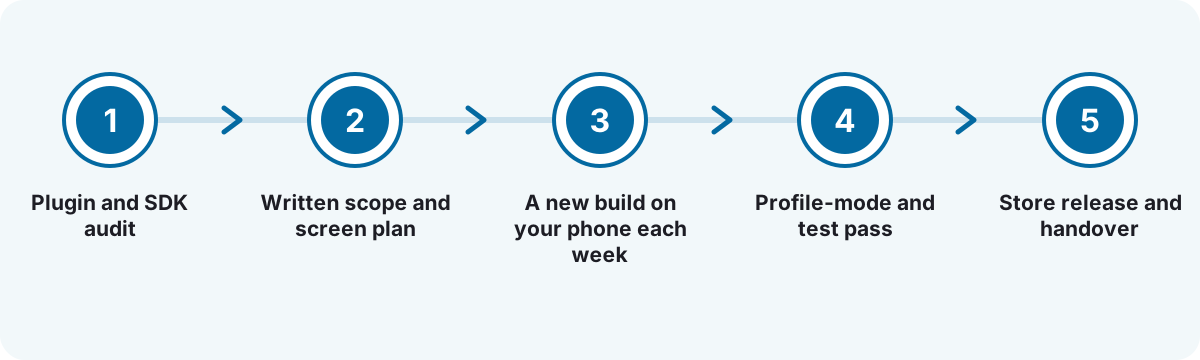
Plugin and SDK audit
Before quoting, we list every device feature and third-party SDK the app touches, then check each on pub.dev: who publishes the plugin, which platforms it supports, how recently it was updated. Anything without a healthy plugin is marked as a native bridge, with its Kotlin and Swift effort estimated separately.
Written scope and screen plan
The quote names each screen and user role, the offline job, every notification, the flavors and the bridges, and it records which person on your side holds the developer accounts, the signing keys and the source code. Nothing is built before you have read that document and signed off on it.
A new build on your phone each week
Test builds arrive through Google Play's internal testing track and Apple's TestFlight, so you and your staff use the real app on your own handsets and reply with comments or screen captures on WhatsApp, rather than opinions about mock-ups.
Profile-mode and test pass
Before release we run the app in profile mode on an entry-level Android phone and an iPhone, watch the UI and raster threads in DevTools, and fix any frame that overruns its budget. Integration tests then walk the critical journeys end to end.
Store release and handover
We produce the Android App Bundle and the iOS archive, submit them under your accounts, answer reviewer questions, and hand over the repository, the README, the keystore details and the symbol files for every released version.
Flutter vs React Native vs fully native: where does each one win?
Three serious ways to put one product on Android and iPhone, compared on what decides the next five years of maintenance rather than the first demo. KaamGPT builds only in the first column, so read the other two as a neutral summary of the alternatives.
| What matters | Flutter (what KaamGPT builds) | React Native | Fully native (Kotlin + Swift) |
|---|---|---|---|
| Language your team maintains | Dart, in one codebase | JavaScript or TypeScript with React, in one codebase | Kotlin for Android and Swift for iPhone, in two codebases |
| How the interface is drawn | Flutter's own engine paints every pixel, with Impeller as the default renderer on iOS and modern Android | React components backed by each platform's native views; New Architecture on by default since 0.76 | Jetpack Compose or Android Views, and SwiftUI or UIKit on iPhone |
| Look across the two platforms | Identical by default, adapted where platform habits matter | Follows each platform's own controls by default | Each app sits fully at home on its own platform |
| A feature Apple or Google released last month | Through a plugin, or our own platform channel if none exists yet | Through a community or custom native module | Usable as soon as the platform SDK supports it |
| Browser version from the same code | Flutter web, suited to app-like screens rather than content sites | Possible through React Native for Web | Not applicable; a web front end is a separate build |
| Testing in the toolkit | Unit, widget and integration testing ship with the SDK | Jest for JavaScript logic, plus third-party end-to-end tools | JUnit and Espresso on Android, XCTest on iPhone |
| Home-screen widgets, watch apps, AR | Need native code written beside the Flutter app | Need native code written beside the React Native app | The natural home for this work |
| Who it suits best | One team shipping a branded app to both stores in step | Companies whose engineers already live in React | Products whose value is mostly platform features |
The honest verdict. Flutter wins when one team must keep a branded app identical on both stores and change it often; that describes most business, booking, ordering and field apps. React Native is the sensible pick when your engineers already think in React and want to share skills with a web team. Fully native earns its double cost when the product is mostly operating-system features. As a Flutter app development company in Bangalore we build only the first route, and if your app belongs in another column we will say so at scoping.
Four Bengaluru briefs where Flutter earns its place
Read these as worked examples, not client stories. Each one shows the Flutter decision landing differently for a distinct type of Bengaluru business.
A seed-stage SaaS founder team in HSR Layout
- The situation
- Its product is a React web dashboard. Pilot customers want approvals and alerts on their phones, the next investor update is weeks away, and no one in-house has ever shipped a mobile app.
- How KaamGPT fits
- A Flutter app covering only the jobs people do away from a desk, calling the existing API, with push alerts and a staging flavor loaded with clean demo data so the pitch never touches production.
- What changes
- The founders demo a real store build, ship weekly fixes to Android and iPhone from one repository, and keep the web team focused on the dashboard.
A cloud kitchen with three outlets around Koramangala
- The situation
- Most orders arrive through aggregators, regulars want to order directly in Kannada or English, and the counter prints kitchen tickets on Bluetooth thermal printers.
- How KaamGPT fits
- A branded Flutter ordering app with strings kept in ARB files for both languages, plus a native printer bridge written in Kotlin for the counter's Android tablets and called from Dart through Pigeon.
- What changes
- Regulars order straight from the brand's own app, tickets print at the counter from the same system, and menu changes reach both platforms in one release.
An appliance-repair firm with technicians based in Whitefield and Electronic City
- The situation
- Technicians carry budget Android phones into basements and gated-community service areas with no signal, job cards are on paper, and the owner wants to follow progress from an iPhone.
- How KaamGPT fits
- Offline-first job sheets stored in SQLite with photo and signature capture, a visible sync queue, and an owner role in the same app; the list screens are profiled on an entry-level handset.
- What changes
- Jobs are closed on the spot even without coverage, and the owner sees finished work as soon as each phone reconnects, all from one codebase.
A coaching institute in Jayanagar with an ageing Android app
- The situation
- A native Android app built years ago is hard to change, and parents on iPhones keep asking for a version they can install.
- How KaamGPT fits
- An audit compares embedding Flutter screens through add-to-app with a full Flutter rebuild of the parent and student flows on the existing data API; for a brand-new iPhone app the rebuild usually wins, because the old Android code cannot run on iOS.
- What changes
- Parents on both platforms see class schedules, dues and marks, and the institute owns one codebase its next developer can maintain.
What does Bengaluru demand of a Flutter app that a demo never shows?
Customers here range from engineers on the newest iPhones in Indiranagar to delivery partners on entry-level Android phones near Electronic City, and one app has to feel smooth for both. Signal vanishes in basement parking, lifts and underpasses. So we profile on a budget Android handset as well as an iPhone, keep the core journey working offline, and keep images and fonts lean, because download size still matters to someone on a prepaid data pack.
Language is the second local variable: menus, receipts and reminders often need Kannada beside English, sometimes Hindi as well. The city also has a deep pool of Flutter developers in Bangalore, from freelancers to in-house teams at product companies in and around Koramangala, HSR Layout and Whitefield. If you are hiring, ask candidates for a release build on your phone, their tests and a profile-mode trace rather than a showreel.
Everything is built from KaamGPT's single Bengaluru office, for clients all over the city and outside it; calls, screen-shares and builds installed on your own handset replace site visits. For app work described around your own part of town, read the area guides for Koramangala, Electronic City and HSR Layout. Whichever Flutter app development company in Bangalore wins your shortlist, ask to see its apps running on real phones.
What has shipping KaamGPT's own Flutter app taught us?
The KaamGPT app is a Flutter app. One Dart codebase produces the Android build, which Google Play lists as KaamGPT - Digital Marketing, and the iPhone build, which the App Store lists as KaamGPT Marketing Agency. Inside it, each of the workspace's business apps runs natively, and it talks to the same Python (FastAPI) and PostgreSQL backend that serves our React web app, so a business rule changed once on the server shows up on every screen.
One codebase never meant zero native code. Phone features on the iPhone needed Swift, written as host code that the Dart layer calls across a channel. That is the normal shape of a serious Flutter product: Dart for every screen and rule, and small, deliberate native pieces at the edges where an operating-system API or a vendor SDK has no maintained plugin.
App Review taught the rest. We took our own build through Apple's review: account deletion inside the app, reviewer access backed by written notes, a screen-recorded tour of the features, and Apple's purchase rules respected. None of that is specific to Flutter, which is exactly the point: a framework choice never excuses an app from store rules, so we plan for review from the first screen.
- Keep business rules on the server, so both phone platforms and the web change together
- Budget for native code at the edges instead of pretending there will be none
- Write the reviewer's notes and demo access during the build, not on submission day
- Judge size and speed on release builds running on real phones
Where does Dart stop and Kotlin or Swift take over?
Flutter reaches the operating system through platform channels. Dart sends a named call over a MethodChannel, Kotlin or Java answers on Android and Swift or Objective-C on iOS, and values cross through a standard codec of numbers, strings, byte arrays, lists and maps. Flutter's documentation now names Pigeon as the recommended default for generating type-safe bindings, so neither side relies on hand-typed method names that break silently.
Some native pieces are views rather than calls. Maps and web views are embedded as platform views, and on Android each composition mode trades fidelity against frame rate: the default texture layer can stutter while a web view scrolls fast, while hybrid composition merges threads and can lower Flutter's frame rate. Home-screen widgets sit outside the app entirely; on iPhone they are WidgetKit extensions that share data with the app through an App Group.
Rendering is the third edge. Flutter paints its own pixels instead of borrowing platform controls. As of Flutter 3.27, its Impeller renderer is the default on iOS, where it is now the only engine, and on Android API 29 and newer; older phones or ones without Vulkan fall back to the OpenGL renderer automatically. We judge smoothness in profile mode on a physical phone, against a budget of roughly 16 milliseconds per frame at 60 fps.
- MethodChannel for one-off calls, EventChannel for continuous streams such as Bluetooth or sensor events
- Pigeon-generated interfaces for any bridge expected to outlive a prototype
- Slow native work moved to a background task queue so the UI thread never waits
- Platform views only where a native map, web view or camera preview cannot be avoided
- A profile-mode run on an entry-level Android handset before every release
What should a Flutter codebase you will own look like at handover?
Flutter's architecture guide splits an app into a UI layer of views and view models and a data layer of repositories and services, with an optional domain layer of use-cases for logic that spans several repositories. Views keep layout and animation; repositories own caching, retries and errors for one type of data each. That separation is what lets a different team, possibly your own future hires, pick the code up without a rewrite.
State management follows from it. The documentation recommends setState for state that belongs to one widget, offers ValueNotifier and InheritedWidget for wider state, and points to community packages without crowning a winner. We choose per app, write the decision into the README and enforce it in review. Dart 3's sound null safety, records and sealed classes then let models describe loading, success and error states the compiler can check.
Release discipline completes it. Unit and widget tests run in continuous integration on every push, integration tests cover the critical journeys on a device, and flavors keep development, staging and production apart. Obfuscation renames symbols but is not encryption, so payment secrets and messaging tokens stay on the server, never inside the app bundle a determined person can unpack.
- Flutter analyze clean, with the lint rules committed to the repository
- pubspec.lock committed and dependencies reviewed with Flutter pub outdated before each release
- Symbol files archived per version so Flutter symbolize can read crash traces
- Signing keys, keystore passwords and store access handed to a named owner on your side
- A README covering flavors, build commands and the release checklist
Which kinds of Bengaluru business suit a single Flutter codebase best?
- Startups building an MVPWeekly builds to both stores from one repository while the product still changes every sprint, without hiring a second mobile engineer.
- Restaurants and cloud kitchensBranded ordering apps with Kannada and English menus and counter-printer bridges, so regulars can place orders directly rather than through a delivery aggregator.
- Home services and repairsBooking and technician apps whose job sheets save offline in basements and upload when the phone finds coverage again.
- Courier and logisticsRate checks, pickup booking and live tracking, with the map embedded as a native platform view inside Flutter screens.
- Clinics and diagnostic centresAppointment and report apps where a calm, identical interface on Android and iPhone matters more than platform flourishes.
- Coaching and educationClass schedules, fee due-date alerts and exam scores for parents, translated through ARB files rather than strings hard-coded in widgets.
- Real estate and propertyImage-heavy listing galleries tuned in profile mode, with site-visit booking that lands in a CRM the sales team already opens.
Why pick KaamGPT as your Flutter app development company in Bangalore?
Our own app ships on Flutter
The KaamGPT app in both stores is a Flutter app we build, release and support ourselves. You are hiring the people who handle its SDK upgrades, crash reports and store reviews, not a team learning Flutter on your budget.
Native code is planned, not discovered
Our iPhone build already carries Swift for phone features. When your app needs a printer SDK, a UPI hand-off or a Bluetooth device, the bridge is estimated in the quote instead of surfacing as a surprise in week three.
A published entry price
₹14,999 for the starter Flutter scope sits in our services catalogue before you ever call us, and anything larger is put in writing and accepted by you before work begins.
A backend already running in production
The FastAPI, PostgreSQL and background-worker stack behind our workspace can sit behind your app too, linking it to KaamGPT CRM and to WhatsApp confirmations your server sends via Meta's official WhatsApp Cloud API.
Accounts and keys in your name
Apps are published under developer accounts your business holds with Apple and Google. Source-code handover, the signing keys and the symbol files are written into the quote, each with a named owner on your side.
Straight answers on fit
If your idea is mostly a watch app, an augmented-reality experience or a content website, we will tell you Flutter is the wrong tool before you spend anything, and point you to the route that suits it.
How does KaamGPT compare with a freelancer or a large agency?
App development in Bengaluru three ways. KaamGPT’s column is from its published price list; the others describe how those arrangements usually work.
| What you get | KaamGPT | A freelancer | A large agency |
|---|---|---|---|
| Starting price | From ₹14,999 per project, as published | Quoted per job | Quoted after a proposal, often as a monthly retainer |
| What is included | iOS + Android; Push notifications; Offline support; App store submission | Whatever one person covers | Set out in the proposal |
| First delivery | Typically 10 days | Agreed per job | Set in the proposal |
| Price agreed | Written quote with scope and price before work starts | Ask for it in writing | In the signed proposal |
| Who you talk to | A Bengaluru team by call, WhatsApp or online meeting · +91 79767 82366 | The freelancer directly | Usually an account manager |
What does Indian law require of a business that holds customer data?
A Data Fiduciary shall protect personal data in its possession or under its control, including in respect of any processing undertaken by it or on its behalf by a Data Processor, by taking reasonable security safeguards to prevent personal data breach.
Where this applies around Bengaluru, Karnataka
- Bengaluru
- Whitefield
- Jayanagar
- Koramangala
- Electronic City
- Indiranagar
- HSR Layout
- Karnataka
- India
Frequently asked questions
30 answersIs Flutter mature enough for an app that takes payments and stores customer data?
Yes, with ordinary care. Release builds are compiled ahead of time to native machine code, and payment screens come from your gateway's own SDK or a maintained plugin rather than from our code. Most data security sits in the backend: a short-lived user token kept in the phone's secure storage, secrets held on the server, and access checked on every API call.
Will a Flutter app feel like a proper iPhone app to my iPhone customers?
It can. Flutter ships both Material and Cupertino widget sets, and we adapt what iPhone users notice by habit: the swipe-back gesture, iOS-style date and time pickers, action sheets and bounce scrolling. Branded screens such as a menu or a booking flow usually look the same on both platforms by design, and where a truly native control matters, such as a map, it is embedded as a platform view.
How does Dart code reach a phone feature that has no Flutter plugin?
Through a platform channel. The Dart side sends a named message; Kotlin on Android and Swift on iOS receive it, call the native API or vendor SDK, and send a result back. For any bridge meant to last, we generate both ends with Pigeon, which Flutter's documentation recommends for type-safe bindings, so a renamed method fails during the build instead of in a customer's hands.
What is Impeller, and should a business owner care about it?
Impeller is the rendering engine that turns Flutter widgets into pixels on the phone's GPU. Flutter's documentation lists it as the default on iOS and on Android API 29 and newer, with other Android devices dropping back to OpenGL automatically. As an owner, care about the result only: smooth scrolling and animation, which we check in profile mode on physical phones before each release.
Can the same Flutter project also give us a web version of the app?
Often. Flutter web compiles the same Dart code to JavaScript, or to WebAssembly with the wasm flag, and suits app-like screens: dashboards, booking tools, portals and admin views. Layouts need rework for wide screens and mouse input, and some plugins have no web implementation, so we list browser-ready and phone-only features at scoping. Flutter no longer adds an offline service worker by default, so offline web use is configured separately.
Should our marketing website be built with Flutter web as well?
No. Flutter's own FAQ says it is not suitable for static, text-rich websites and that its output does not align with what search engines need for indexing. Landing pages, blogs and service pages belong in plain HTML, which is how kaamgpt.com's own guide pages are served. Our <a href="/best-website-development-company-in-bengaluru">website development team</a> handles that side, starting at ₹9,999, and links visitors to your app.
Flutter vs React Native: which should a Bengaluru startup pick?
Pick React Native if your engineers already write React and TypeScript every day and want to share skills with a web team; its New Architecture has been enabled by default since version 0.76. Pick Flutter if you want one rendering engine, an identical branded interface on both platforms and testing tools inside the SDK. Both can ship a good product; the people maintaining it matter more.
Will KaamGPT take on a React Native project instead?
No. KaamGPT works as a Flutter app development company in Bangalore and writes Kotlin or Swift only where a Flutter app needs native code. If your product already runs on React Native, or your in-house engineers are React specialists, a React Native team is likely the better partner, and we would tell you that without hesitation. We can still help with <a href="/software-development-company-in-bangalore">the backend and integrations</a>, the store listings or the marketing around your app.
When would you tell us not to use Flutter?
When the app is mostly the operating system itself: a watch app, an augmented-reality product built around ARKit or ARCore, or something whose main surface is home-screen widgets, Live Activities or a size-limited App Clip. The supported-platforms table on docs.Flutter.dev does not include watchOS, and widgets are written natively in any case. Fully native code, or a lighter web app, fits those better.
How large will our Flutter app be when customers download it?
Somewhat larger than a tiny native app, because the Flutter engine adds a baseline of a few megabytes compressed before your own code, fonts and images. We measure instead of guessing: building with --analyze-size breaks the bundle down by package, Play Console reports the true download size, and Xcode's App Thinning report covers iPhones. Compressed images, trimmed fonts and split debug info keep it down.
Which state management approach will our Flutter app use?
Whichever the app genuinely needs, written down. Flutter's documentation suggests setState for state that belongs to a single widget and leaves wider state to ValueNotifier, InheritedWidget or a community package. Small apps rarely need more than ValueNotifier with view models; larger ones may justify Provider, Riverpod or BLoC. The choice and its reasons go in the README so nobody adds a second pattern later.
How do you test a Flutter app before it goes to the stores?
At the three levels the SDK supports: unit tests for business rules, widget tests for screens and interactions, and integration tests that drive the whole app on a device or emulator. The integration_test package cannot tap native permission dialogs or notifications, so those journeys are checked by hand or with a tool such as Patrol. Fast tests run automatically on each push to the repository.
Can you take over a Flutter app another developer left half-finished?
Usually. We start with an audit: does it build on the current Flutter SDK, what does Flutter analyze report, which packages are outdated or abandoned, is there any test coverage, and does any code predate Dart 3's sound null safety. The audit says whether to continue, refactor or rebuild parts, and that decision is recorded in the quote ahead of any new feature work.
Our Android app is native. Can Flutter add an iPhone version without a full rewrite?
Partly. Flutter's add-to-app support embeds Flutter screens inside an existing Android or iOS app, which suits adding a few new flows to an app you keep. A brand-new iPhone app cannot reuse native Android code, though, so the realistic choice is a Flutter build for both platforms or a separate Swift app. We compare the two after reading your current code and data layer.
Do Flutter apps run smoothly on cheaper Android phones?
They can, when built with those phones in mind. The supported-platforms table on docs.Flutter.dev starts at Android API level 24, and Impeller runs on Android 10 or newer devices with Vulkan, falling back to OpenGL elsewhere. Smoothness depends more on the code: lists built lazily, images decoded at screen size, heavy work kept off the UI thread. We profile on an entry-level handset, not just flagships. Play Console specifics live on our <a href="/android-app-development-company-in-bangalore">Android app development guide</a>.
How do you keep API keys and secrets out of a Flutter app?
By never putting them there. Flutter's documentation calls storing secrets in an app poor practice and is clear that obfuscation only renames symbols. Payment secrets, WhatsApp tokens and admin credentials stay on the server; the app holds a short-lived user token and calls your API with it. The rule applies to every framework, yet it is skipped surprisingly often in inherited projects.
Who keeps the Dart source code, signing keys and store listings after launch?
Your business should. Apps go out under Apple Developer and Google Play accounts that your company holds, so ratings and install history stay with you. Source-code handover, the Android upload keystore, the iOS certificates and the symbol files used to read crash traces are each written into the quote with a named owner. Back the keystore up; losing an upload key means asking Google to reset it.
What budget should I set aside for a Flutter app in Bengaluru?
Quotes from a Flutter app development company in Bangalore swing widely with scope, so compare line items. With KaamGPT, ₹14,999 per project buys the starter Flutter scope: a focused Android and iPhone app with push, offline handling, both store submissions and three months of support. An API with an admin panel, native bridges, payments or a browser build are costed once we have scoped them on a call, plus the store fees Apple and Google charge you.
How soon can a Flutter app go live in Apple's and Google's stores?
Building the starter scope normally needs around ten days. Apple's review and Google's checks come on top, and a brand-new personal Play developer account has to run a closed test ahead of production access, which adds days. Bigger apps get a written schedule with milestones. One Dart codebase helps at this stage: a fix is made once and submitted to both stores together.
Can our Flutter app show menus and messages in Kannada?
Yes. Flutter's localisation tooling keeps every string in ARB files, one per language, and gen-l10n turns them into typed Dart getters, so Kannada, English and Hindi coexist and a translator edits text without touching code. Dates, numbers and rupee amounts follow each locale through the intl package. Translated labels change length, so every screen is checked in each language.
Does hot reload actually make a Flutter project cheaper?
It makes iteration faster rather than the invoice smaller. In debug mode Flutter runs on the Dart VM, so an edited screen appears on the test phone almost at once without losing the app's state, which keeps design reviews with you quick and concrete. Release builds are compiled ahead of time to machine code, so none of that debugging machinery ships to customers.
Can a Flutter app hand customers off to UPI apps and Indian payment gateways?
Yes. At scoping we check whether your chosen gateway ships a maintained Flutter plugin; if it does not, its Android and iOS SDKs are wrapped through a platform channel. UPI flows hand the customer to an installed UPI app and bring the result back to the order screen. The merchant account remains your company's, and for iPhone we first check whether Apple's in-app purchase rules apply to what you sell.
Do I need to own a Mac or an iPhone to get an iOS build made?
You do not need a Mac. iOS builds have to be compiled and signed in Xcode on macOS, and that happens on our side. You do need an Apple Developer account held by your business and, ideally, an iPhone for trying TestFlight builds yourself, because a real handset reveals problems a simulator hides. Android testers install builds from Google Play's internal testing track. Enrolment steps are covered in our <a href="/ios-app-development-company-in-bangalore">iOS app development guide</a>.
Were the client apps in your case studies built with Flutter?
Our published case studies, including <a href="/works/flymycart-courier-android-ios-app-website-digital-marketing">FlyMyCart's Android and iOS apps</a>, <a href="/works/a2z-workhub-home-services-app-website-seo">A2Z WorkHub's customer app</a> and <a href="/works/closetobuy-food-delivery-app-development">CloseToBuy's food-delivery app</a>, describe features and outcomes rather than the framework, so we do not present them as Flutter work. The Flutter proof we point to is our own KaamGPT app on both stores; ask on the call and we can show how its code is organised.
How do we judge Flutter developers in Bangalore before hiring one or an agency?
Ask for evidence that survives outside a demo. A release build installed on your own phone, not a screen recording; the test suite and how it runs automatically; a profile-mode trace of a long list on a budget Android phone; and an example of native code they wrote behind a platform channel. Then ask who will hold the signing keys after launch. Put the same questions to any Flutter app development company in Bangalore you shortlist, ourselves included.
What happens to a Flutter app when Android or iOS ships a major update?
Usually less work than with two native apps, because one codebase is upgraded once. Google raises the target API level that Play requires every year and Apple ships a new Xcode and iOS SDK, and Flutter releases follow both. Within the three-month support window we fix breakages and keep builds current; after that, SDK upgrades and store-policy changes are quoted as ongoing support.
Can our Flutter app send WhatsApp updates and log leads into a CRM?
Yes, through your server rather than the phone. Orders or bookings created in the app reach the backend, which can send WhatsApp confirmations using Meta's official Cloud API through your <a href="/tools/whatsapp-marketing">KaamGPT WhatsApp Business API</a> setup and record the customer in your workspace CRM, available on every <a href="/pricing">KaamGPT workspace plan</a>. Keeping those integrations server-side means the installed app never carries a messaging token that someone could extract.
Is Flutter a sensible choice for an MVP we will demo to investors?
Often, because one codebase gets you onto both platforms quickly and the demo can run as a genuine store build rather than a clickable prototype. Keep the scope tight: one core journey, sign-in, and an admin view only if operations need it. Run the pitch on a staging flavor with clean demo data. With the code layered properly, the MVP can grow into the product instead of being thrown away.
Which database do you use for offline data in a Flutter app?
It depends on the data. Simple settings and flags go in shared preferences; structured records that must survive without a signal, such as job sheets or orders, go in SQLite through drift or sqflite, with a queue marking what has reached the server. Conflicts are settled server-side under clear rules, and the screen tells staff exactly what is still waiting to upload.
How do I start a Flutter project with KaamGPT?
The number +91 79767 82366 takes calls and WhatsApp messages; alternatively, leave your details through the <a href="/services/app-development">App Development service page</a> and we ring back. A short note helps: who the users are, the three things the app must do and any device or SDK it depends on. We reply with questions first, after which you receive a written scope and price before any build begins.