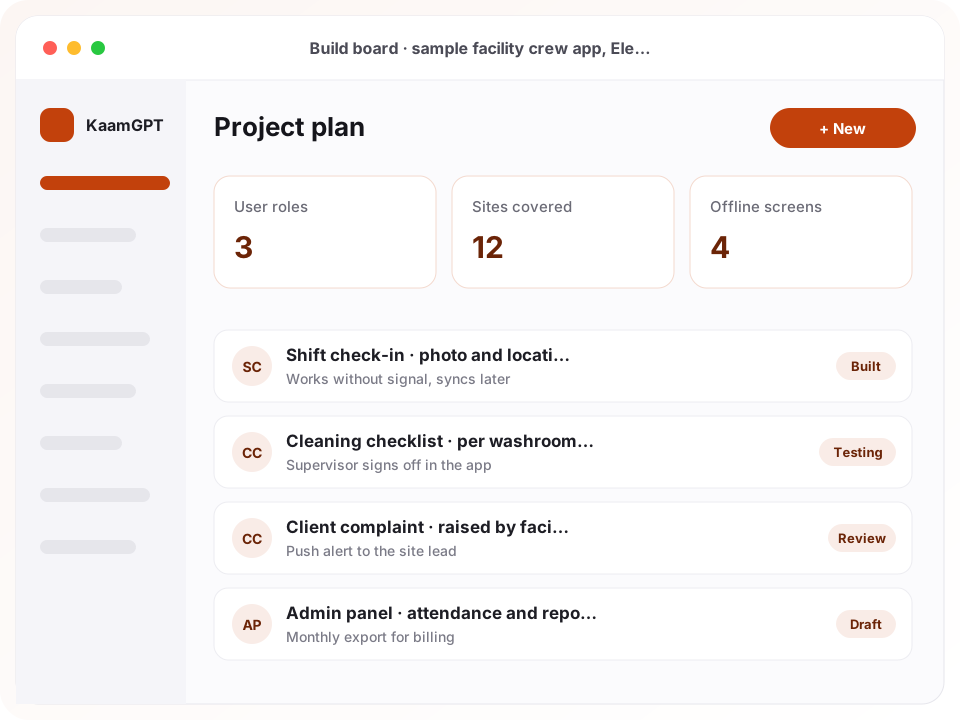
Most enquiries an app development agency in Electronic City receives are not about consumer apps chasing downloads. They come from the firms behind the campuses: a housekeeping contractor with crews across several buildings, a PG group juggling rent and complaints on WhatsApp, a kitchen feeding offices at lunch. KaamGPT builds iOS and Android apps for those operations, with an admin panel for the office and a simple screen for the person on the ground.
KaamGPT works on these projects remotely from Bengaluru. Pricing opens at ₹14,999 for a starting scope that typically takes around ten days and includes both platforms, push alerts, offline storage, submission to the two stores and a quarter of post-launch support. Apps with live tracking, payments or many user roles go higher, and the written quote states by how much before work starts.
- ₹14,999entry price for an app project; tracking, payments and extra roles are quoted after scope
- ~10 daysfor an opening release such as a crew check-in app with an office view
- iOS + Androidone project, both stores, submission handled by us
- 3 monthsof support after launch for fixes and store updates
What kind of work happens around the Electronic City tech parks?
The township grew from a 1978 KEONICS electronics estate into one of Bengaluru's densest IT and ITES clusters, beside Hosur Road in the city's south-east. It is administered by ELCITA and split into Phase 1 and Phase 2, and a single campus there can hold thousands of employees who need cleaning, security, food, transport and maintenance every working day.
Those services are run by local contractors, caterers, cloud kitchens and hardware suppliers, while Neeladri Nagar, Doddathogur and Konappana Agrahara house many of the workers in apartments and PG homes. With the Yellow Line stations that opened in 2025, the Silk Board expressway and the NICE Road link, staff and customers move across a wide area, which is exactly where a phone app earns its keep.
Which apps does an app development agency in Electronic City build for service firms?
Each app below starts from a real workflow we map with you. We scope only the screens and roles you need at launch, then extend.
Field-staff attendance and checklists
Check-in with photo and location, task lists per site, supervisor sign-off and incident reports, all usable offline in basements and syncing when signal returns. More on our mobile app development approach.
Apps in detail →Tenant apps for PG and co-living groups
Rent reminders, maintenance tickets with photos, meal menus and notices, with a manager view that shows open requests by building and room.
Apps in detail →Meal and pantry ordering
Menus by day, order cut-off times, delivery to floor or desk and a kitchen screen that groups orders by building, for caterers and cloud kitchens serving offices.
Apps in detail →Admin panels and reports
A web dashboard for the office: attendance summaries, ticket ageing, order volumes and exports your accountant or client can use for monthly billing.
Apps in detail →A website beside the app
A clear site that explains the service, links to both stores and handles enquiries from people who will never install the app. See our website development work.
Websites in detail →AI help where it saves hours
Summaries of incident reports, suggested replies to tenant tickets or menu forecasting from past orders, scoped as AI development only when the data supports it.
AI in detail →Getting the first users
For customer-facing apps, launch campaigns and store listing copy that bring the first residents or office users on board, under our digital marketing retainer.
Digital marketing in detail →How we build an app for an Electronic City operator
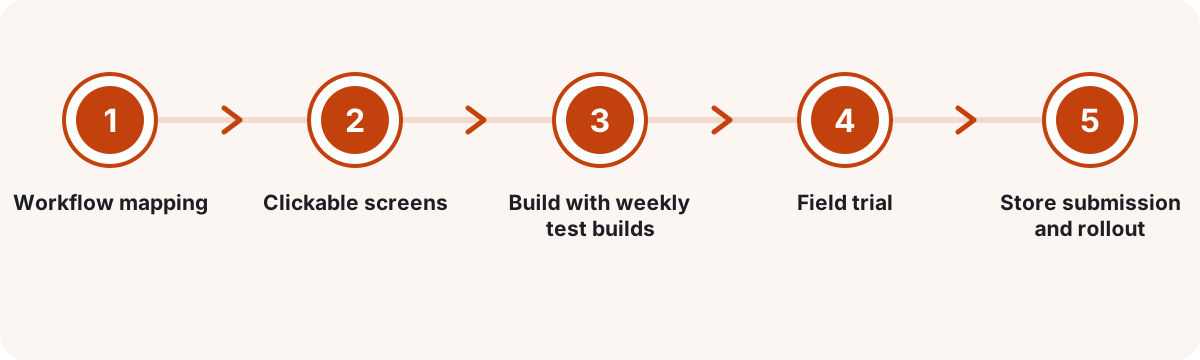
Workflow mapping
On a video call we trace one real shift, ticket or order from start to finish and agree which steps go into version one.
Clickable screens
You receive tappable designs on your phone and try them with a supervisor or resident before any code is written.
Build with weekly test builds
Test versions arrive on your Android and iPhone devices each week, with a short note of what changed.
Field trial
A small crew or one PG building uses the app for a few days; we fix what real use uncovers.
Store submission and rollout
We submit to the App Store and Play Store under your accounts, then support the rollout for three months.
Service firms around the tech parks that use our apps
- Facility management and housekeepingAttendance, checklists, incident reports and client-visible service logs.
- Security agenciesGuard check-ins, patrol points, visitor logs and shift handover notes.
- Corporate caterers and cloud kitchensDaily menus, order cut-offs, floor delivery and kitchen dashboards.
- PG and co-living groupsRent reminders, maintenance tickets, notices and meal plans for residents.
- Employee transport operatorsTrip rosters, driver check-ins and pickup alerts for shuttle and cab routes.
- Training institutesBatch schedules, class links, attendance and doubt-clearing for working learners.
- Clinics and diagnostic centresReport downloads, appointment requests and reminders for corporate health checks.
What does a staff or tenant app cost in Electronic City?
A first scope with one or two user roles, an admin panel and store submission starts at ₹14,999 and runs to roughly ten days. Live tracking, in-app payments, client logins and integrations with payroll or billing tools lift the figure, and a written quote fixes it once we agree the screens. Related services are optional and listed on our pricing page.
App Development
Start hereFrom ₹14,999/project
Typically 10 days
Contractors, PG groups and kitchens moving attendance, tickets or orders out of chats and spreadsheets into one app.
- iOS + Android
- Push notifications
- Offline support
- App store submission
- 3 months support
Website Development
From ₹9,999/project
Typically 7 days
Any operator who also needs a public site to win contracts and link to the stores, from ₹9,999.
- Custom design
- Mobile first
- SEO ready
- CMS included
- Analytics setup
- 1 month free support
AI Development
From ₹49,999/project
Typically 30 days
Firms with enough reports, tickets or order history to automate summaries or forecasts, from ₹49,999 per project.
- Custom AI agents
- Document intelligence
- Workflow automation
- API integration
- Ongoing tuning
Digital Marketing
₹19,999/month
Typically 15 days
Customer-facing apps that need residents or office users to install them, at ₹19,999 a month.
- Channel strategy
- Creative production
- Campaign management
- Weekly reporting
- Apple charges an annual developer fee and Google a one-time fee; those accounts are opened in your company's name.
- Maps, SMS and payment providers bill their usage directly to you.
Why do some Electronic City apps cost more than the starting price?
The number of user roles is the biggest driver. A crew app with one supervisor view is small; add clients who log in to see service records, finance staff who export invoices and drivers who share location, and each role brings screens, permissions and testing.
Integrations come next. Pulling attendance into payroll, or orders into a billing system, depends on what those tools allow. We check before quoting and list each integration separately.
- User roles and how much each one can see or change.
- Offline screens and how conflicts are handled when phones sync.
- Live location, maps and route display.
- Payments, deposits or wallet balances.
- Links to payroll, HR, billing or access-control systems.
- Languages beyond English for crews and drivers.
Why KaamGPT for an Electronic City app
Built around the worst-signal room
We test offline behaviour deliberately, because service apps fail in basements, lifts and plant rooms before anywhere else.
Apps we have shipped
The FlyMyCart courier app runs on Android and iOS, a close relative of a crew or delivery app.
Accounts in your name
Store listings, backend hosting and source code belong to your company, so the app never depends on us to stay alive.
Connected to your workspace
The shared backend can plug into your KaamGPT workspace, keeping customers, leads and service records together.
Remote, on your schedule
Our team sits in Bengaluru rather than in the township, and every review runs over calls, WhatsApp and test builds at times that suit shift work.
Designing for people on shift, not people browsing
A supervisor in a service corridor has one free hand and a few seconds. The app has to open straight to today's site, show what is pending and accept a photo with one tap. We design every staff screen around that moment and push everything else into the office dashboard. An app development agency in Electronic City that ignores this ends up with a beautiful app nobody opens after week two.
Customer-facing apps follow different rules, since residents and office users can simply ignore them. If your first need is a site that wins contracts or fills rooms, our Electronic City website page covers that side.
Offline first for basements
Check-ins, ticked tasks and photos are held on the handset and uploaded once coverage returns, so a dead zone under a tower never swallows a record.
Roles kept separate
Crew, supervisor, client and admin each see only their screens, which keeps the app simple and client data private.
Push alerts with purpose
Notifications for new tickets, missed check-ins and order cut-offs only, so people do not learn to mute the app.
Proof from delivery apps
Our CloseToBuy food delivery app includes live order tracking, the same backbone a kitchen serving office floors needs.
One backend for everything
App, dashboard and public site all read from a single backend, and that backend can link to your KaamGPT workspace, so customer and service records never split across tools.
Where do Electronic City operators lose time without an app?
Service contracts here are judged on attendance, response time and paperwork. When those live in WhatsApp groups, registers and spreadsheets, the office spends evenings reconciling instead of running the business, and clients notice gaps before you do.
- Shift attendance collected on paper or selfies in a group chat, then typed up for monthly billing.
- Checklists that supervisors tick from memory at the end of a shift, with no proof for the client.
- PG tenants reporting leaks, Wi-Fi and food complaints in scattered chats that nobody tracks.
- Office lunch orders taken by phone and spreadsheet, with errors that cost a whole floor's goodwill.
- Staff moving between basements and towers where mobile signal drops, so online-only tools fail.
Native or cross-platform for a crew app?
For attendance, checklists and tickets, a cross-platform build usually makes sense: one codebase, both stores, faster changes. Native code matters more for heavy camera, Bluetooth or background-location work, and we will say so if your workflow needs it.
What matters most is that the app feels natural on each phone and keeps working offline. Crews will not tolerate an app that loses a check-in, whatever it is built with.
- Cross-platform: one codebase, quicker updates, fits most staff apps.
- Native: heavy hardware use or long background tracking.
- Either way: offline storage and a reliable sync.
How should a contractor judge an app partner?
Before hiring any app development agency in Electronic City, ask to see an app that is live in both stores, and ask who owns the store accounts, the backend and the code once the project ends. Then ask how offline records are handled, how many test builds you will receive before launch and what the three months of support actually include. Written answers tell you more than a portfolio of screenshots.
Also ask how they will learn your workflow. For service contracts around the tech parks, a good partner starts from one real shift or order, not from a feature list, and is willing to leave half the ideas for version two so the first release ships quickly and gets used.
- App development
- From ₹14,999; a first scope takes around ten days
- Included
- iOS and Android, push notifications, offline support, store submission, three months of support
- Good fit
- Facility contractors, PG groups, caterers, transport operators, institutes
- Website alongside
- From ₹9,999, optional
- How we work
- Run by the Bengaluru team at a distance; no premises near the tech parks
- Your price
- Agreed on paper after scoping; live tracking and payments raise it
Where this applies around Electronic City, Bengaluru
- Electronic City
- Hosur Road
- Neeladri Nagar
- Doddathogur
- Konappana Agrahara
- Bengaluru
- Karnataka
- India
Frequently asked questions
20 answersIs KaamGPT an app development agency in Electronic City itself?
We serve Electronic City clients, but KaamGPT has no office in the township. The team works from elsewhere in Bengaluru and runs projects over video calls, WhatsApp and test builds sent to your phones, which suits operators whose managers are out on sites all day.
How much does a crew attendance app cost for an Electronic City contractor?
A field staff attendance app covering photo check-in, per-site checklists and an office dashboard begins at ₹14,999 and usually needs around ten days. Linking it to payroll, adding client logins or showing live location raises the price, and each addition is its own line on the written quote.
Can the app work in basements with no signal?
Yes. Check-ins, ticked tasks and photos are kept on the handset and uploaded once there is coverage. We test in airplane mode and on throttled connections, since Electronic City parking levels and service shafts are where signal usually disappears.
Do your app developers in Electronic City projects build both iOS and Android?
Yes. Our app developers deliver both from one project and handle submission to the App Store and Play Store under your company's accounts. Most crews carry Android phones, but managers and clients often use iPhones, so both matter.
What is a corporate meal ordering app, and who needs one?
A corporate meal ordering app lets employees choose from a daily menu before a cut-off, and shows the kitchen grouped orders by building and floor. Caterers and cloud kitchens serving Electronic City offices use it to replace phone orders and spreadsheets.
Can PG tenants raise complaints through an app?
Yes. Residents photograph the problem, choose a category and submit; the manager sees tickets by building and room, assigns them and closes them with a note. Rent reminders and notices can sit in the same app for an Electronic City PG group.
How is a mobile app development company in Electronic City different from a freelancer?
A mobile app development company in Electronic City or anywhere should give you a written scope, both platforms, store submission, a backend you own and support after launch. Ask any provider who holds the store accounts and source code; the answer matters more than the hourly rate.
Will you come to our site to see the workflow?
Site visits are outside the standard scope. Instead, we ask a supervisor to walk us through a shift on a video call and share photos of registers and forms. That is usually enough to design version one, and the field trial covers the rest.
Is there an app development company near me that understands shift work?
We schedule calls before or after shifts, send test builds that crews can try during a quiet hour, and keep feedback on WhatsApp. Working remotely means your supervisors never leave a client site for meetings.
Who owns the app and its data?
Your company. Store accounts, the backend, the database and the source code are all in your name. We handle data under India's data protection rules and keep client and staff records visible only to the roles that need them.
What do the three months of support cover?
Bug fixes, store resubmissions after operating system updates and small adjustments found in real use. New features, roles or integrations are quoted separately, and we agree them in writing before building so an Electronic City client never gets a surprise invoice.
Can the app send push notifications to crews?
Yes, for events that need action: a new complaint at a site, a missed check-in, an order cut-off or a rent reminder. We keep the list short so staff in Electronic City do not start muting the app.
Can clients see service records in the app?
We can add a client role that shows attendance, completed checklists and closed tickets for their site only. It is a strong contract-renewal tool for Electronic City vendors, and it is priced as an extra role on the quote.
Does an employee transport operator need an app?
If you run fixed shuttle or cab rosters, an app for drivers and a pickup alert for riders can replace calls and group messages. Live location adds cost, so we often start with rosters and check-ins across Electronic City and add tracking later.
Can AI help with our reports and tickets?
Sometimes. With enough history, AI can summarise incident reports, suggest replies to common tenant tickets or predict meal volumes. AI development starts at ₹49,999 per project, so we recommend it only when an Electronic City client has the data to justify it.
Do we need a website as well as the app?
Usually, yes. Contracts and new tenants start from a website, not an app store. Our <a href="/website-development-agency-electronic-city-bengaluru">Electronic City website development page</a> covers vendor profiles and PG sites, which can share the app's backend.
Can you promote a customer-facing app after launch?
Yes, through store listing copy, launch campaigns and ongoing digital marketing at ₹19,999 a month. Our <a href="/digital-marketing-agency-electronic-city-bangalore">Electronic City digital marketing page</a> explains how we plan that for this area.
Do you build apps for businesses on Kanakapura Road too?
Yes. The same team works across the southern corridors. Our <a href="/app-development-agency-kanakapura-road-bengaluru">Kanakapura Road app page</a> covers apps for showrooms and residential communities, a different brief from Electronic City service contractors.
How long before crews actually use the app?
Plan a short field trial with one site or one PG building, a ten-minute briefing and a supervisor who champions it. Adoption across Electronic City sites usually follows once the office stops accepting paper registers.
How do we start?
Contractors and operators usually open with a photo of the register or spreadsheet they want to replace. That shows us the workflow faster than any brief. Phone +91 79767 82366, WhatsApp the same number, or send the form, and a mapping call is set up around your shifts.