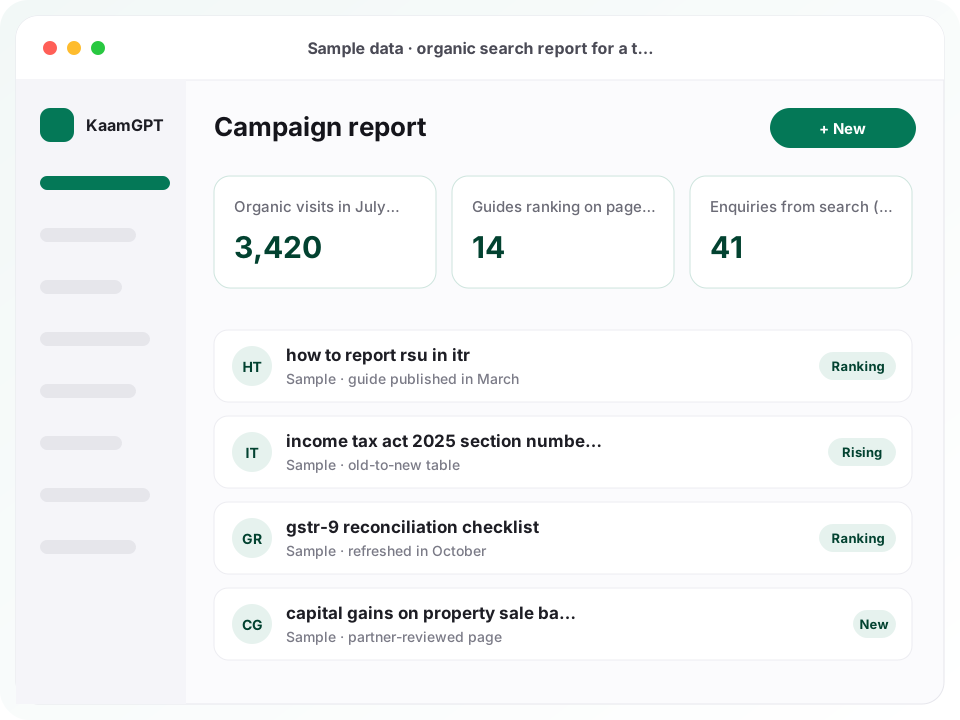
If you are looking for the best SEO company for accounting firms in Bengaluru, the first thing to know is that organic search is the channel ICAI's rules were practically written for. For years the Institute has let chartered accountants hold information on a website that people could find when they looked, while barring them from chasing work.
That pull model is exactly how search works. A founder in Indiranagar types a question about GST on export of services, a retired teacher in Basavanagudi asks about capital gains on a site sale, an engineer in Electronic City searches how to report foreign shares, and the practice that has published a clear, accurate answer is the one they read. KaamGPT builds that library for CA firms, tax consultants and bookkeeping practices in Bangalore, inside the rules that apply to each, and times it so pages are ranking before the questions peak.
- ₹14,999a month is the starting point for SEO, confirmed in a written scope
- ~30 daysfor the audit, keyword map and first pages before monthly publishing begins
- 3–6 monthsis a realistic lead time for a new guide to rank, so deadline content starts early
- Pull modelis how ICAI lets CA firms present reserved services online, and how search works
Which practices get the most from organic search?
- CA firms with advisory desksFirms whose tax and GST advisory work starts with a client's research, not a referral, gain most from deep guides.
- Small CA practices in residential areasOne- and two-partner offices in south and north Bengaluru gain steady local searches from a handful of well-made pages.
- NRI and cross-border tax advisersPractices handling residency, foreign income and property sales by non-residents serve readers who search before they ever call.
- GST practitionersNotice replies, registration, e-invoicing and annual return questions produce search demand all year, with a December peak.
- Bookkeeping and payroll firmsOwners searching for software set-up, PF and ESI registration or month-end routines find firms that explain the process.
- Virtual CFO practicesFounders research fundraising readiness, board packs and cap tables, and judge advisers by the clarity of what they publish.
- Independent tax return preparersNon-CA preparers can pair guides with clear fee pages, since ICAI's limits on fees do not apply to them.
Why do accounting firm websites in Bangalore rarely rank?
When we audit practice websites, the same pattern repeats. The site was built once, lists eight services in a single paragraph, has no author names, and has not been updated since the last change of address. Search engines have nothing to rank it for except the firm's own name.
- One thin services page covers audit, tax, GST, payroll and company law together, so no single query finds a page that answers it.
- Articles copy circulars word for word, adding nothing a reader could not get from the department's own site, and search engines treat them as duplicates.
- Old title tags still say "best CA firm in Bangalore" or "leading tax consultants", wording the ICAI advisory of October 2020 listed as prohibited and that the current guidelines still treat as exaggeration.
- Guides on return filing are published in July, weeks too late to rank for that season's searches, then never refreshed for the next year.
- Client portals and document logins sit on the main domain without care, creating crawl errors and exposing login pages in search results.
What does SEO for chartered accountants and tax practices involve?
An SEO company for accounting firms in Bangalore has to write for two readers at once: a worried taxpayer who wants a plain answer, and a partner who will check every line for accuracy and compliance. Each item below is planned around both.
Keyword map by service and client type
We build accounting firm keywords from real client questions, grouped by service and by who asks: salaried staff, traders, founders, NRIs, manufacturers. Each group gets its own page or guide. Our SEO service keeps that map current as the law and search behaviour change.
SEO in detail →Service pages that follow the website guidelines
Separate pages for tax returns, GST, bookkeeping, payroll and advisory, written factually. Audit and attestation pages stay informational, in keeping with the pull-only rule for reserved services. If the current site cannot support this, a rebuild starts from ₹9,999 per project.
Websites in detail →Partner profiles that show expertise
Search engines and readers both look for who wrote a page. Each guide carries a reviewing partner's name, qualification and membership number, and each partner has a profile with areas of experience, which the guidelines explicitly allow on a firm website.
SEO in detail →Tax content strategy for the year
A calendar of new guides and refreshes tied to budget day, the start of the financial year, return deadlines and the GST annual cycle. Every guide shows the date it was last checked and the law it reflects, so readers know it is current.
SEO in detail →Neighbourhood signals for local searches
Many accounting searches carry a place name or the words near me. Your map listing and contact page must agree with your ICAI-registered address. The local SEO plan for accounting practices covers that side in depth.
Local SEO in detail →Structured data and answer-ready pages
We add organisation, person and FAQ markup where it is accurate, and write short direct answers near the top of guides, so search features and AI assistants can quote the practice correctly rather than paraphrasing a competitor.
AI in detail →Technical care for client portals
Document logins and upload tools, which the guidelines allow, are kept out of search indexes, secured, and separated from public pages so they never leak into results or slow the main site.
Websites in detail →What happens in the first three months of SEO?
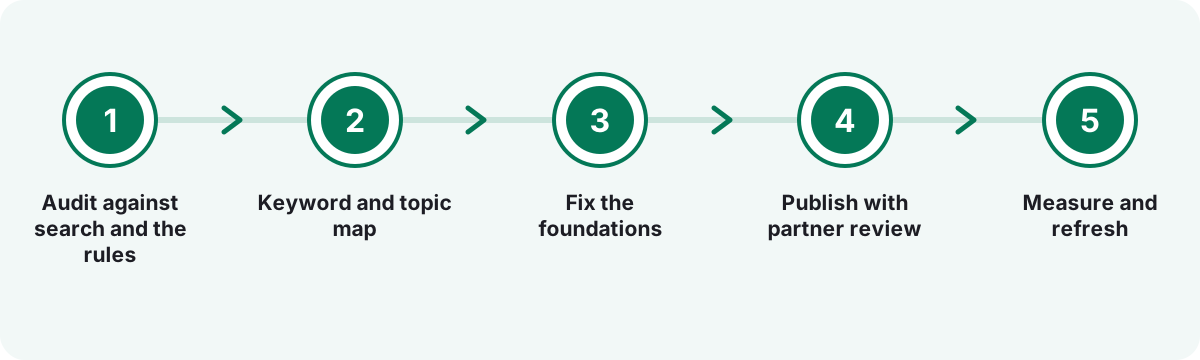
Audit against search and the rules
We crawl the site, check what it ranks for, and read every page against ICAI's website guidelines, listing anything to remove, such as superlatives in titles or fee mentions on a CA firm's pages.
Keyword and topic map
We group searches by service and client type, match each group to an existing or new page, and agree a publishing order that puts the next deadline's guides first.
Fix the foundations
Titles, headings, internal links, page speed, structured data, author profiles and portal handling are corrected so new content has a sound site to sit on.
Publish with partner review
We draft each guide, a partner checks the technical content, and we publish with the review date shown. Nothing goes live without that approval.
Measure and refresh
Monthly reports show rankings, visits and enquiries by page. Before each peak we refresh the guides that matter for it and note what changed in law.
What does SEO for an accounting firm cost?
SEO starts at ₹14,999 a month, with about 30 days for the audit, keyword map and first pages. The written scope states how many new guides and refreshes each month includes, which partner reviews them, and whether translation or a site rebuild is part of the work. Any SEO company for accounting firms in Bangalore should be able to show you that scope before you sign.
SEO
Recommended₹14,999/month
Typically 30 days
Fits CA firms and tax practices whose clients research questions before choosing an adviser, especially founders and salaried professionals.
- Technical audit
- Keyword research
- On-page optimisation
- Content plan
- Monthly reporting
Digital Marketing
₹19,999/month
Typically 15 days
Fits a practice that wants search, social and any lawful paid work run together across the filing year.
- Channel strategy
- Creative production
- Campaign management
- Weekly reporting
Local SEO
₹4,999/month
Typically 14 days
Fits neighbourhood offices where most enquiries come from people searching for an accountant close to home or shop.
- Google Business Profile optimisation
- Local keyword map
- Location page on-page fixes
- Citation building and NAP cleanup
- Local link outreach
- Review replies and posts
- Monthly report
Google Ads
₹4,999/month
Typically 30 days
Fits non-CA tax consultants who need visibility during deadline weeks while their organic pages are still maturing.
- Account setup
- Keyword strategy
- Ad copy testing
- Conversion tracking
- Bid optimisation
Meta Ads
₹4,999/month
Typically 30 days
Fits practices that want to put their educational guides in front of more readers on social platforms.
- Creative testing
- Audience building
- Retargeting funnels
- Pixel setup
- Weekly reporting
Lead Generation
₹24,999/month
Typically 14 days
Fits outsourced accounting and payroll firms that sell retainers to companies and need enquiries handled to a meeting.
- Verified leads
- Multi-channel outreach
- CRM integration
- Lead scoring
- Replacement guarantee
- SEO results build over months; the first quarter is mostly audit, fixes and publishing, with rankings following later.
- We do not buy links, publish copied circulars or write titles with superlatives, so the scope never includes those.
| Package | Starts at | Timeline | Best for |
|---|---|---|---|
| SEO | ₹14,999/month | Typically 30 days | Fits CA firms and tax practices whose clients research questions before choosing an adviser, especially founders and salaried professionals. |
| Digital Marketing | ₹19,999/month | Typically 15 days | Fits a practice that wants search, social and any lawful paid work run together across the filing year. |
| Local SEO | ₹4,999/month | Typically 14 days | Fits neighbourhood offices where most enquiries come from people searching for an accountant close to home or shop. |
| Google Ads | ₹4,999/month | Typically 30 days | Fits non-CA tax consultants who need visibility during deadline weeks while their organic pages are still maturing. |
| Meta Ads | ₹4,999/month | Typically 30 days | Fits practices that want to put their educational guides in front of more readers on social platforms. |
| Lead Generation | ₹24,999/month | Typically 14 days | Fits outsourced accounting and payroll firms that sell retainers to companies and need enquiries handled to a meeting. |
What decides the size of an SEO budget for a practice?
The biggest variable is how many distinct client types you serve. A practice that only files salaried returns needs a small, deep library; a firm serving founders, traders, NRIs and manufacturers needs separate content for each, and each must be reviewed by someone who knows that work.
Partner time is the hidden cost. Every guide needs a technical check, and a firm that cannot spare an hour or two a month for reviews will publish slowly whatever it pays. Our pricing page shows starting points; the quote then sets the review routine alongside the fee.
- The number of client segments and services that need their own pages.
- Whether the existing site can be improved or needs rebuilding first.
- How many guides need yearly refreshes after each budget and deadline change.
- Translation into Kannada or other languages for key pages.
- Technical work on portals, page speed and structured data.
- How much partner time is available for review each month.
Why trust KaamGPT with a practice's search content?
We write to the guidelines
Our drafts follow ICAI's website guidance by default, so partners spend review time on technical accuracy rather than deleting promotional language.
Deadline-first scheduling
Guides are published months ahead of the searches they target and refreshed before every season.
Content built for SEO, AEO and GEO
Pages are written so search engines, answer boxes and AI assistants can all read the same clear, dated facts.
Honest timelines
We tell you that organic search takes months and plan paid or local work for the gap where it is lawful for you.
No link schemes
We earn links by making useful tools and checklists, and never buy them.
One Bengaluru team
Strategists, writers and developers work together by call, WhatsApp and online meetings, with one point of contact.
Who searches for an accountant in Bengaluru, and what do they type?
Search behaviour in this industry splits along the city's neighbourhoods. Families in Malleshwaram, Basavanagudi and Jayanagar tend to search for specific life events: selling an inherited site, a parent's pension and interest income, a property purchase with TDS to deduct. Queries such as "capital gains on property sale bangalore" or "ca for senior citizen itr" are common examples, and many of these searchers would welcome a page in Kannada.
Technology employees along Electronic City, Whitefield and the Outer Ring Road search for problems their employer's payroll does not solve: RSUs and ESPPs, foreign bank accounts, dividends from US shares and claiming credit for tax withheld abroad. Founders around Indiranagar, Koramangala and HSR Layout search for incorporation-year compliance, GST on software exports, payroll set-up and investor reporting. Each group needs different pages, not one generic "income tax services" page.
Practitioners themselves concentrate in the centre as well. ICAI's Bangalore branch is at ICAI Bhawan in Vasanth Nagar, and many established firms sit within reach of it and of the old commercial districts. For SEO that matters less than it once did: a well-written guide from a two-partner firm in Banashankari can outrank a large central firm across the city, because search rewards the clearest answer, not the grandest address.
How would the best SEO company for accounting firms in Bengaluru plan your content?
We plan backwards from the dates your clients care about. A guide meant to rank in July has to be published, indexed and earning links by April or May, so the content year for a practice in Bengaluru begins in January, just before the Union Budget, and is mostly written by the time the new financial year opens.
Topics come from three places: the questions your own team answers every week, the searches visible in your site's data, and changes in law. The third source is unusually rich right now. The Income-tax Act 2025 took effect on 1 April 2026, renumbered the provisions people know by heart and replaced the pairing of previous year and assessment year with a single tax year, while returns for the year ended March 2026 are still filed under the 1961 Act. That transition is a long-running source of confused searches.
Old-to-new section tables
Clients and even junior staff will keep searching for familiar section numbers for years. A maintained page that maps common provisions from the 1961 Act to the 2025 Act, reviewed by a partner, answers both the old and new searches.
One guide per life event
Selling a flat, receiving RSUs, starting a company, hiring a first employee, receiving a GST notice: each event gets its own guide with documents, dates and steps, written so the reader can tell when they need professional help.
Refresh before the season
Each guide is checked every year before its peak month, dated, and updated for budget changes, such as the move of the non-audit business return date from 31 July to 31 August.
Kannada pages where clients need them
For practices serving families and traders, we translate the guides that matter most to them, so a searcher in Malleshwaram or Basavanagudi finds an answer in the language they think in.
Links earned through usefulness
Well-made checklists and calculators get cited by community groups and other professionals. We do not buy links or run schemes; for a CA practice those would also sit badly with the profession's rules.
Measure enquiries, not only rankings
Rankings matter only if they bring the right clients. We tag enquiries by landing page and service, so a partner can see, for example, whether an RSU guide brought salaried clients in July while a broad income tax page brought none, and the next quarter's writing follows that evidence.
How do ICAI's website guidelines read as an SEO brief?
Read with search in mind, the Council's website guidelines are surprisingly helpful. They let a CA firm publish its name, year of establishment, registered addresses, partners with qualifications and areas of experience, staff numbers, job vacancies, services, peer review status, and blogs, articles, bulletins and educational videos on professional topics. Clients may be named, with their permission. That covers almost everything search engines use to judge whether a site is a credible source.
The limits shape the copy rather than the structure. Banner advertisements are not allowed on the site. Services reserved for chartered accountants, such as statutory audit, are presented in pull mode only and are not circulated except on request. A CA must not run any advertisement or circular that solicits people to visit the website, so traffic has to be earned through search, links and reputation. And the information on the site must not differ materially from ICAI's records.
Some items from ICAI's 2020 advisory still guide good CA website content even after the 2026 relaxation: no "leading", "best" or "top firm" language, no "why choose us" sales sections, no awards other than governmental or regulatory ones, and no testimonials. In practice that pushes a firm toward pages that explain rather than persuade, which is also what ranks for informational searches.
- Titles describe the service and place, for example "GST return filing for traders, Chickpet, Bengaluru", never a claim of being the best.
- Partner bylines with membership numbers on every guide; the write-up guidelines treat these particulars as allowed content.
- Audit and attestation pages explain the service and its legal basis, without calls to action pushing visitors to enquire.
- A last-reviewed date and the law version on each guide, so readers and search engines see that it is current.
Why is the Income-tax Act 2025 the biggest content opportunity in years?
A full rewrite of the income-tax law happens rarely. The Income-tax Act 2025 took effect on 1 April 2026, with tax year 2026-27 the first under it, while returns for the year that ended on 31 March 2026 are still filed under the 1961 Act. For a while clients, employers and even software will use both vocabularies. People will search for an old section number, a new one, or a plain description, and many existing pages on the web will be out of date.
Good Income-tax Act 2025 content does not try to summarise the whole Act. It takes the provisions your clients actually meet, such as salary deductions, house property, capital gains, TDS on property purchases or presumptive taxation, and explains for each one what changed, what did not, and which return year each rule applies to. A practice that publishes those pages carefully, with a partner's review, becomes the page others link to when they explain the change.
- Start with the ten provisions your team is asked about most, not the whole statute.
- Show the 1961 and 2025 references side by side, with the tax year each applies to.
- Update the pages after each Finance Act and CBDT clarification, and log what changed.
- Avoid predicting how assessing officers will read new provisions; describe the text and say where advice is needed.
When must a tax guide go live to rank before its deadline?
New pages on an established practice site usually take months, not weeks, to settle in search results, and a brand-new site takes longer. Working backwards from the 2026 calendar, guides for salaried returns due on 31 July should be live by April, guides for non-audit business returns now due on 31 August by May, tax audit explainers ahead of the 31 October return date by July, and GST annual return material by September for the 31 December date.
Refreshes follow a shorter loop. After the Union Budget each February, existing guides are updated within weeks and their dates changed, so a page that already ranks keeps its place with current information. Missing a season is not a disaster, but publishing a July guide in July mostly helps next year.
GST content runs on a faster clock. Monthly and quarterly return questions recur all year, so those guides are evergreen and need checking whenever the portal or the forms change rather than on a seasonal timetable. Notice-reply guides behave differently again: searches rise when the department sends a wave of notices on a common issue, and a practice that already has a calm, accurate explainer on that issue is the one traders find.
- By April: salaried return guides, Form 16 and AIS reconciliation, RSU and foreign asset reporting.
- By May: non-audit business and professional returns for the 31 August date, presumptive taxation explainers.
- By July: tax audit and audit-case return guides for the 31 October date.
- By September: GSTR-9 and reconciliation checklists for the 31 December date, plus late-filing guides.
How does a practice website show expertise that search engines trust?
Search engines look hard at who stands behind advice on money and tax, because a wrong answer can cost a reader dearly. For an accounting practice the strongest signals are ones the guidelines already permit: named partners with their qualifications, year of qualification and areas of experience, the firm registration number, registered addresses, the number of professionals on staff, and, where it exists, peer review status or an Audit Quality Maturity Model level confirmed by a reviewer.
Those details work best when they are consistent. The website, the map listing and directory entries should all match what ICAI holds on record, which the guidelines require anyway, and readers can check a member through the Institute's own Trace a Member facility. A guide signed by a partner whose profile lists relevant assignments, with client consent where names are used, carries more weight than an anonymous article on the same topic, both for readers and for ranking systems.
None of this calls for praise. A plain line such as "reviewed by CA [name], partner, indirect tax" says more than a paragraph about excellence, and it keeps the page inside the write-up conditions.
- A profile page for each partner, linked from every guide they review.
- Firm registration number and registered address in the footer, matching ICAI records.
- Peer review or AQMM details shown factually where the firm has them, without commentary.
- A clear note on each guide that it is general information and not advice for a specific case.
How should non-CA tax consultants and bookkeepers approach SEO?
Practices without chartered accountants as partners are free of ICAI's limits, which opens page types a CA firm should avoid: transparent fee pages, comparison pages for software or service levels, pages built around reviews, and offer pages for early filing. The ASCI code still applies, so every claim has to be true and capable of substantiation, and the firm must never describe itself as a CA firm.
That freedom is useful in search. A bookkeeping company in Koramangala that publishes clear monthly fees by transaction volume answers a question many founders search for, and often wins enquiries that a CA firm cannot chase the same way. Our digital marketing page for accounting firms sets out how the two rulebooks change the wider plan, and the general guide to SEO services in Bengaluru covers the basics of choosing a provider.
- SEO for accounting practices
- From ₹14,999 a month, about 30 days to the first pages
- ICAI website model
- Pull and push allowed; services reserved for CAs stay pull-only
- Content a CA site may carry
- Services, partner details, blogs, articles, educational videos, peer review status
- Income-tax Act 2025
- In force from 1 April 2026; tax year 2026-27 is the first under it
- Publishing lead time
- Deadline guides live several months before July, August and December peaks
- Team
- Bengaluru strategists, writers and developers, working remotely
Where this applies around Bengaluru, Karnataka
- Bengaluru
- Karnataka
- India
- Basavanagudi
- Malleshwaram
- Indiranagar
- Electronic City
- Vasanth Nagar
Frequently asked questions
27 answersIs SEO allowed for chartered accountants under ICAI rules?
Yes. Search engine optimisation works on a website the firm is allowed to have, using content the guidelines permit: services, partner details, articles, blogs and educational videos. What a CA must not do is run advertisements or circulars that solicit people to visit the site, or fill pages with fees, testimonials or superlatives. Earning visits through useful content is consistent with that.
How much does an SEO company for accounting firms in Bangalore cost with KaamGPT?
SEO starts at ₹14,999 a month, with about 30 days for the audit, keyword map and first pages. The written scope lists the guides and refreshes per month, the review routine with your partners, and any rebuild, translation or technical work. A website rebuild, if needed, starts from ₹9,999 per project.
How long does SEO take for an accounting firm website?
Expect the first quarter to go on fixes and publishing, with clearer ranking movement over the following months. New guides on an established site usually need a few months to settle, which is why we publish deadline content well before each season. Accounting firms with older, well-linked domains tend to move faster.
What topics should a CA firm in Bengaluru write about?
Start with the questions your team answers every week, then add life-event guides: selling property, receiving RSUs, starting a company, hiring staff, replying to a GST notice. Add Income-tax Act 2025 explainers for the provisions your clients meet. Each guide should say plainly when professional advice is needed.
Can an accounting firm website use the words best or leading in titles?
A CA firm should not. ICAI's 2020 advisory listed leading, best and top firm wording among prohibited website content, and the current guidelines bar exaggerated claims. Non-CA firms are not bound by ICAI but, under the ASCI code, must be able to substantiate any such claim, which is rarely possible.
Should our practice publish articles on the new Income-tax Act 2025?
Yes, if a partner at the accounting practice can review them. The Act took effect on 1 April 2026, while returns for the year ended March 2026 still follow the 1961 Act, so readers are searching both vocabularies. Clear old-to-new explanations for common provisions are useful to them and likely to be cited by others.
Do accounting firms need a blog, or are service pages enough?
Service pages answer people who already know what they need. Guides and articles reach people who are still working out their problem, which is where many new clients begin. Most accounting firms need both: a page per service and a small library of well-maintained guides around them.
Can a CA firm's website show client names for SEO purposes?
Since April 2026 the guidelines allow a client's name and the nature of the assignment, with that client's permission. For services reserved for chartered accountants only the name may be shown. Fees cannot be published. Case descriptions should stay factual and avoid any suggestion of superiority.
Which keywords do Bengaluru clients use when looking for accountants?
Typical examples include "itr filing for salaried bangalore", "ca for startup compliance koramangala", "gst registration consultant", "capital gains on property sale" and "rsu tax india". These are examples of phrasing, not volume figures; the real list for your practice comes from your site's search data and your team's questions.
How do you make sure tax guides are technically correct?
Our writers research from the Act, rules, notifications and official FAQs, and for accounting firms every draft is reviewed by a partner or senior professional at your practice before publishing. Each guide shows the law version and the date it was last checked, and we keep a change log for every refresh.
Is the best SEO company for accounting firms in Bengaluru one that promises page-one rankings?
No one controls search rankings, and a firm that promises them is either guessing or planning shortcuts that can harm the site. A sound provider explains the plan, publishes on schedule, reports honestly on rankings and enquiries, and tells you when a target is unrealistic.
Can SEO help a GST practitioner near Majestic?
Yes, mainly through local search and practical guides, which suit small accounting firms well. Traders search for GST registration, return filing, e-way bills and notice replies, often with an area name. A practitioner with an accurate map listing and short guides in Kannada and English can be found by traders who were not referred by anyone.
Should an accounting firm in Bengaluru write separate pages for each neighbourhood?
Only where the firm genuinely serves that area and has something specific to say, such as a branch, or a client group concentrated there. Thin copies of one page with the area name swapped tend to be ignored by search engines and add nothing for readers. A single well-made contact page with the registered address usually serves better.
Should a Bengaluru tax practice translate its website into Kannada?
For practices serving families, senior citizens and traders, translating the most-used guides and the contact page is often worth it. Readers are more comfortable, and there are fewer well-made Kannada pages competing for those searches. Technology employees and founders usually search in English.
What technical SEO issues are common on CA firm websites?
On accounting firms' sites we often find slow hosting, missing titles, one page covering every service, client portals indexed in search, broken links to old circulars, no mobile layout, and addresses that differ from ICAI records. Fixing these is usually the first month's work, before any new content is published.
How does SEO help when most of our clients come by referral?
Referred prospects still search the firm's name and read the website before calling. A site with clear services, partner profiles and useful guides confirms what the referrer said. Accounting firms that track how new clients heard of them usually find search supporting referrals far more often than replacing them.
Do ICAI rules stop a CA firm from sharing its articles on social media?
No. The guidelines allow CA firms to link its social pages and to publish write-ups and educational material on social networks. The limits are that members should not solicit people to visit or like their pages and should keep the content within the write-up conditions.
Can a non-CA bookkeeping firm use review stars in search results?
A bookkeeping firm not bound by ICAI can show genuine reviews and mark them up where search engines' rules allow. Reviews must be real and not incentivised, and the firm must not imply it is a CA firm. A CA firm should not display testimonials, which the guidelines still bar.
How many pages does a typical accounting practice website need?
A small practice often starts with a home page, one page per main service, partner profiles, a contact page with the registered address, and eight to fifteen guides. Larger firms with several desks and branches need more, but depth on each topic matters more than page count.
Will AI assistants quote our firm's tax guides?
They may, but nobody can promise it. AI assistants draw on pages that state facts clearly, cite the law and are kept current. We write short direct answers near the top of each guide and add accurate structured data, which gives accounting firms a fair chance of being read correctly.
Can a tax practice target NRI clients through SEO?
Yes. Non-residents with property in Bengaluru search for help with capital gains, TDS on property sales, residency status and repatriation paperwork, usually from abroad and before they travel. Accounting firms that publish clear guides on those topics, with a partner's review, are found by readers who cannot ask a neighbour for a referral.
Can you work on our existing website or must we rebuild it?
We work on the existing site where it can be fixed: titles, structure, speed, content and markup. A rebuild is suggested only if the platform cannot support separate service pages, author profiles or secure portals. Rebuilds start from ₹9,999 per project and are quoted separately.
How should a practice in Bengaluru handle outdated tax articles?
Update the ones that still attract readers, with the new law and a fresh review date. Redirect articles that duplicate newer ones. Mark or remove pieces that describe repealed rules, so readers are never misled by an old page that still ranks for a current question.
Do you also handle the Google Maps listing for accounting firms?
Yes, as part of a wider plan or through local SEO from ₹4,999 a month per location, set out on our <a href="/services/local-seo">local SEO service page</a>. For CA firms we keep the listing factual and aligned with ICAI records, and we do not run review requests that would amount to collecting testimonials.
Who at KaamGPT works on accounting-firm SEO, and how do we reach them?
A Bengaluru team of strategists, writers and developers handles the work by call, WhatsApp and online meetings, with one person as your contact. To discuss your practice's website, call +91 79767 82366 and we will arrange a first review.
What does a monthly SEO report for a tax practice show?
For accounting firms the report shows rankings for main topics, visits by page, enquiries traced to search, guides published and refreshed, technical fixes made, and what is planned before the next deadline. For Bengaluru practices we also show which neighbourhood searches are bringing enquiries.
Can a CA firm publish educational videos for search?
Yes. Educational videos on professional topics are permitted on the websites of CA firms. Videos posted elsewhere should stay educational and within the write-up conditions. Transcripts on the site help search engines understand them and help readers who prefer text.