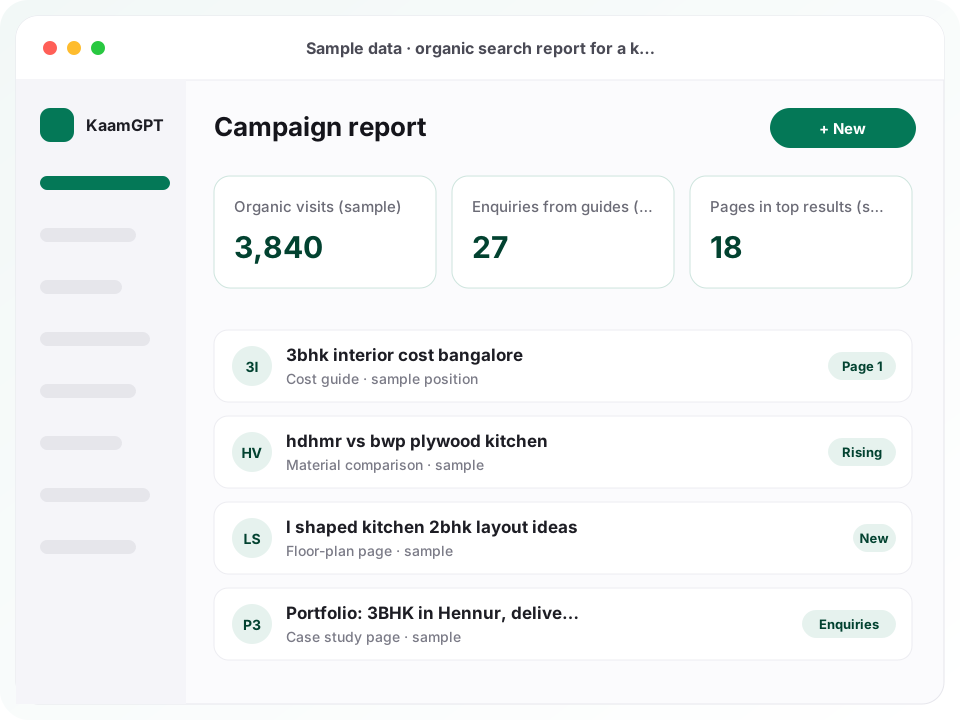
Picking the best SEO company for interior designers in Bengaluru starts with knowing what your buyers read. Long before a couple walks into a studio, they have typed questions such as how much a 3BHK costs to furnish, whether HDHMR is better than plywood, and how many weeks a kitchen takes, and they have quietly formed a view of who explains things honestly.
That research window is where organic search earns its keep for interior firms in Bangalore. Paid ads can buy a click on the day someone is ready, but they cannot make a studio the trusted source during the months of reading before it. Our work builds that trust page by page: cost guides that show real ranges and what drives them, material comparisons written by people who have installed both, floor-plan pages for layouts you have actually furnished, and portfolio pages that read like case studies rather than galleries.
- ₹14,999monthly opens an SEO retainer for a single studio website; the quote names every page
- ~30 daysuntil the audit fixes and the first guides are published
- 4 page typescost guides, material comparisons, floor-plan pages and portfolio case studies
- 0 render-only pagesevery portfolio page carries photographs of a home your team delivered
Which Bengaluru localities are producing new interior searches?
Search demand for interiors rises where apartments are being completed. Anarock's Bengaluru reports for 2025 group the city's housing into zones. In the north they list Hebbal, Yelahanka, Thanisandra Main Road, Hennur Road and the airport road; in the east, Whitefield, KR Puram, Sarjapur Road, Marathahalli, Varthur Road and Bellandur; in the south, Electronic City, JP Nagar, Bannerghatta Road and Kanakapura Road. In January to March 2025, Anarock logged Brigade Group's 1,124-unit Yelahanka project among the quarter's biggest launches.
For SEO this matters in a specific way. Owners do not just search for an interior designer; they search with their locality attached, and sometimes with their tower's layout in mind. A studio that wants to be found by owners on Hennur Road or in Electronic City needs pages that genuinely talk about those places: the apartment sizes common there, the kind of homes you have finished nearby, and how your team handles site access and travel.
None of this means writing a thin page for every locality in the city. A handful of well-made pages for the corridors your crews really serve will do more than a hundred pages that swap one place name for another. Google's systems and careful readers both notice the difference.
What goes into SEO for an interior design website?
The work is listed page by page in your quote under KaamGPT's SEO service. A seo company for interior designers in Bangalore should be able to show you which pages it will write, why each one exists and which question it answers.
Interior cost guide pages
Room-by-room and home-size guides that give realistic ranges and explain what moves them: carcass material, shutter finish, hardware, lofts, false ceilings and electrical work. We write ranges only from your own past quotes, clearly labelled, so every figure can be backed up.
SEO in detail →Material comparisons written from the workshop
BWP plywood against HDHMR, laminate against acrylic, soft-close channels against basic ones. Families search these questions repeatedly. Answers drawn from what your carpenters actually install, including the trade-offs, are what earn links, saves and trust.
SEO in detail →Floor plan pages for layouts you have built
Pages for the typical two- and three-bedroom plans found in the corridors you serve, showing how your team handled the kitchen, wardrobes and storage, with photographs from the finished flat. These pages meet owners while they are still studying their own plan.
SEO in detail →Portfolio case studies, not galleries
Each delivered home gets a page: the brief, the constraints, the materials, the timeline and photos of the result, published with the owner's permission. Renders appear only where labelled. Modular kitchen SEO works best on these pages, because each one answers a specific search.
Websites in detail →Locality pages that earn their place
A small set of pages for the areas your crews really cover, each written around the homes, travel and site access there. These tie into your Maps listing, which KaamGPT's Maps-focused page for design studios covers.
Local SEO in detail →Technical fixes for image-heavy sites
Interior sites are heavy with photographs. We compress and size images, write descriptive file names and alt text, fix slow pages on mobile, tidy duplicate URLs and add structured data that describes the business accurately.
SEO in detail →Honest titles and business details
Page titles, headings and structured data name your profession correctly. If no registered architect works with you, the word architect stays out. Business name, address and phone match your Google profile everywhere.
SEO in detail →How does the best SEO company for interior designers in Bengaluru plan the first year?
We start by listing the questions your own customers asked in their first calls and visits over recent months. Sales teams know them by heart: cost per square foot, which material for a kitchen near the sink, how long the work takes, whether the price includes civil changes. Those questions, matched against what people search, become the content plan.
Then the order matters. Pages that already get impressions but rank just off the first page are improved first, because they move fastest. New cost guides and material comparisons follow, then floor-plan pages and portfolio case studies as your team photographs finished homes. Interior design SEO is a slow build, so we report progress monthly on the pages and searches that matter, not on a vanity traffic number.
Mine the sales calls
A short form for your designers to log every question a customer asks. Repeated questions become guides; unusual ones become FAQ answers. Content written this way sounds like your studio, not like a template.
Price ranges with their reasons
Publishing a range, with the reasons a quote moves up or down, keeps families reading on your site rather than a rival's. Every range is built from your own quotes, labelled as indicative, and updated when material costs change.
Photograph every handover
Your team captures wide shots, details and a short walkthrough at each handover, with the owner's written consent. Without that habit, portfolio case studies cannot be written and the site falls back on renders.
Link guides to proof
Each cost or material guide links to two or three portfolio pages that show the choice in a real home. Readers move from research to evidence in one click, and search engines see a coherent site.
Measure what search brings
Search Console queries, enquiries that started on a guide and studio visits from organic traffic are tracked each month. Pages that draw readers but no enquiries get a clearer next step.
What does KaamGPT charge a studio for search work?
Search work for one studio website carries a ₹14,999 monthly floor at KaamGPT, and audit repairs plus the opening guides normally appear within roughly 30 days. The quote names the page types, how many pages each month and the technical work included. A firm with several websites or a large portfolio backlog gets a bigger written scope.
SEO
Recommended₹14,999/month
Typically 30 days
Suits a firm ready to publish guides and photograph its handovers, opening at ₹14,999 monthly.
- Technical audit
- Keyword research
- On-page optimisation
- Content plan
- Monthly reporting
Digital Marketing
₹19,999/month
Typically 15 days
Suits a studio wanting search woven together with paid campaigns, Maps and WhatsApp under one team; the bundled plan begins at ₹19,999 monthly.
- Channel strategy
- Creative production
- Campaign management
- Weekly reporting
Local SEO
₹4,999/month
Typically 14 days
Suits each staffed studio or display centre that needs its Maps listing kept accurate, from ₹4,999 monthly per location.
- Google Business Profile optimisation
- Local keyword map
- Location page on-page fixes
- Citation building and NAP cleanup
- Local link outreach
- Review replies and posts
- Monthly report
Google Ads
₹4,999/month
Typically 30 days
Suits studios needing calls now, before guides mature; campaign handling begins at ₹4,999 monthly.
- Account setup
- Keyword strategy
- Ad copy testing
- Conversion tracking
- Bid optimisation
Meta Ads
₹4,999/month
Typically 30 days
Suits firms whose delivered homes look good on Instagram and Facebook; ad handling begins at ₹4,999 monthly.
- Creative testing
- Audience building
- Retargeting funnels
- Pixel setup
- Weekly reporting
Lead Generation
₹24,999/month
Typically 14 days
Suits sales desks that prefer screened enquiries with a known keys date, beginning at ₹24,999 monthly.
- Verified leads
- Multi-channel outreach
- CRM integration
- Lead scoring
- Replacement guarantee
- Organic rankings carry no click charges. Should the studio add paid campaigns later, Google and Meta invoice it directly; KaamGPT never handles media money.
- Writing and technical fixes are in the retainer. Professional photography of finished homes is usually arranged by the studio, and we brief what to shoot.
- Compare all starting figures on the KaamGPT pricing page, or read the guide to SEO services in Bengaluru for the general method.
| Package | Starts at | Timeline | Best for |
|---|---|---|---|
| SEO | ₹14,999/month | Typically 30 days | Suits a firm ready to publish guides and photograph its handovers, opening at ₹14,999 monthly. |
| Digital Marketing | ₹19,999/month | Typically 15 days | Suits a studio wanting search woven together with paid campaigns, Maps and WhatsApp under one team; the bundled plan begins at ₹19,999 monthly. |
| Local SEO | ₹4,999/month | Typically 14 days | Suits each staffed studio or display centre that needs its Maps listing kept accurate, from ₹4,999 monthly per location. |
| Google Ads | ₹4,999/month | Typically 30 days | Suits studios needing calls now, before guides mature; campaign handling begins at ₹4,999 monthly. |
| Meta Ads | ₹4,999/month | Typically 30 days | Suits firms whose delivered homes look good on Instagram and Facebook; ad handling begins at ₹4,999 monthly. |
| Lead Generation | ₹24,999/month | Typically 14 days | Suits sales desks that prefer screened enquiries with a known keys date, beginning at ₹24,999 monthly. |
What decides how much SEO an interior firm needs?
Studios of equal size rarely start from the same place. One already has a clean site, a habit of photographing handovers and a designer who likes writing. Another has a slow site built around a slider of renders and no written content at all. The second needs months of foundation before guides can do their job.
The other variable is how many questions your buyers ask that nobody answers well. Searches about kitchen layouts and plywood grades are crowded with generic articles; searches about real costs for a specific home size in a specific corridor are often thin. A seo company for interior designers in Bangalore should point you at the thin ones first.
- How healthy the present site is: mobile speed, page structure, duplicates and photo weight.
- How many delivered homes you can photograph and publish with owners' consent.
- Whether your team can share real quote ranges so that cost guides are honest and specific.
- The number of service lines to cover: full homes, kitchens only, wardrobes, offices, renovations.
- How many localities your crews genuinely serve, which sets the count of area pages worth writing.
- Competition for your main searches from large interior platforms and directories.
Which interior businesses see the biggest return from organic pages?
- Design-and-build home studiosFirms with a stream of delivered apartments to document; every handover can become a case study page.
- Kitchen and wardrobe specialistsSearchers ask about shapes, finishes and hardware constantly, so a focused content library compounds over time.
- Solo designers and small practicesA clear website with honest guides lets a two-person team compete with larger brands on expertise.
- Practices with a registered architectThese can rightly target architecture searches and should say who the registered architect is.
- Commercial and office interior firmsBuyers research process, timelines and past workplaces before inviting bids, so detailed project pages matter.
- Renovation and resale-flat specialistsOwners of older homes search by problem, such as seepage-damaged wardrobes or a cramped kitchen, which suits problem-led guides.
What do the first three months of interior SEO involve?
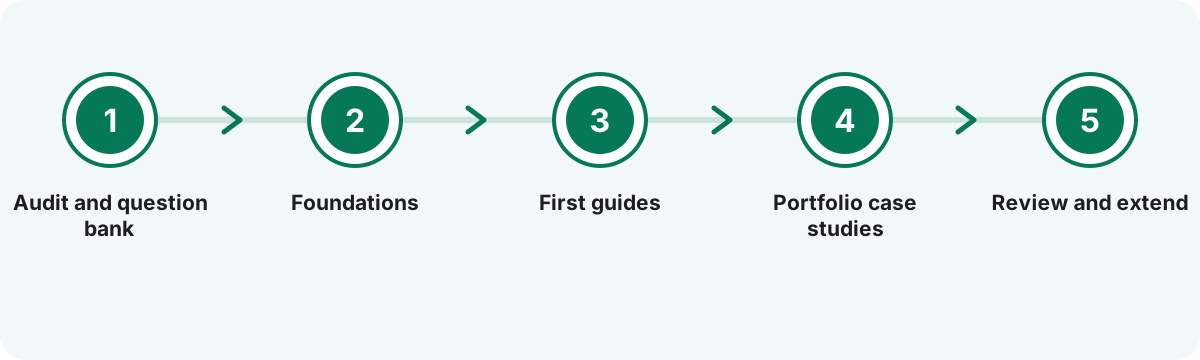
Audit and question bank
We crawl the site, review Search Console and collect the questions your sales team hears, then match them to searches and decide what to fix and what to write.
Foundations
Speed, images, titles, headings, internal links and structured data are fixed, and any misleading titles, such as an unearned use of “architect”, are corrected.
First guides
Two or three cost and material guides go live, each written from your quotes and workshop experience and linked to real portfolio pages.
Portfolio case studies
Delivered homes are written up with the brief, materials, timeline and photographs, starting with projects in the corridors you most want to grow.
Review and extend
Monthly, we look at which pages draw searchers and enquiries, improve those close to page one and add the next set of guides and floor-plan pages.
Why trust KaamGPT with an interior firm's website?
Content from your workshop, not a template
Every guide starts with your designers' answers and your quotes, so the site sounds like your studio and every claim can be backed up.
SEO, AEO and GEO together
Service, area and price facts are stated once, plainly, so Google, featured answers and chat assistants all pick up the same story.
Experience with home-services sites
For A2Z WorkHub, a Bengaluru home-services brand that includes carpentry, we built service and area landing pages and set up its Google profile; the A2Z WorkHub case study shows the approach.
Honest titles and claims
We keep professional titles, prices and timelines accurate, which protects you under consumer law and keeps careful readers on your side.
Plain monthly reporting
You see the searches, pages and enquiries that moved each month, in language a studio owner can act on.
What do Bengaluru homeowners search for before they call a designer?
Interior research comes in layers. Early on, the searches are broad and visual: ideas for a small living room, wardrobe designs for a master bedroom, kitchen colour combinations. These bring large audiences and few enquiries, and they are crowded with image sites and global magazines. A studio can win some of them with original photographs, but they are rarely where the business is decided.
The middle layer is where interior SEO earns money: cost, material and timeline questions asked by people who already own or are about to own a flat. They ask what a full 2BHK costs in Bangalore, whether a kitchen needs BWP plywood, what HDHMR is, how many days a modular kitchen takes after measurement, and whether a quote should include false ceilings and painting. Each of these deserves a careful page.
The last layer is local and specific: a designer near a particular road, interiors for a common 3BHK layout, a modular kitchen showroom open on Sunday. By the time someone searches like this, they are ready to visit. Your locality pages, floor-plan pages and Google profile need to be waiting for them.
- Early-stage examples: “small 2bhk living room ideas”, “wardrobe with loft design”.
- Middle-stage examples: “full home interior cost 3bhk bangalore”, “hdhmr vs plywood for wardrobes”, “how many days for modular kitchen installation”.
- Late-stage examples: “interior designers on Hennur Road”, “modular kitchen showroom Electronic City”, “turnkey interiors Varthur 3bhk”.
Can an interior design firm target searches for architects?
Only if it employs or is a registered architect. Section 37 of the Architects Act, 1972 says that no person other than a registered architect, or a firm of architects, shall use the title and style of architect. A first conviction can bring a fine, and repeat offences can bring imprisonment of up to six months. In Council of Architecture v. Mukesh Goyal, decided on 17 March 2020, the Supreme Court held that the Act protects the title, not the work: unregistered people may design and supervise, but may not call themselves architects.
For SEO, that settles a common temptation. Searches containing “architects” look attractive, and many interior sites put the word in their business name, page titles and meta descriptions. If no registered architect is on the team, that is a use of the title, and it also misdescribes the studio to the reader, which the Consumer Protection Act treats seriously.
The compliant route is simple. Target the searches that describe what you do: interior designer, interior design firm, modular kitchen maker, turnkey interiors. If a registered architect is part of the practice, name that person on the about page and on the projects they led, and only then target architecture searches.
How should portfolio pages be written so they rank and persuade?
A good portfolio page reads like a short case study. It names the type of home and the corridor, describes what the owners wanted and what made it hard, lists the main materials and finishes, gives the time from design sign-off to handover, and shows photographs of the finished rooms. That text gives search engines something to match, and it gives a reader enough to imagine working with you.
Photographs carry most of the weight, so they need care. Use your own shots of delivered homes, with descriptive file names and alt text that say what the image shows. Publish only with the owner's written consent, and leave out anything that identifies the family or the flat number. Where a page includes a render, label it clearly as a render.
ASCI has gone further on computer-generated visuals. Its guidelines on synthetically generated content, signed on 17 September 2026 and in force three months after publication, make labelling mandatory when an ad shows a product that does not yet exist, giving a 3D model of an unbuilt housing complex as the example. Labelling renders on your site as well keeps the whole portfolio consistent.
What should an interior cost guide page actually contain?
A cost guide earns its ranking by being more useful than the generic articles around it. It opens with the home size and scope it covers, such as a full 3BHK with kitchen, wardrobes, a TV unit and a crockery unit, and gives an indicative range drawn from projects your studio has quoted in the last year or so. Then it explains, in plain words, why two families with the same flat can receive very different quotes.
Those reasons are the heart of the page. The core board for carcasses, the shutter finish, the hardware brand, the number of drawers versus shelves, loft heights, false ceilings, lighting points, painting and any civil changes each move the figure. A short table showing how one choice changes the range is worth more than a paragraph of adjectives, and it lets a reader arrive at your studio already knowing what to ask.
Finally, the page should be honest about what it cannot tell. A range is not a quote, prices change when material costs move, and site conditions found at measurement can add work. Saying so plainly protects the studio under consumer law and builds the very trust that makes a family book a visit.
- State the scope, home size and date the range was last checked.
- Show the main cost drivers and how each changes the range.
- Link to two or three delivered homes that sit inside the range.
- Say what is excluded, such as appliances, loose furniture or civil work.
- End with a clear next step: a measurement booking or a studio visit.
Should an interior firm write pages about specific apartment projects?
Owners do search with their project's name, and a page about the 3BHK layout in a large development can be genuinely useful. The question is how to write it honestly. Describe the layout, the storage problems it creates and how your team solved them in a flat you delivered there. Do not suggest that the builder recommends you, has approved your designs or has a partnership with you unless that is true and the builder agrees to be named.
ASCI's code is direct on this. Chapter I tells advertisers not to mention another business, without its consent, in a way that hands them an unfair edge, and it expects every checkable claim to have proof behind it. A studio website is marketing, so the same discipline applies.
In practice we prefer floor plan pages organised by layout type and corridor, with named projects mentioned only where you have delivered homes there and the owners are happy to be shown. That keeps the content truthful, avoids friction with developers and still matches the way owners search.
- Good: “How we fitted a parallel kitchen into a compact 2BHK layout, with photos from a delivered flat on Hennur Road.”
- Risky: “Official interior partner for [project name]” when no such agreement exists.
- Never: a gallery of renders presented as homes you completed in a named building.
Why do so many interior websites get neither traffic nor calls?
Most interior sites are built as portfolios: big images, little text, a contact form. That looks good to the owner and tells a search engine almost nothing about what the studio does, where, for whom or at what cost.
- Galleries with no words. A page of twenty kitchen photos with no description cannot match the question “what does a parallel kitchen cost for a 2BHK” and gives the reader nothing to compare.
- Renders presented as finished work. Visitors spot renders quickly, and a portfolio that mixes them with real photos without saying which is which loses credibility.
- Titles that claim the wrong profession. Many sites use “architects” in their name or page titles with no registered architect on the team, which section 37 of the Architects Act does not allow.
- Prices nobody can find. Families want ranges. Sites that hide every number send them to competitors who explain what a range depends on.
- Locality pages copied from a template. Pages that change only the area name rarely rank for long and never persuade an owner who knows their neighbourhood.
- SEO retainer
- From ₹14,999 a month, first work live in about 30 days
- Core page types
- Cost guides, material comparisons, floor-plan pages, portfolio case studies
- Title rule
- Architects Act 1972 s.37: only registered architects may use the title
- Advertising code
- ASCI Chapter I: substantiate factual claims; no unjustified references to other firms
- Render labelling
- ASCI synthetic-content guidelines signed 17 Sep 2026, effective three months after publication
- Who it suits
- Interior design firms, modular kitchen makers and fit-out contractors in Bengaluru
Where this applies around Bengaluru, Karnataka
- Bengaluru
- Karnataka
- India
- Hennur
- Yelahanka
- Electronic City
- Bannerghatta Road
- Varthur
Frequently asked questions
28 answersWho is the best SEO company for interior designers in Bengaluru?
Pick a team that wants to see your past quotes, your handover photographs and the questions your designers hear, before it talks about keywords. KaamGPT builds interior SEO around cost guides, material comparisons, floor-plan pages and real portfolio case studies, and a single Bengaluru studio site sits on the ₹14,999 monthly tier.
What is the monthly fee for SEO for an interior design firm in Bengaluru?
Organic work for one studio site begins at ₹14,999 monthly with KaamGPT, and roughly a month passes before the first repairs and guides are published. Your site's condition, how many kinds of interiors you sell and the corridors you cover push the figure up or down. Both the page plan and the fee are set down in writing first.
When does organic search start sending enquiries to an interior studio?
Repairs to the site and edits to pages hovering just below page one tend to move first. Fresh cost guides and portfolio write-ups need more patience before search engines trust them. Interior buyers research for months, so the enquiries SEO brings tend to arrive steadily rather than all at once.
Can an interior designer call itself an architect on its website?
Not unless someone on the architects' register practises with you. The protection sits in section 37 of the 1972 Act, and the Mukesh Goyal judgment of March 2020 explains that it guards the name, while the design work stays open to all. Interior firms should describe themselves as interior designers or design-and-build studios instead.
Should interior designers publish price ranges on their website?
Yes, if the ranges come from your own past quotes and the page explains what moves a price up or down. Families searching in Bengaluru want a sense of cost before they visit. Label figures as indicative, say what they include, and keep the source quotes filed away in case ASCI or a customer asks you to prove them.
How should an interior studio write portfolio pages for SEO?
Treat each delivered home as a short case study: the type of flat and corridor, the brief, the main materials, the time from design sign-off to handover and photographs of the finished rooms. Get the owner's written consent, avoid identifying details and label any render as a render. Each page should answer at least one specific search.
Do 3D renders need a label in interior design ads?
ASCI's guidelines on synthetically generated content, signed in September 2026 and effective three months after publication, make labels mandatory where an ad shows something that does not yet exist, citing a 3D model of an unbuilt housing complex as an example. Labelling renders of interiors that are not yet built is the safe and honest course, on ads and on your website.
Can an interior firm write pages about a builder's apartment project?
You can write about layouts you have actually furnished in a project and show the delivered home with the owner's consent. Do not imply that the builder recommends or partners with you unless that is true and agreed. Borrowing a developer's name to gain credibility it never granted runs against Chapter I of the ASCI code.
Which Bengaluru areas have new apartments needing interiors?
Anarock's 2025 reports group active Bengaluru housing into zones: Hebbal, Yelahanka, Thanisandra Main Road and Hennur Road in the north; Whitefield, Sarjapur Road, Varthur Road and Bellandur in the east; Electronic City, Bannerghatta Road and Kanakapura Road in the south. Your SEO should focus on the corridors your crews actually serve.
Why hire a seo company for interior designers in Bangalore instead of a generalist?
It knows what interior buyers ask and in what order: ideas first, then cost, materials and timelines, then a nearby studio. It also knows the traps specific to this trade, such as the architect title, renders passed off as finished work and builder names used without permission. Generalists tend to chase traffic for its own sake.
Is modular kitchen SEO different from SEO for full-home interiors?
The questions differ. Kitchen searches are about shapes, finishes, hardware, appliances and installation time, and many buyers want a showroom visit. Full-home searches are about total cost, project management and timelines. A studio selling both needs separate guides and portfolio pages for each, linked where a family is likely to need both.
Do interior designers need a blog for SEO?
They need useful pages more than a blog. A small set of cost guides, material comparisons and portfolio case studies, kept up to date, usually does more than frequent short posts. If a blog exists, each article should answer a real question from customers and link to evidence in your portfolio.
Will SEO help an interior studio appear in AI assistants?
Clear, consistent facts help. When your services, areas, price ranges and portfolio are written plainly on your site and match your Google profile, AI assistants and answer boxes have accurate material to draw on. Nobody can promise a specific mention, but vague or contradictory pages make one less likely.
How many locality pages should an interior firm in Bengaluru publish?
Only as many as you can write genuinely. A page for each corridor your crews serve, describing the homes, travel and site access there and linking to work you delivered nearby, is useful. Dozens of pages that differ only by area name rarely rank for long and do not convince owners who know their area.
Can SEO compete with large online interior platforms?
On broad idea searches, rarely. On specific questions, often yes. Platforms write generic pages for the whole country, while a Bengaluru studio can answer what a 3BHK on a particular corridor costs, show a delivered flat nearby and explain how its own crew handles site access. That depth is where smaller firms win.
What technical problems do interior design websites usually have?
Heavy, uncompressed photographs that slow mobile pages, sliders with no text, image file names like IMG_2041, missing alt text, duplicate project pages, and contact details that differ from the Google profile. These are fixed in the first month so that new content has a sound base.
Should we hide our prices to avoid competitors seeing them?
Competitors can learn your prices from any customer. Families, meanwhile, leave sites that tell them nothing. Indicative ranges with clear reasons, built from your own quotes, help the right buyers self-select and save your designers time with households whose budget does not fit.
Which numbers show whether interior SEO is working?
We track the searches your pages appear for, positions for the questions that matter, organic visits to guides and portfolio pages, and enquiries and studio visits that began on organic search. Traffic alone is not the goal; enquiries from people with a home to furnish are.
Does SEO help office interior and fit-out firms too?
Yes, though the content differs. Facilities heads and founders research process, timelines, past workplaces and how a firm handles building rules. Detailed project pages and a clear explanation of how bids and site work are run help a fit-out firm get invited to tender.
What should our interior studio hand over at the start?
Logins for the site and Search Console, photographs from recent handovers, the questions buyers keep asking, a few anonymised past quotes for ranges, and a note of the corridors your crews serve. With these, we can audit the site and draft the first guides within the first month.
How can our interior firm reach KaamGPT about organic search?
Send your site's link and a line about the interiors you sell to +91 79767 82366, by call or on WhatsApp. After a look through the site, we talk through the findings over video, then email a page plan with the retainer figure.
Should an interior studio pair organic search with paid search?
They work well together. Ads bring enquiries while organic pages climb, and search term data from ads shows which questions deserve a guide. The paid side is set out on <a href="/best-google-ads-agency-for-interior-designers-in-bengaluru">our Google Ads write-up for interior studios</a>; <a href="/services/google-ads">campaign management</a> carries a ₹4,999 monthly floor, and Google bills the studio for clicks.
Should every finished project become a portfolio page?
Not every one. Choose homes that show a distinct layout, problem or material choice, and where the owner is happy to be shown. A dozen strong case studies across your main corridors and home sizes are worth more than fifty pages of near-identical photos.
Is local SEO part of the interior SEO retainer?
Locality pages and consistent business details are part of it. Ongoing Google Business Profile work, such as review replies, photo updates and posts for each studio, sits under <a href="/services/local-seo">KaamGPT's Local SEO service</a>, priced per location. Many studios run both.
What content should a kitchen showroom publish first?
Start with kitchen shapes for common Bengaluru flat sizes, finish comparisons with care advice, a guide to what a modular kitchen quote should list, and installation timelines from measurement to handover. Link each to photographed kitchens you delivered, and to your showroom's hours and location.
Do reviews and SEO affect each other for interior designers?
They support each other. Reviews on your Google profile reassure the people who find you through organic search, and a site with clear service and area pages helps Google understand which searches your profile should appear for. Asking for reviews after a successful handover helps both.
Can a new interior studio in Bengaluru rank without many past projects?
It can start with honest guides and a few well-documented projects, including any done before founding the studio if you have the right to show them. Be clear about what is yours. Over the first year, photograph every handover so the portfolio grows with the business.
Where can we compare all of KaamGPT's services for interior firms?
Our <a href="/best-digital-marketing-agency-for-interior-designers-in-bengaluru">digital marketing page for interior designers</a> shows how SEO fits into a managed plan alongside ads, Maps and WhatsApp. Each service can also be taken on its own, and every engagement begins with a scope written for your studio.