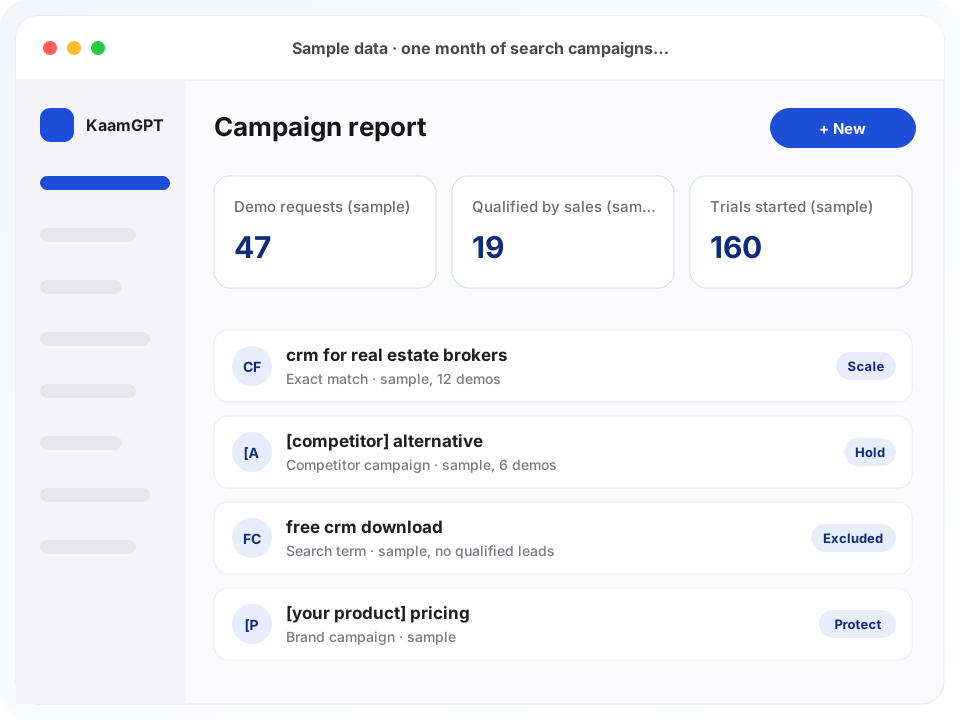
Refusing to pay for the wrong clicks is what marks out the best Google Ads agency for SaaS companies in Bengaluru. Software keywords are expensive, and searches like free invoice generator or what is a CRM bring students, job seekers and people who will never pay. The money is in a narrower set of searches: the category with a buying qualifier, pricing questions, and the names of tools your buyers already use and want to leave.
KaamGPT manages Google Ads for software makers out of Bengaluru: Google bills you for media and our invoice covers only the labour. Since our own workspace product runs a free tier and trials, the distance between an easy sign-up and a paying account is familiar ground. Below: how we would lay out the account, what Google's policies allow when you bid on competitors, how to target buyers abroad and what it costs.
- ₹4,999monthly to manage the account, while clicks are paid to Google by you
- ~30 daysfor audit, tracking repair and relaunch of the rebuilt campaigns
- 3 intent groupscategory, price and rival-name searches, budgeted and landed separately
- 1 source of truthqualified demos and paid accounts imported from your CRM to guide bidding
Which campaign layout would the best Google Ads agency for SaaS companies in Bengaluru choose?
We build the account around intent, not around the product menu. Category searches with a buying qualifier form the core. Pricing and comparison searches get their own campaign because they convert well and deserve protected budget. Competitor searches run separately with careful ad text. Your own brand terms run in a small campaign so rivals bidding on your name do not take the click for free.
Every campaign optimises to an outcome that matters for revenue. For a product-led tool that is usually an activated trial; for a sales-led product, a demo that sales marks as qualified. Those outcomes come from your CRM or product database, uploaded to Google as conversions, so bidding learns the shape of a real customer. Until enough of them exist, we bid to the starting event and watch quality by hand.
Budgets follow evidence. A new campaign starts small, collects data for a few weeks and grows only if its cost per qualified demo or activated trial fits the lifetime value of a customer.
For an early-stage startup with a small budget, the same structure applies at a smaller scale: one market, one or two intent groups and a brand campaign. Spreading a modest budget across many keywords and countries gives each one too little data to learn from, so we would rather run three campaigns well than ten thinly.
Exact and phrase match first
Software budgets disappear fastest on broad match. We start with tightly matched keywords, read the search terms every week and widen only where the data shows it is safe.
Exclusions written before launch
Free, download, crack, tutorial, course, salary, jobs, open source and login are typical exclusions for paid tools. Your own list grows weekly from the search terms report.
Offline conversion import
Qualified demos, opportunities and paid accounts are sent from the CRM back to Google with the click ID, so bidding sees which clicks became revenue weeks later.
Pricing and comparison pages as destinations
Searchers who ask about price or compare tools land on pages that answer that exact question, not on the home page or a generic feature list.
Schedule ads to buyers' working hours
For US or UK campaigns, ads run during their business day and demo slots are offered in their time zone, so a click at 10 a.m. in Boston meets a calendar that works.
Keep the brand campaign small and separate
Your own brand terms usually convert cheaply, which can make a blended account look better than it is. Running brand separately keeps its budget small, protects the name from rival bids and shows honestly how the non-brand campaigns perform.
Which jobs does KaamGPT take over inside a SaaS search account?
We manage the account end to end, from tracking to search terms to landing page advice. The parts below are the usual scope; the written quote confirms which apply to you.
Account audit and restructure
We read the search terms, match types, locations, conversion settings and budgets, then rebuild around intent groups: category, pricing, competitor and brand. Each group gets its own budget so one cannot starve the others.
Google Ads in detail →Conversion tracking from sign-up to payment
We set up the sign-up or demo request as a starting event, then import later outcomes such as activation, qualified demo or paid account from your CRM, so bidding learns from customers rather than form fills.
Google Ads in detail →Competitor and alternative-to campaigns
Campaigns on rival product names and alternative searches, with ad text that describes your own product and a landing page that compares honestly. How the trademark policy applies is explained below.
Google Ads in detail →Country and time-zone set-up
Separate campaigns for each market you sell in, Presence targeting where it fits, ads scheduled to buyers' working hours and bids based on what a customer in that country is worth.
Google Ads in detail →Landing pages for each intent
A pricing-focused page for pricing searches, a comparison page for competitor searches, a use-case page for category searches. If pages need building, website development is quoted separately.
Websites in detail →Sharing what search ads learn with SEO
Search terms that convert become topics for organic pages, which can lower paid spend over time. Our SEO page for SaaS shows how those pages are built.
SEO in detail →Retargeting across Google and Meta
Visitors who read pricing but did not sign up can be reached again on YouTube and display, or on Meta. Our Meta Ads page for SaaS covers that side.
Meta Ads in detail →Search as one source in a sales pipeline
For sales-led products, search ads sit beside outbound email and events. Demo requests from ads go into the same qualification and follow-up process, described on our lead generation page for SaaS and under lead generation services.
Lead generation in detail →Can you bid on a competitor's brand name in Google Ads?
As a keyword, yes. Google's trademark policy lists using trademarks as keywords among the things it will not restrict. Competitor bidding on rival product names is therefore common in software, and your rivals may already be bidding on yours.
The ad text is different. Google may restrict a trademark in ads from a direct competitor, or in ads that use it in a confusing, deceptive or misleading way, once the owner files a complaint. Complaints are accepted only against specific advertisers and only in the countries and industries where the owner has shown trademark rights. So a headline that works in one market can be disapproved in another.
Our practice is to keep rival names out of headlines and descriptions altogether. The ad talks about your product, for example a clear alternative for teams under fifty people with a monthly plan, and the landing page explains the differences. That avoids complaints and, just as important, avoids clicks from the rival's own customers who were looking for their login page.
Comparisons on the landing page should also follow India's advertising code: clear about what is compared, factual and capable of substantiation, with no unfair denigration. Our SEO page for SaaS teams covers how we write those comparison pages.
- Keywords: rival names, rival plus alternative, rival plus pricing, rival plus vs your category.
- Ad text: your product's own strengths; no rival names, logos or implied affiliation.
- Landing page: dated, factual comparison with evidence kept on file.
- Watch for: low click-through and high bounce, which usually mean people wanted the rival's site.
What should a SaaS Google Ads account optimise to?
Automated bidding is only as good as the conversion it chases. If the conversion is a sign-up, the system will find people who sign up easily, and in software those are often students, competitors researching you and people who wanted something free. If the conversion is a qualified demo or an activated trial, it finds more people like your real customers.
The catch is volume and timing. Activation and qualification happen days or weeks after the click, and bidding needs a steady flow of conversions to learn. Our usual path is to track the sign-up or demo request as the primary event at launch, add activation or qualification as soon as the CRM can supply it with the original click ID, and then shift bidding to the later event once enough of them arrive each month.
Offline conversion import is the mechanism: the CRM or product database records the click ID with each lead, and qualified outcomes are uploaded to Google on a schedule. Values can be attached, so a large account counts for more than a small one. Getting this right is often worth more than any change to ads or keywords.
- Launch: sign-up or demo request as the primary conversion, with click IDs stored on every lead.
- Within weeks: activation or sales-qualified demo imported from the CRM, with a value attached.
- Once volume allows: bidding moved to the later event, with the starting event kept for reporting only.
- Throughout: a weekly check that imported outcomes match what sales sees in the CRM.
How do you target US or UK buyers from Bengaluru without wasting clicks?
Google's default location setting, Presence or interest, shows ads to people in or regularly in your target locations and also to people who have shown interest in them. For a travel or property business that interest is useful. For a SaaS product that can only bill and support customers in certain countries, it can mean paying for clicks from people elsewhere who read about the US.
The Presence option limits ads to people likely to be located, or regularly located, in the places you target, and Google notes that exclusions already use Presence by default. For international software campaigns we usually choose Presence, then split campaigns by country so budgets, bids and ad schedules can match each market.
Scheduling matters because US Eastern time runs nine and a half to ten and a half hours behind India, depending on daylight saving. Ads that run on Indian office hours reach Americans overnight, when demo requests sit unanswered. We schedule ads to the buyer's business day and offer demo slots in their time zone, which may mean your team takes some late-evening calls from Bengaluru.
Currency and language complete the set-up. Each country's ads should point to a page with prices in that currency, spelling for that market and proof from customers there where you have permission to show it. Billing details such as sales tax or VAT should be explained before checkout, not discovered after it, which also keeps the ads within Google's pricing disclosure rules.
Do free trial ads need to say what happens after the trial?
Google's misrepresentation policy covers dishonest pricing practices. It does not allow failing to clearly and conspicuously disclose the payment model or the full expense a user will bear, or pricing that creates a false impression leading to unexpected charges.
For free trial ads, that means the ad and landing page must not hide that the trial turns into a paid plan. If a card is required and billing starts automatically, say so near the sign-up button with the price and the date billing begins. If no card is needed, say that too; it is a selling point. Plan prices should be visible on the pricing page, and taxes or seat-based charges explained.
Clear terms also improve the quality of trials. People who understand the price before signing up are more likely to be real buyers, which makes trial-based bidding work better.
A free plan is different from a free trial, and the ad should say which you offer. A free plan with limits never bills unless the user upgrades; a trial ends and either stops or bills. Mixing the two words in ads and pages confuses buyers and draws complaints, so we use one term consistently from ad to checkout.
Which campaign types fit software: Search, Performance Max or YouTube?
Search remains the core of Google Ads for SaaS, because it captures people describing their need in words. It gives the most control over keywords, ad text, landing pages and search terms.
Performance Max spreads budget across Google's inventory automatically. It can work for software when conversion tracking is strong and based on qualified outcomes, but with sign-up tracking alone it tends to find cheap, low-quality conversions. We test it only after the search account and CRM imports are in good shape, with brand terms excluded where possible.
YouTube is useful for retargeting: a short product demo shown to people who visited pricing or started a trial. Cold YouTube campaigns for niche B2B software rarely pay back, though demo request campaigns that combine search with a video retargeting layer can lift results when the product is easier to understand by watching it.
Display campaigns aimed at cold audiences are the weakest fit for most business software. Placements are hard to control, and clicks often come from apps and sites unrelated to work. We leave them out unless there is a specific, measurable reason to test them.
- Search: category, pricing, competitor and brand campaigns, the core of the account.
- Performance Max: only with outcome-based conversions, and kept in its own budget.
- YouTube and display: retargeting with demos and customer walkthroughs, not cold reach.
Fees for running a SaaS search account
Management of a SaaS search account begins at ₹4,999 monthly, and the rebuilt account typically goes live within roughly 30 days. Media money moves from you to Google without touching us. An account covering one market with a few campaigns fits the starting fee; a google ads agency for SaaS companies in Bangalore running several countries, competitor programmes and CRM imports at once will quote more, and the quote explains each line.
Google Ads
Recommended₹4,999/month
Typically 30 days
Software with a clear category or known competitors that buyers already search for by name.
- Account setup
- Keyword strategy
- Ad copy testing
- Conversion tracking
- Bid optimisation
Digital Marketing
₹19,999/month
Typically 15 days
SaaS teams that want search ads planned alongside SEO, email and conversion pages, with one report across all of them.
- Channel strategy
- Creative production
- Campaign management
- Weekly reporting
SEO
₹14,999/month
Typically 30 days
Products hoping to lean less on paid clicks by ranking organically for terms the ads have already validated.
- Technical audit
- Keyword research
- On-page optimisation
- Content plan
- Monthly reporting
Local SEO
₹4,999/month
Typically 14 days
Not usually needed for SaaS, unless customers visit a physical office, demo centre or training room.
- Google Business Profile optimisation
- Local keyword map
- Location page on-page fixes
- Citation building and NAP cleanup
- Local link outreach
- Review replies and posts
- Monthly report
Meta Ads
₹4,999/month
Typically 30 days
Self-serve tools wanting awareness among owners pre-search, plus a second touch for pricing-page readers.
- Creative testing
- Audience building
- Retargeting funnels
- Pixel setup
- Weekly reporting
Lead Generation
₹24,999/month
Typically 14 days
Sales-led products where search ads are one source among outbound and events feeding a shared meeting pipeline.
- Verified leads
- Multi-channel outreach
- CRM integration
- Lead scoring
- Replacement guarantee
- The ₹4,999 entry fee is for management alone; Google charges you separately for every click.
- Missing landing pages can be built as a website project, priced from ₹9,999.
| Package | Starts at | Timeline | Best for |
|---|---|---|---|
| Google Ads | ₹4,999/month | Typically 30 days | Software with a clear category or known competitors that buyers already search for by name. |
| Digital Marketing | ₹19,999/month | Typically 15 days | SaaS teams that want search ads planned alongside SEO, email and conversion pages, with one report across all of them. |
| SEO | ₹14,999/month | Typically 30 days | Products hoping to lean less on paid clicks by ranking organically for terms the ads have already validated. |
| Local SEO | ₹4,999/month | Typically 14 days | Not usually needed for SaaS, unless customers visit a physical office, demo centre or training room. |
| Meta Ads | ₹4,999/month | Typically 30 days | Self-serve tools wanting awareness among owners pre-search, plus a second touch for pricing-page readers. |
| Lead Generation | ₹24,999/month | Typically 14 days | Sales-led products where search ads are one source among outbound and events feeding a shared meeting pipeline. |
Setting a click budget from customer value
Work backwards from customer value rather than picking a round figure. Knowing roughly what a paid account brings in over its life, and how many qualified demos it takes to close one, tells you the ceiling on cost per demo. A first test should buy enough clicks on core keywords in a month for the outcome to mean something rather than reflect chance.
Software clicks in English-speaking markets abroad usually cost more than in India, and competitor terms often more again. That does not make them bad value if the contracts are larger, but it does mean an international test needs its own budget and patience.
We share a simple model with you before launch: expected clicks, expected demo or trial rate, expected qualification rate and the cost per outcome that would justify scaling. Then the first month's data replaces our assumptions.
- Average contract value and how long customers stay.
- How many countries you target and the click costs there.
- Whether rival-name campaigns are in scope.
- How much search volume your category has today.
- Whether the CRM already records click IDs for import.
- How many landing pages need building or rewriting.
What does a software buyer type into Google when they are ready?
By the time a buyer searches with a qualifier, they have usually decided to buy something. A sales head at a mid-sized company along the ORR enters crm with call recording for inside sales; an operations lead in Marathahalli types shift scheduling software pricing; a founder who is tired of a tool types [competitor] alternative cheaper. These searches are rarer and costlier than broad ones, but each click is much likelier to turn into a trial or a demo.
Who searches is often not who signs. The searcher is frequently a manager or an individual user building a shortlist; the budget holder and the IT reviewer come later. So the landing page for a search ad must serve the searcher's immediate question while giving them something to forward: a pricing summary, a security note, a short demo video. Ads that send every click to a home page lose both audiences.
Many Bengaluru SaaS teams, especially those that have grown into the Bagmane Tech Park and Embassy Tech Village campuses, also sell abroad. That changes the account: separate campaigns per country, ads scheduled to that country's working hours, landing pages in the local currency and bidding based on what a customer there is worth. One global campaign with every country switched on is the commonest and costliest set-up we come across.
Search ads by SaaS segment: where do they pay best?
- Small-team utilitiesHigh search volume but many free-seekers; tight negatives and activation-based bidding are essential.
- Single-industry softwareSpecific searches like dental practice management software are affordable and convert well.
- Enterprise and mid-market suitesFewer, costlier searches; demo request campaigns judged by qualified pipeline, not form volume.
- Developer and API productsError-message and integration searches work better than generic category terms.
- AI-native toolsCompetitive auctions on new category terms; clear use-case keywords usually beat the AI label itself.
- Small-business software for IndiaSearches in plain terms such as billing software for shop, often on mobile, with call and WhatsApp extensions.
- Replacements for legacy softwareSearches naming the old product plus alternative, migration or replacement signal a buyer ready to switch.
- Security and compliance toolsSearches tied to an audit or regulation deadline carry urgency and justify higher bids.
Handing over the account: the first five steps
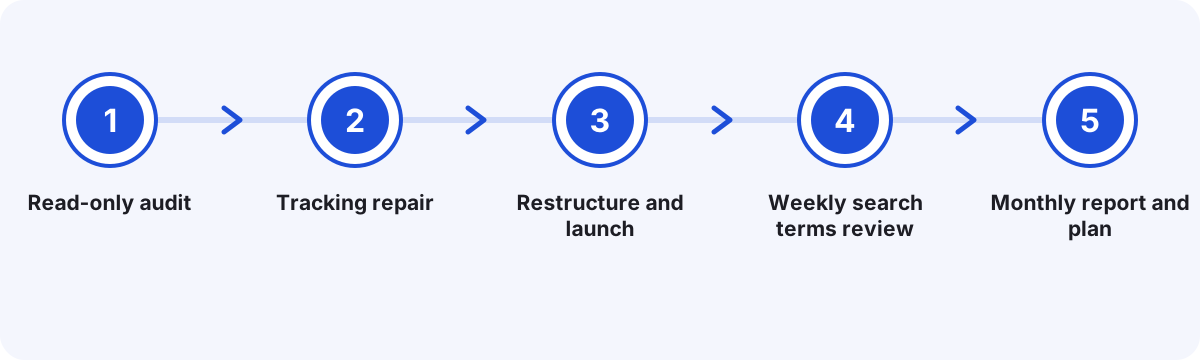
Read-only audit
We review search terms, settings, tracking and spend for the last few months and list where money went without a qualified result.
Tracking repair
Starting events are checked, and an import of CRM outcomes is designed with your team so later conversions reach Google.
Restructure and launch
Campaigns are rebuilt by intent and country, with negatives, ad schedules and landing pages matched to each group.
Weekly search terms review
Every week we add negatives, move budget toward what produces qualified demos or activated trials, and pause what does not.
Monthly report and plan
You get spend, demos or trials, qualified outcomes and cost per qualified result for each campaign, with next month's changes agreed on a call.
Where KaamGPT differs on software search accounts
Outcome-based bidding
We push to train bidding on qualified demos or activated trials as soon as the data allows, not on raw sign-ups.
Policy-aware competitor work
Rival-name campaigns are drafted inside Google's trademark and misrepresentation policies and India's advertising code.
We run a trial funnel too
Our own workspace product has a free tier and trials, so we know how far sign-ups sit from revenue.
Your account, your data
The account and billing stay in your name; our access is a login you can switch off whenever you like.
Plain monthly reporting
Each campaign's cost per qualified result, written up in plain sentences alongside every change made.
Weekly attention, not quarterly
Search terms are read and negatives added every week, because software accounts drift quickly when left alone.
Where do SaaS Google Ads accounts lose money?
Most wasted spend in software accounts comes from a short list of causes. None of them is exotic, and all of them are visible in the search terms report within the first week of an audit.
The pattern behind most of them is that the account was set up to count form fills, and nobody went back to check which form fills turned into revenue. Google's bidding then does exactly what it was told: it finds more cheap form fills.
- Broad match on generic terms like software or tool, matched to searches for free downloads, tutorials, jobs and college projects.
- Bidding optimised to sign-ups, so the system learns to find people who sign up and never return, rather than people who activate or pay.
- One campaign targeting the whole world in English, with Presence or interest left on, paying for clicks from countries the team cannot sell to or support.
- Competitor campaigns that copy the rival's name into the headline, attracting a trademark complaint and confused clicks from the rival's own customers looking for login pages.
- Trial ads that say free without saying what happens after the trial, which frustrates users and runs against Google's rule on disclosing the payment model.
- Search account management fee
- ₹4,999 monthly upwards; rebuilt account live in roughly 30 days
- Click costs
- Charged to your card or invoice by Google itself
- Competitor names as keywords
- Not restricted by Google's trademark policy
- Competitor names in ad text
- Can be restricted after a complaint, in countries where the owner shows rights
- Trial and subscription ads
- Payment model and full cost must be disclosed clearly (misrepresentation policy)
- Location option for exports
- Presence targeting keeps ads to people located in the countries you choose
Where this applies around Bengaluru, Karnataka
- Bengaluru
- Karnataka
- India
- Outer Ring Road (ORR)
- Marathahalli
- CV Raman Nagar
- Bagmane Tech Park
Frequently asked questions
29 answersWhich test reveals the best Google Ads agency for SaaS companies in Bengaluru?
Find out which outcome they would train bidding on and how they would get that data from your CRM. Ask to see how they read a search terms report and which negatives they would add on day one. A strong answer talks about qualified demos or activated trials, not clicks or cost per sign-up.
What is KaamGPT's fee as a Google Ads agency for SaaS companies in Bangalore?
Account management begins at ₹4,999 monthly; Google invoices you for clicks. Accounts covering several countries or with CRM imports and competitor programmes are quoted higher, with each item explained. Every listed price sits on our <a href="/pricing">pricing page</a>.
Can SaaS companies bid on competitor names in Google Ads?
Yes as keywords: Google's trademark policy leaves trademark keywords unrestricted. Using a rival's trademark in ad text can be restricted after a complaint, in the countries where the owner has shown rights. We keep rival names out of ad text and compare honestly on the landing page.
What if a competitor bids on our brand name?
It is allowed as a keyword, so the sensible response is running a modest brand campaign yourself, one that usually wins the click cheaply because your ad is the most relevant. If a rival uses your trademark in its ad text, you can file a complaint with Google in the countries where you hold rights.
Should SaaS companies optimise Google Ads to trials or demo requests?
To whichever later event best predicts payment. For self-serve products that is usually an activated trial; for sales-led products, a demo sales marks as qualified. At launch we track the trial or demo request, then move bidding to the later event once enough arrive from your CRM.
How do SaaS companies import CRM conversions into Google Ads?
The landing page stores the Google click ID with each sign-up or demo request, the CRM keeps it on the lead record, and qualified outcomes are uploaded to Google on a schedule, manually or through an integration. We design the fields and the upload with your team.
How do I target US buyers with Google Ads from India?
Create a separate campaign for the US, choose the Presence location option so ads reach people located there, schedule ads to US business hours, write in US English and land clicks on a dollar-priced page. Offer demo slots in the buyer's time zone.
Do free trial ads need to disclose billing?
Google's misrepresentation policy requires the payment model and the full expense to be disclosed clearly and conspicuously. If a trial converts to a paid plan automatically, state the price and when billing starts near the sign-up. If no card is required, say so.
How much ad spend do SaaS companies need to start?
A month of clicks on core keywords large enough that the outcome is readable, not random. That depends on click costs in your markets and category. We model it with you before launch, and the spend is always paid to Google directly.
Which keywords should SaaS companies avoid?
Usually broad terms such as software or app on their own, and searches with free, download, crack, tutorial, course, jobs, salary or login, unless you offer a free plan and want those users. The exclusion list then lengthens week by week as real search terms come in.
Does Performance Max work for SaaS companies?
Sometimes, but only once conversion tracking is based on qualified outcomes rather than sign-ups. With sign-up tracking alone it tends to find cheap, low-quality conversions. We test it after the search campaigns and CRM imports are working, in its own budget.
How long before Google Ads produce demos for a Bengaluru SaaS team?
The rebuilt account normally runs inside roughly 30 days, and trials or demo requests begin flowing soon after launch. Judging quality takes longer, because qualification and payment come later; most Bengaluru SaaS teams need two or three months of data before scaling budgets with confidence.
Do domestic-only SaaS companies need a different search set-up?
Yes. Indian SMB software campaigns often work best on mobile, with call and WhatsApp options, plain-language keywords and INR pricing on landing pages. Click costs are usually lower than abroad, but so are contract values, so tight targeting still matters.
Should SaaS companies use YouTube ads?
Mainly for retargeting: a short demo shown to people who visited pricing or started a trial. Cold YouTube campaigns for niche business software rarely pay back. For products that are much easier to understand by watching, a small test can be worthwhile.
What landing page should a SaaS search ad use?
The page that answers the search: pricing for price searches, a comparison for competitor searches, a use-case page for category searches. Each should have one clear action, either start a trial or book a demo, and load quickly on mobile.
Do you need admin access to our Google Ads account?
Standard access is enough to manage campaigns; billing stays with you as the owner. Read-only access is enough for the first audit. Revoke our login whenever you choose; the account, its history and the data are yours throughout.
What goes into the monthly search report for SaaS companies?
Per campaign each month: spend, clicks, demo requests or trials, qualified outcomes from the CRM, and cost per qualified outcome. We explain what changed in plain sentences, list the negatives and budget moves made, and agree next month's tests on a call.
Should a Google Ads agency for SaaS companies in Bangalore launch every country together?
We would rather add markets one by one, giving each a dedicated campaign, budget, schedule and landing page. That keeps results readable and stops one market's costs hiding another's performance.
Can you work with our in-house growth team in Bengaluru?
Yes. Often the in-house team owns positioning and landing pages while we run the account, tracking and weekly optimisation. We agree who changes what in writing, and meet online weekly or fortnightly.
What is the fastest way to get a SaaS search audit from KaamGPT?
Phone or WhatsApp +91 79767 82366 and share the product, your selling countries and the profile of a lead worth having. We will ask for read-only access, review the account and reply with findings and a written quote.
Do search ads pay off for SaaS companies before product-market fit?
Often, as a learning tool. A small search budget shows which problem statements and keywords bring real sign-ups or demos, faster than SEO can. It becomes expensive when run broadly before the product and positioning are settled, so we keep early tests narrow.
What is a good click-through rate for SaaS search ads?
No universal benchmark exists, because rates swing widely by keyword type. Brand campaigns usually see far higher rates than competitor or category campaigns. We judge ads by cost per qualified demo or activated trial, and use click-through rate only to compare ad versions within a group.
Where can I read more about Google Ads in Bengaluru generally?
Our <a href="/best-google-ads-agency-in-bengaluru">Bengaluru Google Ads guide</a> explains search advertising for every kind of business; here the focus stays on trials, demos, rival names and cross-border targeting.
Do Bengaluru SaaS teams need a startup-specific Google Ads plan?
A startup with a small budget needs fewer campaigns, not a different method: one market, the highest-intent keywords, a brand campaign and tight negatives. As revenue and data grow, campaigns for competitors, more countries and broader category terms are added. The ₹4,999 management fee is the same starting point either way.
How do you handle the time difference when running US ads from Bengaluru?
Ads are scheduled to US business hours, demo slots are offered in the buyer's time zone, and we agree with you who takes evening calls in Bengaluru. Our own reviews and changes happen during Indian hours, which is fine because the work is analysis, not live chat.
Do SaaS companies sign a minimum term for search management?
The term is written into the quote. Because bidding and testing need a few months of data to show what works for software, we recommend planning for at least one quarter, and we say plainly if early numbers show search is a poor fit for the product.
Should SaaS companies also run SEO alongside Google Ads?
Usually yes. Search ads show quickly which terms bring customers; SEO can then rank for those terms so you pay less over time. Our <a href="/services/seo">SEO services</a> and the SaaS SEO approach linked above are designed to use what the ads account learns.
Can Google Ads work for SaaS companies with a long free plan instead of a trial?
Yes, but the conversion to optimise changes. With a free plan there is no trial end date, so the useful signals are activation and the first upgrade. We import upgrades from your billing system as conversions with values, and judge campaigns over a longer window than a fourteen-day trial would need.
Should a multi-product SaaS company in Bengaluru split its Google Ads accounts?
Not usually. Separate campaigns within one account, with their own budgets and conversion goals, are simpler to manage. Separate accounts can make sense when products have different billing entities, markets or teams responsible for them.