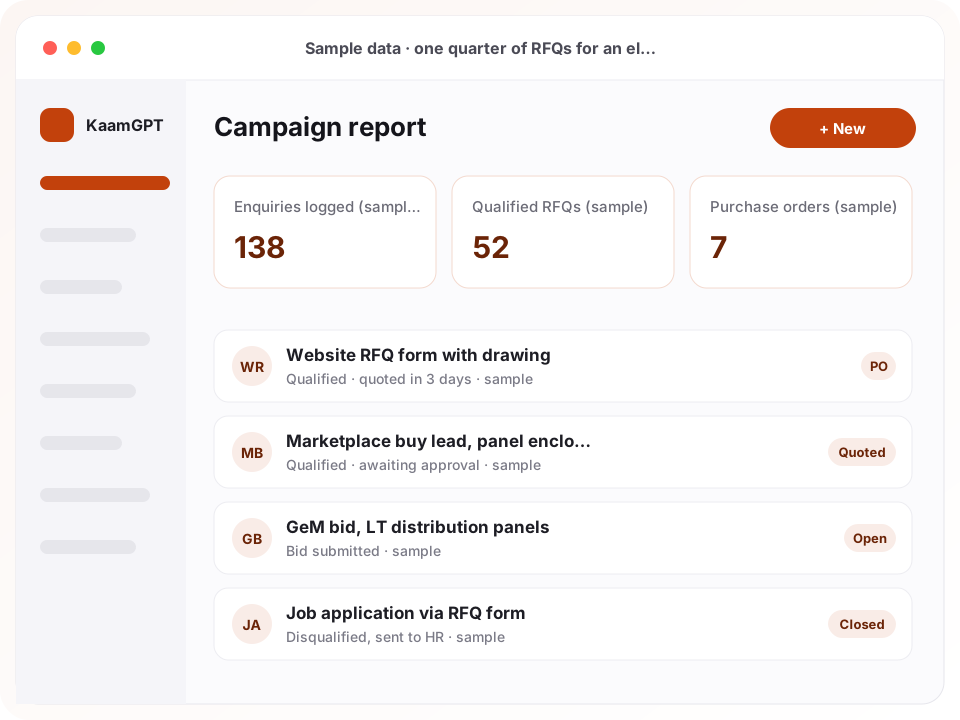
The best lead generation company for manufacturers in Bengaluru is judged less by how many enquiries it produces than by how many of them become quotations and purchase orders. A factory in Peenya or Jigani can already get enquiries from its website, a marketplace subscription, the odd Google ad, past exhibition contacts and referrals. What it usually lacks is a pipeline: one place where every RFQ lands, a quick way to separate real buyers from job seekers and vendors, a named person who quotes on time, and a follow-up routine that lasts as long as industrial buyers take to decide.
KaamGPT sets up and operates that pipeline for small and mid-sized plants, component vendors and exporting units through our lead generation service. Its fee opens at ₹24,999 monthly, and set-up takes roughly a fortnight. Where new enquiries are needed, we combine the right sources, often search campaigns of the kind explained on our factory search-ads page, with marketplace, exhibition and outreach work. Where the plan needs a wider brief, our digital marketing page for manufacturers sets out the whole programme.
- ₹24,999monthly opens the lead generation fee; platforms bill any ad spend or subscription to you
- ~14 daysto map every enquiry source, set up the RFQ sheet or CRM and agree qualification rules
- 6 sourcestypically feed one pipeline: website, ads, marketplaces, GeM, exhibitions and referrals
- 18 monthsis the phased compliance window the DPDP Rules, 2025 set from their November 2025 notification
Where do a Bengaluru manufacturer's enquiries come from?
Geography explains part of it. Bengaluru's industrial areas, stretching from Peenya in the west to the Hosur Road estates in the south, the EPIP zone in the east and the airport-side aerospace park in the north, are full of OEMs and tier-one suppliers who buy from smaller units nearby. Many first contacts happen through referrals inside those clusters, at supplier meets, or across a stall counter at the city's big trade shows.
The rest arrive from further away and through more formal routes. National and overseas buyers find suppliers through search, B2B marketplaces and exporter directories. Public buyers, from central ministries to state-owned companies, increasingly purchase standard items through the Government e-Marketplace. Large private buyers run vendor-registration portals and tender processes of their own.
Each route produces enquiries of a different shape and quality, which is why one pipeline matters. A marketplace buy lead may be price-shopping across ten sellers; a referral from an existing customer may be ready to issue a trial order. Treating them identically wastes your sales engineers' time on the first and risks neglecting the second.
Which pieces make up a factory's lead generation service?
The work has two halves: bringing in the right enquiries and handling them well once they arrive. Which half needs more effort is decided by the audit; many factories need the second half first.
One RFQ pipeline for every source
A shared sheet or CRM holding each enquiry's source, date, contact, requirement, drawing, quantity, target date, owner and stage. Website forms, marketplace leads, WhatsApp chats and exhibition contacts all flow into it.
Lead generation in detail →Qualification rules your team agrees
A short checklist that decides whether an enquiry is a qualified RFQ: a real company, a defined part or product, a quantity, a timeline and a reachable decision-maker. Job applications, vendor pitches and student queries are routed elsewhere on day one.
Lead generation in detail →New enquiries where they are missing
Search campaigns aimed at buyers naming your processes and products, set up through our Google Ads service, with each paid RFQ tracked to the pipeline and, later, to quotation and order.
Google Ads in detail →WhatsApp follow-up with a company number
A company-owned business number carries templates for acknowledgement, drawing requests, quotation dispatch and reminders, keeping chats on the firm's record. Only people who wrote to you first, or opted in, receive them.
WhatsApp campaigns in detail →Quotation follow-up and nurture
A quotation follow-up schedule tied to each quote, plus occasional useful emails to past enquirers and exhibition contacts who opted in: new capabilities, certifications, capacity openings. Every email carries an easy opt-out.
Email campaigns in detail →RFQ forms that collect the right facts
Forms collecting company, part description, a drawing file, material, quantity and the needed-by date, beside a plain consent notice. Where your site cannot host this well, a form or landing page is built as a website project.
Websites in detail →Monthly pipeline review
A monthly look at enquiries, qualified RFQs, quotations, orders and lost reasons by source, with decisions about which sources to grow, fix or drop. This is where marketing spend and sales effort finally meet.
Digital marketing in detail →Which steps fill the first fortnight of an RFQ pipeline?
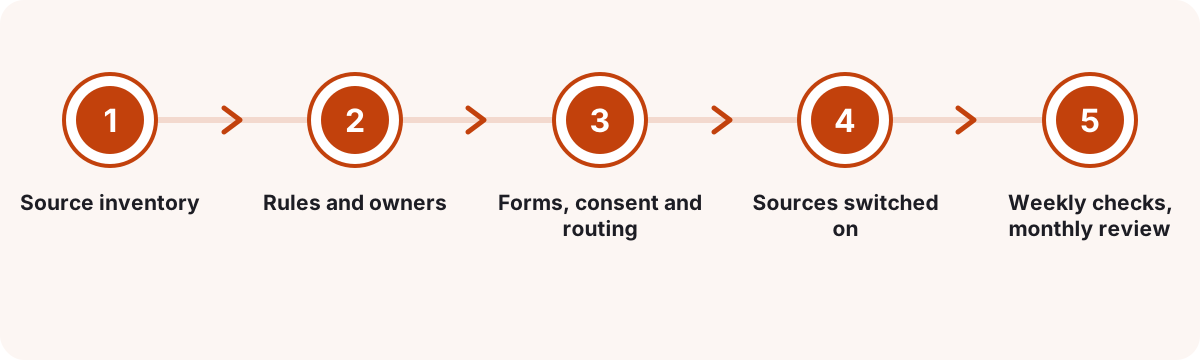
Source inventory
We list every route by which enquiries arrive, who receives them today and where past enquiries are stored, then collect what records exist into one place.
Rules and owners
Qualification criteria, stages, response times and follow-up intervals are agreed with your sales head, and each stage gets a named owner in your team.
Forms, consent and routing
RFQ forms collect the right fields with a clear consent notice, WhatsApp and email routes are set, and job applications and vendor pitches are diverted automatically.
Sources switched on
Existing sources are connected to the pipeline, and new ones, such as search ads or a marketplace profile clean-up, are added where the audit shows gaps.
Weekly checks, monthly review
Weekly checks catch unanswered RFQs and overdue quotations; the monthly review compares sources by qualified RFQs, quotations, orders and lost reasons.
Which manufacturers need a lead generation partner most?
- Build-to-print job shopsHigh RFQ volume with many one-off enquiries, where fast qualification decides which drawings deserve an engineer's time.
- Electrical panel and switchgear makersA mix of private projects, contractor enquiries and public tenders, each needing different tracking and follow-up.
- Capital equipment and SPM buildersFew, large enquiries with long approval cycles, where months of disciplined follow-up protect each opportunity.
- Component exportersOverseas enquiries across time zones, samples and approvals, where a missed reply can lose a whole account.
- Suppliers selling to government buyersGeM listings and bids run alongside private RFQs, with their own deadlines and documents.
- Industrial consumables makersRepeat orders and reorder reminders matter as much as new buyers, so customer records drive the next sale.
- Aerospace and defence sub-suppliersQualification and documentation stages stretch for months, and a pipeline keeps every open approval visible.
What is the monthly fee for a factory's lead generation?
KaamGPT's catalogue puts lead generation at ₹24,999 monthly as the entry point, with roughly a fortnight of set-up. The written scope states which sources we manage, whether we bring new enquiries or mainly organise and follow up existing ones, the qualification rules, and the monthly report. Ad spend and marketplace subscriptions, where used, move from your account to those platforms without passing through us. Every other service's opening figure appears on the price list.
Lead Generation
Recommended₹24,999/month
Typically 14 days
Opening at ₹24,999 monthly, it fits manufacturers whose quoting team can take more work and who need enquiries captured, qualified and chased properly.
- Verified leads
- Multi-channel outreach
- CRM integration
- Lead scoring
- Replacement guarantee
Digital Marketing
₹19,999/month
Typically 15 days
The managed plan, whose entry fee is ₹19,999 monthly, suits a factory that wants marketing channels run together and can handle follow-up in-house.
- Channel strategy
- Creative production
- Campaign management
- Weekly reporting
SEO
₹14,999/month
Typically 30 days
SEO, with fees beginning at ₹14,999 monthly, builds organic enquiries over time and lowers the cost of each RFQ the pipeline receives.
- Technical audit
- Keyword research
- On-page optimisation
- Content plan
- Monthly reporting
Local SEO
₹4,999/month
Typically 14 days
Maps work, ₹4,999 monthly for every site, helps visiting buyers and auditors reach a plant once an RFQ moves to the audit stage.
- Google Business Profile optimisation
- Local keyword map
- Location page on-page fixes
- Citation building and NAP cleanup
- Local link outreach
- Review replies and posts
- Monthly report
Google Ads
₹4,999/month
Typically 30 days
Search ad management, ₹4,999 monthly as a base, is the quickest way to add buyer enquiries when the pipeline needs volume.
- Account setup
- Keyword strategy
- Ad copy testing
- Conversion tracking
- Bid optimisation
Meta Ads
₹4,999/month
Typically 30 days
Meta management, carrying the same ₹4,999 monthly base, helps with dealer recruitment and retargeting rather than with direct RFQs.
- Creative testing
- Audience building
- Retargeting funnels
- Pixel setup
- Weekly reporting
- We do not sell or buy contact databases; scraped or purchased lists sit badly with consent duties and rarely contain real buyers.
- Exact enquiry or order numbers cannot be promised, because they depend on your market, capacity and quotations; we commit to the work and to transparent reporting.
| Package | Starts at | Timeline | Best for |
|---|---|---|---|
| Lead Generation | ₹24,999/month | Typically 14 days | Opening at ₹24,999 monthly, it fits manufacturers whose quoting team can take more work and who need enquiries captured, qualified and chased properly. |
| Digital Marketing | ₹19,999/month | Typically 15 days | The managed plan, whose entry fee is ₹19,999 monthly, suits a factory that wants marketing channels run together and can handle follow-up in-house. |
| SEO | ₹14,999/month | Typically 30 days | SEO, with fees beginning at ₹14,999 monthly, builds organic enquiries over time and lowers the cost of each RFQ the pipeline receives. |
| Local SEO | ₹4,999/month | Typically 14 days | Maps work, ₹4,999 monthly for every site, helps visiting buyers and auditors reach a plant once an RFQ moves to the audit stage. |
| Google Ads | ₹4,999/month | Typically 30 days | Search ad management, ₹4,999 monthly as a base, is the quickest way to add buyer enquiries when the pipeline needs volume. |
| Meta Ads | ₹4,999/month | Typically 30 days | Meta management, carrying the same ₹4,999 monthly base, helps with dealer recruitment and retargeting rather than with direct RFQs. |
Which yardstick should a manufacturer use for lead generation spend?
By cost per qualified RFQ and, over time, cost per order, never by cost per lead. An inexpensive enquiry from a student or a rival supplier costs your engineer an hour and produces nothing. A qualified RFQ from an OEM may be worth months of retainer if it becomes a repeat part.
Ask any lead generation company for manufacturers in Bangalore how it defines a qualified RFQ, who replies to new enquiries, how follow-up is scheduled and what happens to contacts who never agreed to marketing. Our general B2B lead generation guide explains how we approach those questions across sectors.
Remember the hidden cost on your side as well. A pipeline only works if someone in the plant updates stages, sends quotations and answers buyers' technical questions. Plan for a sales coordinator or engineer to spend part of each day on it. Where that time does not exist, we can take on more of the acknowledgement and follow-up work, and the scope and fee reflect that.
- How many enquiry sources need to be connected and managed.
- Whether new enquiries must be generated or existing ones mainly organised and followed up.
- The number of product lines, markets and languages involved.
- Whether your team already uses a CRM or must adopt a shared sheet.
- How much follow-up your own team can handle and how much we take on.
Why work with KaamGPT on manufacturing leads?
Pipeline before volume
We fix capture, qualification and follow-up before adding enquiries, so new spend turns into quotations instead of a longer backlog.
No bought lists
We build enquiries from your own channels and consented contacts, not from scraped or purchased databases that waste time and invite complaints.
Consent handled properly
Forms, exhibition capture and follow-up are designed around notice and consent, with the DPDP Rules' phased timeline in mind.
Reports a sales head can use
Monthly figures by source and stage, with lost reasons, tell you which sources and which habits to change, in plain numbers.
Channels and tools under one roof
Search ads, SEO, WhatsApp and email are run by the same team, and KaamGPT builds its own messaging software for follow-up sequences.
In what order does the best lead generation company for manufacturers in Bengaluru assemble an RFQ pipeline?
It starts by counting. Before paying for a single new lead, we note each route by which enquiries currently reach you and pull the last few months of them into one sheet, as far as records allow. That alone usually reveals which sources matter, how long quotations take and where buyers go silent. Many owners are surprised to find that a source they were about to cancel produced their best orders, or the reverse.
Then the rules. Your sales head, an engineer and we agree what a qualified RFQ is, who owns each stage, how fast an acknowledgement goes out and when a quotation is chased. B2B lead generation for manufacturers succeeds or fails on these unglamorous habits more than on clever campaigns.
Only after that do we add sources. New enquiries go into a pipeline that can handle them, so the extra money spent on ads, marketplaces or outreach turns into quotations rather than into a longer list of unanswered emails.
Log every enquiry within a day
Whatever the channel, each enquiry enters the rfq pipeline within one working day, with its source tagged. Exhibition cards are entered in the week of the show, not when someone finds time.
Acknowledge fast, quote on a promised date
A same-day acknowledgement confirms receipt, asks for anything missing and states when the quotation will follow. Buyers forgive a quote that takes a few days far more readily than silence.
Chase quotations on a schedule
Each quotation gets follow-up dates. A polite check after a few days, a technical clarification offer, then a monthly touch while the buyer's approval runs, until the RFQ is won, lost or closed.
Record why RFQs are lost
Price, lead time, missing certificate, capacity, no response: a lost reason on every closed RFQ turns failures into a list of fixable problems for sales and production.
Treat sources differently
Referrals and repeat customers get priority handling; marketplace leads get a quick qualifying call; GeM bids follow their own calendar. One pipeline, but not one speed for all.
Keep consent with the record
Each contact's record notes how they reached you and what they agreed to receive, so follow-up stays within what the person expects and the law allows.
Why do manufacturers lose RFQs they already paid to get?
In most plants we talk to, the enquiries are there. They arrive in the sales email, the marketplace app on the owner's phone, a WhatsApp chat with a former customer, a pile of exhibition cards and a call to the reception. Nobody has a full list, so nobody can say how many came in last month, how many were quoted or why the rest were dropped.
That gap costs more than any marketing budget. A buyer who sends a drawing and hears nothing for a week has usually gone to the next supplier, and the money spent on the ad, the subscription or the stall that produced him is simply lost.
- Enquiries scattered across personal phones, shared inboxes and marketplace apps, with no single record and no owner.
- No lead qualification, so sales engineers spend hours quoting price-shoppers while a serious OEM waits for a reply.
- Quotations sent without a follow-up date, then forgotten when the buyer goes quiet during internal approvals.
- Exhibition contacts entered months late, or never, and emailed without any record of consent.
- Lost RFQs never analysed, so the same reasons, such as price, lead time or a missing certificate, keep repeating.
What makes an industrial enquiry a qualified RFQ?
A qualified RFQ is one your sales engineer should spend time quoting. In practice that usually means five things are known: who the buyer is and which company they represent, what part or product is needed, in what quantity and how often, by when, and whether the person is involved in the buying decision. A drawing or specification is the strongest single signal, because nobody sends one casually.
Enquiries missing some of these are not thrown away. They go to a short qualifying step: a call or WhatsApp message asking for the drawing, the annual volume or the target date. Buyers who answer are moved up; buyers who do not are kept in a nurture list if they agreed to it. This keeps engineers on the work most likely to become orders.
Disqualification matters just as much. Job seekers, students, vendors pitching services and consumers asking for a single piece should be routed out on the first day, politely, so they never clog the pipeline or distort the numbers.
- Company and contact verified, with the contact's role in the purchase.
- Part or product defined, ideally with a drawing or specification.
- Quantity per order and expected annual volume.
- Required date and delivery location.
- Any approval steps: samples, first-article inspection, vendor registration.
How does the DPDP Act change how a manufacturer collects and uses leads?
B2B contacts are still people. A purchase manager's name, mobile number and work email, held digitally, are personal data under the Digital Personal Data Protection Act, 2023, which Parliament enacted on 11 August 2023. Its Rules followed on 14 November 2025, and their obligations phase in across eighteen months, so the obligations are arriving now rather than in some distant future.
According to the government's release, the Rules require data fiduciaries to issue standalone, clear and simple consent notices explaining the specific purpose for which personal data is collected and used. They also require prompt, plain-language notice to affected people after a data breach, visible contact details for someone who can answer data questions, and an answer within 90 days at most when someone asks to see, fix or delete their data.
For a manufacturer's lead process this translates into practical habits: a clear consent notice on every RFQ form and exhibition capture sheet, using contacts only for what they agreed to, an easy opt-out in every email and WhatsApp template, a named person who answers data requests, and no purchased or scraped lists. This is general information, not legal advice; take your own counsel's view on how the Rules apply to your company.
Should a manufacturer sell to government buyers through GeM?
If your products are common-use goods that ministries, departments or public sector undertakings buy, the Government e-Marketplace is hard to ignore. GeM is set up as a Section 8 company wholly owned by the Government, sitting under the Commerce Department, and its home page carries a notice aimed at Udyam-registered sellers. Listings, bids and reverse auctions there follow their own rules and calendar, so they belong in the pipeline as a separate source with deadline tracking.
Udyam registration is the usual first step for an MSME. On the official portal, registration costs nothing, involves no paperwork and relies on the applicant's own declaration, with an Aadhaar number as the only input, with PAN and GST-linked investment and turnover data pulled from government records. It also warns users to beware of fake sites, so register only on the official portal and never pay an intermediary that appears in ads.
Classification changed from 1 April 2025. A micro enterprise now has investment up to 2.5 crore rupees and turnover up to 10 crore; a small enterprise up to 25 crore and 100 crore; a medium enterprise up to 125 crore and 500 crore. Many units that outgrew the old limits are again eligible for MSME status, which can matter for public buyers and schemes.
How quickly should a factory reply to an RFQ, and how long should it follow up?
Acknowledge the same working day, even if the quotation will take a week. A short reply that confirms the drawing was received, asks for anything missing and gives a quotation date tells the buyer you are organised. Silence tells them the opposite, and in a competitive RFQ they may simply move on to the next supplier who answers.
After the quotation, follow up on a schedule rather than when someone remembers. A check after a few days to answer technical questions, another when the buyer's approval is likely to have moved, then a gentle monthly touch while the requirement remains open. Industrial approvals often stall for reasons unrelated to you, such as a project delay or a budget freeze, and the supplier who stays politely present is often the one called when they restart.
Close the loop either way. Record a win, a loss with its reason, or a closure after an agreed period of no response. A pipeline full of zombie RFQs hides the real picture and wastes the weekly review.
Which enquiry sources suit which kinds of manufacturer?
No single source fits every factory, and the mix usually shifts as a business grows. A build-to-print job shop near Peenya tends to win its best work through referrals and repeat customers, with search ads and a marketplace profile filling gaps when capacity opens up. A maker of standard catalogue items leans more on search, marketplaces and distributors, because its buyers compare off-the-shelf options. Capital equipment builders rely on exhibitions, consultants and long relationships, where a few enquiries a quarter can matter enormously.
Public-sector suppliers add GeM bids and tenders, which run on fixed calendars and documentation rather than on conversations. Exporters add overseas search, sourcing platforms and agents, with the extra complication of time zones and samples. Each of these behaves differently in the pipeline, which is why every record carries its source.
After three to six months of tagged data, patterns usually become visible: which sources produce qualified RFQs, which produce orders, and which only produce work for the sales team. That evidence, rather than habit or a vendor's sales pitch, should decide where next year's budget goes.
- Job shops: referrals, repeat buyers, search ads for spare capacity.
- Standard products: search, marketplaces, distributors and dealers.
- Capital equipment: exhibitions, consultants, long-term follow-up.
- Public buyers: GeM listings and bids, tender portals.
- Exporters: overseas search, sourcing platforms, agents and trade fairs.
- Lead generation fee
- From ₹24,999 a month; about 14 days to set up
- Measure
- Qualified RFQs, quotations and orders by source
- DPDP Act, 2023
- Enacted 11 August 2023; Rules notified 14 November 2025, phased over 18 months
- Rights requests
- To be answered within a maximum of 90 days under the DPDP framework
- Udyam registration
- Free, paperless, self-declared on the official portal
- Contact lists
- Never bought or scraped; built from your own consented contacts
Where this applies around Bengaluru, Karnataka
- Bengaluru
- Karnataka
- India
- Peenya
- Jigani
- Whitefield
- Yelahanka
Frequently asked questions
28 answersWhich tasks fall to a lead generation company for manufacturers in Bangalore?
It brings enquiries from the right sources into one pipeline, qualifies them, makes sure each one is acknowledged and quoted on time, and follows up until the buyer decides. Where enquiries are too few, it adds sources such as search ads or marketplace work. For a manufacturer, success is measured in qualified RFQs, quotations and orders.
What is KaamGPT's fee for a manufacturer's lead generation?
The fee opens at ₹24,999 monthly, after roughly a fortnight of set-up. The written scope lists the sources we manage, the qualification rules and the reporting. Platform costs such as ad spend or marketplace subscriptions stay between you and the platform.
Do you sell lists of buyers or purchase managers?
No. We do not buy, sell or scrape contact databases. Such lists rarely contain people with real requirements, and contacting them sits badly with India's DPDP Act and its Rules on notice and consent. We build a manufacturer's pipeline from its own channels and from people who contacted it or agreed to hear from it.
What counts as a qualified RFQ for a manufacturer?
An enquiry from an identifiable company and contact, for a defined part or product, with a quantity, a timeline and someone involved in the purchase decision. A drawing or specification is the strongest signal. Enquiries missing details get a quick qualifying call or message before an engineer spends time quoting.
Does the DPDP Act apply to B2B leads?
The Act covers digital personal data of individuals, and a purchase manager's name, number and email are about an individual, so B2B lead records are generally within scope. The DPDP Rules, 2025, notified on 14 November 2025, phase in obligations over 18 months. Take your own legal advice on the details for your manufacturing business.
What should our RFQ form say about consent?
A short, clear notice next to the submit button explaining what you will use the details for, such as responding to the enquiry and sending related updates if the person opts in, how to withdraw, and whom to contact about their data. Keep marketing consent as a separate, unticked choice.
How fast should a Bengaluru factory reply to a new RFQ?
The same working day, at least with an acknowledgement that confirms receipt, asks for anything missing and gives a quotation date. Buyers comparing several Bengaluru suppliers often favour the one who answers first and clearly. Keeping a promised quote date earns more trust than a hurried price.
How long should we follow up a quotation?
Until the RFQ is won, lost or closed by agreement. A check a few days after sending, another when the buyer's approval should have moved, then a polite monthly touch while the requirement is open. Industrial approvals stall for many reasons, and the manufacturer who stays present is often called when they restart.
Can you manage our IndiaMART or other marketplace leads?
We can bring marketplace leads into the same pipeline, qualify them quickly and track which ones become quotations and orders. That shows whether the subscription pays back. Marketplace leads are often shared with other sellers, so speed and a sharp qualifying question matter more there than for referrals.
Should a manufacturer register on GeM?
If you make common-use goods or services that ministries, departments or public sector undertakings buy, it is worth considering. GeM is a Government-owned marketplace for those buyers, and Udyam-registered sellers are addressed directly on its site. Treat GeM bids as their own source in the pipeline, with deadlines tracked carefully.
Is Udyam registration free for manufacturers?
Yes. The official Udyam portal states that registration is free, paperless and based on self-declaration, needing only an Aadhaar number, with PAN and GST-linked data fetched automatically. It warns users about fake sites, so a manufacturer should register only on the official portal and never pay an intermediary found through ads.
What are the MSME limits from April 2025?
From 1 April 2025, a micro enterprise has investment up to 2.5 crore rupees and turnover up to 10 crore; small, up to 25 crore and 100 crore; medium, up to 125 crore and 500 crore. A manufacturer that outgrew the earlier limits may qualify again, which can matter for public buyers and schemes.
How do you handle exhibition leads from Bengaluru shows?
Before the show we settle how each visitor's need and consent will be noted, then load every contact into the pipeline within the week. Qualified RFQs go to sales immediately; others enter a follow-up sequence only if they agreed to it. Shows at BIEC and Yelahanka in Bengaluru are planned this way.
What should we ask when choosing the best lead generation company for manufacturers in Bengaluru?
Ask how it defines a qualified RFQ, who replies to new enquiries, how follow-up is scheduled, how consent is recorded and whether it buys lists. Request an example of its monthly report. A good answer is specific about quotations and orders, not just lead counts and cost per lead.
Will a lead generation company for manufacturers in Bangalore commit to an order count?
No honest one can. Orders depend on your pricing, capacity, quality and the buyer's own approvals, none of which an agency controls. Our written commitment covers the work: sources managed, response and follow-up routines, and transparent reporting of qualified RFQs, quotations and orders each month.
Do we need a CRM for an RFQ pipeline?
Not at first. A well-designed shared sheet with clear stages, owners and dates works for many manufacturers. A CRM helps once volume grows, several salespeople are involved or follow-up reminders need automating. We can start with a sheet and move to a CRM later without losing history.
Can you do outbound outreach to OEM purchase teams?
Selectively. Targeted, personal approaches to purchase or engineering teams at companies that clearly use your process can work, especially with a relevant capability note. We avoid bulk cold campaigns to scraped lists, respect every opt-out and keep records of how each contact was found.
Should we use SMS for follow-up?
Sparingly. Promotional SMS in India goes through the DLT registration system for sender headers and templates set up under TRAI's commercial communication regulations, which adds set-up work. For B2B follow-up, email and WhatsApp to people who contacted you are usually more practical for a manufacturer.
How do you stop job seekers clogging our RFQ pipeline?
Company, part details and quantity are required fields on the RFQ form, the website has a clear careers route, and the first qualification step sends job applications to HR on day one. Bengaluru manufacturers receive many applications through sales channels, so this routing alone often frees hours each week.
What does a monthly lead generation report show?
Enquiries by source, qualified RFQs, quotations sent, orders won, lost reasons, average time to acknowledge and to quote, and overdue follow-ups. It ends with recommendations: which sources to grow or drop and which habits to change. A manufacturer's sales head should be able to act on it the same day.
Can you help an exporter manage overseas RFQs?
Yes. Overseas enquiries go into the same pipeline with time-zone-aware response targets, sample and approval stages, and follow-up suited to longer cycles. We also check that export enquiry forms carry a consent notice suitable for where the buyer is based, and route replies to someone who can answer in the buyer's working hours.
What is the first step with KaamGPT?
Phone +91 79767 82366, or WhatsApp a few recent enquiries there with a line on how each arrived. Back comes a sketch of your present pipeline, its main leaks and a written scope for setting it right, priced from the published starting fee.
Do you also generate leads for other B2B sectors?
Yes. Other sectors are covered in our <a href="/best-b2b-lead-generation-agency-in-bengaluru">Bengaluru B2B lead generation overview</a>. For a manufacturer the differences are the drawings, the long approval cycles, public procurement through GeM and the need to keep engineers' time for qualified RFQs.
Will you talk to our buyers directly?
Only where agreed, for example to acknowledge enquiries, request missing details or schedule calls on your behalf, using your company's name, number and templates. Technical discussions and pricing stay with your team, because buyers expect to hear from the manufacturer's own engineers and sales staff.
How do you keep follow-up within what contacts agreed to?
Each record carries a consent note: how the person reached you and whether they opted in to updates. Follow-up about their own RFQ continues as expected; promotional messages reach opted-in contacts alone, and every message offers an easy opt-out. Requests to correct or delete data are passed to your named contact quickly.
Where do most manufacturers' best leads come from?
It differs from plant to plant, so we count instead of guessing. For many job shops, referrals and repeat customers produce the best orders; for standard products, search and marketplaces; for public buyers, GeM. A few months of tagged data usually shows a manufacturer where to spend more and where to stop.
Can lead generation work alongside our existing sales team?
Yes, and that is how most engagements run. We organise sources, qualification and follow-up routines; your sales engineers quote, negotiate and visit. Weekly checks flag anything overdue, and the monthly review is held with your sales head, so the pipeline supports the team rather than replacing it.
Do you work with manufacturers outside Bengaluru city limits?
Yes. Plants in Hosur, Tumakuru, Bidadi, Doddaballapur or further away are handled the same way, because the pipeline lives in a shared sheet or CRM and the work happens over calls, WhatsApp and video. Location matters only for buyer visits and audits, which your own team handles, and for Maps accuracy, which we can check from Bengaluru.