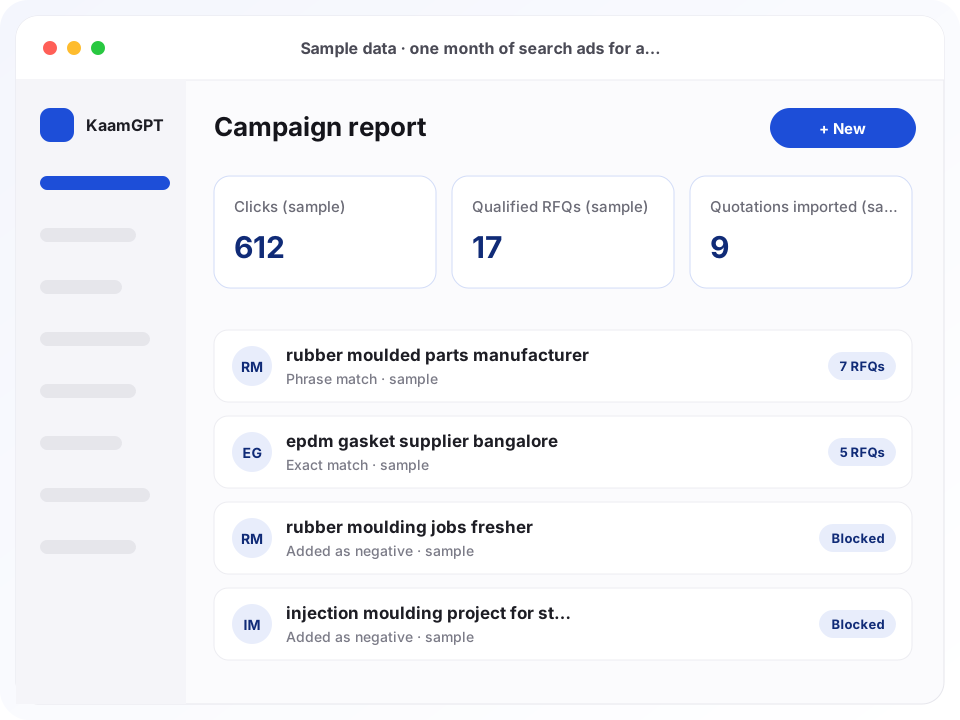
The best google ads agency for manufacturers in Bengaluru is the one that spends your money only when someone with a drawing is searching. That sounds obvious, yet most factory accounts we audit pay for the opposite: clicks from people looking for jobs at CNC companies, students hunting for project ideas, hobbyists asking how die casting works and shoppers who wanted a retail product. Search ads can be one of the quickest routes to new RFQs for an industrial supplier, but only when the account is built around what buyers actually type.
KaamGPT runs Google Ads management for small and mid-sized factories, component suppliers and exporters across the city. The fee opens at ₹4,999 monthly, and clicks are billed by Google to your own card. We work remotely, by call and WhatsApp, with read access to your account and the RFQ sheet. If your problem is the pipeline after the click, our lead generation page for manufacturers covers it; if it is the website itself, see our SEO page for manufacturers.
- ₹4,999opens our monthly management fee; click costs go on your card via Google
- ~30 daysto rebuild keywords and negatives, fix conversion tracking and settle bidding
- 90 daysis the longest conversion window Google Ads offers for some sources, against a 30-day default
- 1 metricrules the account: cost per qualified RFQ, later cost per purchase order
Where are Bengaluru's industrial buyers, and where are they searching from?
Many of your buyers sit in the same city as your plant. The Peenya belt beside Tumkur Road, the Electronic City, Bommasandra and Jigani estates along Hosur Road, the Export Promotion Industrial Park at Whitefield and the KIADB Aerospace Park near Devanahalli all house OEMs and tier suppliers who buy parts, tooling and services from smaller units nearby. Defence and aerospace supply chains gather around events such as Aero India at Yelahanka, and rail suppliers know the Rail Wheel Factory in the same suburb.
But a large share of industrial demand for Bengaluru suppliers comes from elsewhere: OEMs in Pune, Chennai, Hosur and the NCR, project contractors across India, and importers abroad. Location targeting therefore needs more thought than draw a circle around the factory. A job-work unit might target Bengaluru and Hosur tightly, while a maker of standard components might target all of India and three export countries, each in its own campaign with its own budget.
Google Ads lets you reach people present in, or regularly in, your chosen locations, or the broader Presence or Interest group that also includes people showing interest in those places. Google recommends the broader setting as a default on Search, and suggests Presence when you only want users actually in those areas. For a job-work unit serving nearby plants, Presence usually fits better; for a component maker happy to quote anyone in India, the broader option may be fine.
Which building blocks go into a manufacturer's ad account?
Every account is different, but these are the building blocks we use for industrial suppliers. Most of them are about reducing waste before increasing spend.
Keyword groups built from drawings and RFQs
We read your recent enquiries and purchase orders and build ad groups around the process, part, material and standard that buyers actually name, using phrase and exact match. Broad match is introduced only once conversion data reflects real RFQs.
Google Ads in detail →Negative lists that keep job seekers out
Shared lists of negative keywords for manufacturers: jobs, vacancies, salary, fresher, internship, training, course, syllabus, project, PDF, PPT, meaning, DIY and second-hand. They are reviewed weekly against the search terms report and grow with the account.
Google Ads in detail →Conversions that reflect real buyers
Drawing-upload forms, calls of a sensible length and taps on the WhatsApp button are each tracked as distinct actions. Later, qualified RFQs, quotations and orders are imported back from your sheet or CRM, so bidding learns what a buyer looks like.
Google Ads in detail →Landing pages for each process
Each ad group points to a page about that process or product, with size range, materials, tolerances, certifications and an RFQ form above the fold. Where the site cannot do this, our web build team makes a landing page for it.
Websites in detail →A reply routine for ad enquiries
Paid enquiries go cold fast. We agree who replies, how quickly, and what they ask: drawing, quantity, material, delivery date. Unanswered RFQs are flagged daily so money spent on the click is not wasted after it.
Lead generation in detail →Call and location assets for urgent work
For breakdown spares and job work, call assets and location assets let a maintenance engineer ring or drive over directly. They are switched on only while a person at the plant is free to pick up.
Google Business Profile in detail →Search-term insights handed to SEO
The terms that produce RFQs at a reasonable cost become the priority list for organic pages, so you pay for those clicks only until the website can earn them.
SEO in detail →Which campaign layout would the best Google Ads agency for manufacturers in Bengaluru choose?
By buyer and intent rather than by product catalogue. One campaign might cover job work for nearby OEMs, another standard components for buyers across India, a third export enquiries, and a small one your own brand name. Each has its own budget, locations, hours and landing pages, so a strong product cannot quietly starve a weaker one of spend, and a weak one cannot hide inside a blended average.
Within each campaign, b2b google ads work best when ad groups are tight. A group for EPDM gaskets should not share ads with silicone extrusions, because the buyer who types one wants to see it named in the headline and on the page. Tight groups also make the search terms report readable, which is where most savings are found.
We keep Search as the backbone. Performance Max and display can work for some manufacturers once there is enough reliable conversion data, especially imported quotations, but launched early they tend to chase cheap form fills. We test them later, with a separate budget and clear rules for switching them off.
Separate campaigns by buyer type
Local job work, national components, export and brand each get their own campaign, budget and reporting. This keeps decisions clear when one segment performs and another does not.
Schedule ads to staffed hours
Ads run when your team can answer calls and WhatsApp, usually working hours on working days, with the weekly plant holiday excluded. A missed call from an urgent buyer is a wasted click and a lost order.
Bid on value once data exists
Early on, manual or simple automated bidding keeps control. Once qualified RFQs and quotations are imported regularly, bidding can optimise for them rather than for raw form fills.
Protect the brand cheaply
A small campaign on your company and product names keeps resellers and marketplaces from capturing buyers who were already looking for you, at very low cost per click.
Review search terms every week
Every week the search terms report is read line by line, new negatives are added and promising terms are moved into their own groups. This habit, not clever bidding, is what keeps an industrial account clean.
What is the fee for a factory's search ads, and who pays for clicks?
We charge ₹4,999 monthly at the entry level, and an account rebuild with settled tracking takes about thirty days. The click budget is a separate choice, settled between you and Google, and we discuss it as an example range until you choose a figure. The written scope names the campaigns, the conversion set-up and the reporting. Our rate card lists where each service begins.
Google Ads
Recommended₹4,999/month
Typically 30 days
Search ad management, ₹4,999 monthly to begin with, is the core fit for a supplier whose buyers search by process, part or material when they need a vendor.
- Account setup
- Keyword strategy
- Ad copy testing
- Conversion tracking
- Bid optimisation
Digital Marketing
₹19,999/month
Typically 15 days
With ₹19,999 monthly as its base, the managed plan is for a manufacturer wanting search ads tied to SEO, email and exhibition follow-up.
- Channel strategy
- Creative production
- Campaign management
- Weekly reporting
SEO
₹14,999/month
Typically 30 days
SEO, beginning at ₹14,999 monthly, turns the search terms that ads prove profitable into pages that bring RFQs without paying per click.
- Technical audit
- Keyword research
- On-page optimisation
- Content plan
- Monthly reporting
Local SEO
₹4,999/month
Typically 14 days
Maps work, ₹4,999 monthly for each site, backs up call and location assets for spares counters and job-work units.
- Google Business Profile optimisation
- Local keyword map
- Location page on-page fixes
- Citation building and NAP cleanup
- Local link outreach
- Review replies and posts
- Monthly report
Meta Ads
₹4,999/month
Typically 30 days
Meta management, with the same ₹4,999 monthly entry point, complements search for hiring, dealer recruitment and retargeting, not for core RFQs.
- Creative testing
- Audience building
- Retargeting funnels
- Pixel setup
- Weekly reporting
Lead Generation
₹24,999/month
Typically 14 days
Lead generation, beginning at ₹24,999 monthly, adds qualification and follow-up when ads already bring more enquiries than the team can handle.
- Verified leads
- Multi-channel outreach
- CRM integration
- Lead scoring
- Replacement guarantee
- Clicks are invoiced by Google to the manufacturer and never routed through KaamGPT; budget figures we discuss are illustrations, not prices.
- Should a landing page or a fresh site be needed first, that becomes its own website job, priced from ₹9,999.
| Package | Starts at | Timeline | Best for |
|---|---|---|---|
| Google Ads | ₹4,999/month | Typically 30 days | Search ad management, ₹4,999 monthly to begin with, is the core fit for a supplier whose buyers search by process, part or material when they need a vendor. |
| Digital Marketing | ₹19,999/month | Typically 15 days | With ₹19,999 monthly as its base, the managed plan is for a manufacturer wanting search ads tied to SEO, email and exhibition follow-up. |
| SEO | ₹14,999/month | Typically 30 days | SEO, beginning at ₹14,999 monthly, turns the search terms that ads prove profitable into pages that bring RFQs without paying per click. |
| Local SEO | ₹4,999/month | Typically 14 days | Maps work, ₹4,999 monthly for each site, backs up call and location assets for spares counters and job-work units. |
| Meta Ads | ₹4,999/month | Typically 30 days | Meta management, with the same ₹4,999 monthly entry point, complements search for hiring, dealer recruitment and retargeting, not for core RFQs. |
| Lead Generation | ₹24,999/month | Typically 14 days | Lead generation, beginning at ₹24,999 monthly, adds qualification and follow-up when ads already bring more enquiries than the team can handle. |
How much should a manufacturer spend on Google Ads?
Enough to learn from, and nothing extra until that learning is in. The useful way to set a first budget is backwards from cost per rfq: decide what a qualified RFQ is worth to you, given your quote-to-order rate and typical order value, then fund enough clicks to produce a meaningful number of RFQs in two or three months. Spending less than that rarely produces data you can act on.
Cost per click varies widely by process and region, so treat any figure an agency quotes before seeing your account as a guess. A google ads agency for manufacturers in Bangalore should show you the search terms, the conversions and the cost per qualified RFQ every month, and say outright when a process is too expensive to advertise profitably.
A worked illustration, with invented figures: suppose one in five qualified RFQs becomes a quotation the buyer takes seriously, and one in four of those becomes an order. Then a single order needs roughly twenty qualified RFQs, and the acceptable cost per RFQ is a twentieth of the profit you expect from a first order plus a fair share of repeat business. Run the same sum with your own numbers before choosing a budget.
- How many processes, product lines and buyer segments need their own campaigns.
- How competitive the searches are in Bengaluru, across India and in any export market.
- Whether landing pages exist for each process or must be built first.
- Whether conversion tracking works today and whether RFQ outcomes can be imported.
- For how many hours each day someone can respond to calls and chats generated by ads.
Which manufacturers get the most from search ads?
- Job-work and contract manufacturersMachining, fabrication, coating and moulding units whose buyers search for a process when an existing vendor fails or capacity runs short.
- Spares and replacement-part makersUrgent searches from maintenance teams suit call assets and tight scheduling, because the buyer wants an answer today.
- Standard industrial component makersGaskets, fasteners, bushes, hoses and enclosures sold across India, where product-level ad groups match specific searches.
- Special-purpose machine and automation buildersFewer searches but larger orders, so careful keyword choice and long conversion windows matter more than volume.
- Exporters of engineered goodsCountry-level campaigns in the buyer's language, scheduled for their time zone, sending traffic to export pages.
- Packaging and consumables suppliersRepeat buyers search by size and material, and brand campaigns help keep reorders from drifting to marketplaces.
- Testing, calibration and inspection labsService-like searches with clear intent, often local, where call assets and location assets earn their keep.
What changes when KaamGPT takes over a factory's ad account?
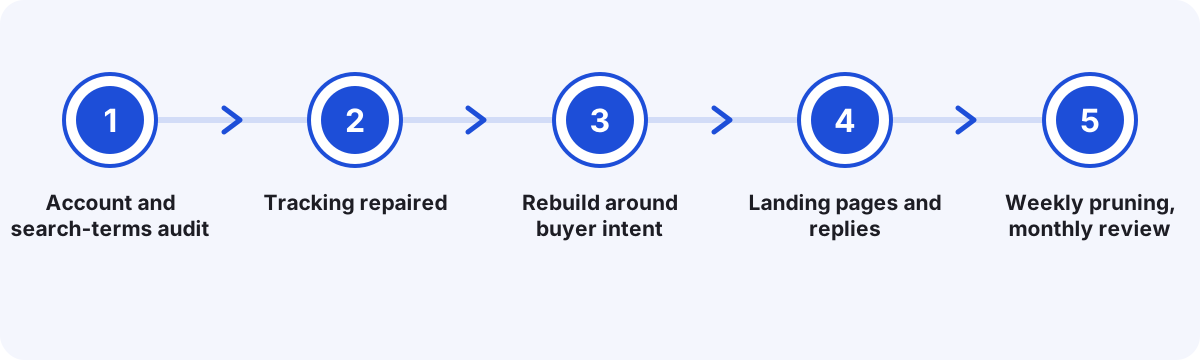
Account and search-terms audit
We go through recent months of search queries, placements and conversions, list where money went to job seekers or irrelevant buyers, and check how conversions are counted today.
Tracking repaired
RFQ forms, calls and WhatsApp clicks are tracked as separate actions, job applications are excluded, and a way to import qualified RFQs and quotations from your sheet or CRM is agreed.
Rebuild around buyer intent
Campaigns are split by buyer type, ad groups tightened around processes and parts, negatives applied, display and app placements removed, and schedules matched to staffed hours.
Landing pages and replies
Each ad group gets a relevant page, and your team agrees a reply routine for paid enquiries so that every click has a fair chance of becoming a quotation.
Weekly pruning, monthly review
Search terms are pruned every week. Monthly, cost per qualified RFQ and per quotation is compared across campaigns, and together we agree what to scale, fix or stop.
Why hand your search ads to KaamGPT?
We read the search terms
Most savings in industrial accounts come from the unglamorous weekly job of reading what people actually typed. We do it every week, not when a report is due.
We count buyers, not forms
Our reports separate qualified RFQs from job applications and sales pitches, and we push for quotation and order data so bidding learns from real outcomes.
Your account, your data
Your company remains the named owner of the ad account and its billing. Our access is as a manager, so history and data remain yours if you move on.
Plain advice on spend
If a process costs more per RFQ than it can earn back, you hear it from us, with a suggestion to shift budget, rather than spending it to keep the account busy.
Connected to the rest of the funnel
Landing pages, WhatsApp follow-up and SEO can be handled by the same team, so the ad, the page and the reply tell one consistent story.
Which searches signal a real industrial requirement?
Searches that name a part or process together with a material, size, standard, quantity or application usually come from someone with a job to fill. Examples of the pattern are busbar fabrication supplier, gear manufacturer for conveyor drives, aluminium die casting moulds maker, epdm gasket supplier bangalore and urgent cnc job work bangalore. These are illustrations, not search-volume claims, and your own enquiries will reveal the exact phrasing your buyers use.
Words such as supplier, manufacturer, vendor, job work, OEM, bulk, quotation and price list lean towards buyers. Words such as how, what is, meaning, course, salary, project, PDF and near me used with a trade name lean towards learners, job seekers and retail shoppers. Neither list is perfect, which is why weekly reading of the search terms report matters more than any rule.
Some valuable searches are short and ambiguous, for example a bare component name. Those can work in exact match with careful landing pages and a modest bid, so the account learns whether they bring RFQs before more money goes in.
- Buyer signals: supplier, manufacturer, vendor, job work, OEM, bulk, quotation.
- Learner signals: how, what is, course, training, project, PDF, PPT, meaning.
- Job-seeker signals: jobs, vacancy, salary, fresher, walk-in, internship.
- Retail signals: price for home, buy one, near me with a consumer product.
How do you measure Google Ads when an order takes months?
Industrial orders rarely land inside a campaign's reporting month. The fix is to measure in stages and feed the later stages back to Google. Stage one is the raw enquiry; stage two, an RFQ your team marks as qualified; stage three, a quotation sent; stage four, a purchase order. Each stage gets a value that reflects what it is worth to you.
Offline conversion import makes this work. The click identifier Google adds to ad clicks is captured with the RFQ, stored in your sheet or CRM, and uploaded with the stage and date when the RFQ is qualified or quoted. Google Ads conversion windows can be set from one day up to 90 days for some conversion sources, with 30 days as the default, so we set them to suit your typical RFQ-to-quotation time.
Purchase orders that arrive after the window closes still matter. We record them in the monthly review against their original source, so you can see which campaigns produced orders even when Google itself can no longer credit them.
What can Customer Match and remarketing do for a supplier?
Customer Match lets you upload contact lists, such as past buyers or exhibition visitors, to reach or exclude them in Google's networks. Google's policy says you may only upload customer information collected in a first-party context, must disclose in your privacy policy that you share customer data with third parties to perform services, and must obtain consent where the law requires it. India's DPDP Act, 2023 and its 2025 Rules add consent and notice duties of their own.
There is also an eligibility limit many smaller manufacturers miss. All policy-compliant advertisers can use Customer Match lists for observation and exclusions, but using them for targeting needs 90 days of Google Ads history and more than USD 50,000 of lifetime spend. For most SME accounts, the realistic uses are excluding existing customers from prospecting campaigns and observing how listed contacts behave.
Website remarketing is simpler. People who opened a capability page yet never sent an RFQ can see search ads with a higher bid when they search again, or a reminder on other placements. With long buying cycles, a reminder weeks later, when the requirement firms up, can be the click that matters.
How should an exporter run search ads for overseas buyers?
Export search campaigns work best as separate campaigns per country or region, not as one global campaign. Each has its own language settings, budget, schedule matched to the buyer's working day and a market-specific landing page, with the certifications, packaging, Incoterms and lead times importers look for.
Keywords change too. Importers often use different product names, spellings and units from Indian buyers, and many add words such as from India, OEM or private label. Start from your actual export enquiries and from the terms your overseas distributors use, rather than translating the Indian keyword list.
Replies are the hardest part. An enquiry from Europe that arrives during Bengaluru evening hours needs an answer by the buyer's next morning. If your team cannot cover that, schedule ads to the overlap of working hours, and set an automatic acknowledgement that promises a reply time you can meet.
When is Google Ads the wrong tool for a manufacturer?
Search ads need searches. If your product is a custom assembly that buyers describe only in drawings, or a component sold to five OEMs who already know every supplier, there may be too few relevant searches to justify an account. In that case exhibitions, marketplace listings, direct outreach to purchase teams and a strong website usually do more, and we will say so after the audit.
Ads also fail when the plant cannot respond. A capacity-constrained unit that already turns work away, or a sales team that takes a week to quote, will waste paid enquiries. Fix capacity or the quoting routine first; then advertise.
Finally, be wary of ads promising the lowest price per part. Industrial buyers who choose on price alone tend to switch quickly, and a google ads agency for manufacturers in Bangalore should help you attract buyers who value delivery, quality and engineering support as well. Our general Google Ads guide for Bengaluru explains how we approach other sectors.
Why do factory ad accounts burn money on the wrong clicks?
Industrial words attract a surprisingly mixed crowd. CNC, welding, moulding and fabrication are also the names of trades people want to learn and jobs they want to apply for, and many components share names with consumer products. An account set up with broad keywords and default settings will happily spend on all of them.
The other leak is measurement. When the only conversion tracked is a form submission, every student enquiry and job application counts as a success, and automated bidding learns to find more of them. Fixing what the account counts usually beats any change to bids.
- Broad keywords such as CNC machining or sheet metal with no negatives, so job seekers, trainees and students take most of the clicks.
- Display and app placements switched on by default, spending on mobile games and unrelated sites that no purchase manager will ever open.
- Every form fill counted as a conversion, so smart bidding is trained on job applications and supplier sales pitches.
- Ads that send buyers to the home page instead of the page for the process or part they searched for.
- Campaigns running at night and on the plant's weekly holiday, when no one is around to take a call or a WhatsApp message.
- Management fee
- ₹4,999 monthly at entry; clicks billed by Google to you
- Set-up
- About 30 days to rebuild keywords, negatives and tracking
- Main metric
- Cost per qualified RFQ, then per quotation and order
- Conversion window
- Up to 90 days for some sources; 30-day default
- Customer Match targeting
- Needs 90 days of history and over USD 50,000 lifetime spend
- Account ownership
- Stays with the manufacturer; KaamGPT has manager access
Where this applies around Bengaluru, Karnataka
- Bengaluru
- Karnataka
- India
- Peenya
- Whitefield
- Bommasandra
- Devanahalli
Frequently asked questions
28 answersCan search advertising win RFQs for B2B manufacturers?
It can, when campaigns target searches that name a process, part or material and the account excludes job, course and retail traffic. It works less well for products nobody searches for by name, where exhibitions, marketplaces and direct outreach do more. A short test with good tracking shows which case a manufacturer is in.
What is KaamGPT's fee for running a manufacturer's search ads?
The entry fee is ₹4,999 monthly for management. Click costs are a separate matter between you and Google, charged to your own card. The written scope lists the campaigns, conversion tracking and reports, and grows only if you add segments such as export markets or new product lines.
How do we stop job seekers clicking our factory's ads?
Use phrase and exact match for buyer terms, add negative keyword lists for jobs, vacancies, salary, fresher, internship, training and similar words, remove display and app placements, and read the search terms report weekly. Also add a careers link on the site so applicants are not pushed into the RFQ form.
What first-test budget suits a Bengaluru manufacturer?
Work backwards from what a qualified RFQ is worth to you and fund enough clicks to see a meaningful number of RFQs in two or three months. Costs per click vary by process and market, so any number given before reviewing your searches is only an example. A Bengaluru manufacturer should expect the first month to be partly a learning cost.
Can Google Ads track which clicks became purchase orders?
Partly. With offline conversion import, qualified RFQs and quotations captured with Google's click identifier can be uploaded back into the account within the conversion window. Orders that arrive later are tracked in our monthly review against their original campaign, even if Google can no longer credit them.
Should a manufacturer use Performance Max campaigns?
Not at the start. Performance Max optimises towards whatever conversions it is given, and in a new industrial account those are often cheap form fills. Once the account imports qualified RFQs and quotations reliably, a separate, closely watched test can make sense for some manufacturers.
Can we use our customer list in Google Ads?
Under Google's Customer Match policy, only first-party data with proper disclosure and consent can be uploaded. Every compliant account can use lists for exclusions and observation, but targeting with them needs 90 days of history and over USD 50,000 of lifetime spend, which most SME manufacturers have not reached.
Which keywords suit a CNC machining company?
Terms that combine machining with a part, material, tolerance, batch size or sector, such as turned components in a given steel grade or precision machining for aerospace parts. Bare words such as CNC or machining attract learners and job seekers and need heavy negatives if used at all by a manufacturer.
Should our ads send people to the home page?
Rarely. A buyer searching for EPDM gaskets should land on the gasket page, with sizes, materials, certifications and an RFQ form near the top. Home pages make the buyer hunt, and many leave. Each ad group should point to the page that matches its search.
When should a factory's ads run?
When someone can answer calls and WhatsApp, usually working hours on working days, with the weekly plant holiday excluded. Urgent spares buyers call immediately, and an unanswered call is a wasted click. Export campaigns follow the buyer's time zone, within hours your team can cover.
Can a plant outside Bengaluru hire you for search ads?
Yes. Accounts are managed remotely, so a plant in Hosur, Tumakuru or Mysuru is handled exactly like one in Peenya or elsewhere in Bengaluru. What matters is that your team can share enquiry data and reply quickly; location targeting is set around your buyers, wherever they are.
What goes into a manufacturer's monthly ads report?
Every month, campaign by campaign: spend, clicks, enquiries, qualified RFQs, quotations, orders where known, and cost per qualified RFQ. It also lists the main queries we blocked, what we altered and the next month's plan, discussed on a short call.
Can we advertise Udyam or MSME status in our ads?
You can mention it if it is true, as some buyers prefer MSME suppliers. Keep it accurate and do not imply that a registration is a quality certification. Remember also that the Udyam portal itself says registration is free, so never pay an ad-driven site to register you.
Should we bid on our competitors' company names?
It is possible within Google's rules, but in industrial niches where buyers know suppliers personally, it can look aggressive and usually converts poorly. We prefer to spend on process and part searches. If you want to test it, we keep competitor names out of the ad text and judge it on qualified RFQs.
What questions help pick the best Google Ads agency for manufacturers in Bengaluru?
Ask how they will separate buyers from job seekers, what counts as a conversion, whether they will import quotations, and how often they read search terms. Insist the account stays registered to your company. A good answer sounds specific to industrial buying, not a general pitch about clicks and impressions.
Can a small unit justify a google ads agency for manufacturers in Bangalore?
If your buyers search for what you make, often yes, starting small. With management priced from ₹4,999 monthly, a modest test budget can show within a few months whether a manufacturer's searches produce RFQs at an acceptable cost. If they do not, we will tell you and suggest other routes.
How fast can Google Ads bring RFQs for a Bengaluru factory?
Often within the first weeks of a rebuilt account, if the searches exist and the landing pages are relevant. Quotations and orders take longer because of the usual approval cycle. Expect the first month to be about cleaning traffic and the second and third about improving cost per qualified RFQ for your Bengaluru plant.
Do call ads suit spares and breakdown work?
Yes, when the phone is answered. A maintenance engineer with a stopped line wants to talk, not fill a form. Call assets limited to staffed hours, with each call's length recorded, suit manufacturers that supply urgent spares or repair work. Outside those hours, the ads should pause.
What landing page content converts industrial buyers?
The process or product named in the headline, size range, materials, tolerances, certifications, sample parts by sector, typical lead times and an RFQ form that accepts drawings. A phone number and WhatsApp button help. Long company histories and stock photos do not persuade a manufacturer's buyer.
How should leads from Google Ads be followed up?
Fast and specifically: acknowledge the RFQ the same working day, confirm the drawing, quantity, material and target date, and give a realistic quotation date. Record each step in the RFQ sheet. Our lead generation page for manufacturers explains how that pipeline is built.
Can Google Ads help us find dealers or distributors?
A little. Some prospective dealers search for dealership or distributorship opportunities by product. Meta Ads and direct outreach usually do more for dealer recruitment, as our <a href="/best-meta-ads-agency-for-manufacturers-in-bengaluru">Meta Ads page for manufacturers</a> explains. Search ads remain strongest for buyers with a requirement.
What if our previous agency still controls the account?
Request admin rights for your company's Google login, or open a new account under the company if they will not cooperate. History is useful but not essential. From then on, the manufacturer owns the account and billing, and any agency, including us, works through manager access.
Will you need our quotation data?
To optimise properly, yes: at minimum, which RFQs were qualified and which were quoted, with dates. Values can be bands rather than exact amounts. Without this, the account can only learn from raw enquiries, which in a manufacturer's account include many that will never buy.
Do you also handle YouTube or display for manufacturers?
Occasionally, for remarketing to people who viewed capability pages, or for product demonstrations of machines. They are rarely the first priority. Search for buyer intent comes first, and display is added only with separate budgets and conversion goals a manufacturer agrees to.
What is the first step with KaamGPT for a Bengaluru factory?
Phone +91 79767 82366, or WhatsApp your Google Ads customer ID and website there. We review your recent search terms and conversion set-up, then send a written note on what we would change first and a quote for managing the account.
Can ads promote our stall at a Bengaluru exhibition?
Search ads can catch people searching for an exhibition and its exhibitors, and location targeting around the venue is possible during show days. Meta ads and email to existing contacts usually do more. For shows at BIEC or Yelahanka, we plan these as small, time-boxed campaigns.
Do you work with manufacturers who sell only through dealers?
Yes, though the goal changes. Ads may aim to find new dealers, support existing ones with brand searches, or send end customers to a dealer locator. We agree with the manufacturer which outcome counts before any money is spent.
Why do our Google Ads bring sales pitches instead of buyers?
Vendors, software sellers and agencies also search for manufacturers and use your RFQ form to pitch. Excluding phrases such as supplier list or vendor database helps a little; the real fix is a form that asks for part details, quantity and a drawing, plus conversion tracking that counts only qualified RFQs. Bengaluru factories see this pattern often.