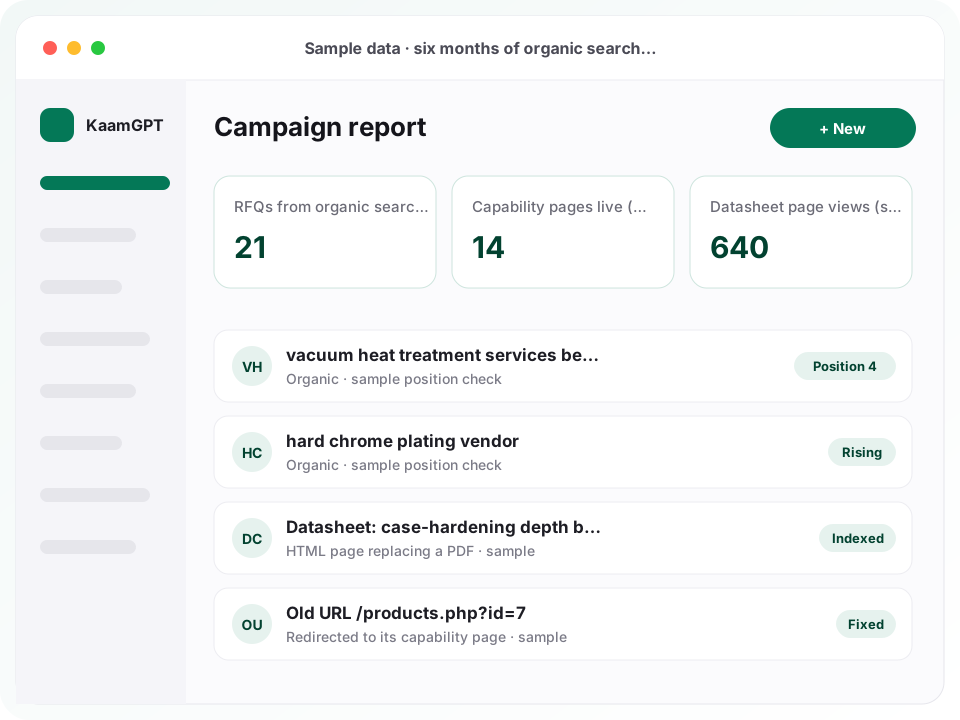
Anyone weighing the best SEO company for manufacturers in Bengaluru should first picture the engineer typing into the search box. She needs a vacuum heat-treatment partner, a source of SS 316 flanges or a vendor for custom wire harnesses, and she types exactly that, often with a grade, a size or a standard attached. Whoever has a page that answers that precise need, in plain technical language, gets the visit. A home page full of mission statements does not.
That is the whole idea behind SEO for a factory: describe each product or process you offer, on its own page, well enough that Google and the engineer both understand it. KaamGPT does this from Bengaluru for SME manufacturers, suppliers and exporters, with the monthly fee beginning at ₹14,999. Search ads can test which terms bring RFQs faster, as our Google Ads page for manufacturers explains, and plants that receive visitors also need the Maps work set out on our Maps guide for factories.
- ₹14,999monthly opening fee for SEO; pages and tasks are itemised before work begins
- ~30 daysfor the audit, a keyword map and the earliest capability pages
- 1 URLfor each process, product family or application a buyer searches for
- 0 doorway pagesno town-name clones of a single page
What would the best SEO company for manufacturers in Bengaluru fix first?
The order of work follows one principle: Google can only rank what it can read and what clearly deserves to exist. So technical problems that hide pages come first, then the keyword map that decides which pages should exist, then the writing. Links and outreach come last, because nobody links to a page that has nothing specific to say.
In practice, seo for b2b suppliers rewards depth over breadth. Ten pages that each answer an engineer's question completely will usually do more than a hundred thin ones. We would rather publish slowly with your production team checking every figure than quickly with guesses about tolerances.
Expect early movement on long, specific searches, often within a few months, and slower progress on broad terms where marketplaces and large brands already sit. Both appear in the monthly report, without spin.
Make every capability crawlable
Fix indexing settings, remove duplicate URLs, redirect old product addresses and make sure each important page is linked from the menu. Engineers and search crawlers both give up on sites that hide pages three clicks deep.
Turn PDFs into pages
Each key datasheet becomes an HTML page with its table of grades, sizes and tolerances in text, while the PDF stays available as a download. Search engines and answer engines can then quote the figures directly.
Write in the buyer's units and standards
If buyers specify by IS, DIN, ASTM or ISO references, or in inches for export customers, the page does too. Matching the standard a drawing calls out is often what decides relevance for a technical search.
Show proof without breaking confidentiality
Part photographs, inspection records and sector lists build trust, but many OEM contracts forbid naming the customer. We refer to the work by sector and component type unless the customer has agreed to be named.
Earn links from real industry sources
Membership listings of associations you belong to, exhibition exhibitor pages, supplier directories and technical articles in trade media. Paid links and link networks, which Google's policies prohibit, are off the table.
What does SEO for a manufacturer involve, month by month?
The work below is spread across the engagement in the order your audit suggests. A plating unit with a clean site might start writing on day ten; a moulder with a broken old site might spend the first month on structure.
A keyword map drawn from real RFQs
We read the enquiries you already receive, the way your customers' drawings and purchase orders describe parts, and the terms your engineers use, then group searches by process, material, product family and application. Each group gets exactly one target page.
SEO in detail →Capability and application pages
Pages for each process or product family that state size range, materials, tolerances, finishes, batch sizes, inspection and certificates, with photos of real parts. Application pages explain how you serve a sector such as pumps, railways or medical devices, in that sector's own vocabulary.
SEO in detail →A structure an engineer can navigate
Clean URLs, a menu organised by capability rather than by department, fast pages and redirects from old addresses. Where the platform blocks this, a rebuild is scoped through our website development team before SEO writing starts.
Websites in detail →Paid search as a testing bench
Before we write twenty pages, a small paid campaign can show which phrasing actually produces RFQs. The Google Ads service runs that test; the SEO work then commits to the terms that proved themselves.
Google Ads in detail →The plant on Google Maps
Buyers coming for an audit, couriers collecting samples and walk-in trade customers find factories through Maps. A correct Business Profile with permanent signage at the gate supports, but never replaces, the national pages.
Local SEO in detail →Counting RFQs that come from search
Organic traffic is only useful if it turns into drawings and quantities. We tag the RFQ form, email links and WhatsApp buttons so each enquiry from search is recorded with the page it started on.
Lead generation in detail →Follow-up for datasheet readers
Engineers who download a full datasheet or catalogue, and opt in to updates, receive a few useful notes over the following months: a new material, an added machine, a capacity opening. Nothing more frequent than the buyer would welcome.
Email campaigns in detail →How do engineers search for a supplier, and what must the page show?
Technical buyers search in fragments of their own specification. Examples include ss 316 flange supplier bangalore, aluminium extrusion profiles manufacturer karnataka, vacuum heat treatment for tool steel, custom wire harness manufacturer india and laser cutting job work near peenya. These are illustrations of the pattern, not volume estimates: a material or grade, a process, sometimes a place, rarely a brand.
When the engineer lands, the page has a few seconds to confirm three things. Can this supplier make my part, in my material and size? Do they hold the tolerance or finish I need? Is there evidence, such as photos, equipment or certificates, that they have done it before? Pages that answer those in the first screen keep the visitor; pages that open with a slideshow of the factory gate lose them.
This is why technical content for engineers looks different from consumer copy. Tables beat adjectives. A size-range table, a list of materials with grades, a short note on inspection equipment and a clear RFQ button do more than paragraphs about commitment to quality.
- State size range, materials, tolerances and finishes in text, not only in images.
- Name the standards and certificate scopes you actually hold.
- Show real parts, described by sector and component type.
- Put the RFQ route, with drawing upload, on every capability page.
Why do city pages and copied catalogues backfire?
A common shortcut sold to manufacturers is a set of pages titled with every city in India, each repeating the same text: CNC machining in Pune, CNC machining in Chennai, and so on. Google's spam policies describe this directly. Doorway abuse includes having multiple pages targeted at specific regions or cities that funnel users to one page, and keyword stuffing includes blocks of text listing cities and regions a page is trying to rank for.
The same policies describe scaled content abuse: many pages generated chiefly to game rankings instead of helping users, however they are produced. Product descriptions copied from a marketplace or rewritten by a tool fall into the same trap, because they add nothing a search engine cannot already find elsewhere.
The honest alternative is less glamorous. One strong page per capability, an accurate location section for the plant, and application pages written for sectors you genuinely serve. If you deliver across India, say so on the capability page; you do not need a separate page for every state to be found by a buyer in another one.
How should an exporter structure its website for overseas buyers?
Export seo starts with a decision about structure. Google's guidance on multi-regional and multilingual sites sets out the options, including country-code domains and subdirectories on one domain, and recommends labelling language or regional versions with hreflang annotations or sitemaps. For most Bengaluru SMEs, subdirectories such as a German or Spanish section on the main domain are the simplest to maintain.
The same guidance warns against redirecting visitors automatically by language, because Google's crawler usually comes from the United States and does not send a language preference, so it may never see your other versions. Let buyers choose their language with a visible switch instead.
Content for importers also changes in substance, not just language. They want export packaging, Incoterms you work with, lead times by sea and air, the certifications their market expects and units they use. A translated Indian page without those details rarely persuades them.
Can a factory website outrank IndiaMART and other marketplaces?
For broad product terms, often not, at least not quickly. Large B2B marketplaces publish huge numbers of category pages and have years of links, so a search for a generic product name will usually show them near the top. Fighting for those terms head-on is an expensive way to disappoint yourself.
Where a manufacturer can win is specificity. Searches that combine a process with a grade, a size, an application or a standard are far less crowded, and a detailed page written with the team that runs the machines can beat a marketplace category that lists hundreds of sellers. Your company name, your products' model names and your niche processes should also lead to your own site.
Keep marketplace listings, but make them consistent with the website, link back where allowed, and treat them as a separate source in the RFQ sheet. Over time, your own pages carry more of the specific searches while listings handle the general ones.
Which pages should a manufacturer's website have, and in what order?
Most factory sites we see have five pages: home, about, products, gallery and contact. That structure suits a brochure, not a supplier that wants to be found for specific work. A site built for search grows around capability pages, with everything else supporting them.
The order of building matters because your engineers' review time is limited. Start with the capabilities that carry the best margins or the most spare capacity, since those are the RFQs you most want. Then add application pages for the two or three sectors you serve best, the datasheet pages behind them, and only then the export sections and longer technical articles.
A quality page deserves more attention than it usually gets. Buyers' quality teams look for inspection equipment, measuring instruments, process controls and certificate scopes, and many shortlists are decided there. A plain, factual quality page, linked from every capability page, often lifts enquiry quality more than any keyword change.
- Capability pages, one per process or product family, ranked by margin and spare capacity.
- Application pages for the sectors you already supply well.
- Datasheet pages with grades, sizes and tolerances in text.
- A quality and certification page linked from every capability page.
- Export sections, then technical articles that answer real buyer questions.
What does factory SEO cost with KaamGPT?
In KaamGPT's catalogue the SEO fee begins at ₹14,999 monthly, and the first round of work takes about thirty days. The written scope says how many pages are planned, which technical fixes are included and how RFQs from search will be reported. A plant with many product families or an export layer needs more writing, and the quote grows accordingly. Our price list shows the opening figure for each service.
SEO
Recommended₹14,999/month
Typically 30 days
Beginning at ₹14,999 monthly, this is the core choice for a supplier whose customers study process, material or application before they ask for a price.
- Technical audit
- Keyword research
- On-page optimisation
- Content plan
- Monthly reporting
Digital Marketing
₹19,999/month
Typically 15 days
The managed plan, opening at ₹19,999 monthly, suits factories that want SEO joined to ads, email and exhibition follow-up under one team.
- Channel strategy
- Creative production
- Campaign management
- Weekly reporting
Local SEO
₹4,999/month
Typically 14 days
Costing ₹4,999 monthly for each location at the start, it covers a factory gate, spares counter or regional sales desk that visitors must locate on Maps.
- Google Business Profile optimisation
- Local keyword map
- Location page on-page fixes
- Citation building and NAP cleanup
- Local link outreach
- Review replies and posts
- Monthly report
Google Ads
₹4,999/month
Typically 30 days
Search ad management, ₹4,999 monthly to begin, helps when RFQs are needed before the organic pages have matured, or to trial keywords first.
- Account setup
- Keyword strategy
- Ad copy testing
- Conversion tracking
- Bid optimisation
Meta Ads
₹4,999/month
Typically 30 days
Meta management, also ₹4,999 monthly to begin, is rarely an SEO companion for industrial sales, though it helps with hiring and dealer recruitment.
- Creative testing
- Audience building
- Retargeting funnels
- Pixel setup
- Weekly reporting
Lead Generation
₹24,999/month
Typically 14 days
Opening at ₹24,999 monthly, it adds qualification and follow-up for factories already getting enquiries they cannot handle well.
- Verified leads
- Multi-channel outreach
- CRM integration
- Lead scoring
- Replacement guarantee
- Writing is checked by your technical team before publishing; the time that takes is agreed at the start so the schedule is realistic.
- A rebuild is quoted on its own, with ₹9,999 as the floor, and we suggest one only when the current platform blocks the SEO work.
| Package | Starts at | Timeline | Best for |
|---|---|---|---|
| SEO | ₹14,999/month | Typically 30 days | Beginning at ₹14,999 monthly, this is the core choice for a supplier whose customers study process, material or application before they ask for a price. |
| Digital Marketing | ₹19,999/month | Typically 15 days | The managed plan, opening at ₹19,999 monthly, suits factories that want SEO joined to ads, email and exhibition follow-up under one team. |
| Local SEO | ₹4,999/month | Typically 14 days | Costing ₹4,999 monthly for each location at the start, it covers a factory gate, spares counter or regional sales desk that visitors must locate on Maps. |
| Google Ads | ₹4,999/month | Typically 30 days | Search ad management, ₹4,999 monthly to begin, helps when RFQs are needed before the organic pages have matured, or to trial keywords first. |
| Meta Ads | ₹4,999/month | Typically 30 days | Meta management, also ₹4,999 monthly to begin, is rarely an SEO companion for industrial sales, though it helps with hiring and dealer recruitment. |
| Lead Generation | ₹24,999/month | Typically 14 days | Opening at ₹24,999 monthly, it adds qualification and follow-up for factories already getting enquiries they cannot handle well. |
What drives the cost of industrial SEO?
The biggest driver is the number of distinct things you sell. A unit that only does laser cutting needs perhaps five or six pages; a fabricator offering cutting, bending, welding, powder coating and assembly for five sectors needs dozens. Export sections add translation and review. A site that needs restructuring adds technical work up front.
When comparing quotes from any seo company for manufacturers in Bangalore, ask how many pages each month the fee buys, who checks technical accuracy, and how organic RFQs will be counted. Our SEO service page lists what the standard scope covers.
There is also an internal cost that quotes rarely mention: your engineers' time. Every capability page needs someone who knows the process to answer questions and check the draft. Budget an hour or two a week from a production or quality person during the first months. Plants that protect that hour see pages published on schedule; plants that cannot spare it see the SEO plan slip, whatever the agency does.
- The number of processes, product families and applications that each need a page.
- Whether today's site is repairable or must be restructured before writing starts.
- How many export markets need their own sections, languages or units.
- How quickly your engineers can review drafts and supply photos, grades and tolerances.
- How crowded the searches are with marketplaces and large national brands.
How does Bengaluru's industrial map show up in search results?
Bengaluru Urban has sixteen industrial areas by Invest Karnataka's count, and buyers often know them by name. In the west, the Peenya and Rajajinagar estates sit off Tumkur Road and are full of machine shops, electrical makers and rubber and plastic moulders. To the south, Electronic City leads into the Bommasandra and Jigani estates. The Mysore Road side runs past Kengeri towards Kumbalgodu's industrial area and Bidadi, while the north has the Rail Wheel Factory at Yelahanka, commissioned in 1984, and KIADB's aerospace park out by the airport.
For industrial seo, these names matter less than people expect. A buyer in Pune or Chennai looking for powder-coated enclosures does not care which estate you are in; he cares that you make them in his size range and finish. Cluster names help when the buyer wants a nearby vendor for audits and short deliveries, which is common for OEMs within Bengaluru, and that is better handled by the plant's Maps presence and one honest location section than by dozens of area pages.
So a Bengaluru manufacturer's search plan usually has two layers. The national layer covers processes, materials and applications for buyers anywhere in India. The export layer, where relevant, covers products and certifications for overseas importers, in their language and with their units. Location wording appears where it is true and useful, and nowhere else.
Which kinds of plants and suppliers benefit most from organic search?
- Heat treatment and surface finishingJob-work buyers search by process and steel grade, so a page per treatment with depths and hardness ranges matches them closely.
- Castings and forgingsSearches name the alloy, weight range and end use, which suits detailed capability pages with real part photos.
- Special-purpose machine buildersEach machine type and automation cell deserves its own page, with the problem it solves and the industries it serves.
- Electronics manufacturing servicesPCB assembly, box build and cable harness buyers look for process detail, test capability and quality systems before they enquire.
- Pumps, valves and fluid-handling makersProduct-family pages with sizes, pressure classes and materials meet engineers who search by specification.
- Engineered-goods exportersOverseas importers need export sections in their language and units, built to Google's guidance for multi-regional sites.
- Food and process equipment fabricatorsBuyers compare materials, hygiene finishes and capacities, and application pages written per food category work well.
How do the first six months of factory SEO unfold?
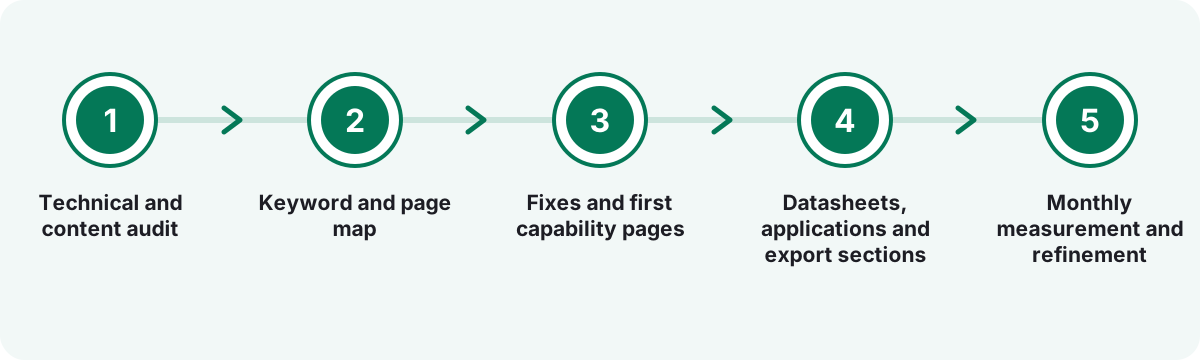
Technical and content audit
We crawl the site, check what Google has indexed, list broken and duplicate URLs, measure page speed and note every capability that has no page of its own.
Keyword and page map
Searches are grouped by process, product and application, each group is assigned to one URL, and the map is signed off by you before writing begins.
Fixes and first capability pages
Technical fixes go live, old URLs are redirected, and the most commercially important capability pages are drafted, checked by your engineers and published.
Datasheets, applications and export sections
PDF datasheets become readable pages, application pages follow for your main sectors, and export sections are added where you sell abroad.
Monthly measurement and refinement
Positions, organic visits, datasheet views and RFQs from search are reported by page. Pages that attract visits but no enquiries are rewritten; new gaps go on the map.
What sets KaamGPT's SEO approach apart for factories?
Engineers check every figure
Nothing technical is published until someone from your production or quality team has approved it. One wrong grade costs more trust than a missing page.
Pages for capabilities, not towns
We follow Google's spam policies and do not build doorway pages that repeat one text with a different city name. Location wording appears only where it is true.
Written for AI answers too
Clear facts in text, consistent across your site and listings, are what AI assistants quote. We write so that search engines and answer tools read the same story.
RFQs, not just rankings
Rankings are reported, but the monthly review is about which pages produced enquiries with drawings, and what to change on those that did not.
Part of a wider team
When SEO alone is too slow, our people can also run search ads, Maps work or RFQ follow-up, without you briefing a second agency.
Why do factory websites stay invisible on Google?
When we audit a manufacturer's site, the problem is rarely a missing keyword. It is usually that the site never says, in text that a crawler can parse, what the company actually makes. The knowledge lives in the owner's head, in PDF brochures and in photos of machines with no captions, so Google has very little to match against an engineer's query.
A second pattern is the redesign that quietly undoes years of visibility. A new theme goes live, product URLs change, nobody sets redirects, and the pages that engineers had bookmarked or that Google had ranked simply vanish. Months later the owner notices fewer enquiries and blames the market. An SEO audit before any redesign, and a redirect map during it, prevents most of that loss.
- One page called Products that lists twenty capabilities in a single paragraph, so not one of them can rank on its own.
- Catalogues and datasheets uploaded only as scanned PDFs or images, which hold tolerances and grades that crawlers and AI tools struggle to read.
- Product descriptions pasted from a marketplace listing or a competitor's site, leaving nothing original for Google to prefer.
- Dozens of near-identical pages for every city and state, which Google's spam rules classify as doorway abuse rather than useful content.
- Heavy, slow pages on an old platform, with broken links from a past redesign and no record of which organic visits became RFQs.
- SEO starting fee
- ₹14,999 monthly; first round of work in about 30 days
- Page rule
- One URL per process, product family or application
- Doorway pages
- Not built; Google's spam policies name city-swapped pages as doorway abuse
- Datasheets
- Converted from PDF into readable HTML pages, PDF kept as download
- Export sections
- Subdirectories with hreflang, following Google's multi-regional guidance
- Measure of success
- RFQs from organic search, by landing page
Where this applies around Bengaluru, Karnataka
- Bengaluru
- Karnataka
- India
- Rajajinagar
- Peenya
- Electronic City
- Yelahanka
Frequently asked questions
29 answersWhat should an seo company for manufacturers in Bangalore deliver in the first month?
A technical audit, a list of capabilities that have no page, a keyword map grouped by process, material and application, and the first fixes to indexing and redirects. Writing usually begins once the map is agreed. A manufacturer should also get a clear plan for how RFQs from organic search will be counted from then on.
What is KaamGPT's SEO fee for a manufacturing unit?
Our SEO fee begins at ₹14,999 monthly. The scope names how many pages are planned each month, which technical fixes are included and how organic RFQs are reported. A manufacturer with many product families or export sections needs more writing, and the quote grows to match before work starts.
When will organic search start sending RFQs to a Bengaluru factory?
Specific, long searches can start sending visits within a few months of publishing good pages. Broad product terms take much longer, and some may stay with marketplaces. RFQs follow visits, and orders follow RFQs after the usual quotation and approval cycle, so a Bengaluru manufacturer should plan SEO as a six-to-twelve-month investment.
Should a manufacturer make a separate page for each city it supplies?
No, not as copies with the city name swapped. Google's spam policies describe region- or city-targeted pages that send visitors on to a single page as doorway abuse. Say on each capability page that you deliver across India or abroad, keep one honest location section for your plant, and spend the effort on capability depth instead.
Are PDF catalogues bad for a manufacturer's SEO?
They are not harmful, but they are weak on their own. Scanned PDFs and image-heavy brochures hide tables of grades, sizes and tolerances from search engines and AI tools. Turn the key datasheets into web pages with the figures in text, and keep the PDF as a download for buyers who want to save it.
What is a capability page?
A page about one process or product family, such as CNC turning, powder coating or cable harness assembly, that states size range, materials, tolerances, finishes, batch sizes, inspection and certificates, with photographs of actual components and an RFQ button. For a manufacturer, capability pages are the main ranking assets.
Can SEO help a Bengaluru exporter find overseas buyers?
Yes, if the export section is built for those buyers. Use subdirectories per language or region, label them with hreflang, avoid automatic language redirects, and write in the importer's units, standards and terms of trade. A translated copy of the Indian page rarely persuades an importer on its own.
Will our customers' names or drawings appear on the site?
Only with their written agreement. Many OEM contracts restrict naming the customer or showing their parts. We describe work by sector and component type instead, for example a turned shaft for an industrial pump maker, which shows capability without breaking a manufacturer's confidentiality duties.
Do we need to blog to rank as an industrial supplier?
Not in the usual sense. Capability, application and datasheet pages matter far more than general blog posts. Articles help when they answer real engineering questions your buyers ask, such as choosing between two coatings or grades, and when they link to the relevant capability page.
How do you measure SEO success for a manufacturer?
By RFQs from organic search, recorded with the page each one started on, alongside positions for the agreed keyword groups, organic visits and datasheet views. The yardstick for a Bengaluru manufacturer is enquiries with drawings and quantities, not traffic totals.
Can our old website be fixed, or does it need rebuilding?
Often it can be fixed: redirects, cleaner menus, faster images and new capability pages. A rebuild is worth it when the platform cannot create clean URLs, loads slowly whatever is done, or cannot be changed except by whoever built it. We say which applies after the audit, and a rebuild is quoted separately.
Does SEO help with AI assistants like ChatGPT or Gemini?
Clear, consistent facts in text help any system that reads the web, including AI assistants. If your capability pages, Business Profile and directory listings all state the same processes, materials and location, answer tools are more likely to describe a manufacturer accurately. Nobody can promise to be named in those answers.
Who writes the technical content?
Our writers draft it from interviews with your engineers, machine lists, sample photos and existing documents. Your production or quality person checks every figure before publishing. That review step is built into the schedule, because accuracy matters more to a manufacturer's buyers than speed.
What makes the best SEO company for manufacturers in Bengaluru worth hiring?
It should ask technical questions before writing, refuse doorway pages, convert datasheets into readable pages, and report on RFQs rather than traffic alone. It should also tell you honestly which broad terms marketplaces will keep. If an agency promises first position for a generic product name, be wary.
Should a manufacturer still list on marketplaces while doing SEO?
Usually yes. Marketplaces attract buyers who like posting requirements and comparing sellers, and they rank strongly for broad product terms. Keep the listing details consistent with your website, record those enquiries as a separate source, and let your own pages win the specific searches.
Which keywords matter most to industrial buyers?
Searches that combine a process or product with a material, grade, size, standard or application. Examples include a coating plus a steel grade, or a component plus an end use. These are narrower than generic product names, but the people typing them often have a drawing ready for a manufacturer.
Do you build links for factory websites?
We earn them from real sources: associations you belong to, exhibition exhibitor lists, supplier directories, partner pages and technical articles. We do not buy links or use private networks, which breach Google's policies and put a manufacturer's site at risk.
Can you do SEO in Kannada or other Indian languages?
For industrial buyers in India, technical pages are usually in English, because drawings and specifications are. Kannada or Hindi pages can help consumer-facing product lines or dealer recruitment. For exports, we discuss which languages your buyers use and have native reviewers check them.
How does SEO work with Google Ads for a Bengaluru manufacturer?
Ads bring enquiries while pages are still maturing, and the search-term reports show which phrasing produces RFQs. SEO then builds lasting pages around the proven terms. Our Bengaluru team can run both, so the keyword map and the ad groups stay aligned.
Will a slow website hurt a manufacturer in search?
Yes. Engineers often browse on a phone during plant visits. Factories tend to upload large machine photos and slideshows that load slowly. Compressing images, removing heavy sliders and fixing hosting issues help both visitors and search engines, and are among the first fixes we make.
Should product pages show prices?
Most made-to-order manufacturers cannot publish fixed prices, and that is fine. Show what drives price, such as material, quantity and finish, typical minimum order quantities and lead times, and make the RFQ route obvious. Standard catalogue items with stable prices can show them if your sales team is comfortable.
What schema markup helps a manufacturer?
Organization markup with your legal name, address and contact details, breadcrumb markup for the page structure, and FAQ content written on the page itself. Product markup suits catalogue items with clear details. Markup supports pages that are already good; it does not rescue thin ones.
How do you handle a manufacturer with plants in several locations?
Capabilities stay on one set of pages, with each plant's processes noted where they differ. Each plant that receives visitors gets its own accurate location details and Maps presence. We do not create separate copies of every capability page per plant.
How do we contact KaamGPT for an SEO audit of our factory site?
WhatsApp your website address to +91 79767 82366, or ring it, adding a sentence about your products and their buyers. A short written audit follows, covering what Google currently indexes, which capabilities lack a page, and what we would fix first for your manufacturing business in Bengaluru.
Is an seo company for manufacturers in Bangalore useful if most sales come through referrals?
Often yes, because referred buyers still look at your website before picking up the phone. A site that clearly shows capability supports the referral, and organic search adds buyers your network cannot reach, such as OEMs in other states or importers abroad. Start small and measure how many RFQs search adds.
Where do manufacturers usually go wrong with SEO?
Hiring for traffic rather than RFQs, buying city-page packages, copying descriptions from competitors or marketplaces, hiding datasheets in PDFs, letting the site break during a redesign, and publishing technical figures nobody checked. Each one wastes months that a slow, careful approach would have saved.
Should a manufacturer redesign its website before starting SEO?
Not automatically. A redesign without a redirect plan can wipe out the visibility you already have. We audit first, keep pages that rank, map every old URL to its new home, and only then change the design. Many manufacturers find that new capability pages on the existing site bring more RFQs than a fresh look would.
Can SEO help an industrial supplier in Bengaluru win government buyers?
Indirectly. Public buyers mostly purchase through the Government e-Marketplace and tenders, not through organic search. A clear website still helps their officers verify a supplier's capability and certificates once a bid is in. For a Bengaluru supplier selling to public bodies, the GeM listing and the website should describe products the same way.
How much time will our engineers need to give the SEO work?
Plan for an hour or two a week from someone in production or quality during the first months, mainly to answer questions and check drafts. Later it drops to occasional reviews of new pages. A manufacturer that cannot spare this time should start with fewer pages rather than publish figures nobody has checked.