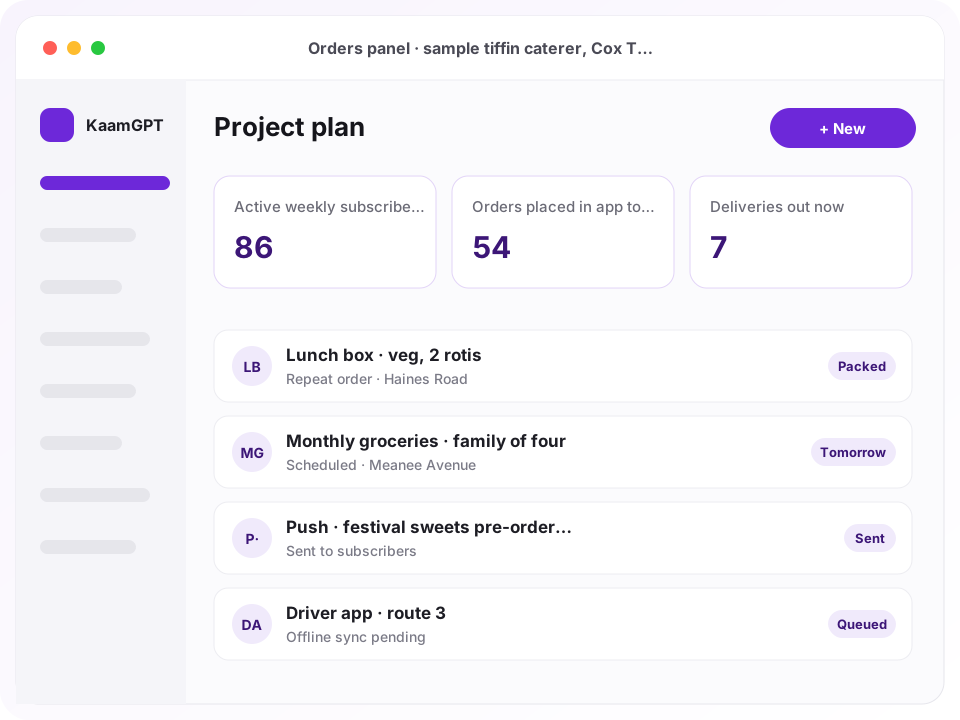
An app earns its place when the same customers come back every week, and that is the test any app development agency in Cox Town should apply before quoting. Tiffin caterers, provision stores delivering monthly groceries and sweet shops with standing festival orders pass it; a shop visited twice a year usually does not.
Our apps run on one backend for iPhone and Android and can plug into your KaamGPT workspace, keeping customers, orders and messages together. The Bengaluru team talks to Cox Town owners on calls and WhatsApp and sends test builds straight to their phones. Our mobile app development guide explains the wider approach.
- ₹14,999opens the conversation for a Cox Town ordering app; subscriptions or delivery tracking move it higher
- 10 daysis about how long a single-shop ordering app takes once caterers sign off the screens
- 3 monthsof aftercare follow go-live, so festival-season bugs get fixed without a new invoice
- 2 storeslistings on Google Play and Apple's store, opened under the family firm's own name
Which Cox Town businesses actually need an app?
Cox Town, officially Sarvagnanagara, is a settled Cantonment neighbourhood between the railway line, Wheeler Road and the Ulsoor polo ground. Its roads, from Assaye Road to Haines Road and Narayan Pillai Street, are lined with homes and the family firms that serve them: caterers, sweet shops, provision stores, tailors and clinics, several now in the hands of a second or third generation.
Those firms rely on regulars. Tamil and Anglo-Indian families who have lived here for decades, the Sindhi community around its colony near Wheeler Road and newer residents drawn by the ITC Infotech campus and Bengaluru East station all order the same things repeatedly. Repeat demand is exactly where an app beats a website, because a saved address, a saved order and a push notification remove the friction of each purchase.
Where customers visit only occasionally, a website is the better first step, and our Cox Town website development page explains that route. For promotion once the app is live, see the Cox Town digital marketing page.
What can an app development agency in Cox Town build for regular-order businesses?
Each item below is a common module. A small caterer may need two; a store with its own delivery team may need five.
Customer ordering app
Browse, order, pay or choose cash on delivery, and repeat last week's order in two taps. Built once for iOS and Android with a native feel, with saved addresses for customers across Cox Town and nearby lanes.
Apps in detail →Subscriptions for tiffins and groceries
Customers pause, skip or change a daily tiffin or monthly grocery plan themselves, and the kitchen sees tomorrow's count before closing.
Apps in detail →Delivery and staff app
A separate app for delivery boys or catering staff showing today's drops, customer notes and a done button. Offline support means updates queue when signal drops and sync later.
Apps in detail →Admin panel for the owner
A web panel to add products, change prices, see orders and staff status, and export records. It runs on the same shared backend as the apps.
Apps in detail →Push notifications that customers want
Order confirmed, out for delivery, festival pre-orders open. Messages are kept few and useful, because an app that nags gets deleted.
Apps in detail →A companion website
Many customers meet you on the web first. A website from ₹9,999 can carry app store links, the menu and an order form for people who will not install anything.
Websites in detail →AI help where it saves time
For larger firms, AI development from ₹49,999 can add features such as reading a handwritten order list or answering routine questions in chat.
AI in detail →Getting the first installs
Our digital marketing retainer at ₹19,999 a month promotes the app to existing customers and nearby households once it is live.
Digital marketing in detail →What are the steps from idea to Play Store and App Store?
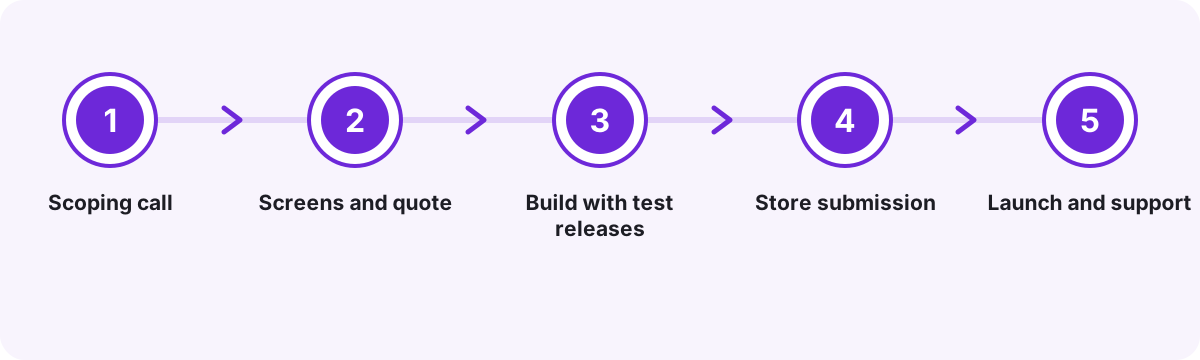
Scoping call
We map how orders flow today, who uses what, and what version one must do. No site visit is needed; a call and a few screenshots of your current WhatsApp flow are enough.
Screens and quote
Rough screens for the customer app and the delivery app, plus a rupee quote with timeline and outside costs such as SMS.
Build with test releases
The owner, the delivery boys and a couple of loyal customers install test builds and send notes on WhatsApp.
Store submission
Store listings, screenshots and privacy answers are written by us and sent to Google Play and Apple under the family firm's accounts; reviewer questions come to us.
Launch and support
The app goes live, staff are trained on the admin panel, and three months of support begin for fixes and updates.
Cox Town firms that suit an app
- Tiffin and meal caterersDaily subscriptions with skip and pause, and a kitchen count ready each evening.
- Provision and grocery storesMonthly baskets reordered in two taps, with a delivery slot the customer chooses.
- Sweet shops and bakeriesFestival pre-orders opened by push notification and collected or delivered on a chosen day.
- Clinics and diagnostic centresAppointment booking, reminders and report downloads, with patient data handled carefully.
- Laundry and tailoring servicesPick-up requests, order status and ready-for-collection alerts for regular customers.
- Community groups and hallsMember notices, event registration and hall booking in one small app.
- Water, gas and dairy suppliersRecurring deliveries with a driver app that works offline and records each drop.
How much does an app cost for a Cox Town business?
For a Cox Town caterer or grocer, a first app begins at ₹14,999 and usually takes around ten days, with Android and iPhone versions, push alerts, offline mode, store listing and three months of aftercare all counted in. That covers ordering for one shop. Add riders, live tracking, payments and a separate owner panel and it becomes a larger delivery product, priced higher in a written quote before anything is built.
App Development
Start hereFrom ₹14,999/project
Typically 10 days
The customer app, staff app and admin panel, built for iOS and Android from ₹14,999 and quoted by scope.
- iOS + Android
- Push notifications
- Offline support
- App store submission
- 3 months support
Website Development
From ₹9,999/project
Typically 7 days
A companion site with the menu, store links and a web order form, from ₹9,999.
- Custom design
- Mobile first
- SEO ready
- CMS included
- Analytics setup
- 1 month free support
AI Development
From ₹49,999/project
Typically 30 days
Automation such as reading order lists or answering routine chat questions, from ₹49,999 per project.
- Custom AI agents
- Document intelligence
- Workflow automation
- API integration
- Ongoing tuning
Digital Marketing
₹19,999/month
Typically 15 days
Promoting the app to regulars and nearby households once it is live, from ₹19,999 a month.
- Channel strategy
- Creative production
- Campaign management
- Weekly reporting
- Your firm opens its own Apple and Google developer accounts and pays their fees, which keeps the apps legally yours.
- Payment gateway, SMS and map services bill you directly; the quote lists each one.
What pushes an app quote above the starting price?
The number of separate apps and screens matters most. A customer app alone is one thing; a customer app, a driver app and an owner's panel is three products sharing a backend. Live tracking, online payments and subscriptions each add work and testing.
When comparing any mobile app development company in Cox Town or elsewhere, ask what happens after launch. Operating systems update every year and stores tighten their rules, so an app nobody maintains stops working. Our three months of support cover that first stretch, and ongoing maintenance can be quoted after it.
- How many apps: customer only, or customer, staff and admin.
- Payments, subscriptions or wallet features.
- Live location tracking for deliveries.
- Offline behaviour and syncing for staff in weak-signal areas.
- Integrations with billing software or your KaamGPT workspace.
- Languages and accessibility requirements.
Why build a Cox Town app with KaamGPT?
Delivery apps we have shipped
Our CloseToBuy food-delivery app, with live order tracking, and the FlyMyCart Android and iOS courier app show the kind of work involved.
One backend, your workspace
Orders, regulars and messages live on one backend that can join your KaamGPT workspace instead of three separate tools.
Apps in your name
The developer accounts, store pages and customer records are registered to the family business; we only hold access you grant.
Honest about scope
When a WhatsApp catalogue or a simple website would do the job for a Cox Town shop, you hear that on the first call.
Support after launch
Three months of support are included, covering fixes, store review questions and operating-system changes.
How should a Cox Town business roll out its first app?
Begin with the customers you already have. A printed card in every delivery bag and a message to your regular WhatsApp list will bring the first installs far more cheaply than ads. Launch with ordering and repeat orders only, watch how people use it for a few weeks, then add subscriptions or loyalty.
App developers in Cox Town can build almost anything; the discipline is in leaving things out of version one. We write down what the first release must do, what can wait, and how you will judge whether the app is working, such as the share of orders that come through it.
Migrate regulars one by one
Offer each weekly customer help installing the app at their next delivery, so the move from WhatsApp happens with a person, not a broadcast.
Keep phone ordering open
Older customers may never install an app. Staff can enter their orders in the admin panel, so every order still lands in one list.
Design for patchy signal
Staff apps save work locally and sync when the network returns, which matters in older buildings and around the railway line.
One notification plan
Agree up front which events trigger a push message and how many promotions a month, so customers keep notifications switched on.
Measure the switch
Track what share of orders arrive through the app each week; that single figure tells you whether to invest further.
Where do phone and WhatsApp orders break down?
Most Cox Town firms already take orders digitally, just not in an organised way. Messages arrive on a personal phone, someone copies them into a notebook, and the delivery boy is sent off with a list that may already be out of date.
- Orders scattered across calls, WhatsApp chats and notes, with no single list of what is due today.
- Regular customers retyping the same order every week because nothing remembers it.
- Delivery staff with no route or status, so customers ring the shop to ask where their order is.
- Festival rushes that swamp the phone line while the owner is also at the counter.
- No record of which customers have stopped ordering, so no chance to win them back.
Should a small Cox Town shop choose native or cross-platform?
For most neighbourhood businesses the answer is whichever gives a good experience on both iPhone and Android for one budget. Fully separate native apps double the work; a single shared codebase with native-feel screens covers ordering, notifications and offline use well. Features that lean on specialised hardware are the exception and are discussed at scoping.
Store rules matter as much as the technology. Apple's review guidelines and Google Play's target API requirements change over time, and an app that falls behind can be removed from sale. Planning for those updates is part of choosing an app development company in Cox Town that will still be there after launch.
- One codebase, native feel, both stores.
- Store policy updates planned into maintenance.
- Hardware-heavy features discussed case by case.
- Tiffin or grocery ordering app, Cox Town
- Priced upward of ₹14,999 once the order flow is mapped
- Build window for a focused first release
- Roughly ten days after the quote is signed
- What ships in version one
- Android and iPhone builds, push alerts, offline mode, store listing, a quarter of aftercare
- Menu or catalogue site to sit beside it
- ₹9,999 upward
- Optional smart features
- AI work begins at ₹49,999
- Where the team sits
- Elsewhere in Bengaluru; Cox Town owners work with us by phone and test builds
Where this applies around Cox Town, Bengaluru
- Cox Town
- Bengaluru
- Karnataka
- India
- Frazer Town
- Cooke Town
- Lingarajapuram
- 560005
Frequently asked questions
21 answersHow much does an app development agency in Cox Town charge at KaamGPT?
A single-shop ordering app for a Cox Town caterer or grocer usually lands close to ₹14,999, with a build window near ten days. Tiffin subscriptions with pause and skip, a delivery-boy app and online payment each widen the scope, so the figure you sign is the one in the written quote, not the headline.
Do you have a team based in Cox Town?
No. Nobody from KaamGPT sits in Cox Town. The app development agency in Cox Town that caterers deal with is our Bengaluru team, reached on the phone or WhatsApp, with test builds landing on the owner's own handset. Travelling to the shop is outside the standard scope.
Is an app worth it for a Cox Town caterer?
If customers order every day or every week, usually yes. A tiffin caterer with regular subscribers saves hours each week when customers pause, skip and reorder themselves. A caterer who mainly handles occasional weddings is better served by a website with an enquiry form.
Will regulars on iPhones and on Android both be able to order?
Yes. One shared backend serves the two versions, each with a native feel, so a tiffin order from an iPhone and a grocery order from an Android handset both land in the same list at your Cox Town counter.
Do you submit the app to the Play Store and App Store?
Yes. Store listings, screenshots and the privacy form are prepared by us, and the Cox Town business's own developer accounts are used for Google Play and Apple, so the apps never belong to us. Apple and Google charge those accounts' fees directly.
Can delivery staff use the app where the signal is weak?
Yes. Staff apps include offline support: deliveries marked done, notes and photos are saved on the phone and sync when the network returns. That matters in older Cox Town buildings and along the railway side where coverage can drop.
Can customers still order by phone once we have the app?
Yes, and many should. Staff can enter phone orders in the admin panel so every order still sits in one list. Older regulars in Cox Town may never install an app, and nobody should be pushed away for that.
What happens after the three months of support end?
Once the three months are up, the Cox Town owner chooses: a maintenance plan priced at that point, or handing the code and store accounts to someone else. Each yearly iOS or Android release can break old apps, so leaving one untended for long is a risk.
How do app developers in Cox Town handle customer data?
Only what a tiffin or grocery order needs, usually a name, number and flat address, is stored, and it sits on your own backend. The privacy policy the stores ask for is written with you, and India's data protection rules should be checked by your adviser.
Can the app send push notifications about festival orders?
Yes. Push notifications are included. We agree which events send a message, such as order confirmed or out for delivery, and how many promotional messages a month you will send, so Cox Town customers keep notifications switched on.
Can orders flow into our KaamGPT workspace?
Yes. Regular customers, their saved orders and any WhatsApp or email follow-ups can sit together in KaamGPT, because the app's backend links to your workspace rather than living on its own.
Can a group of Cox Town shops share one delivery app?
It is possible, but that makes it a small marketplace with several sellers, payouts and a shared delivery team, which is a much larger build than one shop's app. A delivery app for local shops in Bangalore of that kind is quoted well above the starting price, and we would plan it in phases.
How is a mobile app development company near me different from a remote one?
Mainly in how meetings happen. Cox Town owners test our builds on their phones and talk to us on video, which is as fast as sitting together. The bigger question for any app firm is who keeps it running after launch.
Can you build an app for a Cox Town clinic?
Yes. Clinic apps usually cover appointment booking, reminders, doctor timings and report downloads. Health data needs careful handling, so we collect the minimum, keep it on your backend and describe it plainly in the privacy policy the stores review.
Can the ordering screens look like our shop?
Yes. We start from Apple's and Google's own layout conventions, then use your shop's colours, name and food photos. The family tries the screens on test builds before anything is sent to the stores.
Can the app take online payments?
Yes. A payment gateway can be added for UPI, cards and wallets, with cash on delivery kept as an option. The gateway's own fees are billed to you, and adding payments is part of the scope, so the quote reflects it.
Should we build the website or the app first?
For most Cox Town businesses, the website comes first, because new customers find you by searching. Add the app when regulars order often enough to value saving an order. Our Cox Town website page covers that first step, and <a href="/pricing">pricing</a> lists both.
Have you built delivery apps before?
Yes. <a href="/works/closetobuy-food-delivery-app-development">CloseToBuy</a>, one of our case studies, lets Bengaluru diners order from restaurants and follow the order to their door, and <a href="/works/a2z-workhub-home-services-app-website-seo">A2Z WorkHub</a> pairs a home-services app with a website. Both are on the <a href="/services">services page</a> list of work, with what was built for each.
How do we get Cox Town customers to install the app?
Start with the regulars you already have: a card in every bag, a message to your WhatsApp list and help installing at the next delivery. Paid promotion comes later, once the app is proven with existing customers.
Can you add features after launch?
Yes. Most good apps grow in small releases. New features after launch are quoted separately, and the first three months of support cover fixes and updates to what was originally built.
What is the first step towards a Cox Town ordering app?
Message or ring +91 79767 82366 with roughly how many regulars order each week and whether it is tiffins, groceries or sweets. A short call comes next, then a written quote naming every screen of your Cox Town app.