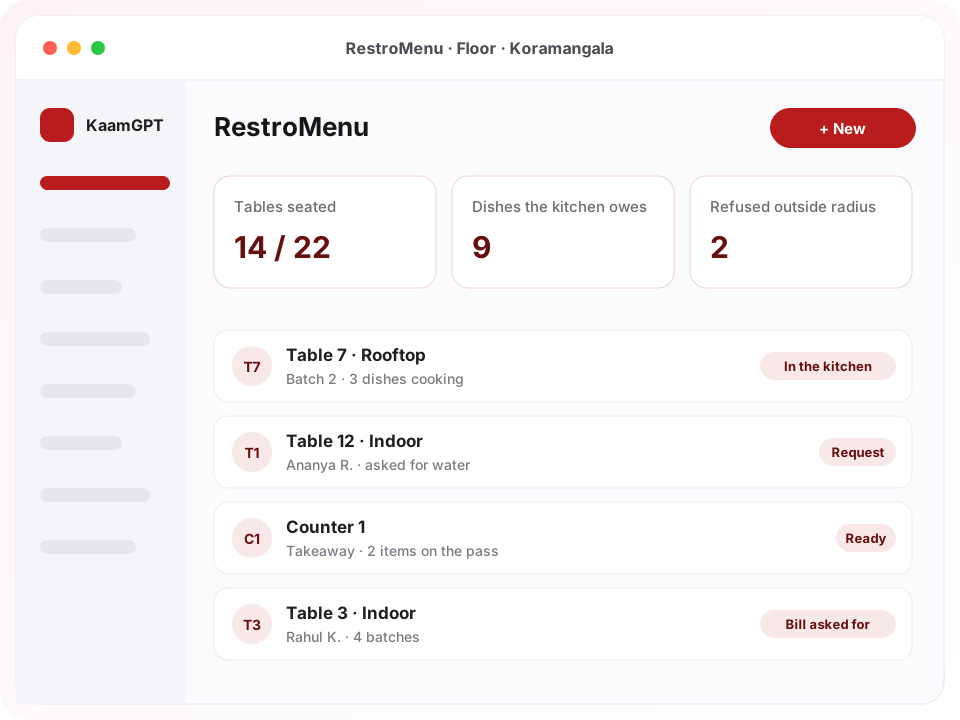
The search for the best QR code restaurant ordering in Bengaluru tends to begin with one practical worry: what stops someone who photographed a table card from ordering to your kitchen from home? KaamGPT RestroMenu answers it by treating the printed QR as a table label, never a key. Before any batch is accepted, the diner's phone is confirmed with a WhatsApp code and a location reading taken at that tap is checked against the radius you drew around the branch.
Everything a service needs sits behind that gate. A live floor shows which tables are seated, ordering, waiting on food or asking for the bill. A kitchen screen ages each ticket from white to amber to red. Diners call for water or cutlery from their phones, and the visit settles through the catalogue, GST engine and stock ledger of KaamGPT's retail and restaurant POS. See the whole flow on the RestroMenu product page; it is built for food businesses only.
- ₹0Free plan includes all of RestroMenu, for a workspace of up to 5 employees
- 20–5,000 mordering radius, set separately for every branch you pin
- 6-digitWhatsApp code from your own linked number before a phone can order
- 1 billfor every round a table orders, priced by the POS tax engine
Where does geo-verified ordering matter most across Bengaluru's dining neighbourhoods?
Along 12th Main and 100 Feet Road in Indiranagar, restaurants share walls and upper floors, so a generous radius would let the cafe next door order into your kitchen. That is where the best QR code restaurant ordering in Bengaluru earns its place: a tight fence pinned from inside the room, an accuracy limit that refuses vague indoor readings, and an override for the rare phone that cannot get a fix. Church Street's narrow frontages call for the same care.
Koramangala and HSR Layout are full of rooftops and multi-level venues, where one branch can hold Rooftop, Indoor and Private areas plus a bar station of its own. In Whitefield, tech-park canteens care more about the lunch wave than about fences, so their counter cards run as takeaway. Tiffin rooms in Malleshwaram and the stalls on the food street at VV Puram favour quick counters too, with a menu that shows what is still available.
Chains that span the city, say an outlet in Koramangala and another in Whitefield, run each as its own branch with its own pin, radius, stations and POS location. A dish can be off at one branch and still on at the other without copying the whole menu. Outlets elsewhere in Karnataka work exactly the same way.
Why does a plain table QR invite orders from people who are not there?
A QR sticker encodes a web address, and web addresses travel. The card gets photographed for a story, forwarded to a college group, saved in a browser. If that link alone can place an order, anyone holding it can send food to an empty table, summon a waiter at midnight or pad a stranger's tab. The risk is sharpest on a dining strip like Church Street, where the next outlet is a few doors away.
The usual fallback is switching phone ordering off and going back to a notepad, which throws away the part diners enjoyed. The best QR code restaurant ordering in Bengaluru keeps the convenience and moves the trust somewhere sturdier: the diner's phone number, their position at the moment they tap Place order, and a table visit that staff can close. RestroMenu is built on exactly that, and every refusal is written down so a manager can explain it.
- A forwarded table link can push a real ticket into the kitchen from someone sitting at home.
- Handwritten KOTs get misread at the pass, and nobody can say how long table 9 has been waiting.
- A second round of drinks restarts the order or lands on a separate bill that the cashier merges by hand.
- The kitchen runs out of prawns at nine, yet the printed or PDF menu keeps offering them.
- When a guest disputes a ticket, there is no record of which phone placed it or from where.
Which Bengaluru food businesses get the most from geo-verified table ordering?
Illustrative scenarios rather than client stories: four kinds of venue and how each would set RestroMenu up.
A 70-cover rooftop bar-restaurant in Koramangala 5th Block
- The situation
- Weekend crowds spread across two levels, and runners cannot reach every table quickly. A table card shared in a group chat has already produced a phantom order for an empty corner, and the owner wants that closed off.
- How KaamGPT fits
- One branch with Rooftop and Indoor areas, a tight radius pinned from the middle of the building and a sensible accuracy limit. The bar gets its own station screen, so drinks tickets never mix with the grill, and the owner keeps the override, the one button that lets a refused phone through.
- What changes
- Drinks and small plates reach the right station without shouting, and every refused attempt leaves a record the manager can read back to a guest.
A business hotel with a room-service kitchen near MG Road
- The situation
- Room service runs on a phone extension that rings out during the checkout rush. Orders are scribbled on paper, and charges reach the front desk late, if at all.
- How KaamGPT fits
- Rooms are created in bulk from Room 101 upwards with room service switched on, and the radius covers the whole building. Guests scan the card on the desk, verify on WhatsApp and order; the kitchen display shows the room label, and POS records the settled bill as room service.
- What changes
- Hotel room service QR ordering replaces the unanswered extension, and the kitchen always knows exactly which room is waiting.
A busy darshini on Sampige Road, Malleshwaram
- The situation
- Breakfast is stand-up and fast, lunch adds a handful of tables, and customers keep asking what is still available. A location check at the parcel counter would only slow the queue.
- How KaamGPT fits
- The parcel counter is set up as a takeaway point, which skips the location check by design, while the lunch tables keep the fence. The breakfast section is time-boxed to morning hours, and items that run out stay visible, greyed and marked finished for now.
- What changes
- The counter moves as quickly as before, seated diners order without waving, and nobody walks up asking for vada that ended at ten.
A corporate canteen operator inside a Whitefield tech park
- The situation
- Lunch arrives in one wave. Employees queue to order, then crowd the counter waiting for a token number to be called over the noise of the hall.
- How KaamGPT fits
- Counter cards run as takeaway, so employees scan at the counter, order without a location check and verify by WhatsApp. Each station, from the dosa tawa to the meals line, sees only its own dishes, and diners follow every item from received to ready on their phones.
- What changes
- The queue shifts from the counter to the phone, and each kitchen line works only on what belongs to it.
What runs behind a RestroMenu table card, from scan to settled bill?
Eight working parts, from the fence around each branch to the report that names the dishes nobody orders.
A fence drawn per branch
Each branch gets its own pin and radius, anywhere from 20 metres for a kiosk to 5,000 for a sprawling resort. Stand in the dining room and tap Use this device's location instead of copying numbers off a map. The app will not save a fence whose accuracy limit is as wide as its radius, because that fence could never refuse anybody.
Fresh location before every batch
The recommended mode checks position when the table opens and again moments before each order, using a reading the phone takes at that tap. Someone who verified at eight and walked home cannot keep ordering from the sofa. Readings too vague to prove presence are refused with advice to switch on precise location and Wi-Fi, never with a bare no.
WhatsApp code from your number
A six-digit code arrives from the WhatsApp number your workspace has linked, so diners see your name rather than a stranger's. Codes expire after five minutes by default, allow a handful of wrong tries and are capped per phone per hour, which stops anyone flooding a stranger's phone at your expense. You can switch the code off entirely.
Kitchen screen split by station
Tickets land on a browser-based kitchen display system for restaurants that refreshes every six seconds, filters by station such as tandoor, bar or desserts, and rings once for each new ticket. Colour tracks waiting time rather than status: white, then amber, then red on thresholds you choose. One tap moves a dish or a whole ticket along.
Rounds that never reset
Starters at eight, mains at 8:40, kulfi at half past nine: each is its own batch on the same table visit. A dish already served stays served while the new batch queues, and the diner's tracking screen shows every item as received, cooking, ready or served. Everyone at the table can verify and order, or one phone can control the table.
Waiter, water and bill calls
Diners tap for a waiter, water, cutlery, tissues, a table wipe or the bill instead of waving across a crowded room. Each call sits on the floor view until someone acknowledges it and marks it done. Calls can be geo-guarded too, so a bookmarked link cannot summon staff to an empty table long after the meal.
Dish pages that answer questions
Every dish can carry a photograph taken on the phone's rear camera, a video link, ingredients, allergens, calories, a chilli rating and a veg, non-veg, egg, vegan or Jain mark. Sections can open only at breakfast or on chosen days. Mark a dish finished for now with a return time and it reappears by itself.
Settlement into one POS invoice
Settling a table combines every batch into one invoice, priced by the same tax engine and stock ledger as the till, with service charge, packaging and delivery as proper lines. Split payment across cash, UPI, card and other tenders. Even after they leave, diners can reopen the bill on their own phone, save it and rate the visit.
What does RestroMenu cost for one outlet versus a restaurant group?
There is no separate RestroMenu subscription to buy. The app rides along with all four KaamGPT tiers, Free among them, so a restaurant can put the best QR code restaurant ordering in Bengaluru on its own tables before spending a rupee. Every figure is in INR, and the checkout screen spells out the exact rupee amount. Longer billing cycles, whether quarterly, half-yearly or yearly, cut the effective monthly figure; KaamGPT's plan comparison page lays out each cycle.
Free
₹0forever
No card needed
At ₹0, one small cafe gets the whole app, fence, WhatsApp codes, kitchen screen and single bill included, on a workspace capped at 5 employees, with a monthly allowance of 200 WhatsApp messages and 512 MB for dish photographs.
- Up to 5 employees
- 1,000 emails / month
- 200 WhatsApp messages / month
- 512 MB storage
- Community support
Starter
₹999/month
or ₹9,590 billed yearly — 20% less
At ₹999 monthly, after 14 trial days, one restaurant or cafe can grow to 25 employees, a monthly allowance of 5,000 WhatsApp messages, 5 GB for a fully photographed menu, and help over email.
- Up to 25 employees
- 25,000 emails / month
- 5,000 WhatsApp messages / month
- 5 GB storage
- Email support
Growth
Recommended₹2,999/month
or ₹28,790 billed yearly — 20% less
At ₹2,999 monthly, a group running several branches, each with its own radius and stations, gets room for 100 employees, 30,000 WhatsApp messages monthly, 25 GB, priority handling of support emails and API access.
- Up to 100 employees
- 1,50,000 emails / month
- 30,000 WhatsApp messages / month
- 25 GB storage
- API access
- Priority email support
Business
₹7,999/month
or ₹76,790 billed yearly — 20% less
At ₹7,999 monthly, hotel groups and larger chains get room for 500 employees, 150,000 WhatsApp messages monthly and 100 GB, with onboarding and priority support included while branches are pinned and cards printed.
- Up to 500 employees
- 7,50,000 emails / month
- 1,50,000 WhatsApp messages / month
- 100 GB storage
- API access
- Priority support + onboarding
Optional add-ons
- Restaurant website buildA website that links to your public menu can be built under Website Development, starting at ₹9,999 per project; scope and timeline arrive in a written quote.
- Tiers differ only in employees, monthly email and WhatsApp allowances, campaigns and storage; every one of them includes RestroMenu in full.
- Verification codes and order confirmations leave from the WhatsApp number you link to the workspace, so that phone has to stay connected and online through every service.
- A kitchen tablet or screen, printing and laminating the QR cards, and the WhatsApp phone itself are costs the restaurant carries.
- All prices are shown in INR, and the checkout screen confirms the exact figure before you pay.
How does a Bengaluru restaurant go from signup to its first verified order?
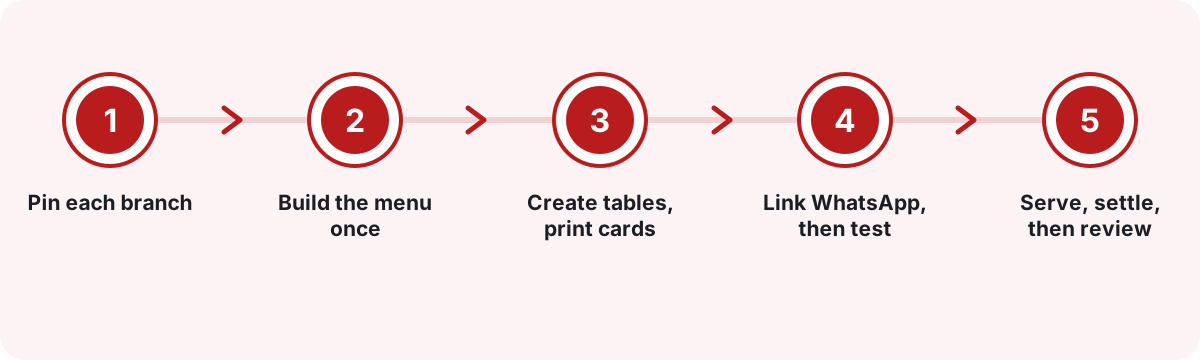
Pin each branch
Open the branch settings while standing inside the dining room, capture its coordinates, choose a radius and an accuracy limit, and keep the recommended check mode. Link the branch to its POS location so stock and bills land against the right outlet.
Build the menu once
Add dishes into sections; creating a dish creates its POS product with price and tax, so there is never a second catalogue. A new workspace already has Starters, Main course, Breads, Desserts and Beverages, and add-on groups handle sizes, spice and extras.
Create tables, print cards
Add tables, rooms or counters singly, or up to 200 at a time with a prefix such as T or Room. Print the vector QR sheet straight from the browser, cut the cards and stand them where people sit.
Link WhatsApp, then test
Link the WhatsApp number that will send codes and order confirmations. Scan a card from your own phone, verify, place a test order and watch it appear on the kitchen screen before any guest sees the system.
Serve, settle, then review
Staff watch the floor, answer requests, work tickets and settle each visit into one bill. At week's end, reports show covers and spend by day, cooking time against pass time, dishes nobody ordered and what diners rated.
How does RestroMenu compare with a PDF menu sticker or a link-only ordering tool?
Anyone shortlisting the best QR code restaurant ordering in Bengaluru is choosing between broadly three set-ups. Here is how each behaves on a packed Friday night.
| What matters | KaamGPT RestroMenu | PDF menu on a QR sticker | Link-only QR ordering tool |
|---|---|---|---|
| Who can send an order to the kitchen | A WhatsApp-verified phone, inside your radius, on an open table visit | Nobody; a waiter still writes the KOT | Anyone holding the link, wherever they happen to be |
| How tickets reach the kitchen | Kitchen display by station, ageing white to amber to red | Handwritten or typed KOT slips | Varies by vendor; ask how tickets reach the pass |
| Second and third rounds | New batch on the same visit; earlier dishes keep their status | The waiter takes it all again | Varies; check whether rounds merge into one bill |
| A dish runs out mid-service | One tap marks it finished for now, back at a set time | Reprint the PDF or tell each table | Edit the item inside that tool's own menu |
| Prices and stock | One catalogue shared with POS; stock moves at settlement | Prices kept in the PDF and the billing software separately | Separate catalogue unless it syncs with your POS |
| The final bill | Every round on one POS invoice with split tenders, viewable on the diner's phone | Separate billing software | Separate billing unless integrated |
| When a guest disputes an order | Security log with the refusal reason and the distance, for managers only | No record of who ordered what | Order history, without proof anyone was present |
The honest verdict. Pick RestroMenu when diners place their own orders and you need confidence they were actually at the table, or when you want every round on a single POS bill. A PDF menu is enough if waiters take every order and you only want to save on printing. A link-only tool can suit a pure takeaway counter where presence is irrelevant, though RestroMenu treats takeaway cards that way too.
How wide should the ordering radius be for a Bengaluru restaurant?
Start from the building, not the map. The radius is measured from the pin, so pin the centre of the dining room while standing in it. A single-floor cafe on a quiet road can run tight; a mall food court or a hotel with a poolside and a banquet wing needs room for a guest at the far edge to pass. The presets step from 30 to 500 metres, and any value from 20 to 5,000 is accepted.
The accuracy limit matters as much as the radius. Every reading a phone reports comes with an error circle in metres, and indoors, under a concrete slab or in a basement, that circle widens. RestroMenu refuses any reading vaguer than your limit and asks the diner to turn on precise location and Wi-Fi, rather than guessing either way.
Test from the worst seats before the first live service: the corner table by the kitchen door, the rooftop parapet, the private room downstairs. If one seat fails repeatedly, widen the radius a step or loosen the accuracy limit slightly. For the rare guest whose phone simply will not get a fix, an admin can let that one device order for the next 30 minutes, with a written reason that stays on record.
- Pin from inside the room, then open the map link to confirm the dot.
- Keep the recommended mode that checks at the table and before every order.
- Set parcel counters up as takeaway points; they skip the fence by design.
- After the first weekend, read the security screen for low-accuracy refusals.
What should the best QR code restaurant ordering in Bengaluru check before a dish reaches the kitchen?
No single signal proves a diner is genuinely at table 12, so RestroMenu stacks five and trusts none of them alone. Permission to order is worked out afresh on every request from the table visit, the branch's check mode and the age of the last accepted reading. It is never a stored yes that stays true after the guest leaves; only a staff member's explicit revoke is kept.
The browser sends raw latitude, longitude and accuracy, and the server does the arithmetic, so a modified page cannot simply declare itself inside. The diner is never told how far away they were, because a number like that would let someone calibrate a fake location in two tries; the manager sees the metres on the security screen instead.
Rate limits catch the rest. Each visit has a ceiling on batches and a minimum gap between them, and codes are capped per phone per hour. When a limit trips, the attempt is logged with its reason, so a pattern of refusals from one number is visible rather than silent.
- The QR card says which table, and nothing more.
- A fresh location reading says near the branch, right now.
- The WhatsApp code says this phone number belongs to this diner.
- The table visit says someone is seated tonight, and closing it ends every permission.
- The device binding says this browser; the session token never travels in the link.
What should a restaurant manager measure after the first month of table ordering?
Begin with the kitchen report, because it separates two different problems. Time from ticket to ready belongs to the cooks; time from ready to served belongs to the floor. A dish with a short prep and a long wait on the pass needs another runner, not a louder chef. The dishes report is the other quiet goldmine: alongside the best sellers, it lists what nobody ordered at all.
Then read the security screen. A cluster of low-accuracy refusals from one seating area points at a radius or accuracy limit that is too tight for that part of the building. An alert that codes could not be delivered usually means the linked WhatsApp phone went offline, which stops every new diner verifying, so check that phone before each service.
A diner's location history is personal data under India's DPDP Act, 2023, and RestroMenu collects it for one narrow purpose. Verification records are deleted after 90 days by default, and you can shorten or lengthen that window in settings. Keep it as short as your dispute window allows.
- Covers, batches and average spend per day, per branch.
- Cooking time against pass time, by dish and by station.
- Dishes that never sold in the chosen period.
- Average star ratings from diners, with their written comments.
Which kinds of food business is RestroMenu built for?
- Casual dining restaurantsSeveral rounds per table on one bill, with a kitchen screen split into tandoor, curry and dessert stations.
- Cafes and bakeriesTakeaway counter cards, a veg filter and search for diners, and trays marked finished for now as they empty.
- Pubs, bars and microbreweriesA bar station that sees only drinks tickets, and the option to let one phone control each table.
- Hotels and resortsRooms as QR points taking room service orders, with a radius wide enough to include the poolside and lawns.
- Darshinis and tiffin roomsBreakfast sections that open only in the morning, fast parcel counters, and a fence kept for seated tables.
- Corporate canteens and food courtsEmployees order from a counter card and follow each dish from received to ready on their own phone.
- Sweet shops and juice barsA photographed public menu for browsing, plus counter ordering that keeps festival rushes moving.
What does a restaurant gain when table ordering shares a workspace with POS and CRM?
No second catalogue to reconcile
A dish is a POS product wearing a photograph: one price, one tax rate, one stock figure. The counter and the table never disagree about what a plate of paneer tikka costs.
Stock leaves once, at settlement
Ingredients come off the ledger when the visit is billed rather than when the first round is ordered, so cost of goods matches the moment of sale. Add-ons like an extra espresso shot can draw stock too.
Regulars recognised by their number
A verified WhatsApp number is matched to an existing customer record rather than duplicated, and each round appears on that customer's timeline next to their past bills.
Roles that protect the fence
Waiters, cooks and cashiers get the screens their shift needs. Changing a radius or overriding a location check is admin-only by default, so nobody on the floor can be talked into weakening it.
Privacy defaults you can defend
Codes and session tokens are stored only as hashes, the diner never learns the distance that refused them, and location history is deleted after 90 days unless you choose a different window.
Part of a bigger toolkit
With 100+ Indian companies already on KaamGPT, the same login can also run attendance for kitchen staff, WhatsApp campaigns to past diners and invoices for catering clients.
- Price
- Rides along with every tier: ₹0 Free, then ₹999 Starter, ₹2,999 Growth or ₹7,999 Business per month (INR)
- Trial
- Paid tiers open with 14 trial days; Free runs a workspace capped at 5 employees
- Diner side
- Any phone browser, Android or iPhone; nothing to install
- Staff side
- Floor, kitchen display, menu, tables, security and reports in the KaamGPT web app
- Integrations
- POS catalogue, stock and billing; CRM timeline; QR Studio table codes; linked WhatsApp number
- Contact
- Book a RestroMenu walkthrough by phone or WhatsApp from any button on this page
Where this applies around Bengaluru, Karnataka
- Bengaluru
- Karnataka
- India
- Indiranagar
- Koramangala
- Church Street
- Malleshwaram
- VV Puram
- HSR Layout
- Whitefield
Frequently asked questions
22 answersHow much does QR table ordering cost on KaamGPT?
Nothing extra: RestroMenu sits inside every KaamGPT tier instead of carrying its own fee. A single cafe can run it on Free for ₹0; ₹999 a month buys Starter, ₹2,999 buys Growth and ₹7,999 buys Business, and paying for a quarter, half-year or year at once trims the monthly figure. For the best QR code restaurant ordering in Bengaluru at one outlet, Free or Starter usually does the job. Figures are in INR, the checkout screen confirms what you pay, and <a href="/pricing">the plans page</a> compares tiers.
Can we try RestroMenu on our tables without paying first?
Yes. On the ₹0 Free tier the whole app works, fence, WhatsApp codes and kitchen screen included, for a workspace capped at 5 employees and 200 WhatsApp messages each month. Starter, Growth and Business add 14 trial days before billing starts. <a href="/signup">Open a KaamGPT workspace</a> and scan a test card at one of your own tables the same day.
Do diners need to download an app to order from the table?
No. Scanning the card opens the menu in the phone's own browser on Android or iPhone. The diner types a name and number, enters the WhatsApp code, allows location, and orders. The cart survives an accidental reload or a switched app, and a refused order keeps its cart so nobody re-adds nine dishes after a weak indoor signal.
What happens if a diner's phone cannot get an accurate location indoors?
The reading is refused as too vague rather than as outside, and the diner is asked to turn on precise location and Wi-Fi and try again. Their cart stays intact. If one phone still cannot get a fix, an admin can let that device order for the next 30 minutes with a written reason, which is logged on the security screen.
Can someone order from home using a photo of our table QR code?
Not in the recommended mode. The QR only identifies the table; to order, a phone must pass a WhatsApp code and a fresh location reading inside your radius, taken moments before each batch. Anyone outside can still read the menu, which is harmless. If a card gets defaced or overused, an admin can issue that table a new code, and the old card stops working immediately.
What if our WhatsApp phone goes offline during dinner service?
New diners cannot receive codes, so the screen tells them to ask a member of staff instead of waiting on a message that never arrives. The failure is recorded on the security screen with its cause, such as the phone being offline or the template switched off. Keep the linked phone charged and online during service, or switch the code requirement off temporarily.
Can several people at one table order from their own phones?
Yes. By default everyone at the table verifies separately and adds their own batches to the same visit, with room for up to 12 phones on one table by default. Alternatively, set one phone to control the table while others only browse, which suits a bar running a tab. Either way, all batches end up on one bill.
How do chefs see orders, and can tickets be split by station?
Orders appear on the kitchen display, which runs in a browser on a kitchen tablet, laptop or wall screen and refreshes every six seconds. Create stations such as tandoor, bar or desserts and assign menu sections to them; each screen can filter to one station. Tickets turn amber and then red as they wait, and a bell rings once for every new ticket.
How do we mark a dish as sold out for the evening?
Open the dish on the menu screen and switch it off, optionally with a time it should return and a short note. Diners see it greyed and marked finished for now instead of it vanishing. Price, stock and the POS product stay untouched, and it comes back on its own once the return time passes. One branch can switch a dish off while another keeps selling it.
Does RestroMenu handle hotel room service as well as restaurant tables?
Yes. Create rooms instead of tables, individually or in bulk from a number like 101, and switch room service on. A card on the desk opens a room-service visit, the kitchen display shows the room label, and the settled bill is recorded in POS as room service rather than dine-in. Areas can be wings, floors or the poolside.
How is the final bill calculated, and can a table pay by UPI and cash together?
Settlement sends every batch through the same tax engine the KaamGPT till uses, adding service charge, packaging or delivery as separate lines. The screen shows an estimate that can differ by a rounding paisa from the final invoice. Payment can be split across cash, UPI, card, wallet, bank transfer or on account, and a bill-level discount can be applied at the till.
Which other KaamGPT apps does RestroMenu connect to?
It shares POS's product catalogue, stock ledger and invoicing, so dishes, prices and bills live in one place. Verified diners land on the CRM customer timeline. It sends codes through the WhatsApp number linked for WhatsApp Blast, and <a href="/best-dynamic-qr-code-generator-in-bengaluru">QR Studio's dynamic codes</a> can front each table with a branded, re-pointable code that keeps the table's ordering link.
How quickly can one restaurant go live on RestroMenu?
The technical part fits into an afternoon. A new workspace already has a main branch, a floor with four tables and five menu sections, so you can print a card and test a scan early on. Most of the effort is photographing and pricing dishes, pinning the branch from inside the room and creating the rest of your tables in bulk.
We already have printed QR menus from another provider. How do we switch?
Rebuild the menu in RestroMenu first; each dish you add becomes a POS product with its price and tax, so billing is ready at the same time. Create your tables in bulk, print the new QR sheet and swap the cards table by table on a quiet afternoon. There is no importer from other menu tools, so plan the menu entry as a task in its own right.
Who owns the diner and location data, and how is it protected?
Under KaamGPT's terms, your business owns its customer data, and each workspace is walled off from every other tenant. Verification codes and session tokens are stored only as hashes, the session token never appears in a link, and diners are never shown the distance that refused them. Location records are deleted after 90 days by default, a window you control, and POS sales reports export daily bills, revenue and profit as CSV.
What support do we get after the restaurant goes live?
It depends on the tier. Free relies on community support, Starter adds help over email, Growth moves your emails to the front of the queue, and Business brings priority support plus onboarding. Inside the product, the security screen explains every refused order, failed code and revoked device in plain words, which settles most why-was-my-order-refused questions at the table without raising a ticket.
Can someone walk us through RestroMenu before we sign up?
Ring the KaamGPT team on +91 79767 82366, or send a WhatsApp to that same number. Share the number of branches, tables or rooms and how the kitchen divides its stations, and a team member will run a scan, a verified order, the kitchen screen and a settled bill on a set-up close to yours before suggesting a tier.
Why not just keep a PDF menu behind a QR sticker?
A PDF menu only shows dishes; a waiter still takes every order and someone still types it into billing. RestroMenu lets verified diners order, routes tickets to a kitchen display, tracks each dish and settles every round on one bill. That combination is what the best QR code restaurant ordering in Bengaluru should mean, beyond a picture of your menu.
Which food businesses should skip RestroMenu?
Anyone without a dining room, guest rooms or a service counter. A delivery-only cloud kitchen that takes all its orders through aggregator apps gains little, and non-food retailers are better served by POS alone. If your guests rarely carry smartphones, or you have no WhatsApp number to link, a waiter-led flow may suit you better.
Does it work for restaurants outside central Bengaluru or elsewhere in Karnataka?
Yes. Every branch carries its own pin, radius and timezone, which defaults to Asia/Kolkata, so outlets in Mysuru, Mangaluru or Hubballi work exactly as one in Jayanagar. Indian numbers typed as 98765 43210, with +91 or with a leading zero count as the same person. For the best QR code restaurant ordering in Bengaluru and beyond, location only needs a phone and a pin.
Can diners browse our menu before they arrive?
Yes. Every workspace can publish a public menu link that anyone can open from anywhere, with no location check or code, which makes it a digital, contactless QR menu for your Instagram bio, a shop-front poster or your Google listing. Ordering stays locked to table cards. The public page shows photographs, veg marks, a veg-only filter and search.
Can staff stop a table or one phone from ordering mid-meal?
Yes. From the floor view, open the table and revoke ordering for the whole visit or for one diner's phone, then restore it later if needed. Closing or settling a visit ends every device's permission in one step, and visits nobody closed are swept automatically after eight hours without activity, so a forgotten table cannot keep taking orders overnight.