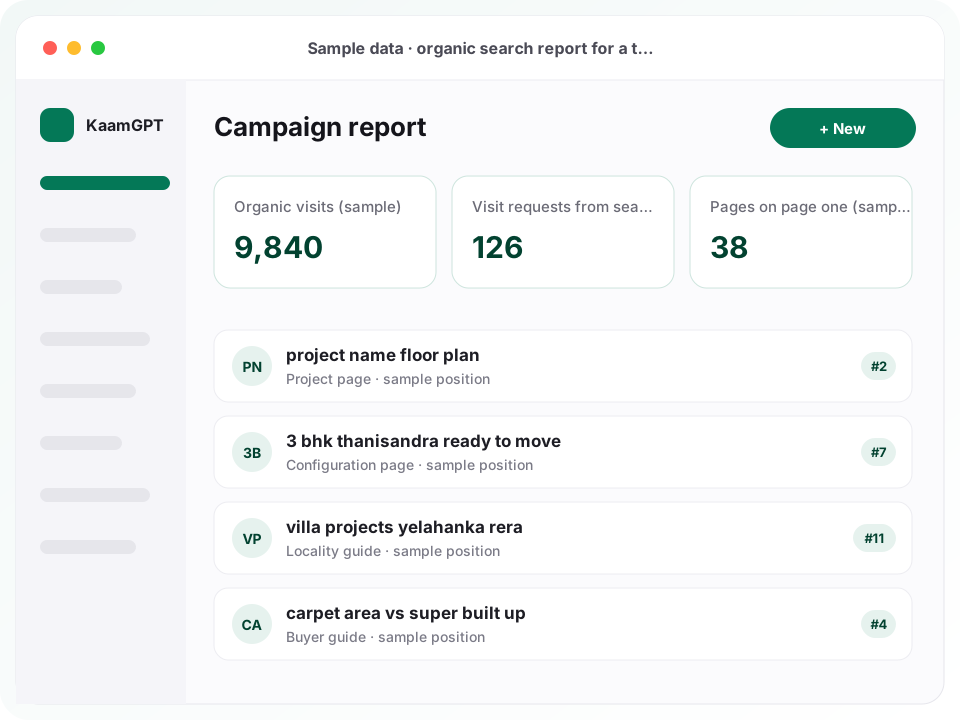
When developers set out to find the best SEO company for real estate in Bengaluru, they usually begin with one annoyance: type the project's own name into Google and a listing portal appears above the official website. Portals have years of links and thousands of pages; most project sites are a single brochure page with the floor plans saved as images. Fixing that is less about tricks and more about building the pages a careful buyer needs, on a domain that keeps its value from one launch to the next.
KaamGPT's SEO service is priced from ₹14,999 a month, with the groundwork taking roughly a month. For a property business, that work centres on one site for the developer, with a page for every project, phase and configuration, plus guides to the localities where you actually build. Our pages are written for Google, for featured snippets and for AI chat tools at the same time, since all three favour plain facts a reader can verify. This page sets out how buyers research, what K-RERA expects your pages to show and how we would organise the site.
- ₹14,999a month is where SEO for a developer or broker begins, scoped in writing
- ~30 daysof groundwork covering the audit, site structure, first repairs and opening project pages
- 1 URLfor each project, phase and configuration, all on the developer's own domain
- 13 Dec 2019K-RERA told property portals not to list projects without their registration details
Why do project websites lose search traffic to the portals?
Property portal competition is real, but portals are not unbeatable on the searches that matter most to a developer. Your own project name, your brand and the detailed questions about your projects are searches where the official site should win, and usually loses for reasons that can be fixed.
- A new domain for every project. Each launch gets its own short-lived website, so links and reputation never build up in one place, and the site disappears when the project sells out.
- Brochures instead of pages. Floor plans, specifications and location details live inside images or a downloadable PDF that search engines read poorly and buyers cannot search.
- Facts that disagree. The possession date, unit count or approvals on the website disagree with the official K-RERA listing, which undermines trust with both buyers and search engines.
- Copied locality pages. Dozens of near-identical pages for areas where the developer has never built, which Google's spam policies describe as doorway abuse.
- Deleted history. Completed projects are removed instead of being kept as proof of delivery, throwing away links and the evidence buyers look for.
How would the best SEO company for real estate in Bengaluru organise your website?
A developer's website works best when it is organised like a well-indexed reference shelf. The home page explains who you are and links to every project. Each project hub carries the registration number, a link to the Authority's site, the location, configurations, status and documents. Phases and configurations sit beneath it. Locality guides and buyer guides sit beside the projects and link into them, so every useful answer points the reader to a home they could actually buy.
An SEO company for real estate in Bangalore should also leave you with a site your own team can keep current. We set up simple templates for construction updates and new phases, so each quarterly change reaches the website the same week it reaches the K-RERA portal.
Map searches to pages before writing anything
We group real searches into project, configuration, locality and question clusters, then assign each cluster to exactly one page, so two of your pages never compete for the same query.
Write locality guides only where you build
Locality guide pages cover commute times, schools, hospitals, planned infrastructure and what is currently under construction, written from your own knowledge of the area and refreshed when facts change.
Keep every K-RERA fact in one place
Registration number, approvals and status are kept in one fact block per project, copied from your Authority filing, so the website never disagrees with the portal.
Turn sales calls into content
Your sales team hears the same twenty questions every weekend. Once a month we note them down and turn the commonest into guides and project FAQs.
Keep finished projects as proof
Completed projects move into a delivered-projects section with handover dates and photographs, which keeps their links and answers the question buyers ask most: does this builder finish on time?
What does search optimisation involve for a property developer?
The aim is simple to state: when a buyer searches for your project, your locality or a question about either, your own site gives the clearest answer. These are the pieces of work that get it there, in roughly the order we take them on.
Audit of the site you already have
We crawl the current site and every old project domain, list what search engines can and cannot read, find broken links and duplicated pages, and compare your rankings for project names with the portals that outrank you. The audit ends with a short, ordered list of fixes rather than a long report nobody acts on.
SEO in detail →One domain, with a place for every project
Old microsites are folded into the developer's main domain with permanent redirects, so their links count again. Each project gets a hub page, with child pages for phases and configurations, built as text a buyer can search rather than images. This structure is what project page SEO rests on.
SEO in detail →Quick pages on mobile data
Heavy sliders, uncompressed renders and autoplay video slow project pages badly on mobile data. Where the existing site cannot be fixed, we rebuild the templates with compressed images, readable floor-plan tables and a visit form that works on a small screen.
Websites in detail →Guides to the questions buyers research
Buyers spend months checking approvals, khata, carpet area, possession timelines and loan eligibility. Guides that answer those questions plainly, each linking to the relevant project, bring in people early and give your sales team something useful to send.
SEO in detail →Facts set out for answer engines
Structured data for the organisation, each project and its address, plus a consistent fact block with registration number, configurations, carpet areas and status, helps search engines and AI assistants quote your details accurately instead of a portal's version.
SEO in detail →The sales office on Google Maps
Unpaid listings and the local map results strengthen one another. A verified listing for your sales or experience centre, with matching name and address, supports the project pages. The local SEO page for real estate covers what Google allows a property business to list.
Local SEO in detail →Joining organic and paid search
Search Console data shows which questions bring people to the site; paid campaigns can test new phrases before we write for them. Read how that fits a full plan on the real estate digital marketing page, and how paid search is run on the Google Ads page for property.
Digital marketing in detail →Why choose KaamGPT for a property website's search work?
Experience building a property platform
For TRECOM, a property community covering homes, plots and commercial units, KaamGPT built the platform along with its content hub and technical SEO.
One set of facts for every kind of search
Every page states each project's facts once and clearly, so Google, snippets and AI chat tools all pick up one consistent version.
Regulatory facts handled carefully
Registration numbers, the Authority's web address and approval details are copied from your filing and checked each quarter, never paraphrased from memory.
Reports in the language of sales
We report organic visit requests and calls alongside rankings, because a page at the top that brings no enquiries is not a success.
A team that answers quickly
We work from Bengaluru over phone, WhatsApp and video, and answer within one business day.
What does real estate SEO cost with KaamGPT?
Pricing begins at ₹14,999 a month for a builder or broker; the first month or so goes on the audit, the new structure and an opening batch of project pages. A single project on a clean site sits near that entry point. Folding several old microsites into one domain, writing a large library of locality guides or rebuilding slow templates adds to the scope. Before work starts, the agreed pages, repairs and reports are listed on paper, and billing never depends on keywords or positions.
SEO
Recommended₹14,999/month
Typically 30 days
Fits developers and brokers who want their own site to win project, locality and buyer-question searches over the long sales cycle.
- Technical audit
- Keyword research
- On-page optimisation
- Content plan
- Monthly reporting
Digital Marketing
₹19,999/month
Typically 15 days
Fits a developer who wants organic search run alongside ads, social and WhatsApp by one team, from ₹19,999 a month.
- Channel strategy
- Creative production
- Campaign management
- Weekly reporting
Local SEO
₹4,999/month
Typically 14 days
Fits each sales office or experience centre that should appear on Google Maps, from ₹4,999 a month per location.
- Google Business Profile optimisation
- Local keyword map
- Location page on-page fixes
- Citation building and NAP cleanup
- Local link outreach
- Review replies and posts
- Monthly report
Google Ads
₹4,999/month
Typically 30 days
Fits a launch that cannot wait for organic rankings, with Google Ads management from ₹4,999 a month.
- Account setup
- Keyword strategy
- Ad copy testing
- Conversion tracking
- Bid optimisation
Meta Ads
₹4,999/month
Typically 30 days
Fits launches that need walkthrough videos in front of households not yet searching, with Meta Ads management from ₹4,999 a month.
- Creative testing
- Audience building
- Retargeting funnels
- Pixel setup
- Weekly reporting
Lead Generation
₹24,999/month
Typically 14 days
Fits a team that wants organic enquiries qualified and booked into site visits, with lead generation from ₹24,999 a month.
- Verified leads
- Multi-channel outreach
- CRM integration
- Lead scoring
- Replacement guarantee
- We publish on your own domain, so the pages and the links they earn build up in your site, not in a separate one we control.
- Photography, drone footage and renders used on project pages come from your team or your production partners; we advise on what each page needs. Catalogue prices for every service are on the pricing page.
| Package | Starts at | Timeline | Best for |
|---|---|---|---|
| SEO | ₹14,999/month | Typically 30 days | Fits developers and brokers who want their own site to win project, locality and buyer-question searches over the long sales cycle. |
| Digital Marketing | ₹19,999/month | Typically 15 days | Fits a developer who wants organic search run alongside ads, social and WhatsApp by one team, from ₹19,999 a month. |
| Local SEO | ₹4,999/month | Typically 14 days | Fits each sales office or experience centre that should appear on Google Maps, from ₹4,999 a month per location. |
| Google Ads | ₹4,999/month | Typically 30 days | Fits a launch that cannot wait for organic rankings, with Google Ads management from ₹4,999 a month. |
| Meta Ads | ₹4,999/month | Typically 30 days | Fits launches that need walkthrough videos in front of households not yet searching, with Meta Ads management from ₹4,999 a month. |
| Lead Generation | ₹24,999/month | Typically 14 days | Fits a team that wants organic enquiries qualified and booked into site visits, with lead generation from ₹24,999 a month. |
What decides how much SEO a developer needs?
Search is slower to pay back than advertising and lasts longer, so the useful question is how much groundwork your site needs before it can compete. A developer with one domain, a few well-built project pages and clean history needs mostly content. A developer with six lapsed microsites, brochures saved as pictures and a sluggish theme needs repairs first, and those absorb the opening months.
For planning, think in quarters rather than weeks. The first quarter usually fixes structure and publishes the core project pages; the second fills in configurations, buyer guides and locality guides; by the third, Search Console shows which pages bring organic site visit enquiries and the plan follows the evidence.
- Number of live projects. Each needs a hub, phase pages and configuration pages, so a five-project developer has more to build than a single-tower one.
- State of the existing site. Old microsites, broken redirects and image-only pages need repair before new content can help.
- Breadth of localities. Guides are written only for areas where you build, and a developer active in four corridors needs more of them than one active in one.
- Competition on your queries. Project names shared with other developments, or crowded localities, need more content and links to win.
- Speed of your updates. Sites that publish construction progress and new phases promptly need less catch-up work each quarter.
- Languages. Bilingual Kannada and English pages reach more families but mean more writing and checking.
How does an SEO engagement with us unfold?
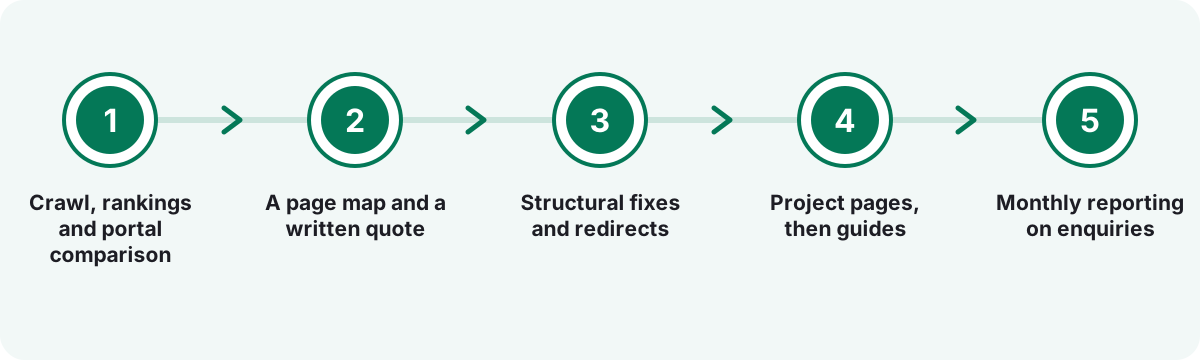
Crawl, rankings and portal comparison
We crawl your site and old domains, record where you rank for each project name, and note which portal pages outrank you and why.
A page map and a written quote
You receive the proposed site structure, the list of pages to create or merge, the fixes in order of impact and our fee.
Structural fixes and redirects
Old microsites are redirected, templates are repaired and the fact block for each project is checked against its K-RERA page.
Project pages, then guides
Project hubs and configuration pages go first because they are closest to a booking; buyer and locality guides follow in monthly batches.
Monthly reporting on enquiries
Each month we report rankings, organic visits and, most importantly, visit requests and calls that came from search, then set the next batch.
Which kinds of property business gain most from organic search?
- Builders with several towersSeveral projects at once, each with phases and configurations that deserve their own searchable pages.
- Plot and layout promotersBuyers search approvals, layout plans and title questions long before they search a project name.
- Luxury villa developersFewer, more deliberate buyers who read detailed guides and compare specifications carefully.
- Resale and new-launch brokersA content site that explains localities well can bring buyers who are not yet loyal to any project.
- Office and shop sellersBusiness buyers and tenants search by micro-market, floor plate and approvals for their use.
- Rental and co-living operatorsYear-round searches by students and professionals for rooms near colleges and tech parks.
- Listing sites and proptech start-upsLarge sites whose growth depends on clean structure, crawlable listings and useful area guides.
Which Bengaluru localities do buyers research by name?
Few buyers type the whole city's name and stop there. They search for a locality they can commute from, often paired with a configuration and a stage of completion. In the north, Thanisandra sits beside Hebbal and Nagawara on the route to the airport, Nagawara hosts the Embassy Manyata campus beside the ring road, and Yelahanka is the oldest part of the city and its northern end. In the east, Varthur lies between the old airport road and Sarjapur Road, close to the International Tech Park in Whitefield. In the south, Bannerghatta Road runs as a state highway from Hosur Road towards Anekal.
Each of those names carries its own search pattern. Someone searching Thanisandra often wants to know the drive to Manyata and the airport; a Varthur search tends to come with questions about the nearby tech parks; a Bannerghatta Road search may come from a family already in South Bangalore that wants to stay close. Real estate SEO in Bangalore therefore works locality by locality, and only where the developer has a project or real knowledge to share, because a guide written about a place you have never built in will be thin and buyers can tell.
What do Bengaluru homebuyers search before they ever call a builder?
Most of a property decision happens before the first phone call, and much of it happens in a search box. Early on, buyers search broadly by locality, budget and configuration. Later, the searches turn into due diligence: is the project registered, what approvals does it hold, what is the khata position, how big is the flat really, and has this builder delivered on time before? Late in the process they search the project name with words like price, possession and reviews.
Each stage needs a different kind of page. Broad searches are best met by locality and configuration pages. Due-diligence searches need guides written in plain language, with the relevant law or document explained and the project's own position stated. Late searches need the project hub itself to be accurate, current and easy to act on. A site that only has a brochure page competes in the last stage alone, and by then many buyers have already formed a view on a portal.
Area is a good example of where clarity wins. The RERA Act defines carpet area as the net usable floor area of a flat, excluding external walls, service shafts, exclusive balconies and open terraces, but including internal partition walls. A configuration page that states carpet area clearly, with balcony area shown separately, answers a question many buyers search before they trust any price.
- Early-stage example queries: 2 bhk apartments yelahanka new launch, gated community bannerghatta road, flats near manyata tech park.
- Due-diligence example queries: how to check rera registration karnataka, a khata vs b khata apartment, occupancy certificate meaning, carpet area vs super built up area.
- Late-stage example queries: project name possession date, project name price per sq ft, builder name completed projects.
Why should every project page carry its K-RERA details?
A project page is an advertisement in the eyes of the law. Under Section 11, any advertisement has to give prominence to the regulator's web address and the project's registration number. The same section requires the promoter to keep the project's page on the Authority's website up to date every quarter: units booked, approvals taken and pending, and construction status. Buyers who check one against the other notice when they disagree.
The portals have their own obligations. In December 2019 K-RERA directed digital portals not to carry projects without their registration details, and told portals that only advertise to say so in a disclaimer and advise readers to cross-check with RERA websites. That direction works in a developer's favour: a project hub that shows the number, links to the Authority's page and states the same facts becomes the source the portals, and the buyer, are told to check.
For search engines and AI assistants, consistency matters as much as presence. When the registration number, configurations and status match across your site, your Business Profile and the Authority's page, there is one clear set of facts to quote. We keep those details in a single block per project and update it whenever a quarterly filing changes.
Can a developer publish a page for every locality in Bangalore?
It is tempting, and it usually backfires. Google's spam rules call it doorway abuse when pages exist to rank for near-identical queries and funnel visitors to one destination, and they cite multiple pages targeting individual cities or regions as an example. They describe scaled content abuse as generating many pages mainly to manipulate rankings rather than help readers. A hundred near-identical pages, each with a locality name swapped in, fit both descriptions.
The test we apply is whether a page would be useful to someone who will never buy from you. A guide to Thanisandra written by a developer with a project there, covering the airport drive, the nearby business parks, schools and the roads under construction, passes. A page about a locality where you have no project and nothing specific to say does not, so we do not write it.
Fewer, better guides also suit buyers. A family comparing three corridors wants depth on each, with honest drawbacks, and is more likely to trust a developer who admits that one road floods in the monsoon than one whose every page says the same pleasant things.
What should happen to a project's pages after it sells out?
Deleting them is a common and costly mistake on real estate sites. A sold-out project page has collected links, reviews and search history over several years, and it is often the best evidence a developer has. Instead, the hub moves into a delivered-projects section with the handover date, photographs of the finished buildings and the occupancy certificate status. Configuration pages are redirected to the hub so that their links are not lost.
Those pages keep earning their keep. Buyers of your next launch search the old project to judge your record, residents search it for association matters, and resale or rental enquiries arrive through it. A short note pointing to your current projects nearby turns that traffic into new enquiries without misleading anyone about what is still for sale.
- Keep the URL, change the status: sold out, handed over, occupancy certificate received.
- Redirect configuration and phase pages to the project hub, never to the home page.
- Add photographs of the finished project and the date of handover.
- Link to current projects in the same corridor, clearly labelled as different projects.
What does a well-built project hub contain, section by section?
When a developer asks an SEO company for real estate in Bangalore what a good project page looks like, the honest answer is a page that a careful buyer could use to decide whether to visit, without phoning anyone. That means facts first and adjectives last. The order below works for apartments, villas and plotted layouts alike, with small changes for each.
Every section should be text that search engines can read and buyers can copy into a message to a relative. Renders and videos sit beside the text rather than replacing it, and each image carries a short description of what it shows, so a render of the clubhouse is not mistaken for a photograph of something already built.
- Fact block: the K-RERA number, linked to the regulator's record for the project, developer name, address with map pin, land area, number of units, configurations and current status.
- Configurations: a table of unit types with carpet area, balcony area, facing and floors, each linking to its own page.
- Location: distances and typical travel times to the nearest tech parks, schools, hospitals and metro station, with the date they were checked.
- Construction progress: dated photographs and the same status reported in the latest quarterly filing.
- Approvals and documents: which approvals are in hand and which are pending, stated plainly.
- Questions buyers ask: six to ten answers drawn from real sales conversations, including the awkward ones about delays and maintenance charges.
- Next step: a visit form asking for a preferred date, plus call and WhatsApp options.
- SEO for real estate
- From ₹14,999 a month; roughly a month of groundwork
- Site structure
- One domain; a URL for each project, phase and configuration
- Advertisement rule
- RERA Act s.11(2): Authority's web address and registration number shown prominently
- Portal circular
- K-RERA, 13 December 2019: no listings without K-RERA registration details
- Locality guides
- Written only for areas where the developer builds
- Main measure
- Visit requests and calls from organic search
Where this applies around Bengaluru, Karnataka
- Bengaluru
- Karnataka
- India
- Thanisandra
- Yelahanka
- Nagavara
- Varthur
- Bannerghatta Road
Frequently asked questions
26 answersWhat test separates the best SEO company for real estate in Bengaluru from the rest?
Ask a prospective partner to search your project names in front of you and explain why each portal ranks above you. Then ask what they would do with your old microsites, how they would keep K-RERA details consistent, and how they report enquiries rather than rankings alone. Clear answers to those three, plus a written scope, tell you more than any list of past keywords.
How much does an SEO company for real estate in Bangalore charge with KaamGPT?
Search work for builders and brokers is priced from ₹14,999 a month, with roughly a month of set-up. Bigger sites, several retired domains to fold in or a long list of guides enlarge the job, and our quote names each page and repair in advance. We never charge per keyword or per ranking.
How long does real estate SEO take to bring enquiries in Bengaluru?
Fixes to an existing site, such as redirects and readable project pages, can lift rankings for your own project names within weeks. Locality and buyer-question pages take longer, often a few months, because they compete with portals and news sites. Plan in quarters, and run paid search alongside for any launch that needs enquiries immediately.
Why does a property portal rank above our own real estate website?
Portals have years of links, thousands of pages and fast templates, while many project sites are a single page with plans saved as images. Search engines can read more about your project on the portal than on your site. Building a proper project hub with searchable details, on a domain that keeps its history, is usually the fix.
Should each real estate project in Bengaluru have its own website?
Usually not. Separate domains split your links and reputation, and they tend to vanish once a project sells out. A single developer domain with a hub for every project keeps building strength from one launch to the next. A separate domain can make sense for a joint venture with its own brand, but it should still link clearly to the developer's main site.
What should a real estate project page include to rank well?
The K-RERA number linked to the regulator's record, the address and map, configurations with carpet areas, current status and possession date, approvals, amenities in the approved plan, a few honest travel times and a visit form. All of it should be text, not images, and the facts should match the project's K-RERA page.
Does a project page on our website need the K-RERA registration number?
Yes. A project page counts as an advertisement, and the 2016 Act wants every advertisement to display the K-RERA number and the regulator's web address where readers will notice them. Placing both near the top also helps buyers who search for the number to verify the project, and helps search engines connect your page with the official record.
How often should a developer update its project pages?
At least once a quarter, in step with the official K-RERA listing being refreshed with units booked, approvals and construction status. Construction photographs and possession updates can go up more often. Pages that show a recent date and match the official record are more trustworthy to buyers and more useful to search engines.
Can we create pages for Bengaluru localities where we have no project?
We advise against it. Google's spam policies treat many near-identical pages aimed at different places as doorway abuse, and pages written without real knowledge rarely help buyers. Write guides for the corridors where you build and know the ground, and make each one genuinely different.
What happens to SEO when a real estate project sells out?
Keep the project hub, mark it as sold out or handed over, add photographs of the finished buildings and link to your current projects nearby. Redirect old configuration pages to the hub. The page keeps its links and becomes evidence of delivery, which is exactly what buyers of your next project will look for.
Do floor plans uploaded as images hurt property SEO?
They limit it. Search engines cannot reliably read sizes, room names or carpet areas from an image or a PDF, and buyers on phones struggle to zoom. Keep the image for viewing, and add a simple text table with configuration, carpet area, balcony area and facing beside it.
What should a Bengaluru real estate developer write about on its blog?
Topics buyers actually research: how to check a project's K-RERA page, what an occupancy certificate is, khata basics, carpet area, home-loan documents, registration and stamp duty steps, and honest guides to the localities where you build. Every article should point to the matching project and be reviewed by a person who understands the rule or procedure it explains.
Can SEO help a plotted layout developer near Bangalore?
Yes, often more than for apartments. Plot buyers research approvals, layout plans, title and road access for a long time, and those questions suit detailed guides. A page for each layout with its approval details, plot sizes and a clear map, plus guides on checking a layout before buying, can bring steady enquiries between launches.
Does real estate SEO reach buyers who live abroad?
It does, because buyers abroad research online even more than local ones. Clear project pages, video walkthroughs embedded with descriptions, document checklists and guides on buying property in India from overseas all rank for searches made from other countries. A contact option that works across time zones, such as WhatsApp, matters on those pages.
Does KaamGPT handle SEO for real estate brokers in Bengaluru?
Yes. A broker or channel partner needs a site built around its own brand and the localities it knows, with listings that carry each project's K-RERA details and the broker's own agent registration. Locality guides and buyer guides suit brokers well, because a broker's value is advice across projects rather than a single development.
How do AI assistants pick up information about a real estate project?
They draw on pages they can read and trust, so clear facts on your own site matter: registration number, location, configurations, carpet areas and status, stated the same way everywhere. Nobody can control what an assistant says, but consistent, well-structured pages make it more likely that it quotes your details correctly rather than an outdated listing.
Can you promise our project will reach the first page of Google?
No. Rankings depend on competition, your site's history and Google's own changes, and any agency that promises a position is guessing. Our promise covers the agreed work: repairs, pages, updates and a frank monthly account of rankings, organic traffic and enquiries for your real estate site.
Should a Bengaluru property website have pages in Kannada?
If many of your buyers are more comfortable reading Kannada, yes. Translated project pages and guides can reach families searching in their own language, especially for plotted layouts and projects on the city's edges. They should be written properly by a fluent writer, kept in sync with the English pages and connected to them so search engines know they are versions of each other.
How do you measure whether real estate SEO is working?
Rankings for project names come first, then organic visits to project and configuration pages, and finally the calls and visit requests that come from search. We tag those enquiries so your sales team can record whether they turned into site visits. If pages rank but bring no enquiries, we change the pages, not the report.
Do reviews affect search results for a real estate developer?
They affect how buyers judge you and how your Business Profile appears for searches about your sales office. Reviews posted on other sites also show up when buyers search your project name with the word reviews. Calm, factual replies to each review, the harsh ones about delays included, do more good than any attempt to bury them.
Should a property launch run SEO and paid search side by side?
Yes. Paid clicks produce enquiries from day one while fresh pages bed in, and the list of queries that triggered those ads tells our writers which phrases buyers really use. Once organic pages rank for the project name, you can usually spend less on branded ads and move budget to locality searches.
Which technical faults turn up most on Bangalore real estate websites?
Slow pages weighed down by large renders and sliders, floor plans only as images, missing redirects from old project domains, several pages competing for the same project name, broken enquiry forms on mobile and no structured data. Each is fixable, and fixing them often helps rankings for your own project names quickly.
Our project description is copied on several portals. Does that hurt our ranking?
It can make it harder for your page to stand out, because search engines see the same text in many places. Keep a fuller, more detailed version on your own site, with information portals do not have, such as construction updates, delivered-project history and answers to buyers' questions, and give portals a shorter description that links back.
Does a one-project real estate developer gain anything from SEO?
For one project with a short sales window, paid search may matter more. SEO still pays if you plan more projects, because the domain, links and guides carry over to the next launch. A modest scope that builds a proper project hub and a few buyer guides is often the sensible starting point.
Which logins does KaamGPT need to begin SEO on our real estate site?
Logins for Search Console and your analytics tool, the website's content management system or hosting, and any old project domains you still own. We also ask for the K-RERA registration details of each project and a short list of questions your sales team hears most often, which shapes the first guides we write.
How do I contact KaamGPT about SEO for a Bengaluru real estate site?
Send your site address and the projects on sale by phone or WhatsApp to +91 79767 82366. Inside one business day, we check where your project names rank right now and send a priced proposal.